I was actually lucky enough to encounter a couple of small poke plants, small enough to be solidly in the 'pick me' category:
Erring on the side of caution, I boiled the pokeweed that I had harvested in three changes of water, then sauteed it in some olive oil with some garlic. The greens have a nice flavor, similar to that of spinach... and I consumed them without any ill effects, though they do tend to 'clean you out' very well if you know what I mean, and I think that you do. I can readily see a small amount of pokeweed becoming part of the weekly foraging take, in season. We have a secondary growth of stinging nettles coming up, and the pokeweed would be a good accompaniment for the nettles and lamb's quarters in my typical green slurry.
So, now that I'm a poke-eater, I guess that I could qualify for a song of my own:
Polk Salad Bastard, the dude likes getting plastered.
Everybody thought it was a joke, that this Northern boy is chowing down on poke.
A big, bald, Schick razor shaving bastard.
I found a really great cover version of Polk Salad Annie by Sammarinese singer Little Tony (who's a better Ciacci than Scott Baio ever could be). I particularly like this version because he was singing the song phonetically and made some charming errors due to his unfamiliarity with such regionalisms as 'truck patch'. I find this version a lot of fun, but not quite as much fun as Tony Joe White's duet with Johnny Cash:
I think Italians would 'get' the whole polk salad thing- Italian cuisine specializes in making bitter things delicious, and pokeweed seems like it belongs alongside such greens as escarole, arugula, and radicchio. I think poke would go well with beans, which like pokeweed can be poisonous if prepared incorrectly. Like poke, they can also clean you out really well.
I prefer the original, with it's sparer arrangement:
I love the blackly comic nature of the song, especially the bit about Annie's "wretched, spiteful, straight-razor totin' woman" of a mother. Now, that's the kind of individual who could thrive on a poisonous weed!
EDIT: Finally fixed those embeds... maybe I shouldn't smoke pokeweed before posting!
Today, after locking up at work, I picked a mess of poke, which will be boiled tomorrow:
I also picked a bagfull of nettles, which pack a whallop of a sting, but have no toxins... though the mature, flower-bearing plants accumulate phytoliths, which can irritate one's urinary tract. I tend to parboil the nettles to kill the 'sting', though drying them has the same effect.
As the old maxim goes, the dose makes the poison, and even such commonly eaten plants as the ubiquitous red kidney bean and spinach contain toxins. The best way to deal with these toxins is to eat a variety of plants, which is pretty much what I get when I forage- I throw the miscellaneous greens together into a food processor and puree them into a green slurry, the composition of which varies as the foraging season progresses. Now, pokeweed will join the nettles and dock and garlic mustard and lambs' quarters and dandelion greens in the mix.
I'm not a Southerner by any stretch of the imagination, but I recently added pokeweed (Phytolacca americana) to my foraging repertoire. It's toxic, though tasty, and it comes up in the early spring, right around the time that my beloved stinging nettles are poking (heh) out of the ground. It was with some surprise that I recently found a post about pokeweed from the Saveur website.
It's a good article, but the idea of pokeweed making it to farmers' markets isn't plausible to me... after all, the stuff is toxic (though so are the ubiquitous kidney beans we eat worldwide). They are delicious, when boiled thrice, then cooked with oil or bacon drippings or what-have-you, but they do, as food historian and chef Michael Twitty noted in the article: “It will clean you out from the top of your head to the bottom of your feet.” I don't know if it's because the body is trying to unload the stuff, but it gives Plantago a run (heh) for the money. For the record, I also eat Plantago, but it's not very high on my list.
This post also gives me an excuse, as if one were needed, to tout Michael Twitty's work- the man is a national treasure from a historical, sociological, and culinary standpoint:
My first exposure to the man was through his collaboration with the good folks at Townsends, with his period re-enactor cooking demonstrations being a good introduction to his oeuvre:
Akara are delicious, they'd go really well with a side of poke sallet.
It's spring in the northeastern United States, so that means that the pokeweed (Phytolacca americana) is coming up. As I've noted in previous posts, pokeweed is poisonous to mammals, though birds go nuts for the berries, which accounts for the plant's ubiquity throughout the continent, as seeds pass unscathed through the digestive tracts of these efficient dispersal agents. Consequently, we have the plants all over the place.
Pokeweed is delicious, once boiled thrice, in changes of water, but there are lingering toxins. The stuff tends to 'clean you out'. I don't have any plans for tomorrow, though, so I think tomorrow might be a poke sallet day.
Wow, I almost let Mardi Gras get by me without a post- I can't let that happen. One of my brother Vincenzo's army buddies is a guy from the heart of Cajun country whose family was adopted en masse by my family. My mom is very proud of her French heritage, so she immediately took a shine to la famille M_____, who were proud Children of Acadia. The père of the family is a lawyer who specializes in the byzantine property laws of an area characterized by changing watercourses, and most of his clients had agricultural interests (one client was a rice farmer who decided to diversify his business by raising crawfish in the flooded paddies). Needless to say, the man is an amazing cook- he made it a point to demonstrate his culinary skills to his various clients so they would be sure to bring him bushels of crawfish and shrimp whenever he threw a party. When I visited my brother Vincenzo at Fort Polk, the family came up from Lafayette Parish, jumbo shrimp and boudin packed in coolers. More important was the endless supply of Boudreaux and Thibodeaux jokes- one characteristic of Cajuns is the ability to poke fun at their own foibles.
My brother's army buddy always got a kick out my Mamoun's Falafel Restaurant shirt, deliberately conflating "Mamoun" with Mamou (later on, he underwent an intensive Arabic language course at the Defense Language Institute- he can now order a falafel/baba ghanouj combo in Arabic. My personal favorite Cajun band is, appropriately enough, Steve Riley and the Mamou Playboys. Here's the band playing Bon Reve:
So, to the Cajun branch of the extended family, and to all of my readers, let me just say, laissez les bon temps rouler, mes cheres.
As if this week weren't bad enough, via Crooks and Liars, I learned of the death of singer/songwriter Tony Joe White. I wrote a post running down several versions of my favorite song of his, Polk Salad Annie, and I have added pokeweed to my foraging repertoire. In my version of the Great American Songbook, 'Polk Salad Annie', the heroine of this darkly humorous song, occupies a place somewhere between the great ladies of rock and roll, such as Peggy Sue and Barbara Ann, and such protagonists of tall tales as Paul Bunyan and Pecos Bill. Here's Tony Joe White having a blast singing the song with Johnny Cash:
Besides having a great baritone, Tony Joe White's genius at songwriting is evident when one considers the artists who performed his songs. In a melancholy vein, Tony wrote Rainy Night in Georgia, which was memorably covered by soul crooner Brook Benton and legend Ray Charles:
The spicy Steamy Windows was covered by Tina Turner:
Tony released an album, Hoodoo, in 2013 and played live on TV with Jools Holland and the Foo Fighters:
I'd eat a mess of poke to commemorate the man, but we've already had a frost this season, and as he warned Johnny Cash, "If you eat it after a frost, it'll MOlest ya." Thanks for the decades of great music, Tony Joe.
For years, I have represented myself as a huge Tim Powers fan. I will readily tell anyone who asks me about my literary tastes that one of my all-time favorite novels is The Anubis Gates, a book so tightly constructed that one could poke it in one place, and the whole thing will jiggle like a jello mold. Seriously, get your hands on a copy of this book NOW... I really should post a review of the book one of these days, I'm due to re-read it.
Other Powers books that I have enjoyed immensely are The Stress of Her Regard, a tale of destructive supernatural muses, and Declare, a supernatural thriller that reads like a "straight" take on the subject of Charles Stross' "Laundry" novels. I have also enjoyed On Stranger Tides, the mother of all supernatural pirate novels and The Drawing of the Dark, a historical fantasy romp in which **SPOILER** and **SPOILER** defend Vienna from a Turkish sorceror in order to protect a magical batch of **SPOILER**.
While portraying myself as a Powers fan, there has been one vexing lacuna in my appreciation of his oeuvre... I had never read Dinner at Deviant's Palace, his postapocalyptic take on the myth of Orpheus and Eurydice. I finally got my hands on a copy of the book, and it is classic Powers (albeit a SciFi/Fantasy, not a historical fantasy). In typical Powers fashion, the protagonist is a sympathetic character with a lost love who is put through some serious physical punishment in the course of the book... Powers loves to knock the hell out of his protagonists. The hero of Dinner at Deviant's Palace is a professional musician that undertakes harrowing liberation/deprogramming missions to rescue the abductees of a sinister cult. The milieu of the novel is an "after the bomb" Los Angeles metropolitan area, with Venice being portrayed as a particularly horrific hellhole, centered on the eponymous evil nightclub:
Though in his years in Venice Rivas had prided himself on being a particularly wild, nothing-to-lose young man, boating by moonlight down canals sane people shunned even at noon and participating in several foolish duels, he had taken care never to venture within blocks of Deviant's Palace. But the stories he'd heard about the place still colored his nightmares: stories of fantastic towers and spires that threw dark stains on the sky, so that even at noon stars could be seen twinkling around the warped rib-cage architecture of its upper levels; of nonhuman forms glimpsed weeping in its remoter windows; of what creatures were sometimes found dying in the canals that entered the place through high arches, and what things these creatures sometimes said; of wooden gargoyles writhing in splintery agony on rainy nights and crying out in voices recognized by passersby as those of departed friends... The place was supposed to be more a nightclub than anything else, and Rivas remembered one young lady who, after he'd impatiently broken off their romance even more quickly than he'd instigated it, had tearfully told him that she was going to get a waitress job at Deviant's Palace. He had never permitted himself to believe that she might really have done it, in spite of the evening when a walruslike thing that a gang of fishermen had netted and dragged to shore and were butchering by torchlight rolled its eyes at him and with its expiring breath pronounced the pet name she'd always called him ...
Powers' "Ellay" is a setting in which a flashy mode of transportation is an old Chevy body mounted on a horse-drawn wagon, antique pistols retrofitted to fire poisoned darts are fashion accessories for rich women, and money has such denominations as fifths, half-pints, and jiggers. The use of language is up to Powers' high standard, with a lot of "oh, shit!" moments as the reader has a flash of comprehension- for instance, the seemingly innocuous sentence "Why don't you go home and just deal with things you know something about, sport?" is an insult sufficient to provoke a duel. A couple of classic Powers touches pop up here and there in the narrative- the malevolent floating horrors known as hemogoblins remind this reader of a particularly memorable creepy floating horror in The Anubis Gates, and a "translation" of Ovid's Metamorphoses by William Ashbless to open up Book Two (as far as I got in the book) had me bursting out with laughter.
While I haven't finished the book, I know that I am hooked because one of my first inclinations was to grab a map of the Los Angeles metropolitan area so I could place the narrative in a better geographic context (I got your number "San Berdoo"). As far as the postapocalyptic speculative fiction genre goes, the book stakes out a mid-point between the serious-yet-with-comedic-touches A Canticle for Leibowitz and the gonzo "mutants with telepathic powers" fantasy Hiero's Journey- though it has to be said that the religion depicted in Dinner at Deviant's Palace is a far cry from the civilization-preserving churches of those novels.
Yeah, I was done with living a lie, so I finally picked up Dinner at Deviant's Palace. Finally coming clean with my appalling lapse is as sweet as Currency Brandy. I apologize to any readers (and you know who you are) who might have thought that I was conversant with the work... and I swear I didn't read this Boing Boing blurb before getting the book. If I had, I probably would have paid a lot more than I did for my copy.
I didn't have an opportunity to listen to more than an hour or so of today's impeachment hearings, being preoccupied with a flat tire on the way to work... I will have to catch up on the testimony of Ambassador Yovanovich now that it's quiet. That being said, I was able to poke around the weirder precincts of the t00bz, and I found a doozy:
Helena Blavatsky? Now, that's a name I've not heard in a long time... a long time. I had never really connected Blavatsky and her Theosophist movement to 'Star Wars'. I am well aware of the connection between Theosophy and the 'Weird Tales' authors of the early 20th century, but I figured that the religious underpinnings of 'Star Wars' could pretty much be summed up as Taoism 101. I know that Edgar Rice Burroughs, an influence on George Lucas (or at least those who influenced him), incorporated theosophical ideas into his 'Barsoom' books. I guess in the minds of the right-wing conspiracy mongers, anything that smacks of a non-Christian spirituality, even though it incorporates a pretty anodyne good-vs-evil plot, is connected with infernal forces. Oh, well... as I've said before, the greatest trick the authoritarians every played was convincing the world that the devil exists. Could any Jedi mind trick be that effective?
Aunt Snow wrote a bunch of posts about the Theosophical community and other nontraditional sects in the LA metro area, which make for fascinating reading.
No, no, no, this post isn't about Matt Gaetz, it's about my upcoming appointment for my first inoculation with the Pfizer COVID-19 vaccine. Local sites were booked solid until 5/21, so I decided to book an appointment at the NY state vaccination site at SUNY Middletown, about seventy-eight miles away. If things go well, I get my poke at 5PM, with a follow-up on 4/28.
I haven't been on a decent road trip in a while... I'm earmarking two and a half hours for travel (an extra hour according to the Google directions) just to take into account traffic problems and possible wrong turns (I've studied the map, and I wrote down the route, so I doubt this will happen).
I have to confess that I didn't sleep well last night. I kinda felt like a kid on Christmas morning, feeling a sense of anticipation. Even now, there's this sort of timeless feeling, a weird combo of 'you don't have to leave yet' and 'you should get on the road'. I really can't wait until this is all over, and I think the first thing I'm going to do on 4/29 is to buy a new Metrocard, then on my first day off, head down to Chinatown... it's been over a year since I've been to Manhattan.
It will be nice to get back to some semblance of normality, even if it takes not one, but two dates with a prick to do so.
Very rarely do I get off the boat, looking for mangoes, but Rumproast post about conservative "humor" led me to click on a link to "Pajamas Media" in order to count coup. The Rumproast post has a point-by-point breakdown of a right-wing "comedian's" essay, and illustrative examples showing that right-wingers just aren't that funny. In the original essay that's lampooned, the moran writes:
Take me, for example. I’m certified funny by all the national authorities. In fact, doctors often use my material as a diagnostic tool. If someone reads something I’ve written and doesn’t laugh, that probably means he has a brain tumor.
This is why Republicans favor deregulation... obviously the national authorities have been co-opted and now certify sub-standard wags as funny. Well, a reader posted a rather lengthy, pretty thoughtful comment to the post, and the author responded by riffing on what he'd written before:
21. Pastor of Muppets
Is this even remotely serious? All the best comedians since roughly ever have been liberals, minorities, or at least have left leanings. George Carlin, Lenny Bruce, Chris Rock, Jerry Seinfeld, Bill Hicks, Tina Fey, John Stewart, Stephen Colbert, Eddie Murphy, Louis C.K., and those are just off the top of my head. I could go on all day. The only “conservative” comedians I can think of are Jeff Foxworthy, Ann Coulter, Rush Limbaugh, Larry the Cable Guy and that ventriloquist guy with the skeletal terrorist puppet. Ron White isn’t even that conservative; he just speaks with a twang.
I understand that the point of this whole website is to basically chant “Conservatives good, liberals bad!” ad infinitum, but by any metric, funny liberals greatly outnumber funny conservatives. And there is a reason for this: good comedy is the process of taking traditional, everyday, normal, familiar institutions and ideas, and ridiculing them until they look weird and funny. This is what conservatives can’t handle. They can’t handle their sacred institutions being ridiculed. They can’t handle their traditions and ideas being challenged. And they don’t seem to understand that this is what good comedy is about.
Instead, conservatives view comedy as the polar opposite: the normal ridiculing and shaming the weird and different until it conforms. This is what conservative “comedians” like Ann Coulter do: ridicule gays, minorities, woman, liberals, etc. There’s not much of a set up or a punch line; conservative humor is essentially the political equivalent of “yo mama” jokes: “Liberals are so stupid that [fill in the blank]“. There’s really no thought required. All it does is help conservatives affirm their preconceived beliefs: “Oh, look dear, this woman on the teevee is making fun of liberals, and we hate liberals, so we must be right! Aren’t we so clever?!” But where are the conservative comedians challenging conservative idea? They largely don’t exist, because conservatives won’t accept it.
One of the few exceptions to this are Trey Parker and Matt Stone, the creators of South Park, who are both self-proclaimed conservatives and outrageously funny. And they are equal opportunity: they’ll poke fun at Al Sharpton one week, and Glenn Beck the next. And yet, conservatives don’t watch South Park. Liberals tend to be the biggest viewing audience. And this underscores my point: it’s not that conservatives aren’t, or can’t be funny, it’s more that conservative audiences generally don’t appreciate nuanced, challenging humor; they instead prefer “yo mama” jokes. April 6, 2012 - 10:42 am
Frank J. Fleming
You may have a brain tumor. April 6, 2012 - 11:09 am
Heh, what a rejoinder... I decided to don wetsuit, slither into the fetid waters, and respond.
Surprisingly, the comment made it through moderation... I may have to click through once more to see Frank's witty rejoinder. Something tells me that an average lefty could win a battle of wits with the guy with one hemisphere tied behind his or her back.
Speaking of the brain and conservatives, remember folks, they aren't anterior cerebral cortex people, they're amygdala people. If a conservative indicates that he or she was joking, it's probably a pathetic attempt to walk back eliminationist or otherwise horrible rhetoric. Expect the horrid John Derbyshire to hide behind Thalia's skirt any moment now...
Dr Moreau (could there be a more perfect name for a biologist?) began her lecture with a note of gratitude toward her subjects, noting that ants have taken her around the world, and that tropical fieldwork is tough, fun, and rewarding. She learned how to do rainforest 'canopy work' in French Guiana, and her travels sometimes involved unintended consequences, such as dealing with tropical illnesses. While her collecting of specimens was typically above-board, involving extensive dealings with customs agents, she once smuggled a tick out of Uganda... in her nose (this seems to be a trend). She underscored the importance of documenting biodiversity by noting that habitat degradation is affecting many ecosystems. Dr Moreau chose to study ants because they are beautiful and diverse, with approximately thirteen-thousand species known to science, with estimates of unidentified species being twice that number. Notable ant varieties include the fungus-growinng ants, the army ants, which can be used as emergency sutures in the field, and the honeypot ants, which include two convergently-evolved lineages, one in Mesoamerica, one in Australia. Dr Moreau noted that the honeypot ants live in environments which have boom-or-bust resource cycles, so 'repletes' store liquid resources until they are needed. She offered this piece of advice- eat the golden repletes, which are filled with nectar... the dark ones are often filled with the remains of rotting carcasses. Dr Moreau then covered the Dracula ants, which feed prey items to their larvae, then poke holes in them in order to drink their hemolymph, resulting in heavily-scarred larvae.
After this introduction to some of the more outré ants, Dr Moreau then discussed the processes that generate biodiversity. Some branches of the ants' evolutionary tree have more species than others, and some regions of the globe harbor more species of ants than others. Some traits have evolved numerous times in different ant lineages. Speciation can occur due to geographic separation of populations. Determining the pace of evolution, whether fast or slow, depends on studying the fossil record. One crucial factor in evolution is symbiosis- organisms evolve together. Dr Moreau quoted her doctoral advisor, E.O. Wilson, who characterized ants and other invertebrates as "The little things that run the world." Then she amended this observation by noting that microbes are the little things which run the little things which run the world.
Dr Moreau then covered variety of symbiotic relationships which ants have with other organisms. There are ants which 'farm' scale insects for the honeydew they secrete. Other ants have a mutualistic relationship with acacia trees- the trees provide food and shelter for the ants, which defend the trees from herbivores. Also, there are ants which have symbiotic relationships with fungi, both beneficial and horrifically deleterious. Ants don't exist in isolation, when studying them, researchers need to think about other organisms as well.
Ant evolution and the evolution of the flowering plants are inextricably linked- although ants aren't pollinators, some groups of ants exploded evolutionarily with the spread of the angiosperms. Many ants shifted from predation to plant-based diets. Ants play an important role in seed distribution, with certain plants having evolved structures called elaiosomes, protein-rich and fatty tissues which are attractive to ants. After eating the elaiosomes, the ants discard the rest of the seeds in their nitrogen-rich middens, far from the mother plant.
With thirteen thousand ant species known to science, a phylogeny of ants is needed to understand evolutionary relationships and dispersal. Fossil ants are not uncommon- ant fossils are typically of insects trapped in amber and insects being compressed in fine sediment. To form a decent paleontological record, at least forty-three fossils are needed for minimum calibration points. The are extant ant fossils from one-hundred million years ago on, but there seems to be an explosive radiation of ant genera in a narrow window, about thirty million years ago- this ant invasion explosion occurred when the ants rode the wave of flowering plants.
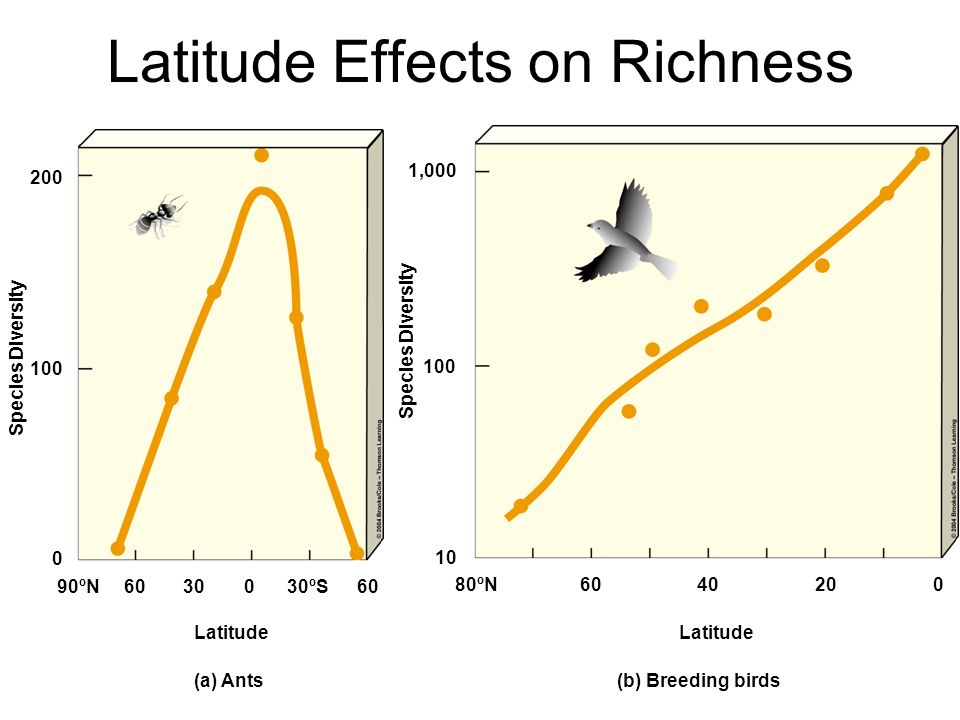
There is a latitudinal gradient in ant species richness, with the tropics harboring more species than colder regions. Dr Moreau indicated that there are two models to explain the biodiversity of the tropics- the cradle model and the museum model. The cradle model posits that evolution occurs more quickly in the tropics, that new species evolve in the tropics more frequently than in higher latitudes. The museum model posits that older evolutionary lineages tend to survive better in the tropics, that ancient forms persist. Put succinctly, in the cradle model, the tropics are species pumps, in the museum model, they are stable places in which species can hold out for a long time. The first ants evolved about one-hundred and forty million years ago. The configuration of Earth's continents was different then- subsequent plate tectonics affected the distribution of ants. The greatest diversity among the ants, the most endemic genera and the most species, is in the Neotropics. With evidence of the survival of older forms and the diversity of novel forms, it would be safe to characterize the tropics as both cradle and museum.
Ants are efficient at exploiting novel ecological niches. With the evolution and spread of flowering trees, ants were able to spread into the forest canopy (conifers aren't a rich source of exploitable resources). The evolution of herbivory among the ants coincided with the co-evolution of ants and endosymbiotic bacteria. Ants provide an excellent opportunity to study the diversity, distribution, and influence of gut bacteria. While ants harbor diverse bacterial communities, the nitrogen-fixing Rhizobiales are common among plant-eating ants, which feed at low trophic levels. The highly predatory army ants do not need nitrogen-fixing symbionts. Herbivory necessitated bacterial symbionts, which are not distributed equally throughout the ants' evolutionary tree. In the co-evolutionary process, more closely related ants have more closely related bacterial symbionts.
Dr Moreau then gave us an overview of the gastrointestinal anatomy of an ant, with an emphasis on the locations in which bacterial symbionts are found. Dissections of ants were conducted, and the bacteria in the mouth, the crop (from which ants can regurgitate liquid for other ants), the midgut, and the hindgut (the leg was also sampled as a 'control'). All of the dissected individuals had similar bacterial flora in their midguts and hindguts. The bacterial communities of the ants were dictated by what the ants ate. The herbivorous turtle ants have co-evolved with their gut bacteria for over forty-five million years. The bacterial communities of various ants- the herbivorous ants, the highly predatory army ants, the not-entirely predatory bullet ants- have to be compared and contrasted. In one particular project, Costa Rican bullet ants were collected, and their gut bacteria were studied.
After this fantastic overview of ants and their bacterial symbionts, Dr Moreau shifted the topic of the talk to the importance of science outreach, and the diverse tools needed to share scientific knowledge. Commitment to science necessitates outreach and popularization. Scientists have to convey to people how important science is to their lives. In order to combat the stereotypical view people have of scientists, scientists have to meet with people. Dr Moreau put together an exhibit called The Romance of Ants to chronicle her life and career in graphic novel form. The theme of the exhibit is that everyone is a scientist at heart.
The lecture was followed by a Q&A session. The first question involved the evolution of eusociality in the hymenoptera- eusociality evolved several times among the different branches of the hymenoptera- there are non-eusocial bees and wasps as well as eusocial ones. Here's an overview of eusociality and genetics (ants, bees, and wasps are haplodiploid- males are born from unfertilized eggs, so sisters are more closely related to each other than they are to the mothers or to any potential offspring). Some bastard in the audience asked about the antibiotic properties of ants- ants have a metaplueral gland which produces an antibiotic fluid which protects against bacterial or fungal pathogens- ants have a lot of associated bacteria and fungi. Dr Moreau then pointed out that the bastard had attended all-but-one of the Secret Science Club lectures, which caused said bastard to blush in a most incandescent fashion, luckily the beacon-like effect wasn't so apparent in the darkened Bell House. The bastard then asked Dr Moreau a hypothetical about using ants to treat a cut in the field- while ant, uh, antibiotics aren't a panacea, the use of army ant heads as sutures would definitely be in the tropical pharmacopeia. Another attendee asked about the ant population of New York- after a joke about hipster ants in Brooklyn, Dr Moreau noted that fungus-growing ants survive on Long Island, tending to build their colonies under power lines. Another question concerned invasive ants- out of the one-hundred worst invasive species worldwide(PDF), five are ants. Invasive ant species can devastate ecosystems and outcompete native species. They thrive in locations disturbed by humans. Ants have many characteristics which make them good invaders, such as the ability to exploit novel ecological niches. In the case of the Argentine ant, the insects form mega-colonies which do not compete- offspring of different queens will interact cooperatively, probably due to the ants passing through a narrow genetic bottleneck, so all of them are closely related. Another questioner asked when eusociality first appeared in the Tree of Life- the termites, which can be likened to eusocial cockroaches, were the first eusocial insects to evolve and there are even fungus-farming termites. How do ants communicate? Ants communicate through scent- they have glands which produce pheromones, which are chemical signals to other ants. How do researchers determine fossil ant affinities? Some fossil ants have unique morphologies, but many fossil ants are similar to modern genera- younger specimens look more similar to modern ants than older ones. Regarding behavior, every ant colony acts as an individual, each worker ant can be likened to a cell in a multicellular animal. This breaks down in the case of the invasive Argentine ant supercolonies, in which neighboring colonies are not recognized as different from each other. Regarding dissection, ant specimens are handled with jewelers' forceps, though Dr Moreau joked that a common refrain in the lab is, "Don't talk to me on dissection day!" Dr Moreau noted that there is ant-specific citizen-science- volunteers can catch ants in their backyards and send them to the lab. Dr Moreau then discussed the various body forms among ant species, and while most ants produce small workers and big soldiers, there are about ten species which produce super-soldiers, and that the 'super-soldier' gene can be switched on in individuals to produce these oversized soldiers... super-soldiers can be produced in the lab. Regarding the acquisition of gut bacteria, every time an insect sheds its exoskeleton, it sheds its respiratory and digestive invaginations, and loses gut bacteria. New bacteria are obtained from other ants through oral/anal trophallaxis.
Dr Moreau ended her lecture by stating that she is unwilling to let go of field research... She is a typical field biologist, she likes looking at live things as much as studying dead ones. She joked that some of her keenest observations were picked up lying on the ground picking up chiggers and ticks while studying her subjects.
As an individual who tends to prefer biology to the other sciences, I have to say that Dr Moreau really hit a grand slam with this lecture. She imparted important knowledge about some of our most interesting fellow denizens of Earth with passion, she outlined a model for communicating scientific knowledge to the general public, and she was very entertaining. I like to talk about the 'Secret Science Sweet Spot'- that combination of hard-science lecture, adventure narrative, and advocacy that characterize the best of the lectures, and this lecture hit on all of those cylinders. Also, Dr Moreau was in town for a conference, and all-around good-guy Dr Simon Garnier was the person who told her about the SSC, inspiring her to lecture in Gowanus. Dr Garnier attended with a bunch of students from his lab, and there were a gaggle of entomologists hanging out in the beautiful Bell House. In an informal discussion over beers, I had a talk with a young entmologist about haplodiploploidy and eusociality, and he mentioned that the thrips, which are haplodiploid, also have some eusocial species. Surrounded by entomologists, I made a joke about these entomologists forming a 'hymenoptera gang' and zooming along the highways and byways on Vespas. Good times, nerding out with great people!
Kudos to Dr Moreau, Dorian and Margaret, and the staff of the beautiful Bell House. Also, high fives to all of the assorted biologists in attendance, you are all doing great work.
Here's a short video of Dr Moreau lecturing on the evolution of ant gut bacteria:
Here's a longer video featuring Dr Moreau lecturing on biodiversity and the evolution of ants:
Dr Moreau also has several videos on the Field Museum's Brain Scoop YouTube channel. If you are going to get stuck in a time-sink, I can think of few better ones than the Brain Scoop.
Last night, I left for work early so I could run some errands. My first stop was an Indian grocery about halfway between home and work... if disruptions occur, and I have to subsist on rice and legumes for a while, I would need spices, and this is a place to buy them in bulk for an inexpensive price.
When I arrived, I found the parking lot full, so I parked across the street. Upon entering the store, I saw that the line for the cashiers stretched the length of the store, and the shelves were denuded of large bags of rice and various forms of ‘dal’. I pretty much left as soon as I saw I’d have little success there.
I then stopped by a small supermarket close to work, where I picked up a couple of containers of star anise (a precursor to Tamiflu- hey, even I occasionally engage in magical thinking). I checked out all of the aisles and, sure enough, about eighty-percent of the TP was gone (I bought a 12-pack two weeks ago, having been down to my last roll). Most of the dried beans were also gone, but I picked up a couple of bags of yellow split peas (alas, the pigeon peas were sold out) and some bulgur. The bread section was practically empty.
I imagine most local supermarkets are similarly cleared out. People have taken the self-isolation message seriously. Personally, I am holding out for foraging season to begin, the nettles, knotweed, and poke should be coming up any day now.
Well, now that I have your attention... Last night, I attended a special birthday performance by Friend of the Bastard Saasha Foo. Well, I'll begin by saying that she should consider a name change to Saasha Feu, because the girl was on fire- she called her set Devil with a Heart of Gold, and I instantly thought, "This could be the basis for a hilariously warped musical comedy to submit to the Fringe Festival."
Miss Foo introduced herself with the eponymous ad-libbed tune, then launched into a hilarious evisceration of Burt Bacharach's Wives and Lovers, turning the dated "default sexism" of the song into a satire of the Beauty-Industrial Complex. Yeah, Brazilian waxing and bleaching "down there" were undreamed-of in Burt's heyday, but Saasha worked them into her brutal-yet-affectionate takedown of the song... hey, it's 3PM, hubby's due back by 7, so girl get cracking! She followed this with another genre-subverting take on a breakup-and-resultant-heartache song, Was I Just Another Blonde to You? Confronting her ex with a younger version of herself, she asks the inevitable questions, such as: "Was I just another sticky bun to break in two?" Put a "Y" on the End of "Man" was her take on polyamory, in which Saasha sings that she wants to schtupp just about every man she sees on the street. The show-stopper for me, though, was the hilarious Park Slope Gigolo, in which Miss Foo sings of the eponymous "working man" paying his way by servicing the stay-at-home mothers who congregate in the local Tea House. The surefire cure for post-partum depression, the Park Slope gigolo ("the sugar in your Bigelow") has his own baby sitter. Saasha followed this up by a mission statement- she wants to start pimping d00ds out to supplement her income (motherlovers take notice, Brooklyn fathers take heed). Saasha's show of love for country music took the form of a takedown of a coked-up former boss who looked on her ass as his "personal property"- a Foo-vian take on Take This Job and Shove It. Her finale was another satire of the pressures on women to conform to unrealistic standards of beauty (a duet with a friend)- The Tapeworm, Gay Porn Diet. Why suffer at the gym, or deprive yourself of calorie laden treats when you can enlist the services of a special little friend, a Platyhelminthine buddy which will allow you to sit on the couch all day long, eating cinnamon rolls slathered with an entire tub of margarine and watching gay porn? Trying to fit into that wedding dress? Just enlist the services of a tapeworm, just make sure it doesn't poke out during the ceremony. Wow, what a finale. Throughout the night, I had to restrain myself from drinking while Saasha was singing... I had visions of Hoegaarden shooting out of my nose. Yeah, she's that funny, and her brilliantly distorted version of the universe (the Foo-niverse, if you will) is a great place to visit for a couple of hours. Adam Klipple and Gary Wang provided an excellent musical background for Saasha's gleefully cracked songscapes.
While I can't find any "spit take" inducing videos of Saasha, here she is in her "serious" mode... I apologize for the darkness of the video image, but one can just make out Miss Foo's trademark "cat eye" vintage glasses and bangs:
After the performance, I told her that, within ten years, drag performers would be imitating her. She replied, "That's the nicest thing anyone's ever said to me."
Rock on, Saasha Foo, and get cracking on the musical!
Wow, this post will top off the "Yonkers Trilogy" that has marked this week's posting.
Like many cash-strapped municipalities, the City of Y decided that legalized gambling would be a financial panacea- the self-imposed gullibility tax poses few problems for politicians of the two major parties. The legalization of gambling in the U.S. is a funny beast... in most regions, legalized gambling has been confined to reservations, riverboats, or racetracks. The New York City metro area lacking any extant native groups (the Ramapough Lenape Nation is the closest extant native group, straddling the NY/NJ border about twenty miles from NYC), New York state allowed the historic Yonkers Raceway to install slot machines, and the racetrack transformed into a "racino" in 2006.
Well, the only thing I gamble with is my life, and the prospect of feeding a slot machine (like a Skinner Box rat which almost never gets any goodies) holds no fascination for me. I do go to the place de vez en cuando, though, to see live entertainment.
One "must see" act is Yonkers native Dr. Nazar Sayegh, who is not only a family practitioner, but a hall of fame Elvis interpreter as well. Last night, to commemorate the eve of the King's birthday, Dr Sayegh brought his act to the raceway for two sets of music. I am happy to say that he wore jumpsuits for both sets, and am even happier to say that he sang a rendition of Poke Salad Annie. The good doctor puts on a fun show, and comes across as a genuinely nice fellow. If a sequel to Bubba Ho-Tep is ever green-lighted, the good doctor should certainly get a cameo as a nursing home physician.
Bonus Yonkers trivia:Lady Gaga is now on record telling Jay Leno that the rumor that she was a Yonkers native upset her more than the rumor that she was a hermaphrodite.
The Big Bad Bald Bastard is a character played by Monsieur _______ of the City of Y______. The role of the Bastard is a handy one to play on subways, walking the streets, and in dive-bars, when being a nerdy, bookish sort is not to one's advantage.