Showing posts sorted by relevance for query dark matter. Sort by date Show all posts

Wednesday, October 1, 2014

Inaugural Secret Science Club North: Dark Side, Upper West Side

Last night, I headed down to the scintillating Symphony Space for the inaugural Secret Science Club North featuring astrophysicist Dr Priyamvada Natarajan of Yale University, the Dark Cosmology Center (sounds "Harry Potteresque", no?) of the Niels Bohr Institute at the University of Copenhagen, and the University of Delhi, where she has been appointed to a lifetime honorary professorship.

Last night, Dr Natarajan's lecture was titled "Unveiling the Dark Side of the Universe". The lecture centered on the search for dark matter. She began her lecture by stating that, while there has been much progress, the problem of dark matter remains unsolved. Since the Classical period, there have been various conceptions concerning the nature of outer space, with the ancient Greeks proposing the existence of Ether as an extraterrestrial element. Other ultramundane "elements" such as phlogiston and miasma were postulated to explain natural phenomena that were poorly understood. While these conceptions of materials out of the ordinary have fallen by the wayside, the universe remains quite peculiar.

The "ordinary" matter in the universe is really quite extraordinary- it composes less than 5% of the makeup of the universe. Approximately 23% of the universe is composed of dark matter, while 72% is composed of dark energy. Dr Natarajan mused that exploring the nature of dark matter and dark energy can be likened to a crime scene investigation in which there are many clues, but there's no body. There are independent lines of compelling evidence, but the dark matter cannot be directly observed.

Dr Natarajan proceeded to give us a quick overview of current cosmology. While there is no direct data for the Big Bang, there is a "signature" of a period approximately three minutes after the Big Bang, and evidenct of the condition of the universe 400,000 years after the event, which occurred approximately 13.8 billion years ago. The universe started off as a "soup" of dark matter, much of it in clumps. The first galaxies appeared approximately one billion years after the Big Bang. Galaxies developed around clumps of dark matter.


Dr Natarajan then gave us an overview of dark matter and dark energy. She quipped that, when cosmologists don't know the nature of something, they add the adjective "dark" to a term. She reiterated that dark matter composes 90% of matter, while dark energy composes over 71% of the "stuff" in the universe. Cosmologists do not know what dark energy is, but they know what it does- dark energy plays a role in the increase in the rate of the expansion of the universe. In 1929, Edwin Hubble discovered that the universe was expanding... in the 1990's it became evident that the "gas pedal" of the universe's expansion had been floored. In the early stages of the universe, the radiation resulting from the Big Bang dominated the universe, but dark energy is currently the dominant force at work in the universe.

Looking out into space is looking back in time- the speed of light and the age of the universe are both finite, therefore our view of the universe is finite. The farther a particular celestial body is, the further back in time the light from that body originated (the light from the sun takes eight minutes to reach the earth, so our view of the sun is of an eight-minute old Sol). Basically, our observations of distant objects are old "snapshots". There's a boundary beyond which the universe cannot be observed. "Ordinary" atoms are extraordinary- the most common of elements are hydrogen and helium. Heavier elements are produced in starts through fusion reactions, but as the universe cools, the formation of heavier elements becomes more difficult. Dr Natarajan quipped that, while romantics muse about our being made of stardust, one could just as easily say that we are made of cosmic trash. Thanks Obama Dr Natarajan!

The lecture continued with a discussion of gravity, the force of attraction between different bodies which, as formidable a force as it is, falls off over distance. The gravitational forces in the solar system are dominated by the sun- and bodies further from the sun orbit more slowly. Observers tried to apply the same model of rotational velocity to galaxies, expecting them to behave similarly to the solar system, but the galactic rotational curves differed markedly. Astronomers Vera Rubin and Kent Ford observed that the actual rotational curves did not follow the theoretical models and noted the peculiarities without making any claims. The observed rotational curves suggested a lot of mass far from the centers of the observed galaxies and a deficit of mass in the galactic center. The only explanation for these rotational curves is a huge mass of unseen matter at the fringes of these galaxies. Every galaxy has an exterior "halo" of dark matter extending ten times further than the observable matter.

By the 1980s, a theoretical framework was developed to align with the observations. Dark matter does not seem to interact with baryonic matter or photons. It does not emit anything... it's invisible. Dark matter can only be "observed" by its effect on the motion of "nearby" objects.

One particularly interesting line of evidence for dark matter is its effect on light- gravitational lensing. The universe, space/time, can be likened to a sheet (although there is nothing above or below the "sheet") which is bent by gravity. Light traveling through space/time is bent by mass. The more massive a object is, the bigger the "pothole" that it creates in space/time. British astrophysicist Arthur Eddington was able to verify the curvature of space and bending of light while observing the apparent position of a star during a solar eclipse. Light from distant galaxies is bent by dark matter. The shapes of the galaxies that we see are distorted. Some regions of the cosmos are more "cluttered" with mass than others. Observers are able to compare the distribtion of shapes from regions of more mass with those from regions of less mass in order to figure out their shapes and to infer the amount of matter deflecting light. Mathematical models can be used to "undo" the distortion. Dr Natarajan likened this to tomography- images are analyzed "slice by slice" in order to figure out the size of the "pothole" in space/time to determine the amount of mass.

Large conglomerations of dark matter act as good gravitational lenses, and observations of the lensing effects indicate that galaxy clusters are held together by dark matter. Big enough gravitational lenses can split images, but each galaxy has its unique "fingerprint"- its spectrum. Light beams can become split multiple times, helping in the mathematical modeling of dark matter lenses- the distortion of light is systematic, and the position of distorted images allow the modeling of the dark matter making up a particular gravitational lens. The stars themselves only have 10% of the mass needed for distortions- they are small beacons in a much larger mass.

Gravitational lensing was first observed in 1979 by astronomers D. Walsh, R. F. Carswell, and R. J. Weymann who observed twin images of a single quasar- the presence of an intervening galaxy creates a double image.

Observation of the distorting effects of dark matter "halos" allows inferences to be made about their shapes. These halos tend to be smooth and ellipsoid around galaxy clusters, but have an overlay of more granular, or lumpy accretions. The amount of lumps in a particular halo of dark matter leads to a lot of distortion.

The next part of the lecture was accompanied by some particularly gorgeous images. She compared an image of the galaxy cluster Cl2244 obtained in the 80s using the Canada–France–Hawaii Telescope with another image taken a decade later using the Hubble Space Telescope. The finer resolution of the Hubble-obtained image allows for a better "map" of the dark matter causing the gravitational lensing. In the image embedded below, the "arcs" are actually distorted images of galaxies in the cluster:


Dr Natarajan then displayed an image of the Abell 2218 Galaxy Cluster, which she jokingly referred to as the "Brad Pitt and Angelina Jolie of galaxy clusters" due to the frequency with which it has been photographed. Abell 2218 is the first cluster that allowed the mapping of "lumps" of dark matter. In the "undistorted" image of Abell 2218, the younger galaxies appear blue while the yellow "blobs" belong to the cluster itself:


Oddly enough, there don't seem to be any good images of the dark matter "map" of this particular cluster on the t00bz... At any rate, the most dramatic distortion of images indicates tightly packed accretions of dark matter- the "punctuated" fabric of space/time.

Another important feature of gravitational lenses is the fact that they magnify distant galaxies and bring them into view. By "calibrating" the gravitational lens of galaxy cluster Abell 1689, one of the most massive clusters known, astronomers were able to discover the most distant (therefore "oldest") galaxy known. Dr Natarajan likened the cluster to the "optometrist of the cosmos".

Dr Natarajan then paused to ask, "Why are we mapping dark matter?" She indicated that information about the nature of dark matter is sitting in the shape of the dark matter "granules". In a typical galaxy cluster, stars are one percent of the total mass, with hot gas making up another nine percent, and the remaining ninety percent being dark matter. She then showed a breathtakingly beautiful image of the Bullet Cluster, showing the collision of two galaxy clusters:


In the image, the blue sections represent the map of the associated dark matter, while the pink section depicts the energy producing collision of the gas associated with the two clusters. Note the the dark matter doesn't interact with the gaseous collision. It can be inferred that dark matter is not a gas- in the equation of state, P=0 for dark matter.

In the current theoretical model, to which the reconstruction of gravitational lenses corresponds, dark matter serves as the "scaffolding" of galaxy structures. Simulation of the filamentary structure has been undertaken to determine some of the properties of dark matter- cold dark matter would result in granular filaments while warm dark matter would result in smoother filaments. The Cold Dark Matter model seems to better reflect current observations.

The Hubble Frontier Fields project will involve "staring" at a particular cluster "lens" for months to enable the reconstruction of dark matter distribution in order to map filaments of dark matter.

When asked if she had any theories about the nature of dark matter, Dr Natarajan stated that, while nothing is known, one possibility is that dark matter is composed of WIMPs, Weakly Interacting Massive Particles, specifically the hypothetical particles dubbed neutralinos. Columbia University's XENON project is an attempt to detect dark matter.

The inaugural lecture of the Secret Science Club North was fantastic. Dr Natarajan was an engaging, informative speaker who was able to make complex concepts comprehensible, and her enthusiasm for the subject was infectious. Hats off to my good friends Dorian and Margaret for pulling off yet another major success, and thanks to Dr Natarajan for knocking it out of the park. After the lecture, the good doctor was hanging out and entertaining questions from attendees. From what I've heard, the lecture was recorded, so I'll let you guess which of the questioners was yours truly when it is made available. In the meantime, here is a short video of Dr Natarajan talking SCIENCE:


I drank considerably less last night than I do at the Bell House. To replicate the Secret Science Club North experience, you can simply sip one drink while watching rather than chugging a sixer.

Wednesday, May 19, 2021

Secret Science Club Zoom Lecture: The Disordered Cosmos

Tonight, my great and good friends at the Secret Science Club are presenting a Zoom lecture with theoretical physicist, cosmologist, and feminist theorist Dr Chanda Prescod-Weinstein of the University of New Hampshire.  Dr Prescod-Weinstein is a founder of Particles for Justice and author of The Disordered Cosmos.

Dr Prescod-Weinstein began her lecture with the story of the cosmos- the universe went through a period of inflation after the Big Bang, when spacetime expanded rapidly.  the age of the universe is approximately 14 billion years, the number changes as more data accumulates.

Evidence about the period after the Big Bang can be observed in the form of the cosmic microwave background radiation.  The CMB radiation is the coldest radiation in the universe- with an average of 2.7 degrees Kelvin and little variation.  It has been 'mapped' by the Planck space observatory:

Dr Prescod-Weinstein then showed the 'first light' infrared image from the Spitzer space telescope, depicting the universe about 400 thousand years after the universe began.  In this infrared image, one can see nuclear fusion 'turn on' in stars:


Dr Prescod-Weinstein  followed this up with an image from the Hubble deep field depicting a multitude of galaxies:


Dr Prescod-Weinstein noted that theoretical physicists attempt to piece together a coherent mathematical story of the universe.  Images are snapshots, the physicists try to find out why they look like they do.  How much information is imprinted on the photons depicted in these snapshots?

The different colors in the Planck telescope image represent tiny fluctuations which signify the seeds of structure formation... the nascent.stars, galaxies, globular clusters which ultimately form  the seeds of the beginning of us, since we are also structures formed in the universe.

The Planck image represents a degree of homogeneity, the composition of the universe was similar, and isoptropy, the universe is uniform in all directions.  On a cosmological scales, the universe is full of galaxies, connected by filaments between.  The universe is expanding, but Dr Prescod-Weinstein didn't quite like modeling this as galaxies getting farther apart, likening the expanding universe to an inflating balloon... one wouldn't characterize the distance between dots on a balloon as empty space.  The expansion of the universe is increasing in speed, and this cosmic acceleration has come to be known as dark energy. 

Most of the matter in the universe has not been observable, and dark matter has been proposed to account for this lack of observable 'standard model matter'.  In the 1970s, astronomer Vera Rubin noted that the rotational speed of the Andromeda Galaxy seemed to be wrong and proposed that dark matter at the edges of the galaxy caused the discrepancy between what she observed and what had been expected.  In the sciences, theory and observation need to be reconciled.  For a while, there was a debate over whether dark matter or a  new theory of gravity would be correct... the consensus position was to stick with dark matter.  Dr Prescod-Weinstein stated that she personally prefers the term 'invisible matter' to 'dark matter', illustrating what she meant by cupping her hands and quipping that, if she had a handful of dark matter, light would be passing through it, it wouldn't obscure vision.  As far as the term 'dark energy' is concerned, she prefers 'cosmic expansion problem' to describe this phenomenon.

It is believed that galaxies are surrounded by a halo of dark matter.  Large galaxies also have satellite galaxies with halos of their own.  The Milky Way has 60 satellite galaxies, including the Magellanic Clouds, within its dark matter gravity well

Light goes through dark matter with no photon interaction.  Dark matter moves slowly.  It is not short lived.  Dark matter is nvolved in the hierarchical structure of the universe.  If dark matter interacts with standard particles, such interactions would have to be sought in particle colliders, and points of interaction could then be sought on an astronomical level.  Dr Prescod-Weinstein displayed a slide depicting possible non-gravitational interactions between dark matter and standard model particles:


In the search for dark matter, certain properties would be expected of a good candidate- such a particle should be stable, colorless/chargeless, cold, non-dissipative, and  consistent with what we see.

Dr Prescod-Weinstein then showed us a Venn Diagram depicting the various theories proposed to explain dark matter:

Dr Prescod-Weinstein stated that the problem probably lies beyond standard model physics.  She noted that confusion is not an obstacle for scientists: "It's our job to be confused and to work beyond our confusion.

Dr Prescod-Weinstein then shifted the topic of the lecture to the axion, a hypothetical particle the existence of which was proposed in the Peccei-Quinn mechanism to solve bad predictions stemming from the strong CP problem.  She displayed a couple of equations outlining the theoretical basis for the axion proposal, and said to ask her about the higglet in the Q&A.

The late physicist Dr Ann Nelson was a champion for axions describing them as natural and elegant, and viable- a good dark matter model  Axions would be bosons.  Bosons can be distinguished from.  fermions- when cooled, fermions go to the lowest energy quantum state possible while bosons when cooled form a condensate with same ground state act as single particle.  Such a condensate could explain fuzzy dark matter in which ultralight axions would.behave like a wave.

One possible detection method for axions would involve an nteraction with electromagnetic fields, resulting in the Primakoff effect, then scientists could look for axions astrophysically- do simulations match what we observe?

Dr Prescod-Weinstein then discussed the ssocial and human side to science.  She is the first black American woman who on a tenure track in theoretical physics.  She has been a barrier breaker throughout her career trajectory.  She noted, though, that Black people have always been involved in science, citing Onesimus, a man enslaved in Cotton Mather's household, who demonstrated how to prevent smallpox with a form of inoculation.

There has always been a Black tradition of science.  Why do race and gender matter?  Social phenomena shape science because universality and objectivity are different.  Physics apply everywhere, but are observers objective when it comes to grant money or the seriousness with which theories are taken?  This is about our assumptions about competence, not physics.  Social justice must also come into consideration, as in the example of indigenous Hawaiian opposition to the construction of the 30 meter telescope in Hawaii.

Dr Prescod-Weinstein ended her lecture by stating that spacetime is curved, not straight- it's not just for straight, white cis men.

The lecture was followed up with a Q&A session.  The leading question was: Why does the cosmic microwave background persist?  The universe prior to it is opaque- the photons that we see have been traveliing through spacetime for 13 billion years, and are red-shifted.  CMB was discovered twice- 1940s observation near a star revealed that space was not empty, but radiation was present.  Then two radio astronomers discovered a signal which wouldn't go away, which turned out to be the CMB.

Some Bastard in the audience took up Dr Prescod-Weinstein's challenge to ask her about the 'Higglet'.  She noted that she is AA Milne fan, and the axion was called the Higglet by Dr Steven Weinberg...    axion was the name of a laundry detergent (the proposed particle cleaned up a problem), named after a Greek orthodox liturgy.  As a Milne fan, the Good Doctor opined that Higglet would have been a more accessible name for the public.

Asked about the TV show The Big Bang Theory- the Doctor was not a fan- white men treating people poorly isn't funny.  This sort of rude behavior injures women and people of color.  The show was grotesque, and damaging to the scientific community.

Galaxy halo theory- is there dark matter outside the halos?  Where do we set the edge of such halos?  There is dark matter inside the galaxy as well, some is probably passing through your body right now.  The one thing that dark matter does have in common with standard model particle matter is interactivity with gravity.

Which experiments have the best potential to find dark matter?  Dr Prescod-Weinstein joked that it's a religious question...She personally loves the Bose-Einstein condensates formed by axions, and noted that she started working on axions because it was an available topic and she became known as a global expert on the topic.  She noted that people working at the Large Hadron Collider searching for supersymmetry started working on axions when they didn't find evidence of supersymmetry.

The doctor noted that the universe does what it does, and the universe doesn't care whether we can understand the universe.  She then amended her statement, saying the universe does what it does, and the universe mostly doesn't care whether we can understand the universe, with human beings being a part of the universe which cares about understanding the universe.

Asked about future research, she informed us that one of her research topics now is the soft interactions of axions.  She would be happy about anything that pushes cosmology beyond the standard model.

Once again, the Secret Science Club team has presented a fantastic lecture.  Kudos to Dr Prescod-Weinstein, and Margaret and Dorian.  For a taste of that SSC experience, here is a lengthy discussion by the Doctor regarding The Disordered Cosmos:


Pour yourself a nice beverage and soak in that SCIENCE!!!

Thursday, January 24, 2013

Secret Science Club Post-Lecture Recap: Dark Matter Matters

On Tuesday night, I headed down to the beautiful Bell House in the Gowanus section of Brooklyn for the latest Secret Science Club lecture, featuring astrophysicist Dr Jeremiah Ostriker, professor emeritus of Princeton University, currently of Columbia University. Dr Ostriker has enjoyed a long, storied career in astrophysics, and his latest book is the brand-spanking new Heart of Darkness: Unraveling the Mysteries of the Invisible Universe, co-authored with Simon Mitton.

Dr Ostriker's lecture was an overview of the study of astronomy and astrophysics, with a concentration on the developments in the field throughout the 20th century- a century of cosmological investigations which culminated in a paradigm that really works, but remains puzzling in many ways.

Dr Ostriker began with a brief survey of astronomical studies from the sixteenth to the nineteenth centuries, beginning with the work, from 1550-1650, of Brahe, Kepler, and Gallileo, who challenged long-standing views of a static cosmos with the Earth at its center, and created the model of the heliocentric solar system. From 1650-1750, Halley, Euler posited universal laws for the cosmos, and applied mathematical analyses to celestial matters. Thomas Wright described the shape of the Milky Way as "an optical effect due to our immersion in what locally approximates to a flat layer of stars." The sun is one star in a galaxy of stars. The majority of a galaxy's stars are near the center of the galaxy- our sun is far from the center of the Milky Way. He also speculated that the dim spiral nebulae were other galaxies, previously, such nebulae were not recognized as such. In 1924, Edwin Hubble confirmed that these spiral nebulae were indeed galaxies. Immanuel Kant elaborated on this theme, speaking of a universe composed of "islands" in the void. In the 1840's a great telescope named the Leviathan was built in the Irish town of Parsonstown specifically to explore the nature of nebulae.

In the 20th Century, Einstein, Hubble and Baade were instrumental in laying the foundations of modern cosmology- not only are there many galaxies, but the galaxies seem to be moving away from each other with a velocity proportional to their separation (an observation known as Hubble's Law. With the discovery that the universe is expanding, there was a question as to whether the universe will expand forever or if gravity will cause the expansion to decelerate and the universe will collapse. When Einstein formulated his Theory of General Relativity, he believed that the universe was static, and postulated a cosmological constant. After seeing Hubble's evidence of an expanding universe, he realized that the universe is not static- the cosmological constant is characterized as Einstein's "greatest blunder".

Physical theories were put on the back burner through much of the 20th Century as astronomers were trying to puzzle out other astronomical questions, such as the size and the age of the visible universe. In the years 1958-1975, ever larger and more powerful telescopes were used to estimate these cosmological parameters. A major breakthrough took place at a Bell Labs radio facility in Holmdel, New Jersey when physicists Arno Penzias and Robert Wilson detected background radiation from the Big Bang.

Additional surveys of the sky showed a large scale structure in galaxy positions- galaxies tend to cluster, and there are filaments between various clusters. The question of the origin of this structure, and the formation of galaxies after the Big Bang became of paramount importance. Immediately after the Big Bang, the elements were "cooking together"-the most common elements are the lightest ones: hydrogen, helium, and lithium. While the Big Bang theory seemed correct by the end of the 1960's, the density of observable matter was deemed insufficient to slow the expansion of the universe. A paucity of matter would lead to an increasingly empty universe, so why would the observed clustering take place... something crucial was missing from the cosmological model.

From 1975-1995, dark matter came into its own. Dark matter was initially proposed as an explanation for discrepancies between the visible matter and estimated total mass in a distant galaxy cluster by astrophysicist Fritz Zwicky in the 1930s. Simply put, the observable matter was insufficient to account for Zwicky's observations of Coma Cluster, a gluster of at least one thousand galaxies. Zwicky, who is largely unsung, theorized that clusters of galaxies are held together by the gravitational force of dark matter. Dark matter seems to be electromagnetically inert- it neither reflects nor emits light- the only observable indication that dark matter exists is its gravitational effect.

In 1977, Dr Ostriker observed that rotation curves showed that most of the mass of a galaxy is in the outer regions of the galaxy that have little light output. The mass goes up as one measures outward. Each galaxy has a vast dark halo. The total amount of matter in the universe is ten times what was originally thought when only visible matter was taken into account. At this point in the lecture, Dr Ostriker observed that Van Gogh was eerily prescient:


Perhaps the best evidence for dark matter was found around the year 2000, when observations of the Bullet Cluster, a cluster of two colliding galaxies, showed that dark matter is not merely composed of baryonic dust and gases, but is something completely different. Dr Ostriker likened the Bullet Cluster to the "Rosetta Stone of Gravity". In his Theory of General Relativity, Einstein theorized that light could be be bent by gravity, an effect known as "gravitational lensing. Gravitational forces, to a large extent resulting from dark matter, cause observed galaxies to form "arcs".

In 1991, the Cosmic Background Explorer satellite confirmed the basic prediction of the Big Bang- a universe filled with black body radiation. The "sky" is not uniform- it shows the seeds for stucture, evidence for dark matter. Tiny early fluctuations grew with time as the universe "evolved".

In the 1990's, evidence suggesting an increase in the pace of the expansion of the universe led to the theory that dark energy permeates the universe.

While the basic model of cosmology seems to work, big questions remain unanswered- what is the origin of the perturbations which gave rise to the structure of the universe? What is dark matter? What is dark energy? In addition, there are Modified Newtownian Dynamics, or MOND theories which posit alternatives to the dark matter/dark energy model, but these are not commonly accepted.

In the Q&A, Dr Ostriker discussed several characteristics of dark matter. Dark matter is not observable in the electromagnetic spectrum, merely by its gravitational effects. While dark matter may "collide", it is unknown whether gamma rays would result from such collisions- any ideas about the nature of dark matter are still theoretical. Closer to stars, baryonic matter is more common- dark matter is less dense. Dr Ostriker opined, "There may be one microgram of dark matter in this room". I looked, but the closest I came to finding it was a pint of Guinness.

At the end of the Q&A session, Dr Ostriker uttered one of the best lines I've ever heard in my life... upon answering the last question he said, "Shouldn't we stop this and start drinking?"

Way ahead of you, good doctor, way ahead of you!

All told, it was another top-notch lecture presented by the Secret Science Club.

Thursday, July 14, 2016

Secret Science Club Post-Lecture Recap: Shedding Light on Dark Matter

Last night, I headed down to the beautiful Bell House, in the Gowanus section of Brooklyn, for this month's Secret Science Club lecture. This lecture featured the triumphant return of Dr Priyamvada Natarajan, of Yale University's departments of astronomy and physics, the Niels Bohr Institute in Copenhagen, and the University of Delhi, India, to the Secret Science Club event horizon. In 2014, Dr Natarajan kicked off the Secret Science Club North with a lecture about dark matter. Last night, Dr Natarajan's lecture was in support of her new book, Mapping the Heavens: The Radical Scientific Ideas That Reveal the Cosmos.

After a brief autobiographical introduction, detailing her childhood in India and her education at MIT and Cambridge University's Trinity College, Dr Natarajan gave a brief overview of science. Science is in the business of rethinking ideas- discarding or refining them as needed. She characterized the current time as a "golden age of cosmology", an amazing confluence of theory and technology, with astronomical discoveries occurring every day. Dr Natarajan described science as the arc of acceptance of radical ideas and stressed the need to demystify the techniques of science, which is the best way to understand nature and to make sense of the universe. Initially, there tends to be pushback towards new ideas, until a preponderance of data convinces skeptics. Fundamental to science is the interplay of ideas and instruments.

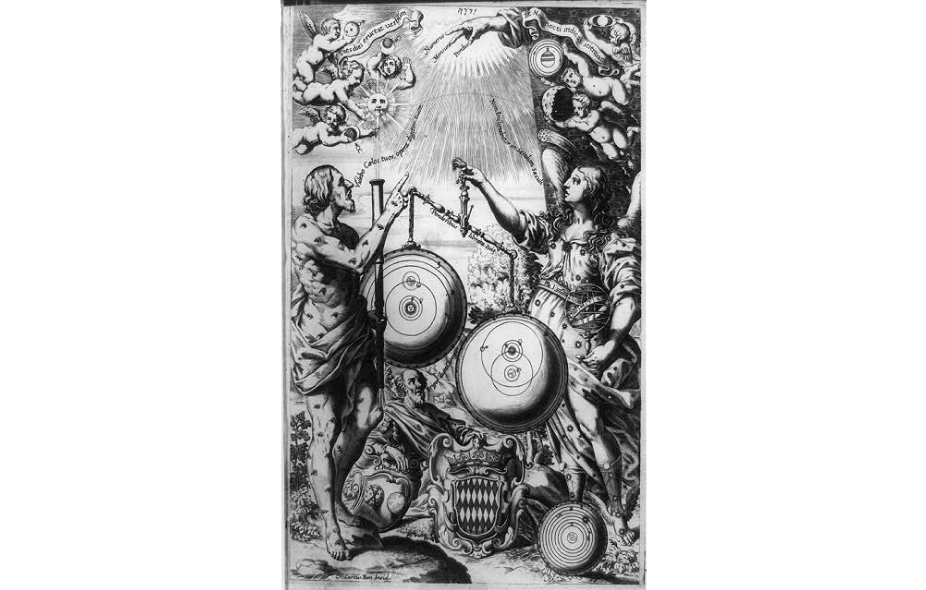
Dr Natarajan gave a brief overview of the history of astronomy, displaying images of the Nebra sky disc and the Venus tablet of Ammisaduqa as early astronomical artifacts. She then displayed an image from Riccioli's Almagestrum Novum depicting the muse Urania discarding the Ptolemaic cosmology and weighing the semi-geocentric model of Tycho Brahe (with the planets orbiting the sun and the whole orbiting the earth, which Riccioli favored) against the wholly heliocentric Copernican model:


Dr Natarajan then quickly pivoted to modern astronomy, specifically the mapping of the universe- citing the Hubble space telescope as being instrumental (HA). The main goals of astronomy are describing the contents, expansion, and eventual fate of the universe. To illustrate this combination of goals, she cited the example of the Cosmic Microwave Background which is a relic of the time shortly after the Big Bang.

Dr Natarajan's lecture then focused on two particular topics- dark matter and black holes. She contrasted the discovery of these two enigmatic phenomena- the existence of dark matter was determined through empirical observation (gravitational effects on other astronomical objects) and the existence of black holes was determined through theoretical modeling.

The topic shifted to dark matter, which was the subject of her fantastic Secret Science Club North lecture. The universe is composed of approximately 70% dark matter, approximately 25% dark matter, and approximately 5% baryonic matter. The existence of dark matter was first proposed by Fritz Zwicky in order to explain the observed behavior of galaxies in the Coma Cluster. In the 1970s, Vera Rubin and Kent Ford observed unexpectedly steady rates in the rotation of galaxies, evidence that there was a 'halo' of matter around these galaxies that balanced out the greater concentration of baryonic matter at their core. While dark matter has never been observed, it has an impact on dynamics- the motion of stars and galaxies and an impact on light rays. In a solar system, the dominant gravity is that of its star. In a galaxy, there is a lot of 'gravitating' dark matter at the edge. Dark matter is lumped and clumped and smeared all over galaxies, but has no interaction with other matter, except through its mass.

Light is both a wave and a particle, it can be bent through a process known as gravitational lensing. This gravitational lensing can be used to observe far distant astronomical features in galaxy clusters. The current model of the universe posits filaments of dark matter with galaxies at the intersections of filaments. The nature of dark matter is encapsulated in its smoothness- using its lensing effects on observable astronomical features, dark matter can be mapped with a high degree of resolution. It is thought that dark matter is cold, with few collisions between particles... Dr Natarajan noted that she was somewhat disappointed that this was so.

While dark matter has not been observed to interact with baryonic matter, except through gravitational forces, there are attempts to detect it- the Large Underground Xenon experiment is an attempt to detect WIMPS (weakly interacting massive particles), which are considered candidates for dark matter. So far, these haven't been found- we are stuck with cold dark matter, but we don't know what it is.

The topic then shifted to the second major focus of the lecture- how black holes became real. Black holes were predicted mathematically, the mathematical models were borne out observationally, to the extent that gravitational waves were recently detected. In science, mathematical models have to be squared with actual objects. Dr Natarajan wryly noted that the term 'black hole' entered the English lexicon in 1756, to describe the Black Hole of Calcutta, the proverbial place of no return. In 1783, John Michell proposed a dark star, and object so massive that light (which in the original Newtonian model was thought to have mass) could not escape its gravitational field. According to Einstein's Theory of General Relativity, mass bends spacetime, theoretically, an object could be so massive that it effectively 'punctured' spacetime. The term black hole was applied to this astronomical phenomenon by John Wheeler.

The first observational evidence of black holes came in the form of mysterious objects dubbed 'quasars' which have been determined to be X-ray emissions from black holes. Black holes are collapsed stars so massive that light cannot escape their gravity once past the event horizon, so dense that, were the Earth to collapse into a black hole, it would measure one cubic centimeter in volume. According to General Relativity, mass bends the curvature of spacetime into 'holes'- the more mass, the deeper the hole. Black holes are infinitely deep, the laws of physics that we know break down in the vicinity of a black hole. The curvature of spacetime due to gravity was described in Einstein's field equations- Karl Schwartzschild proposed a solution describing slowly rotating spherical objects and New Zealander Roy Kerr proposed a solution modeling gravitational fields around supermassive rotating objects.

Subrahmanyan Chandrasekhar, pondering the fate of stars, formulated the Chandrasekhar limit, the maximum mass of a star which will form a white dwarf- according to the Chandrasekhar's theoretical model, more massive stars will collapse into neutron stars, even more massive ones will collapse into black holes. Jocelyn Bell Burnell, while a graduate student, discovered the first pulsar, which turned out to be a radiation-emitting rotating neutron star, empirical evidence for one of Chandrasekhar's theoretical end-term stars. The first empirical evidence of a stellar mass hole was the discovery of Cygnus X-1, a stellar mass hole which is pulling matter from a blue giant companion star.

More massive by far than stellar mass black holes are supermassive black holes. In 1963, Maarten Schmidt of Caltech discovered the first quasar, an extremely distant, extremely black object which was determined to be a scaled up supermassive feeding black hole... the brightness of the 'quasar' results from a 'flare' of matter ejected from the accretion disk of the black hole at high temperature and high velocity.

Major questions remain about black holes... boiling down to three 'F's'- formation, fueling, and feedback. How do they form? How do they grow? What do they do? Where do black holes reside? Does every galaxy harbor a supermassive black hole at its center? What are the 'seeds' of black holes? Do they result from direct collapse? How do they grow? The formation of a black hole would have to involve a lot of gas- everything would have to be right for one to form. Gravitational waves were discovered emanating from colliding black holes by LIGO, the Laser Interferometer Gravitational-Wave Observatory. LISA, the Laser Interferometer Space Antenna, is a project to develop a more sensitive gravitational wave detector.

As Dr Natarajan wrapped up her lecture, she displayed a NASA animation simulating a stellar mass black hole, a groovy visual accompaniment to a thoroughly groovy lecture:


The lecture was followed by a Q&A in which the Bastard was unable to get a question in. One of the most involved questions involved dark energy, which Dr Natarajan likened to the 'gas pedal of the universe', resulting in the increasing speed of the universe's expansion. She postulated that dark energy is a property of spacetime, but that more research was necessary. In the course of the Q&A, she uttered a line which cannot be stressed enough, so I'm putting in all-caps: NOTHING CAN SUPPLANT THE POWER OF DATA.

Dr Natarajan's return to the Secret Science Club, and her debut at the beautiful Bell House, was triumphant one. Kudos to Dr Natarajan, Dorian and Margaret, and the staff of the beautiful Bell House. For a taste of Dr Natarajan's scientific virtuosity, here's a video of the good doctor giving a brief lecture on the subject at hand:


Also, I'd like to give a hearty high-five to Dr Natarajan for the publication of Mapping the Heavens... congratulations! It's nice to see someone who can so perfectly articulate these cosmological concepts on a level that the layperson can understand. At the end of the lecture, Dr Natarajan addressed the packed house and quipped, "I thought I'd be speaking to ten people." I chided her afterwards by noting that her Symphony Space lecture was delivered to a full house. The good doctor has star power, which is entirely appropriate for an astrophysicist. Again, congratulations are in order.

Thursday, April 25, 2019

Search for Dark Matter Sheds Light on Neutrinos

Science works... spending on science is important because scientific inquiry in one topic often pays dividends in other areas of inquiry. Recently, a facility designed as a dark matter detector has observed a two-neutrino double electron capture, a radioactive decay process by which two protons in an atomic nucleus absorb two electrons and release two neutrinos. The next project will be to observe is a neutrinoless electron capture is possible, which would imply that neutrinos are their own antiparticles. The search is still on for dark matter, which is thought to compose 27% of the universe's makeup, but which only interacts with baryonic matter through the force of gravity.

My go-to authority on the... uhhhhh... matter of dark matter is Dr Priyamvada Natarajan of Yale University, who delivered two Secret Science Club lectures on dark matter. Here's a TED talk by the good doctor on dark matter:


For a more in-depth exploration of the matter, the Fermilab has an hour and a half lecture by Dr Natarajan on dark matter and black holes. While the subject matter may be hard to wrap one's head around, I think that Dr Natarajan's almost musical accent makes the lecture fun to listen to even if you are physics averse.

The Secret Science Club also featured a lecture on neutrinos by Dr Ray Jayawardhana of the University of Toronto. I am particularly enchanted with the idea of tying together our knowledge of the infinitesimally small universe within each atom with our knowledge of the mind-bogglingly vast multiverse. Science, I repeat, works.

Tuesday, October 6, 2020

Secret Science Club Zoom Lecture Summary: A Brief Vacation from Earth

 Tonight, I am tuning in to a remote lecture presented by my great and good friends at The Secret Science Club

featuring astrophysicist Dr Katie Mack of the North Carolina State University. Appropriately enough for these seemingly eschatological times, the lecture is related to her new book: The End of Everything (Astrophysically Speaking). It'll be a nice vacation, contemplating an end which will be comfortably distant in spacetime, rather than an imminent one here in the Time of Coronavirus. 

Dr Mack began her lecture with an overview of astrophysics, beginning with the famous 'Blue Marble' picture of the Earth, noting how lonely and fragile our planet looks. In about a billion years, the sun will swell, engulfing Mercury and Venus, and boiling the oceans of Earth, eventually drawing it in. She held out hope that humanity will reach out into the cosmos, perhaps finding new homes, though that will only forestall the end. The universe had a beginning and will have an end, it is gradually becoming less hospitable. 

Dr Mack outlined five possible end of the universe scenarios: a big crunch, heat death, big rip, vacuum decay, and a bounce. 

She continued with a picture of the Milky Way taken from the Southern Hemisphere, then for a simulation of what the galaxy looks like from the outside, she showed us a picture of the Andromeda Galaxy, with the supermassive black hole at its center. The Milky Way contains over 100 billion stars. There are many other galazies- the Hubble Deep Field is an image of a small patch of the sky. Most galaxies are moving away from us and from each other, because the universe is expanding (Andromeda is getting closer). If the universe is expanding, it must have been smaller, hotter, and denser than it is now- this is what led to the Big Bang theory. If the universe is infinite, it was a smaller infinity earlier. 

When we observe light from distant galaxies, we see into the past- the light has been traveling for potentially billions of years. The Hubble Ultra Deep Field presents an image from thirteen billion years ago, about a half-billion years after the Big Bang, and we can actually see light from the hot plasma resulting from the Big Bang if we look far enough... light from the first formation of the universe. We are actually seeing the light from this event, and can map it out. Making a map of the universe using microwaves, a uniform background 'light' is apparent. There is a range of microwave wavelengths that form a Black Body curve which can help astrophysicists determine what the radiation source is. She compared this range to the light emitted by a hot poker. The background radiation is caused by the heat of the early universe. Little temperature fluctuations can be observed with more sensitive wavelength calibrations.

The distribution of matter, density, and the action of gravity can be extrapolated from this image, and computer models can be made to determine how galaxies and galaxy clusters were forming. Dr Mack then began her discussion of the end of the universe... 

The Big Crunch: The universe, now expanding, stops expanding. The outword push of the Big Bang is braked by gravity, and the slowing expansion will reverse. Galaxies will collide with greater frequency than they do now. Our galaxy will collide with Andromeda in about four billion years, stars will string along, new stars will be formed, the supermassive black holes will merge, but our solar system (with its bloated sun) probably won't hit anything else. In the Big Crunch, the collisions won't kill the stars, the compressed radiation from the newly smaller, denser universe will do the job. Space will get so hot from this hard radiation that thermonuclear explosions will destroy the stars. 

 The Heat Death: This is thought to be more likely than the Big Crunch. This is a big freeze- heat is disordered energy. In the Heat Death, the universe will continue to expand forever. In the 1990s, astrophysicists tried to determine the deceleration parameter, whether the expansion of the universe would slow down due to gravity. They discovered that the expansion was increasing, and proposed that dark energy was driving the acceleration. Einstein's cosmological constant was a mathematical model of this 'stretchiness'. In the Heat Death model, the universe gets emptier and emptier, and in one hundred billion years, our galaxy, merged with Andromeda and other locals, will be isolated, with other galaxy clusters invisible. The stars will burn out, the black holes will evaporate, and matter will dissolve into a bit of trace heat, stray photons, and dark matter. Dr Mack noted that this is a sad story. 

The Big Rip: If dark energy goes wrong, and is insufficiently explained by the Cosmological Constant (Einstein wasn't aware of other galaxies as more than a theoretical concept). Einstein didn't know that the universe was expanding, and he formulated the Cosmological Constant to explain why a static universe wasn't falling into itself due to gravity. The Cosmological Constant involves density over time- the amount of mass remains the same even as the universe expands. Matter and radiation become more diffuse, but the Cosmological Constant, the inherent stretchiness of space, remains the same. In one model phantom dark energy could cause density to increase. If this phantom dark energy can move galaxies apart, it can rip galaxies and stars apart, and can even rip smaller bodies apart, eventually ripping the universe apart. We don't know what dark energy is, and the phantom dark energy model can be determined by the Equation of State Parameter. If it is -1, the Heat Death is a good model, if less than -1, it's phantom dark energy, meaning a big rip is likely. Using the Planck microwave background information astrophysicists calculated the Equation of State Parameter, getting a value of -1.028 =/-0.032, suggesting that the Big Rip could be likely in about 188 billion years. 

Vacuum Decay: The discovery of the Higgs Boson was a big driver of this model. The standard model of particle physics includes various quarks, leptons (such as the electron), gauge bosons (force carriers), and the Higgs boson. Gauge bosons are responsible for the strong nuclear force, the weak nuclear force, and electromagnetism. Masses can be calculated and the stability of physics can be determined. The Higgs field sets the rules for how physics works, but the value of the field is thought to have changed at one time in the lifespan of the universe. Our laws of physics are meta-stable, they are stable for now. Dr Mack likened it to a glass on a table, safe for now, but vulnerable to be knocked over- it would be more stable on the floor. The Vacuum State is the lowest energy state and determines the rules of physics for the universe- there are two vacuum states, a false vacuume state and a true vacuum state. If we are in a false vacuum state and 'fall into' a true vacuum state, the laws of physics would alter and the nature of particles will change. We should be safe, but we live in a quantum mechanical universe, so barriers are never really barriers- eventually quantum tunnelling will occur and particles will cross barriers. Subatomic particles are governed by uncertainty, and even the Higgs field could be affected by quantum tunnelling, creating an expanding bubble of the true vacuum state which will cause atoms to fail to hold together. This would occur at the speed of light, so you would never see it coming. Dr Mack quoted a paragraph from a 1980 paper by Sidney Coleman and Frank De Luccia which she characterized as the most beautiful example of scientific poetry:  

“This is disheartening. The possibility that we are living in a false vacuum has never been a cheering one to contemplate. Vacuum decay is the ultimate ecological catastrophe; in a new vacuum there are new constants of nature; after vacuum decay, not only is life as we know it impossible, so is chemistry as we know it. “However, one could always draw stoic comfort from the possibility that perhaps in the course of time the new vacuum would sustain, if not life as we know it, at least some creatures capable of knowing joy. This possibility has now been eliminated.” 

The lecture was followed by a Q&A.  A question about the Big Crunch model led to a response that such a crunch might be an end, not followed by another Big Bang. A question about what lies outside the observable universe, beyond the Big Bang horizon led to the answer that the universe probably just carries on beyond what we can see- there is no sign of an edge. There was probably an inflation, an early rapid inflation, but we can't observe beyond it. 

What caused the change in the Higgs field value changing? That's a quantum mechanics question, but the behavior of the field probably resulted from the cooling of the primordial universe. By measuring the Higgs field, we can come to the conclusion that it could shift again. It's a technical, complicated question, difficult to translate into layperson's terms. 

Regarding dark matter, we have a good standard model for particle physics, and there are no big cracks, so there's no real data to point the way to go research-wise. We know we don't have the whole picture, but discovering what dark matter and dark energy are would open up whole new avenues of research. Why do we know so little about such prevalent components of the universe? They are invisible- dark matter only interacts with other matter gravitationally, it doesn't interact with electromagnetism (nor do neutrinos). There aren't enough neutrinos to account for dark matter though. We just don't know how to build a detector to find it. Dark matter particles might annihilate each other, creating normal matter, but that is theoretical. We can see how dark matter clumps by its gravitational effects, but we don't know what it is made of. Dark energy is even more difficult to study- it is uniformly distributed, invisible, and all it does is stretch space- it could be a property of space itself. We can look at growth of structures but that is not definite. 

Some bastard in the audience asked about the revival of a theory that primordial black holes might explain dark matter- Dr Mack noted that small black holes might explain it, but there are no good models for their formation. They can't be ruled out, but it's an idea that continually falls out of favor and gets revived. She is not optimistic about the black hole model, but it keeps coming back, with different mass ranges proposed.

Kudos to Dr Mack for delivering a mind-expanding and entertaining lecture, and to Dorian and Margaret for presenting it.  Thanks for presenting another fantastic Secret Science Club experience!

 For a taste of the end of the universe, presented in entertaining fashion, here is a video of Dr Mack presenting this topic:


Pour yourself a nice beverage and soak in that SCIENCE!!!

Friday, April 5, 2013

A Glimmer of Light Shed on Dark Matter?

Perhaps the most exciting news this week was the detection of a plethora of positrons in the cosmic ray flux that may be due to the annihilation of dark matter. The positrons (the antimatter equivalent of the humble electron) were detected in the particle streams of the cosmic rays by the international Alpha Magnetic Spectrometer installed on the International Space Station.

In January, I attended a lecture on dark matter, which I posted a recap of. Dark matter is "adjacent" to regular matter, but only interacts with it gravitationally- it is not detectable on the electromagnetic spectrum. There are some theoretical models for dark matter, using such whimsical terms as WIMPs and MACHOs and axions, but nothing substantial is known about the nature of dark matter. Hopefully, the discovery of a stream of positrons amid the general particle flow of the universe represents a glimmer of light shed on dark matter. If this heralds a New Dark Age (hat tip to Smut Clyde, it will be a glorious one.

Postscript: While these results from the International Space Station and CERN represent the best of humanity, international cooperation in the name of scientific inquiry and the furtherance of human knowledge, I have a sinking feeling that more money will be spent dealing with the bellicose posturing of a schlubby schmuck with a bad haircut than was spent on this project.

Wednesday, November 25, 2015

Secret Science Club Post Lecture Recap: Smashing!

On Monday night, I headed down to the beautiful Bell House, in the Gowanus section of Brooklyn, for this month's Secret Science Club lecture, featuring physicist Dr Kyle Cranmer of NYU's Center for Cosmology and Particle Physics and NYU's Center for Data Science. Dr Cranmer was a member of the Large Hadron Collider team which discovered the Higgs boson.

Dr Cranmer began his lecture by displaying an image of a snowflake, which he prized for its beauty and symmetry. While noting that symmetry is not often observed in 'normal' life, as things get smaller, symmetry becomes more common- objects (at this stage, he displayed a scanning electron microscope image of pollen) become more austere, cleaner, more symmetrical. The fundamental particle that makes up 'normal' matter is the atom- each atom is composed of electrons and a nucleus that is made of protons and neutrons, which are made out of quarks, both up quarks and down quarks. Electrons belong to a class of particles known as leptons. Dr Cranmer drolly noted, "Everything you touch is made out of down quarks, up quarks, and electrons.

He then displayed the 'classic' image of an atom, and noted that electrons don't orbit the nucleus of an atom like planets orbit around their sun- a better model for their movement is a cloud probability model. He then displayed a gorgeous image of the hydrogen wave function:


The talk then shifted to the subject of the four fundamental forces of nature... Electromagnetic force, the interaction between magnetism and positive and negative charges- opposite charges attract and same charges repel. The strong force, which holds identically charged protons together in the nucleus of the atom, is stronger than electromagnetic force. The weak force is involved in the interaction between quarks and leptons. Gravity is an attraction between and among masses. Dr Cranmer also delved briefly into Einstein's Theory of General Relativity, mentioning the central importance of an equation:


The universe can be broken down into four forces, one equation, and twelve particles:


One problem that was encountered early on in particle physics is that the equations only worked if the fundamental particles were massless, though it was known that the particles had mass. Physicist Peter Higgs theorized that there was an energy field that permeates the universe (the Higgs field) which every particle 'feels'- different particles are effected in different ways, particles which interact strongly have a lot of mass while particles which are hardly effect have little mass. Dr Cranmer illustrated this principle with a cartoon. The interaction of the particles with the Higgs field gain inertial mass.

Why do particles interact differently with the Higgs field? Fundamental particles can act as waves, the most commonly known example of this being light waves, which are composed of photons. Peter Higgs proposed that there was a particle manifestation of the field, which was dubbed the Higgs boson. In order to test this theory, and to discover whether or not there was a Higgs boson, the biggest particle accelerator in the world was needed. CERN, the European Organization for Nuclear Research, has as its centerpiece a 17 mile long particle accelerator three-hundred feet below ground spanning the Swiss-French border. The ATLAS detectors measure the paths, momentum, and energy of particles, allowing identification to be made. The CMS detector uses a solenoid magnet to bend the paths of particles. Among the gorgeous visuals Dr Cranmer presented was a picture of beautiful transparent lead tungstate.

In the particle accelerator, particles collide and 'lots of stuff' flies off and interacts with the various sensors. Interesting particles show up at the point of collision and decay immediately. The energy of the particle beam, which is steered by electromagnets, rivals that produced by a jumbo jet- it's sufficient to melt copper. Dr Cranmer dryly noted, "You don't want to put your hand in there." Mass and energy being equivalent, new particles are created in collisions. While this occurs rarely, there are forty-million collisions per second. In the quadrillions of collisions which have occurred in the LHC, a few Higgs bosons have been detected. Dr Cranmer compared the search to painting one thousand grains of sand red and then putting them in an Olympic-sized swimming pull filled with sand and then trying to find the red ones. The Higgs boson quickly decays, often into two Z bosons which decay into four leptons. After a statistical 'spike' in the CMS data suggested the existence of the Higgs boson, the discovery of the Higgs was announced on 7/4/2012. In 2013, Peter Higgs and Belgian physicist François Englert won the Nobel Prize in Physics. Dr Cranmer quipped that it's hard to overstate the importance of the discovery of the Higgs boson, but it is possible. He then presented us with a diagram of the standard model of particle physics originally done by David Kaplan- from Dr Cranmer's blog:


The model is self-consistent, but Dr Cranmer noted that there is a problem with the "complete theory of everything", namely it looks like we're done. He then posed the question, "Where do we go now?" His answer, we go from small to large, from the subatomic level to the macro level. He then showed a familiar picture, an image of a galaxy cluster characterized by distorted images caused by light being bent by mass... gravitational lensing. The amount of bending allows us to measure the mass which is causing the bending, and there is a lot more mass than is present in the stars alone. The existence of dark matter can be inferred by its gravitational effects. There is evidence that dark matter forms a 'cosmic web', a scaffolding for the universe in which galaxies and clusters are seeded. Dark matter is not part of the standard model of particle physics.

After the Big Bang, there was a period of inflation, in which the young universe was a hot 'soup' of quarks and gluons. This young, hot, soupy universe was opaque- when it cooled down, atoms began to form and the universe became transparent- this occurred at approximately 13.7 billion years ago as evidenced by cosmic microwave background radiation. Currently, the universe is composed of about 26.8% dark matter, 4.9% 'mundane' matter, and 68.3% dark energy. While telescopes like the Hubble can look farther out and farther back in time, the Primordial Era of the hot, dense, opaque early universe cannot be observed. The LHC probes what the universe was like under those conditions, and the search is on for dark matter, supersymmetry, and extra dimensions.

Dr Cranmer then asked, can we trust extrapolations from the earthly observations to the universe at large? Out conceptual framework is derived from the Theory of General Relativity, Quantum Mechanics, and Field Theory... a combination that can be called 'Relativistic Quantum Field Theory'. Relativity describes the symmetry of space and time. Field theory describes how fields interact with matter. Quantum mechanics describe the wave/particle duality- particles can act as waves, light waves are composed of photons, the Higgs boson is a particle which acts as a wave field.

Dr Cranmer then went on a digression about antimatter- if there are particles, there should be antiparticles. Similarly, if the supersymmetry theory of space and time is correct, there should be superparticles- in theory, one of these 'sparticles' has the properties of dark matter.

The success of the Relativistic Quantum Field Theory is related to spin- particles have spin, which receives a quantum correction- the quantum corrections are expressed in Feynman diagrams. Dr Cranmer described the success of experiments in quantum corrections as 'hitting a hole in one from New York to China. The Higgs boson also receives quantum corrections- corrections which are a quadrillion times the mass of the boson- this is known as the naturalness problem. Questions remain: Why is the Higgs boson so small? Are we missing something? What is the energy scale at which the problem occurs? This renormalization process is akin to adjusting for inflation? The underlying principle to balance the "budget" is supersymmetry- for every boson there's a fermion.

The next question Dr Cranmer posed was, "Does the Higgs boson spell the death of the universe?" The stability of the universe correlates to the ratio of the top mass of the universe and the mass of the Higgs:


As the mass of the universe and the mass of the Higgs increase, the universe could enter a different state, perhaps a state in which atoms cannot exist. The timeframe of this is probably 'kajillions' of years, but it could happen tomorrow. It's possible that this change could result in a 'bubble' universe branching off. It's possible that there is a series of nested universes popping off, a multiverse in which different pockets are connected, but conditions could be radically different. The naturalness problem could be explained by different conditions in different 'pockets'- we can only observe universes which can support life, the anthropic principle. While a lot of physicists are displeased with this model, it's not necessarily wrong. Dr Cranmer likened this to Kepler's nested platonic solids model of the solar system, while it wasn't correct, it wasn't necessarily dumb according to the standards of Kepler's time.

Dr Cranmer ended the LHC portion of the talk by likening CERN's experiments to a menu, with the Higgs boson being an appetizer and Supersymmetry with Dark Matter or Extra Dimensions with Black Holes being the main course. He then briefly touched on extremely energetic particles from space (jokingly referred to as the "Oh My God!" particle) detected by the Fly's Eye Detector. The source of these superenergetic particles can't be too far away, but it is a mystery. In the fluxes of cosmic rays, one of these particles, which typically have the energy of a fastball, per billion square kilometers may hit the earth's surface in a year. The Pierre Auger detector is designed to detect these ultrahigh energy particles. Dr Cranmer then noted that apps could be developed so that every cell phone could be a particle detector, one such app is CRAYFIS.

In the Q&A, the topic of the different interactions with the Higgs field came up- the reason for this is unknown, but there are lots of theories. Some bastard in the audience asked about the implications of the LHC experimental results for quantum entanglement, the so-called 'spooky action at a distance'. When a particle decays, two particles 'fly off', but the angular momentum is conserved. Measuring one of the particles, one can know the state of the other. This doesn't impact the results in the LHC- it's a subtle effect, but it's real. It doesn't drastically change what the particles do, though. Dr Cranmer then riffed on this by mentioning the Black Hole Information Paradox- if something falls into a black hole, what happens to the 'information' that results from its entanglement with another particle? Also in the Q&A, Dr Cranmer talked about the role of dark energy in the expansion of the universe- dark energy 'makes matter allergic to itself'.

Once again, the Secret Science Club dished out another fantastic lecture- kudos to Dr Cranmer, Dorian and Margaret, and the staff of the beautiful Bell House. Here's a special pre-Thanksgiving thanks to everyone.

Thursday, November 10, 2011

Secret Science Club Movie Night

Last night, I headed to the beautiful Bell House in the Gowanus section of Brooklyn for a Secret Science Club sponsored presentation of The Illusion of Time an episode of NOVA's The Fabric of the Cosmos. Rather than give a recap, I've linked to NOVA's site, and the video is available there.

Before the film presentation, Munier Salem of the Columbia Astronomy Public Outreach group gave a brief talk on "The Anatomy of the Cosmos". Most of the universe is composed of dark matter and dark energy. Dark matter, which neither emits nor scatters electromagnetic radiation, is thought to be distributed in "webs" which form the "scaffolding" of the universe. "Normal" or baryonic matter (composed of atoms, as opposed to Byronic matter, which alternates between writing poems and engaging in scandalous behavior, and Baryonyx matter, which went extinct during the Cretaceous period) is thought to aggregate in regions where dark matter clumps. Current models indicate that galaxies are surrounded by a spherical aggregation of dark matter likened to a halo.

Mr Salem's talk was very informative, and he gamely fielded questions from the group on a range of subjects in astronomy and physics. I wish him well in his academic endeavors and look forward to the day when Herr Doktor Salem can give a lecture at the Bell House in the near future.

Tuesday, December 27, 2016

Rest in Peace, Princess of Space

Back in the 1970s, a pioneering woman worked to uncover the machinations of the Dark Side... I am, of course, referring to astrophysicist Dr Vera Rubin, who died this past Sunday at the age of 88. Dr Rubin's observation that the edges of spiral galaxies rotated at the same rate as their centers revealed that there was a 'halo' of dark matter around every spiral galaxy- with less visible matter at the edges of the galaxy than at the center, the rate of rotation at the edges should be slower if one just took into account the visible matter.

She was also an eminently quotable scientist, a champion of research funding and of improving the role of women in the STEM fields. It is often suspected that Dr Rubin was snubbed for a Nobel Prize because of her gender... after all, she did make observations that confirmed the existence of almost 25% of the universe.

On this blog, Dr Rubin's name popped up in my recaps of Dr Priyamvada Natarajan's lectures on dark matter and gravitational lensing. Dr Natarajan's lectures are nice, understandable overviews of the murky subject of dark matter.

Here's a quick biographical video on Dr Rubin, oddly enough, posted nine days before her death:


We lost a pioneering figure in astrophysics and women's rights, and the universe is thereby diminished... Vera was truly a light in the darkness.