On Tuesday night, I headed to the Scintillating Symphony Space, on the Upper West Side of Manhattan, for the latest Secret Science Club North lecture, featuring astrophysicist Dr Jason Kalirai of the Space Telescope Science Institute and NASA's James Webb Space Telescope project. Dr Kalirai's lecture was a commemoration of both the 100th anniversary of the publication of Einstein's Theory of General Relativity and the 20th anniversary of the launching of the Hubble Space Telescope.
Dr Kalirai began his talk by asking, what is our place in the universe? His quick answer was that it depends on when an individual asked that question. He followed up with a quick overview of the history of astronomy, beginning with the ancient Egyptians, who aligned their pyramids with the circumpolar stars and used astronomical observation to determine the times of planting and harvest. He then moved on to a quick discussion of Greek philosophers and mathematicians, such as Pythagoras and Aristotle, who believed that earthly standards could be applied to celestial bodies. He singled out Hipparchus as an avid mapper of the changing positions of celestial bodies, and Ptolemy, whose geocentric model of the universe held sway for fifteen-hundred years, until Copernicus publicized his heliocentric model. Copernicus' model was corroborated by Galileo's discovery of moons orbiting Jupiter. By shifting the center of the universe away from the Earth, our position in the universe was considerably diminished.
In 1920, the Great Debate between Harlow Shapley and Heber Curtis regarding the nature of spiral nebulae took place- Shapely believed that spiral nebulae were formations within the Milky Way, which comprised the totality of the universe, while Curtis believed that spiral nebulae were additional galaxies outside the Milky Way, which would necessitate a vastly larger universe and a Milky Way which was merely one galaxy among many. Edwin Hubble was able to determine that spiral nebulae lay outside the Milky Way by observing a certain type of star in several nebulae, indicating that they lay outside our galaxy.
The next great leap forward in astronomy would require a telescope in space, outside of Earth's atmosphere- in 1946, Lyman Spitzer wrote a paper titled, "Astronomical Advantages of an Extra-Terrestrial Observatory". Within fifty years, the Hubble space telescope was sent into orbit, science fiction became science fact. Dr Kalirai then proceeded to show us some wonderful images from Hubble depicting the life of stars such as the explosion of a star and the end of a supernova. Stars are largely composed of hydrogen and helium- the heavier elements were formed in the core of stars and are disseminated throughout the universe by the explosion of older stars. The Earth formed in a region 'polluted' by supernovae, and we are all made of stars. He also showed lovely images of the Hubble Deep Field, which gave us a glimpse of the thousands and thousands of galaxies in the universe.
The talk then shifted to the topic of Einstein's Theory of General Relativity. In 1905, Albert Einstein published his Special Theory of Relativity. The two main postulates of Special Relativity are that the laws of physics are independent of a frame of reference and that light has a constant speed independent of the direction and motion of its source. According to Special Relativity, time and space are one (physicists speak of spacetime), and that time slows down for objects in motion (time dilation). Special Relativity was thought to apply only to systems in which there is no acceleration, in which speed is constant.
In 1915, Einstein published his General Theory of Relativity, which was a response to Newton's Law of Universal Gravitation- Einstein was not satisfied with Newton's equations, which approximated reality. He desired a more elegant explanation for gravity because Newton's laws break down at high speeds in high gravitational fields. Einstein noted that mass bends space and time, with larger masses distorting spacetime more than smaller masses. Gravity is the interaction of objects in the warped spacetime.
Dr Kalirai then noted that there are five basic pieces of evidence that backed General Relativity. First, the gravity of the sun bends light from objects behind it, an effect observed by astronomer Arthur Eddington during a solar eclipse in 1919, during which it was observed that stars behind the sun could be seen. The second piece of evidence is the observed precession (rotation) of Mercury, which deviates from the precession predicted by Newtonian models. The third piece of evidence supporting General Relativity is gravitational lensing- the bending of light from distant sources by intervening mass (the subject of the first Secret Science Club North lecture was the use of gravitational lensing to infer the presence of masses of dark matter). The fourth piece of evidence in support of General Relativity is stellar life cycles and black holes. Small stars, approximately the size of our sun, will form white dwarfs at the end of their 'lifespans'- these stars expand to form red giants, then lose their outer layers, with the core remaining, a small star remnant about the size of the Earth with a mass approximating that of our sun. Stars with higher mass will end up as pulsars, superdense neutron stars which emit beams of radiation that appear to pulse due to rotation. The largest stars will collapse to form black holes, which are so dense that their escape velocity exceeds the speed of light, so that not even light can escape their gravitational forces. The fifth piece of evidence supporting General Relativity is dark matter and dark energy- Einstein believed in a static universe and postulated a cosmological constant in order to 'hold back gravity' in order to allow his equations to account for it. When Edwin Hubble discovered that the universe is expanding, Einstein is reported to have labeled the cosmological constant his 'greatest blunder'. Dark energy is believed to compose 70% of the universe and is postulated to cause the acceleration of the expansion of the universe.
Dr Kalirai then tied the two major threads of the lecture together, talking about the need for improved telescopes to improve our observation of the universe in order to increase our knowledge. He talked about the James Webb Space Telescope project, which involves sending a telescope with a mirror array the size of a tennis court to a position a million miles away from Earth. The resolution provided by the telescope will exceed that of the Hubble. He also brought up the Wide Field Infrared Survey Telescope, which is supposed to explore the nature of both dark energy and exoplanets. Besides the 100th anniversary of General Relativity and the 25th anniversary of the Hubble, it's the 20th anniversary of the discovery of the first exoplanet. He noted that the Hubble Telescope was limited by its size- he likened its use to peering through a drinking straw. The Wide Field Infrared Survey Telescope will be able to observe a field one hundred times that provided by the Hubble. It is hoped that the WFIRST will allow us to transition from finding exoplanets to learning about exoplanets- using spectra to determine the composition of planetary atmospheres. Another desired result of the use of these telescopes is to search for the first light of the first stars.
All told, Dr Kalirai's lecture was a slam-dunk... he really tied together an introduction to General Relativity and research projects which will expand on our knowledge of astrophysics, the experimental data which corroborated Einstein's theoretical framework. The audience skewed both older and younger than the typical Secret Science Club crowd, with many senior citizens and a sprinkling of children. Only a handful of the Brooklyn regulars were on hand. The main Symphony Space auditorium was about 80% full, and the Q&A session was lively. After the lecture, I had a nice, brief discussion with Dr Kalirai about the use of these telescopes to give us a better idea of the larger structure of the universe- the clusters of galaxies and the tendrils of dark matter which trail from galaxy to galaxy. Dr Kalirai indicated that much of our theories about this structure were extrapolated from the Hubble Deep Field images- we're basically peering through the soda straw and making predictions about that. Any widening of the field will widen our knowledge.
Once again, the Secret Science Club delivered a great program- Dr Kalirai was an engaging, charismatic speaker, a true populizer of science, able to convey complex astrophysical information to a lay audience. Here is a video of him delivering a lecture on our place in the universe:
The lecture begins about ten minutes into the embedded video... pour yourself a nice cold beverage and approximate that Secret Science Club vibe.
Showing posts sorted by relevance for query GENERAL RELATIVITY. Sort by date Show all posts
Showing posts sorted by relevance for query GENERAL RELATIVITY. Sort by date Show all posts
Thursday, October 29, 2015



Tuesday, September 19, 2017
Secret Science Club Post-Lecture Recap: Two Lecturers, Two Black Holes
Last night, I headed down to the beautiful Bell House, in the Gowanus section of Brooklyn, for this month's Secret Science Club lecture featuring Princeton University physicists Steven Scott Gubser and Frans Pretorius, whose latest book, The Little Book of Black Holes, is literally hot off the presses. The two doctors lectured in a 'tag team' style, taking turns at the microphone and occasionally engaging in physical demonstrations of concepts.
While setting up, Dr Gubser joked that, while living in a two-religion household is fine, living in a two-operating system is more difficult, so he made the switch from Linux to Apple at the behest of his brother-in-law. He then began the lecture by discussing time dilation- according to the Theory of General Relativity, time moves more slowly for a moving observer than for a stationary observer. He confessed that the demonstration would be 'slightly fake', because he's not the Flash and could not run near the speed of light, then the two demonstrated the Twin Paradox, as one ran across the stage and the other remained stationary. At the end of the jog, he joked that, at this pace, the jogger would be one femtosecond younger than the stationary observer. The Twin Paradox is not an optimal frame of reference, general relativity doesn't take into account acceleration, and the 'paradox' is a red herring- a better analogy is a pair of hypothetical light clocks, using a photon traveling between two sensors. The speed of light being constant, the photon of a moving time clock would appear to an outside observer to be moving on diagonals, moving a greater distance than a stationary clock:
At greater speeds, the photon would move greater distances. The photon trajectory forms a right triangle relative to the 'clock' and its trajectory, so the Pythagorean theorem can be used to derive the value of Tau (proper time). At any rate, a moving observer would experience slower time relative to a stationary observer.
The lecture then shifted to the subject of gravity. According to the Theory of General Relativity, gravity is a product of the curvature of space- mass bends space, and gravitational forces can also produce a time dilation, with time moving faster the further an observer gets from a source of gravitation. The mass of an object determines the degree to which it can curve space, and the good doctors displayed a graphic which contrasted the amount of curvature among different heavenly bodies, ranging from our sun to a white dwarf to a neutron star to a black hole. Each of these objects represents a degree of compression of mass- a white dwarf is the remnants of a star approximately the size of our sun compressed to a diameter of approximately a few thousand kilometers (thanks, Smut). A neutron star is the remains of a supermassive star which has collapsed under its own gravity- a star with two times the mass of the sun would collapse into a two-kilometer diameter. On Earth, gravitational time dilation effects GPS units.
Stellar black holes are stars which have collapsed into a small enough radius that they cause spacetime to undergo a gravitational collapse within a radius known as an event horizon. This collapse of spacetime is the ultimate expression of curvature, a condition in which a singularity is formed. The spacetime dilation at a singularity is infinite, a hypothetical clock would stop. The Schwartzschild radius is the radius at which a body's mass, compressed into a sphere, would result in gravitational forces which had escape velocities which exceed the speed of light. At the Schwarzschild radius, time dilation is reversed- a stationary observer would find that time moved slower than a moving observer would. One of the pillars of the Theory of General Relativity is that there's no such thing as gravity, just the movement of time in space.
At the event horizon of a black hole, the curvature of space becomes infinite in 'a nasty way'. Crossing an event horizon, an observer would experience an 'oh, damn, what do I do now?' moment. With the stopping of a clock at the singularity, escape would always be in the victim's future... there would be a spaghettification as a subject is stretched out by gravitational forces.
Einstein initially doubted the existence of black holes. As Carl Sagan quipped, extraordinary claims need extraordinary evidence. Evidence for black holes was circumstantial... observations of the center of the galaxy revealed that the stars were orbiting an object four million times the mass of the sun, but no such object was observed. Strong-but-circumstantial evidence pointed to the existence of a supermassive black hole at the center of the galaxy.
Stellar black holes are inferred from accretion disks orbiting something which cannot be observed directly. In 2015, the Laser Interferometer Gravitational-Wave Observatory detected evidence of two black holes colliding. As Dr Gubser noted, the era of gravitational wave astronomy had finally arrived. He also joked that scientists are better at breaking discoveries than making them. Gravitational waves 'marry' matter and energy. In the LIGO-detected event, two stellar mass black holes orbited each other, forming a binary. Two dense concentrations of matter were coming together at the speed of light, and energy was lost to gravitational waves. As the two black holes moved closer, they collapsed with a massive javascript:void(0);energy output- the death throes of a binary black hole collapsing into a single black hole. The evidence for this energy output is circumstantial, the gravity not allowing photons to escape. LIGO's detection of gravitational waves signifies the dawn of a new era in astrophysics. LIGO uses interference patterns to detect the stretching and squeezing of space due to gravitational waves. The collision of the black holes cause the gravitational waves to produce a 'chirp' pattern:
The way in which the waves chirped helped researchers infer the size of the black holes. If the collision of the two black holes had been visible, it would have outshone all of the stars for a fraction of a second.
The lecture was followed by a Q&A session- the Bastard did not have an opportunity to get a question in, but Drs Gubser and Pretorius fielded a wide variety of questions. A question about the evidence for relativity led to a discussion of the eclipse observations of bent light which resulted from gravitational effects. A question about GPS systems elicited response that the systems need to take time dilation into account. A discussion of pulsars, spinning neutron stars, revealed that they pulse at regular frequencies, so they are good clocks. A question about the fate of the universe elicited the response that time ends- relativity predicts its own demise, but that a collapse could possibly be followed by a re-expansion. A question about whether a racecar driver would age more slowly than an avid jogger was answered by the assertion that extreme velocities are needed to make an observable difference in aging. Another audience member asked about Hawking radiation- black holes emit dim and faint radiation, but it is swamped by the Cosmic Microwave Background Radiation. Asked about his 'fantasy' experiment, Dr Gubser answered that he would want a range of interferometers measuring a range of interference pattern up to the ten kilometer ranges, and more sensitive detectors. He also wanted to explore the analogs between black hole collisions and heavy ion collisions (PDF).
Once again, the Secret Science Club has dished out a fantastic lecture. Kudos to Margaret and Dorian, Drs Gubser and Pretorius, and the staff of the beautiful Bell House yet again.
While setting up, Dr Gubser joked that, while living in a two-religion household is fine, living in a two-operating system is more difficult, so he made the switch from Linux to Apple at the behest of his brother-in-law. He then began the lecture by discussing time dilation- according to the Theory of General Relativity, time moves more slowly for a moving observer than for a stationary observer. He confessed that the demonstration would be 'slightly fake', because he's not the Flash and could not run near the speed of light, then the two demonstrated the Twin Paradox, as one ran across the stage and the other remained stationary. At the end of the jog, he joked that, at this pace, the jogger would be one femtosecond younger than the stationary observer. The Twin Paradox is not an optimal frame of reference, general relativity doesn't take into account acceleration, and the 'paradox' is a red herring- a better analogy is a pair of hypothetical light clocks, using a photon traveling between two sensors. The speed of light being constant, the photon of a moving time clock would appear to an outside observer to be moving on diagonals, moving a greater distance than a stationary clock:
At greater speeds, the photon would move greater distances. The photon trajectory forms a right triangle relative to the 'clock' and its trajectory, so the Pythagorean theorem can be used to derive the value of Tau (proper time). At any rate, a moving observer would experience slower time relative to a stationary observer.
The lecture then shifted to the subject of gravity. According to the Theory of General Relativity, gravity is a product of the curvature of space- mass bends space, and gravitational forces can also produce a time dilation, with time moving faster the further an observer gets from a source of gravitation. The mass of an object determines the degree to which it can curve space, and the good doctors displayed a graphic which contrasted the amount of curvature among different heavenly bodies, ranging from our sun to a white dwarf to a neutron star to a black hole. Each of these objects represents a degree of compression of mass- a white dwarf is the remnants of a star approximately the size of our sun compressed to a diameter of approximately a few thousand kilometers (thanks, Smut). A neutron star is the remains of a supermassive star which has collapsed under its own gravity- a star with two times the mass of the sun would collapse into a two-kilometer diameter. On Earth, gravitational time dilation effects GPS units.
Stellar black holes are stars which have collapsed into a small enough radius that they cause spacetime to undergo a gravitational collapse within a radius known as an event horizon. This collapse of spacetime is the ultimate expression of curvature, a condition in which a singularity is formed. The spacetime dilation at a singularity is infinite, a hypothetical clock would stop. The Schwartzschild radius is the radius at which a body's mass, compressed into a sphere, would result in gravitational forces which had escape velocities which exceed the speed of light. At the Schwarzschild radius, time dilation is reversed- a stationary observer would find that time moved slower than a moving observer would. One of the pillars of the Theory of General Relativity is that there's no such thing as gravity, just the movement of time in space.
At the event horizon of a black hole, the curvature of space becomes infinite in 'a nasty way'. Crossing an event horizon, an observer would experience an 'oh, damn, what do I do now?' moment. With the stopping of a clock at the singularity, escape would always be in the victim's future... there would be a spaghettification as a subject is stretched out by gravitational forces.
Einstein initially doubted the existence of black holes. As Carl Sagan quipped, extraordinary claims need extraordinary evidence. Evidence for black holes was circumstantial... observations of the center of the galaxy revealed that the stars were orbiting an object four million times the mass of the sun, but no such object was observed. Strong-but-circumstantial evidence pointed to the existence of a supermassive black hole at the center of the galaxy.
Stellar black holes are inferred from accretion disks orbiting something which cannot be observed directly. In 2015, the Laser Interferometer Gravitational-Wave Observatory detected evidence of two black holes colliding. As Dr Gubser noted, the era of gravitational wave astronomy had finally arrived. He also joked that scientists are better at breaking discoveries than making them. Gravitational waves 'marry' matter and energy. In the LIGO-detected event, two stellar mass black holes orbited each other, forming a binary. Two dense concentrations of matter were coming together at the speed of light, and energy was lost to gravitational waves. As the two black holes moved closer, they collapsed with a massive javascript:void(0);energy output- the death throes of a binary black hole collapsing into a single black hole. The evidence for this energy output is circumstantial, the gravity not allowing photons to escape. LIGO's detection of gravitational waves signifies the dawn of a new era in astrophysics. LIGO uses interference patterns to detect the stretching and squeezing of space due to gravitational waves. The collision of the black holes cause the gravitational waves to produce a 'chirp' pattern:
The way in which the waves chirped helped researchers infer the size of the black holes. If the collision of the two black holes had been visible, it would have outshone all of the stars for a fraction of a second.
The lecture was followed by a Q&A session- the Bastard did not have an opportunity to get a question in, but Drs Gubser and Pretorius fielded a wide variety of questions. A question about the evidence for relativity led to a discussion of the eclipse observations of bent light which resulted from gravitational effects. A question about GPS systems elicited response that the systems need to take time dilation into account. A discussion of pulsars, spinning neutron stars, revealed that they pulse at regular frequencies, so they are good clocks. A question about the fate of the universe elicited the response that time ends- relativity predicts its own demise, but that a collapse could possibly be followed by a re-expansion. A question about whether a racecar driver would age more slowly than an avid jogger was answered by the assertion that extreme velocities are needed to make an observable difference in aging. Another audience member asked about Hawking radiation- black holes emit dim and faint radiation, but it is swamped by the Cosmic Microwave Background Radiation. Asked about his 'fantasy' experiment, Dr Gubser answered that he would want a range of interferometers measuring a range of interference pattern up to the ten kilometer ranges, and more sensitive detectors. He also wanted to explore the analogs between black hole collisions and heavy ion collisions (PDF).
Once again, the Secret Science Club has dished out a fantastic lecture. Kudos to Margaret and Dorian, Drs Gubser and Pretorius, and the staff of the beautiful Bell House yet again.
Tuesday, April 18, 2017
Secret Science Club Post-Lecture Recap: Black Holes, Quantum Mechanics, and String Theory
Last night, I headed down to the beautiful Bell House in the Gowanus section of Brooklyn for this month's Secret Science Club lecture featuring physicist Dr Robbert Dijkgraaf, former president of the Royal Netherlands Academy of Arts and Sciences and director of the Institute for Advanced Studies. Dr Dijkgraaf lectured on the narrow topic of 'basic questions about space and time'.
For a long time, scientists believed that space was infinite and rigid, and that time flows universally on... the universe was the perfect stage on which humans could act. Einstein came onto the stage in the early 20th century and posited that time was merely a 4th dimension, and that space and time were actually unified- spacetime. Dr Dijkgraaf then displayed an animation of a 4-dimensional cube being rotated, similar to this video, noting that this is actually a 2-dimensional rendition of a 4-dimensional cube being rotated. He noted that, the retina being flat, the eye doesn't see in three dimensions, but the brain fills in the third dimension when the image is interpreted. Dr Dijkgraaf joked about a colleague who, on seeing a representation of a 4th dimension hypercube casting a shadow onto the third dimension, commented, "It's more simple to see in five dimensions."
Dr Dijkgraaf compared spacetime to a roll of film, with each particular instant being a frame- he displayed a video of two particles moving through spacetime, then displayed an image of the video broken down into a stack of frames, so that the image of the particles' motion appeared as two strands- he noted that everything happens at once in spacetime. He then joked that every formula should fit on a T-shirt, using Einstein's E = mc2 as an example. The equal sign in the formula connects the two sides of the equation, connecting two different worlds- in the Energy/Mass equivalence formula, energy and mass are 'talking to each other'- a small amount of mass can be converted into a vast amount of energy. Walking across the stage, Dr Dijkgraaf noted that he weights more as he moves across the stage (about one millionth more) than he does while he is standing still. He then displayed an image of Einstein's Field Equations:

He noted that, according to General Relativity, mass tells spacetime how to curve and that spacetime tells mass how to move.
Dr Dijkgraaf then presented a basic history of the Theory of General Relativity, noting that Arthur Eddington's 1919 observation of a total solar eclipse (PDF) offered proof that light was deflected by gravity- the stars behind the sun were visible due to this deflection. Einstein quickly became famous after this proof of his Theory of General Relativity, though communications were fairly slow in those days. Dutch physicist Hendrik Lorentz acted as the intermediarycommunications-relay between Eddington and Einstein. The NY Times responded to the news with a whimsical headline:

Einstein was hailed as a 'new giant in world history' in the German press.
Einstein's calculations indicated that the universe is not static, but is expanding. At one stage, the universe was smaller, perhaps even a mere point. Einstein believed in a static universe, and added a cosmological constant to his equations in order to achieve a static universe. Urban legend has Einstein labeling the cosmological constant as his 'biggest blunder'. The model of an expanding universe was first proposed by Belgian priest and astrophysicist Georges Lemaître, who pioneered the Big Bang theory with his model of a 'primeval atom' or 'cosmic egg'. Edwin Hubble observing a redshift in light from distant galaxies, proved that space is expanding. In 1965, engineers Arno Penzias and Robert Woodrow Wilson accidentally discovered the cosmic microwave background radiation as they adjusted a radio telescope. Dr Dijkgraaf joked that the engineers had scooped the physicists, who were working on the problem of finding evidence for the Big Bang. The immediate post Big Bang period is known as First Light... and for people familiar with the old broadcast televisions, about 1% of TV static was due to radiation from the Big Bang.
In 2003, the WMAP satellite created an image of the cosmic microwave background radiation, an image refined by the Planck spacecraft. Dr Dijkgraaf likened the image of the 300,000 year old universe (from 13.8 billion years ago) to the universe's 'baby photo':

Dr Dijkgraaf noted that instruments cannot 'see' farther than the pointillist painting obtained by WMAP and Planck.
After the Big Bang, matter condensed, stars formed, and galaxies coalesced- the cosmic evolution started to be pieced together in the last one-hundred years, and a different history of the universe is being written. There are unknown facts, but the cosmologists know what they don't know. Dark matter is one mystery, it comprises five times the mass of baryonic matter... Dr Dijkgraaf stated that 'transparent matter' might have been a better name for the stuff. He likened dark matter to a Christmas tree, with the baryonic matter being the lights. Dark energy is the name proposed for the force which causes the increasing rate of expansion of the universe, the force in empty space which pushes the universe apart. Between dark matter and dark energy, 96% of the universe is 'missing', only 4% is known to us. Dr Dijkgraaf noted that other scientific fields work with a lot of 'dark knowledge'- for instance, paleontologists have to reconstruct evolutionary relationships with a fossil record that has huge gaps.
The topic of the lecture then shifted to black holes. There are two broad categories of black holes- stellar black holes are extinct stars which collapse under their own gravity while galactic black holes, also known as supermassive black holes, have a mass of millions or billions of stars. These galactic black holes spew vast radiotion plumes as gigantic, violent explosions constantly occur on their periphery. Stars in the galactic center revolve around the galactic black hole in elliptical orbits. A proposed Event Horizon Telescope would look into the center of the galaxy to obtain more information about the conditions around the black hole in the the galactic center.
Dr Dijkgraaf also noted the discovery of gravitational waves by the Laser Interferometer Gravitational Wave Observatory- this gravitational wave detector observed small waves which probably resulted from the interaction of binary black holes merging into one larger object. The LIGO is sensitive enough to measure the gravitic effects of an overhead cloud- Dr Dijkgraaf joked about 'lying on your back, feeling uplifted'.
A collision between two black holes detected in September 2015, which occurred over 1.3 billion years ago, resulted in the most violent explosion ever measured, a cataclysm which released more energy than that released by the entire visible universe.
Dr Dijkgraaf then shifted the topic of the lecture to particle physics and the Standard Model. He displayed a diagram of the years from concept to discovery:

Looking at the scant duration between theorizing about the existence of the muon and it's discovery, he noted that the joke concerning the discovery was, "Who ordered this?" The Higgs Boson took five decades to find. Peter Higgs, 86 years old when the discovery was made, stated that he was happy that the boson which bears his name was discovered during his lifetime. In contrast, it took a century between Einstein's proposal about gravitational waves and their discovery. Dr Dijkgraaf noted that science is a relay race, and that researches must pass the baton on to their successors.
Black holes took a longer time to discover- in the 18th Century, John Michell proposed the existence of stars with gravitational forces which were so powerful that light could not escape. In terms of mass, if the earth were compressed to the point where its gravitational field was so strong that light couldn't escape, it would be a mass two centimeters in diameter. In 1939, Robert J. Oppenheimer and Hartland Snyder described how a collapsing mass, such as a star collapsing under its own weight, could form a black hole. The black hole itself can be likened to a gravitational singularity, the boundaries of a black hole are known as the event horizon. An object within the event horizon is doomed. Dr Dijkgraaf noted that, if our sun collapsed into a black hole, it would have an event horizon three kilometers in diameter, which he jokingly described as 'Brooklyn sized'.
Time inside the event horizon flows differently, possibly stopping altogether. If the Big Bang represents time's beginning, black holes represent an end of time. The term black hole was coined by John Wheeler, who noted that black holes were a paradox- the laws of physics that we know break down. Nevertheless, the universe works, and we need to formulate a new theoretical framework. Originally, Einstein did not like the Big Bang and black holes, preferring a static universe, but he changed his mind as new evidence accumulated. Dr Dijkgraaf quipped, 'Sometimes, a theory is smarter than its discoverer.'
The topic then shifted to quantum theory- Dr Dijkgraaf posed the question, 'Why is every electron the same, does Nature have a perfect electron factory?' Richard Feynman recounted a telephone call from John Wheeler on this subject:
I received a telephone call one day at the graduate college at Princeton from Professor Wheeler, in which he said, "Feynman, I know why all electrons have the same charge and the same mass" "Why?" "Because, they are all the same electron!"
Dr Dijkgraaf asked us to consider an electron moving up and down through spacetime, making copies of itself and weaving a Big Knot- is the result many particles, or are they all the same? Richard Feynman drew diagrams representing the behavior of particles, showing the splitting and recombination of particles. The Feynman diagrams even graced the family van. In quantum mechanics, there is one edict- 'Everything which is allowed is obligatory, everything which can happen will happen.' The duplication of particles through quantum mechanics might form an explanation for dark energy.
The Planck length (×10-35 meter range) represents the size of the tiny 'pixels' which make up the universe, while the Hubble Scale (×1025 meter range) represents the size of the universe. About smack dab in the middle we find the scale at which life is organized (×10-5 meter range). The hot Big Bang was preceded by a period of rapid expansion of space known as the Cosmic Inflation Period. The classical density perturbations, the small disturbances at the quantum level, determined the large structure of the universe... the very small determines the structure of the very big. Dr Dijkgaard quipped that empty space is an exciting subject, and that more money should be dedicated to the study of Nothing.
Thermal energy, known as Hawking radiation is expected to be emitted from the event horizon of a black hole- two particles are thought to be produced at the event horizon, one which cannot escape and one of which is liberated due to quantum mechanics. Dr Dijkgraaf paused in the lecture to joke, 'What is the sound before the Big Bang? Oh, shit!" He noted that black holes are the most mysterious objects that we are aware of... they are the most complex objects, the objects which collect the most 'information'.
This formed Dr Dijkgraaf's shift into string theory and the role of black holes in string theory. He brought up such topics as AdS/CFT correspondence and the holographic principle, noting that a 'holographic universe' can be projected on black holes because of the physics that occurs on the event horizon. Space can warm and time can wrap. The visible universe can be explained by the interaction of light and matter, but the interactions are complicated and chaotic. The basic building blocks of the universe, though, are simple. Particle physicists see simplicity, but complexity can be seen in the interaction of molecules in a glass of water. Hydrodynamics and thermodynamics are emergent properties... the laws that regulate spacetime might emerge from something more simple, perhaps pure information acting as a matrix.
In the Q&A, some bastard in the audience asked the good doctor to comment on this recent model calling into question the role of dark energy. He responded that physics is an ever-changing field and that, ten years from now, the entire model might be different due to refinements and new observations, though it must be noted that Einstein was usually correct. In response to another question, Dr Dijkgraaf recounted an amusing family anecdote- his son asked him, 'What happened before the Big Bang?' He replied, 'That's what Daddy is working on.' The next day, his son asked, 'And?'
All in all, Dr Dijkgraaf delivered a great lecture- it was a combination of grand overview of physics and mind-bending string theory that I really need to read up on more. He is an engaging, informative lecturer who has a huge following online... if you can read Nederlandish, he has a lot of material. Once again, the Secret Science Club dished up a fantastic lecture- kudos to Dr Dijkgraaf, Dorian and Margaret, and the staff of the beautiful Bell House. I'll try to hunt down video links to illustrate these topics, but right now I have to run out for a second night of beer-drinking in a row. It's bar trivia night, and what better way to celebrate Useless Knowledge is there?
For a long time, scientists believed that space was infinite and rigid, and that time flows universally on... the universe was the perfect stage on which humans could act. Einstein came onto the stage in the early 20th century and posited that time was merely a 4th dimension, and that space and time were actually unified- spacetime. Dr Dijkgraaf then displayed an animation of a 4-dimensional cube being rotated, similar to this video, noting that this is actually a 2-dimensional rendition of a 4-dimensional cube being rotated. He noted that, the retina being flat, the eye doesn't see in three dimensions, but the brain fills in the third dimension when the image is interpreted. Dr Dijkgraaf joked about a colleague who, on seeing a representation of a 4th dimension hypercube casting a shadow onto the third dimension, commented, "It's more simple to see in five dimensions."
Dr Dijkgraaf compared spacetime to a roll of film, with each particular instant being a frame- he displayed a video of two particles moving through spacetime, then displayed an image of the video broken down into a stack of frames, so that the image of the particles' motion appeared as two strands- he noted that everything happens at once in spacetime. He then joked that every formula should fit on a T-shirt, using Einstein's E = mc2 as an example. The equal sign in the formula connects the two sides of the equation, connecting two different worlds- in the Energy/Mass equivalence formula, energy and mass are 'talking to each other'- a small amount of mass can be converted into a vast amount of energy. Walking across the stage, Dr Dijkgraaf noted that he weights more as he moves across the stage (about one millionth more) than he does while he is standing still. He then displayed an image of Einstein's Field Equations:

He noted that, according to General Relativity, mass tells spacetime how to curve and that spacetime tells mass how to move.
Dr Dijkgraaf then presented a basic history of the Theory of General Relativity, noting that Arthur Eddington's 1919 observation of a total solar eclipse (PDF) offered proof that light was deflected by gravity- the stars behind the sun were visible due to this deflection. Einstein quickly became famous after this proof of his Theory of General Relativity, though communications were fairly slow in those days. Dutch physicist Hendrik Lorentz acted as the intermediarycommunications-relay between Eddington and Einstein. The NY Times responded to the news with a whimsical headline:

Einstein was hailed as a 'new giant in world history' in the German press.
Einstein's calculations indicated that the universe is not static, but is expanding. At one stage, the universe was smaller, perhaps even a mere point. Einstein believed in a static universe, and added a cosmological constant to his equations in order to achieve a static universe. Urban legend has Einstein labeling the cosmological constant as his 'biggest blunder'. The model of an expanding universe was first proposed by Belgian priest and astrophysicist Georges Lemaître, who pioneered the Big Bang theory with his model of a 'primeval atom' or 'cosmic egg'. Edwin Hubble observing a redshift in light from distant galaxies, proved that space is expanding. In 1965, engineers Arno Penzias and Robert Woodrow Wilson accidentally discovered the cosmic microwave background radiation as they adjusted a radio telescope. Dr Dijkgraaf joked that the engineers had scooped the physicists, who were working on the problem of finding evidence for the Big Bang. The immediate post Big Bang period is known as First Light... and for people familiar with the old broadcast televisions, about 1% of TV static was due to radiation from the Big Bang.
In 2003, the WMAP satellite created an image of the cosmic microwave background radiation, an image refined by the Planck spacecraft. Dr Dijkgraaf likened the image of the 300,000 year old universe (from 13.8 billion years ago) to the universe's 'baby photo':

Dr Dijkgraaf noted that instruments cannot 'see' farther than the pointillist painting obtained by WMAP and Planck.
After the Big Bang, matter condensed, stars formed, and galaxies coalesced- the cosmic evolution started to be pieced together in the last one-hundred years, and a different history of the universe is being written. There are unknown facts, but the cosmologists know what they don't know. Dark matter is one mystery, it comprises five times the mass of baryonic matter... Dr Dijkgraaf stated that 'transparent matter' might have been a better name for the stuff. He likened dark matter to a Christmas tree, with the baryonic matter being the lights. Dark energy is the name proposed for the force which causes the increasing rate of expansion of the universe, the force in empty space which pushes the universe apart. Between dark matter and dark energy, 96% of the universe is 'missing', only 4% is known to us. Dr Dijkgraaf noted that other scientific fields work with a lot of 'dark knowledge'- for instance, paleontologists have to reconstruct evolutionary relationships with a fossil record that has huge gaps.
The topic of the lecture then shifted to black holes. There are two broad categories of black holes- stellar black holes are extinct stars which collapse under their own gravity while galactic black holes, also known as supermassive black holes, have a mass of millions or billions of stars. These galactic black holes spew vast radiotion plumes as gigantic, violent explosions constantly occur on their periphery. Stars in the galactic center revolve around the galactic black hole in elliptical orbits. A proposed Event Horizon Telescope would look into the center of the galaxy to obtain more information about the conditions around the black hole in the the galactic center.
Dr Dijkgraaf also noted the discovery of gravitational waves by the Laser Interferometer Gravitational Wave Observatory- this gravitational wave detector observed small waves which probably resulted from the interaction of binary black holes merging into one larger object. The LIGO is sensitive enough to measure the gravitic effects of an overhead cloud- Dr Dijkgraaf joked about 'lying on your back, feeling uplifted'.
A collision between two black holes detected in September 2015, which occurred over 1.3 billion years ago, resulted in the most violent explosion ever measured, a cataclysm which released more energy than that released by the entire visible universe.
Dr Dijkgraaf then shifted the topic of the lecture to particle physics and the Standard Model. He displayed a diagram of the years from concept to discovery:

Looking at the scant duration between theorizing about the existence of the muon and it's discovery, he noted that the joke concerning the discovery was, "Who ordered this?" The Higgs Boson took five decades to find. Peter Higgs, 86 years old when the discovery was made, stated that he was happy that the boson which bears his name was discovered during his lifetime. In contrast, it took a century between Einstein's proposal about gravitational waves and their discovery. Dr Dijkgraaf noted that science is a relay race, and that researches must pass the baton on to their successors.
Black holes took a longer time to discover- in the 18th Century, John Michell proposed the existence of stars with gravitational forces which were so powerful that light could not escape. In terms of mass, if the earth were compressed to the point where its gravitational field was so strong that light couldn't escape, it would be a mass two centimeters in diameter. In 1939, Robert J. Oppenheimer and Hartland Snyder described how a collapsing mass, such as a star collapsing under its own weight, could form a black hole. The black hole itself can be likened to a gravitational singularity, the boundaries of a black hole are known as the event horizon. An object within the event horizon is doomed. Dr Dijkgraaf noted that, if our sun collapsed into a black hole, it would have an event horizon three kilometers in diameter, which he jokingly described as 'Brooklyn sized'.
Time inside the event horizon flows differently, possibly stopping altogether. If the Big Bang represents time's beginning, black holes represent an end of time. The term black hole was coined by John Wheeler, who noted that black holes were a paradox- the laws of physics that we know break down. Nevertheless, the universe works, and we need to formulate a new theoretical framework. Originally, Einstein did not like the Big Bang and black holes, preferring a static universe, but he changed his mind as new evidence accumulated. Dr Dijkgraaf quipped, 'Sometimes, a theory is smarter than its discoverer.'
The topic then shifted to quantum theory- Dr Dijkgraaf posed the question, 'Why is every electron the same, does Nature have a perfect electron factory?' Richard Feynman recounted a telephone call from John Wheeler on this subject:
I received a telephone call one day at the graduate college at Princeton from Professor Wheeler, in which he said, "Feynman, I know why all electrons have the same charge and the same mass" "Why?" "Because, they are all the same electron!"
Dr Dijkgraaf asked us to consider an electron moving up and down through spacetime, making copies of itself and weaving a Big Knot- is the result many particles, or are they all the same? Richard Feynman drew diagrams representing the behavior of particles, showing the splitting and recombination of particles. The Feynman diagrams even graced the family van. In quantum mechanics, there is one edict- 'Everything which is allowed is obligatory, everything which can happen will happen.' The duplication of particles through quantum mechanics might form an explanation for dark energy.
The Planck length (×10-35 meter range) represents the size of the tiny 'pixels' which make up the universe, while the Hubble Scale (×1025 meter range) represents the size of the universe. About smack dab in the middle we find the scale at which life is organized (×10-5 meter range). The hot Big Bang was preceded by a period of rapid expansion of space known as the Cosmic Inflation Period. The classical density perturbations, the small disturbances at the quantum level, determined the large structure of the universe... the very small determines the structure of the very big. Dr Dijkgaard quipped that empty space is an exciting subject, and that more money should be dedicated to the study of Nothing.
Thermal energy, known as Hawking radiation is expected to be emitted from the event horizon of a black hole- two particles are thought to be produced at the event horizon, one which cannot escape and one of which is liberated due to quantum mechanics. Dr Dijkgraaf paused in the lecture to joke, 'What is the sound before the Big Bang? Oh, shit!" He noted that black holes are the most mysterious objects that we are aware of... they are the most complex objects, the objects which collect the most 'information'.
This formed Dr Dijkgraaf's shift into string theory and the role of black holes in string theory. He brought up such topics as AdS/CFT correspondence and the holographic principle, noting that a 'holographic universe' can be projected on black holes because of the physics that occurs on the event horizon. Space can warm and time can wrap. The visible universe can be explained by the interaction of light and matter, but the interactions are complicated and chaotic. The basic building blocks of the universe, though, are simple. Particle physicists see simplicity, but complexity can be seen in the interaction of molecules in a glass of water. Hydrodynamics and thermodynamics are emergent properties... the laws that regulate spacetime might emerge from something more simple, perhaps pure information acting as a matrix.
In the Q&A, some bastard in the audience asked the good doctor to comment on this recent model calling into question the role of dark energy. He responded that physics is an ever-changing field and that, ten years from now, the entire model might be different due to refinements and new observations, though it must be noted that Einstein was usually correct. In response to another question, Dr Dijkgraaf recounted an amusing family anecdote- his son asked him, 'What happened before the Big Bang?' He replied, 'That's what Daddy is working on.' The next day, his son asked, 'And?'
All in all, Dr Dijkgraaf delivered a great lecture- it was a combination of grand overview of physics and mind-bending string theory that I really need to read up on more. He is an engaging, informative lecturer who has a huge following online... if you can read Nederlandish, he has a lot of material. Once again, the Secret Science Club dished up a fantastic lecture- kudos to Dr Dijkgraaf, Dorian and Margaret, and the staff of the beautiful Bell House. I'll try to hunt down video links to illustrate these topics, but right now I have to run out for a second night of beer-drinking in a row. It's bar trivia night, and what better way to celebrate Useless Knowledge is there?
Thursday, December 13, 2018
Secret Science Club Post-Lecture Recap: Quantum Physics, It's What's for Breakfast
Last night, I headed down to the beautiful Bell House, in the Gowanus section of Brooklyn, for this month's Secret Science Club lecture featuring Dr Chad Orzel, of Union College's physics and astronomy department. Besides teaching at Union College, Dr Orzel has written science books for the general public, including How to Teach Physics to Your Dog and his newly released Breakfast with Einstein: The Exotic Physics of Everyday Objects. Last night's lecture riffed off of Breakfast with Einstein, the central trope of which is an exploration of the role of physics in a typical American's morning routine.
Dr Orzel began his lecture with a declaration- you may thing that quantum physics is weird and exotic, remote from everyday life. This is a self-inflicted wound on the part of physicists, with even popular science writers publishing books with words such as 'enigma' and 'puzzle' in the title. Physicist Niels Bohr notably said: "Anyone who is not shocked by quantum theory has not understood it." Dr Orzel quipped that scientists inhabit the same world that everyone else does- they glean clues from everyday objects. He started with breakfast, specifically the glow of the heating elements of an electric toaster. The color of the glow is not dependent on the material of the element, but on its temperature. The color of an object dependent on its temperature was expressed by Wien's law. Black-body radiation is the thermal radiation emitted from an opaque, non reflective body :

The physics behind the problem of the black-body radiation spectrum is a hard problem to crack- there is a lack of radiation at ultraviolet wavelengths. A simple, obvious approach doesn't work to solve the problem. Black-body radiation can be modeled using a box with a small hole in it- light entering the box bounces around inside before escaping, most of the entering light gets absorbed by the walls of the box- what an observer sees in the hole doesn't depend on what entered- there is only a tiny leak of light from outside. A good analogy of this box model is a pipe organ- the pipes of an organ can be considered boxes with holes, only certain sound frequencies can occur in specific pipes, which accounts for the different pitches they produce. As waves travel back and forth, they interfere with each other, creating peaks and valleys. The symbol for wavelength is a lowercase lambda, with a single wave being defined as the distance for a wave to attain a peak, then descend to a valley, and return to the starting point. A single up-and-down motion is half a wave:

Light works in a similar manner as sound does- shorter wavelengths have longer frequencies. With the interaction of waves bouncing around within a box, there are lots of ways to produce various wavelengths. With the interaction of waves, a heating object, according to the classical physics model of the time, should emit an infinite amount of ultraviolet light and x-rays. Since this does not occur, this model was termed the ultraviolet catastrophe- Dr Orzel joked that this would be a great band name. Max Planck resorted to a 'desperate trick' to resolve the problem of black-body radiation, proposing that there were 'oscillators' in the walls of the box producing light, each oscillation having a characteristic energy which it can emit only in multiples of one. Planck was never quite satisfied with his 'solution' to the problem of black-body radiation. Quantum processes eliminate the problem, eliminating high energy. Dr Orzel then showed us an infamous image illustrating black-body radiation. Planck thought his solution was ugly, an inelegant trick. An 'obscure patent clerk in Switzerland', as Dr Orzel joked, proposed another solution- though light acted as waves, it was also made of particles, dubbed photons. A look at hot objects like toaster heating elements resulted in the start of quantum physics.
The second part of the morning routine which Dr Orzel invoked in his lecture was a beeping alarm clock. Neils Bohr observed that atoms of a particular element absorb and emit light at certain frequencies, each element has its own spectrum, producing bright bands at certain wavelengths:

By observing the different spectra, new elements could be identified. Dr Orzel advised us to think of electrons orbiting an atom's nucleus- an electron emits light when it moves from a high energy orbit to a low energy orbit. He described electrons as being 'happier' in certain orbital states, emitting light as they move between sites. Time is measured by the oscillations of cesium atoms, with one second being equivalent to 9,192,631,770 oscillations of a cesium atom. The U.S. Time Reference site derives the official time from atomic clocks, in which cesium atoms are cooled down, then released into a vacuum cavity in which they interact with microwave sources which measure oscillations- one of these atomic clocks could run continuously for one billion years before deviating by one second. Cell phones interact sync with these atomic clocks. A plug-in alarm clock syncs up with the alternating current from the wall outlet, sixty cycles per second. Dr Orzel quipped that even a cheap alarm clock uses quantum physics.
Dr Orzel joked that it takes three things to make a talk, so he moved onto his third example of everyday quantum physics- the internet. Computer operation depends on the most infamous thought experiment ever conceived, the Schrödinger's cat though experiment. In this thought experiment, a cat is placed in a diabolical device, a box equipped with a source of poison which can be triggered by the radioactive decay of an element also placed within the box. There is a fifty percent chance of the radioactive decay triggering the release of the poison within an hour. At the end of the hour, will the cat be alive or dead? According to quantum theory, the cat is both alive and dead until the box is opened, and the state of the cat is observed. According to Bohr, the special state of electrons explain the light bands of the spectrum, but this can't explain all states. Bohr attempted to find reasons why some states are special. In 1923, Louis de Broglie theorized that electrons, while particles, have the properties of waves, and that special states are due to oscillations. The theory that electrons behave as waves can be empirically tested through the 2 slit experiment- light shone through a barrier with two slits will create light and dark spots, an interference pattern. Atoms emitted through two slits will also create an interference pattern reminiscent of light waves. As hydrogen waves move through space, they spread out and electrons are shared between atoms over time, and electrical bonds are shared through atoms. The uncertainty of which electrons belong to which atoms are similar to the uncertainty about whether that cat in the box is alive or dead. A computer's silicon chips work via the control of electrons moving through a solid- the internet exists, as Dr Orzel joked for cat pictures, and because of Schrödinger's cat.
Dr Orzel wrapped up his lecture by stating that the ordinary activities we engage in every day are quantum at their roots, but that the discovery of quantum mechanics was a towering intellectual achievement, and that the people responsible for quantum theory are titans. Dr Orzel ended his lecture with a beautiful statement- he doesn't want to drag quantum theory down to the mundane level, he wants to elevate everyday occurrences.
The lecture was followed by a Q&A session. The first question involved the relationship between quantum mechanics and the standard model- quantum mechanics involves very small things, while the standard model works for bigger things. He noted that there is a smooth transition between quantum and standard wave models. Another question involved the possibility of quantum computing, which has generated a lot of buzz- the idea behind it is that the quantum mechanics can be mapped onto traditional systems so that a value can be either 0 or 1 or both. This would be useful for computing large values rapidly, and would be invaluable for code-breaking. Some bastard in the audience, wanting to open up a can of worms, asked whether Dr Orzel thought that string theory has any theoretical value- Dr Orzel, with good humor, noted that string theory has opened up some useful mathematical queries, but has not modeled anything. The following question involved the many worlds hypothesis, which posits that all possible measurements of atoms can occur- electrons are in many states, observers are in many states, and instruments are in many states. Heady stuff, that... A question regarding relativity elicited a funny response from Dr Orzel- quantum physics and special relativity play well together, up to fifteen decimal places, but quantum physics doesn't play well with general relativity. The problem is that quantum physics is 'spiky', and spikiness doesn't mesh well with the smooth spacetime of general relativity. Black holes are the one phenomenon where both play well together. Regarding math- physics depends on the, as Eugene Wigner put it, 'unreasonable effectiveness of mathematics in the natural sciences'- the rapidly increasing computational power available to researchers has had a great effect on the sciences. The last question of the night involved quantum entanglement, Einstein's 'spooky action at a distance'- if two entangled particles are separated, even at great distances, effecting one will effect the other in similar fashion- the action will occur faster than the speed of light, even over arbitrarily large distances. The particles are in an uncertain state until measured, which prevents entanglement from being used for faster-than-light communication... the confirmation takes place at a rate slower than the speed of light. Well, so much for the ansible...
Dr Orzel delivered a great lecture- mindbending concepts served up as sweetly as a plate of waffles. His bringing the everyday tasks of a morning to the lofty heights of quantum theory was done with charm and humor. Put succinctly, he knocked it out of the park. Kudos to the good doctor, Margaret and Dorian, and the staff of the beautiful Bell House. Dr Orzel has a lot of videos on YouTube explaining various concepts in physics. Here is the video which is the precursor to his speech of last night:
Start your day with SCIENCE!
Dr Orzel began his lecture with a declaration- you may thing that quantum physics is weird and exotic, remote from everyday life. This is a self-inflicted wound on the part of physicists, with even popular science writers publishing books with words such as 'enigma' and 'puzzle' in the title. Physicist Niels Bohr notably said: "Anyone who is not shocked by quantum theory has not understood it." Dr Orzel quipped that scientists inhabit the same world that everyone else does- they glean clues from everyday objects. He started with breakfast, specifically the glow of the heating elements of an electric toaster. The color of the glow is not dependent on the material of the element, but on its temperature. The color of an object dependent on its temperature was expressed by Wien's law. Black-body radiation is the thermal radiation emitted from an opaque, non reflective body :

The physics behind the problem of the black-body radiation spectrum is a hard problem to crack- there is a lack of radiation at ultraviolet wavelengths. A simple, obvious approach doesn't work to solve the problem. Black-body radiation can be modeled using a box with a small hole in it- light entering the box bounces around inside before escaping, most of the entering light gets absorbed by the walls of the box- what an observer sees in the hole doesn't depend on what entered- there is only a tiny leak of light from outside. A good analogy of this box model is a pipe organ- the pipes of an organ can be considered boxes with holes, only certain sound frequencies can occur in specific pipes, which accounts for the different pitches they produce. As waves travel back and forth, they interfere with each other, creating peaks and valleys. The symbol for wavelength is a lowercase lambda, with a single wave being defined as the distance for a wave to attain a peak, then descend to a valley, and return to the starting point. A single up-and-down motion is half a wave:

Light works in a similar manner as sound does- shorter wavelengths have longer frequencies. With the interaction of waves bouncing around within a box, there are lots of ways to produce various wavelengths. With the interaction of waves, a heating object, according to the classical physics model of the time, should emit an infinite amount of ultraviolet light and x-rays. Since this does not occur, this model was termed the ultraviolet catastrophe- Dr Orzel joked that this would be a great band name. Max Planck resorted to a 'desperate trick' to resolve the problem of black-body radiation, proposing that there were 'oscillators' in the walls of the box producing light, each oscillation having a characteristic energy which it can emit only in multiples of one. Planck was never quite satisfied with his 'solution' to the problem of black-body radiation. Quantum processes eliminate the problem, eliminating high energy. Dr Orzel then showed us an infamous image illustrating black-body radiation. Planck thought his solution was ugly, an inelegant trick. An 'obscure patent clerk in Switzerland', as Dr Orzel joked, proposed another solution- though light acted as waves, it was also made of particles, dubbed photons. A look at hot objects like toaster heating elements resulted in the start of quantum physics.
The second part of the morning routine which Dr Orzel invoked in his lecture was a beeping alarm clock. Neils Bohr observed that atoms of a particular element absorb and emit light at certain frequencies, each element has its own spectrum, producing bright bands at certain wavelengths:

By observing the different spectra, new elements could be identified. Dr Orzel advised us to think of electrons orbiting an atom's nucleus- an electron emits light when it moves from a high energy orbit to a low energy orbit. He described electrons as being 'happier' in certain orbital states, emitting light as they move between sites. Time is measured by the oscillations of cesium atoms, with one second being equivalent to 9,192,631,770 oscillations of a cesium atom. The U.S. Time Reference site derives the official time from atomic clocks, in which cesium atoms are cooled down, then released into a vacuum cavity in which they interact with microwave sources which measure oscillations- one of these atomic clocks could run continuously for one billion years before deviating by one second. Cell phones interact sync with these atomic clocks. A plug-in alarm clock syncs up with the alternating current from the wall outlet, sixty cycles per second. Dr Orzel quipped that even a cheap alarm clock uses quantum physics.
Dr Orzel joked that it takes three things to make a talk, so he moved onto his third example of everyday quantum physics- the internet. Computer operation depends on the most infamous thought experiment ever conceived, the Schrödinger's cat though experiment. In this thought experiment, a cat is placed in a diabolical device, a box equipped with a source of poison which can be triggered by the radioactive decay of an element also placed within the box. There is a fifty percent chance of the radioactive decay triggering the release of the poison within an hour. At the end of the hour, will the cat be alive or dead? According to quantum theory, the cat is both alive and dead until the box is opened, and the state of the cat is observed. According to Bohr, the special state of electrons explain the light bands of the spectrum, but this can't explain all states. Bohr attempted to find reasons why some states are special. In 1923, Louis de Broglie theorized that electrons, while particles, have the properties of waves, and that special states are due to oscillations. The theory that electrons behave as waves can be empirically tested through the 2 slit experiment- light shone through a barrier with two slits will create light and dark spots, an interference pattern. Atoms emitted through two slits will also create an interference pattern reminiscent of light waves. As hydrogen waves move through space, they spread out and electrons are shared between atoms over time, and electrical bonds are shared through atoms. The uncertainty of which electrons belong to which atoms are similar to the uncertainty about whether that cat in the box is alive or dead. A computer's silicon chips work via the control of electrons moving through a solid- the internet exists, as Dr Orzel joked for cat pictures, and because of Schrödinger's cat.
Dr Orzel wrapped up his lecture by stating that the ordinary activities we engage in every day are quantum at their roots, but that the discovery of quantum mechanics was a towering intellectual achievement, and that the people responsible for quantum theory are titans. Dr Orzel ended his lecture with a beautiful statement- he doesn't want to drag quantum theory down to the mundane level, he wants to elevate everyday occurrences.
The lecture was followed by a Q&A session. The first question involved the relationship between quantum mechanics and the standard model- quantum mechanics involves very small things, while the standard model works for bigger things. He noted that there is a smooth transition between quantum and standard wave models. Another question involved the possibility of quantum computing, which has generated a lot of buzz- the idea behind it is that the quantum mechanics can be mapped onto traditional systems so that a value can be either 0 or 1 or both. This would be useful for computing large values rapidly, and would be invaluable for code-breaking. Some bastard in the audience, wanting to open up a can of worms, asked whether Dr Orzel thought that string theory has any theoretical value- Dr Orzel, with good humor, noted that string theory has opened up some useful mathematical queries, but has not modeled anything. The following question involved the many worlds hypothesis, which posits that all possible measurements of atoms can occur- electrons are in many states, observers are in many states, and instruments are in many states. Heady stuff, that... A question regarding relativity elicited a funny response from Dr Orzel- quantum physics and special relativity play well together, up to fifteen decimal places, but quantum physics doesn't play well with general relativity. The problem is that quantum physics is 'spiky', and spikiness doesn't mesh well with the smooth spacetime of general relativity. Black holes are the one phenomenon where both play well together. Regarding math- physics depends on the, as Eugene Wigner put it, 'unreasonable effectiveness of mathematics in the natural sciences'- the rapidly increasing computational power available to researchers has had a great effect on the sciences. The last question of the night involved quantum entanglement, Einstein's 'spooky action at a distance'- if two entangled particles are separated, even at great distances, effecting one will effect the other in similar fashion- the action will occur faster than the speed of light, even over arbitrarily large distances. The particles are in an uncertain state until measured, which prevents entanglement from being used for faster-than-light communication... the confirmation takes place at a rate slower than the speed of light. Well, so much for the ansible...
Dr Orzel delivered a great lecture- mindbending concepts served up as sweetly as a plate of waffles. His bringing the everyday tasks of a morning to the lofty heights of quantum theory was done with charm and humor. Put succinctly, he knocked it out of the park. Kudos to the good doctor, Margaret and Dorian, and the staff of the beautiful Bell House. Dr Orzel has a lot of videos on YouTube explaining various concepts in physics. Here is the video which is the precursor to his speech of last night:
Start your day with SCIENCE!
Wednesday, November 25, 2015
Secret Science Club Post Lecture Recap: Smashing!
On Monday night, I headed down to the beautiful Bell House, in the Gowanus section of Brooklyn, for this month's Secret Science Club lecture, featuring physicist Dr Kyle Cranmer of NYU's Center for Cosmology and Particle Physics and NYU's Center for Data Science. Dr Cranmer was a member of the Large Hadron Collider team which discovered the Higgs boson.
Dr Cranmer began his lecture by displaying an image of a snowflake, which he prized for its beauty and symmetry. While noting that symmetry is not often observed in 'normal' life, as things get smaller, symmetry becomes more common- objects (at this stage, he displayed a scanning electron microscope image of pollen) become more austere, cleaner, more symmetrical. The fundamental particle that makes up 'normal' matter is the atom- each atom is composed of electrons and a nucleus that is made of protons and neutrons, which are made out of quarks, both up quarks and down quarks. Electrons belong to a class of particles known as leptons. Dr Cranmer drolly noted, "Everything you touch is made out of down quarks, up quarks, and electrons.
He then displayed the 'classic' image of an atom, and noted that electrons don't orbit the nucleus of an atom like planets orbit around their sun- a better model for their movement is a cloud probability model. He then displayed a gorgeous image of the hydrogen wave function:

The talk then shifted to the subject of the four fundamental forces of nature... Electromagnetic force, the interaction between magnetism and positive and negative charges- opposite charges attract and same charges repel. The strong force, which holds identically charged protons together in the nucleus of the atom, is stronger than electromagnetic force. The weak force is involved in the interaction between quarks and leptons. Gravity is an attraction between and among masses. Dr Cranmer also delved briefly into Einstein's Theory of General Relativity, mentioning the central importance of an equation:

The universe can be broken down into four forces, one equation, and twelve particles:

One problem that was encountered early on in particle physics is that the equations only worked if the fundamental particles were massless, though it was known that the particles had mass. Physicist Peter Higgs theorized that there was an energy field that permeates the universe (the Higgs field) which every particle 'feels'- different particles are effected in different ways, particles which interact strongly have a lot of mass while particles which are hardly effect have little mass. Dr Cranmer illustrated this principle with a cartoon. The interaction of the particles with the Higgs field gain inertial mass.
Why do particles interact differently with the Higgs field? Fundamental particles can act as waves, the most commonly known example of this being light waves, which are composed of photons. Peter Higgs proposed that there was a particle manifestation of the field, which was dubbed the Higgs boson. In order to test this theory, and to discover whether or not there was a Higgs boson, the biggest particle accelerator in the world was needed. CERN, the European Organization for Nuclear Research, has as its centerpiece a 17 mile long particle accelerator three-hundred feet below ground spanning the Swiss-French border. The ATLAS detectors measure the paths, momentum, and energy of particles, allowing identification to be made. The CMS detector uses a solenoid magnet to bend the paths of particles. Among the gorgeous visuals Dr Cranmer presented was a picture of beautiful transparent lead tungstate.
In the particle accelerator, particles collide and 'lots of stuff' flies off and interacts with the various sensors. Interesting particles show up at the point of collision and decay immediately. The energy of the particle beam, which is steered by electromagnets, rivals that produced by a jumbo jet- it's sufficient to melt copper. Dr Cranmer dryly noted, "You don't want to put your hand in there." Mass and energy being equivalent, new particles are created in collisions. While this occurs rarely, there are forty-million collisions per second. In the quadrillions of collisions which have occurred in the LHC, a few Higgs bosons have been detected. Dr Cranmer compared the search to painting one thousand grains of sand red and then putting them in an Olympic-sized swimming pull filled with sand and then trying to find the red ones. The Higgs boson quickly decays, often into two Z bosons which decay into four leptons. After a statistical 'spike' in the CMS data suggested the existence of the Higgs boson, the discovery of the Higgs was announced on 7/4/2012. In 2013, Peter Higgs and Belgian physicist François Englert won the Nobel Prize in Physics. Dr Cranmer quipped that it's hard to overstate the importance of the discovery of the Higgs boson, but it is possible. He then presented us with a diagram of the standard model of particle physics originally done by David Kaplan- from Dr Cranmer's blog:

The model is self-consistent, but Dr Cranmer noted that there is a problem with the "complete theory of everything", namely it looks like we're done. He then posed the question, "Where do we go now?" His answer, we go from small to large, from the subatomic level to the macro level. He then showed a familiar picture, an image of a galaxy cluster characterized by distorted images caused by light being bent by mass... gravitational lensing. The amount of bending allows us to measure the mass which is causing the bending, and there is a lot more mass than is present in the stars alone. The existence of dark matter can be inferred by its gravitational effects. There is evidence that dark matter forms a 'cosmic web', a scaffolding for the universe in which galaxies and clusters are seeded. Dark matter is not part of the standard model of particle physics.
After the Big Bang, there was a period of inflation, in which the young universe was a hot 'soup' of quarks and gluons. This young, hot, soupy universe was opaque- when it cooled down, atoms began to form and the universe became transparent- this occurred at approximately 13.7 billion years ago as evidenced by cosmic microwave background radiation. Currently, the universe is composed of about 26.8% dark matter, 4.9% 'mundane' matter, and 68.3% dark energy. While telescopes like the Hubble can look farther out and farther back in time, the Primordial Era of the hot, dense, opaque early universe cannot be observed. The LHC probes what the universe was like under those conditions, and the search is on for dark matter, supersymmetry, and extra dimensions.
Dr Cranmer then asked, can we trust extrapolations from the earthly observations to the universe at large? Out conceptual framework is derived from the Theory of General Relativity, Quantum Mechanics, and Field Theory... a combination that can be called 'Relativistic Quantum Field Theory'. Relativity describes the symmetry of space and time. Field theory describes how fields interact with matter. Quantum mechanics describe the wave/particle duality- particles can act as waves, light waves are composed of photons, the Higgs boson is a particle which acts as a wave field.
Dr Cranmer then went on a digression about antimatter- if there are particles, there should be antiparticles. Similarly, if the supersymmetry theory of space and time is correct, there should be superparticles- in theory, one of these 'sparticles' has the properties of dark matter.
The success of the Relativistic Quantum Field Theory is related to spin- particles have spin, which receives a quantum correction- the quantum corrections are expressed in Feynman diagrams. Dr Cranmer described the success of experiments in quantum corrections as 'hitting a hole in one from New York to China. The Higgs boson also receives quantum corrections- corrections which are a quadrillion times the mass of the boson- this is known as the naturalness problem. Questions remain: Why is the Higgs boson so small? Are we missing something? What is the energy scale at which the problem occurs? This renormalization process is akin to adjusting for inflation? The underlying principle to balance the "budget" is supersymmetry- for every boson there's a fermion.
The next question Dr Cranmer posed was, "Does the Higgs boson spell the death of the universe?" The stability of the universe correlates to the ratio of the top mass of the universe and the mass of the Higgs:

As the mass of the universe and the mass of the Higgs increase, the universe could enter a different state, perhaps a state in which atoms cannot exist. The timeframe of this is probably 'kajillions' of years, but it could happen tomorrow. It's possible that this change could result in a 'bubble' universe branching off. It's possible that there is a series of nested universes popping off, a multiverse in which different pockets are connected, but conditions could be radically different. The naturalness problem could be explained by different conditions in different 'pockets'- we can only observe universes which can support life, the anthropic principle. While a lot of physicists are displeased with this model, it's not necessarily wrong. Dr Cranmer likened this to Kepler's nested platonic solids model of the solar system, while it wasn't correct, it wasn't necessarily dumb according to the standards of Kepler's time.
Dr Cranmer ended the LHC portion of the talk by likening CERN's experiments to a menu, with the Higgs boson being an appetizer and Supersymmetry with Dark Matter or Extra Dimensions with Black Holes being the main course. He then briefly touched on extremely energetic particles from space (jokingly referred to as the "Oh My God!" particle) detected by the Fly's Eye Detector. The source of these superenergetic particles can't be too far away, but it is a mystery. In the fluxes of cosmic rays, one of these particles, which typically have the energy of a fastball, per billion square kilometers may hit the earth's surface in a year. The Pierre Auger detector is designed to detect these ultrahigh energy particles. Dr Cranmer then noted that apps could be developed so that every cell phone could be a particle detector, one such app is CRAYFIS.
In the Q&A, the topic of the different interactions with the Higgs field came up- the reason for this is unknown, but there are lots of theories. Some bastard in the audience asked about the implications of the LHC experimental results for quantum entanglement, the so-called 'spooky action at a distance'. When a particle decays, two particles 'fly off', but the angular momentum is conserved. Measuring one of the particles, one can know the state of the other. This doesn't impact the results in the LHC- it's a subtle effect, but it's real. It doesn't drastically change what the particles do, though. Dr Cranmer then riffed on this by mentioning the Black Hole Information Paradox- if something falls into a black hole, what happens to the 'information' that results from its entanglement with another particle? Also in the Q&A, Dr Cranmer talked about the role of dark energy in the expansion of the universe- dark energy 'makes matter allergic to itself'.
Once again, the Secret Science Club dished out another fantastic lecture- kudos to Dr Cranmer, Dorian and Margaret, and the staff of the beautiful Bell House. Here's a special pre-Thanksgiving thanks to everyone.
Dr Cranmer began his lecture by displaying an image of a snowflake, which he prized for its beauty and symmetry. While noting that symmetry is not often observed in 'normal' life, as things get smaller, symmetry becomes more common- objects (at this stage, he displayed a scanning electron microscope image of pollen) become more austere, cleaner, more symmetrical. The fundamental particle that makes up 'normal' matter is the atom- each atom is composed of electrons and a nucleus that is made of protons and neutrons, which are made out of quarks, both up quarks and down quarks. Electrons belong to a class of particles known as leptons. Dr Cranmer drolly noted, "Everything you touch is made out of down quarks, up quarks, and electrons.
He then displayed the 'classic' image of an atom, and noted that electrons don't orbit the nucleus of an atom like planets orbit around their sun- a better model for their movement is a cloud probability model. He then displayed a gorgeous image of the hydrogen wave function:

The talk then shifted to the subject of the four fundamental forces of nature... Electromagnetic force, the interaction between magnetism and positive and negative charges- opposite charges attract and same charges repel. The strong force, which holds identically charged protons together in the nucleus of the atom, is stronger than electromagnetic force. The weak force is involved in the interaction between quarks and leptons. Gravity is an attraction between and among masses. Dr Cranmer also delved briefly into Einstein's Theory of General Relativity, mentioning the central importance of an equation:

The universe can be broken down into four forces, one equation, and twelve particles:

One problem that was encountered early on in particle physics is that the equations only worked if the fundamental particles were massless, though it was known that the particles had mass. Physicist Peter Higgs theorized that there was an energy field that permeates the universe (the Higgs field) which every particle 'feels'- different particles are effected in different ways, particles which interact strongly have a lot of mass while particles which are hardly effect have little mass. Dr Cranmer illustrated this principle with a cartoon. The interaction of the particles with the Higgs field gain inertial mass.
Why do particles interact differently with the Higgs field? Fundamental particles can act as waves, the most commonly known example of this being light waves, which are composed of photons. Peter Higgs proposed that there was a particle manifestation of the field, which was dubbed the Higgs boson. In order to test this theory, and to discover whether or not there was a Higgs boson, the biggest particle accelerator in the world was needed. CERN, the European Organization for Nuclear Research, has as its centerpiece a 17 mile long particle accelerator three-hundred feet below ground spanning the Swiss-French border. The ATLAS detectors measure the paths, momentum, and energy of particles, allowing identification to be made. The CMS detector uses a solenoid magnet to bend the paths of particles. Among the gorgeous visuals Dr Cranmer presented was a picture of beautiful transparent lead tungstate.
In the particle accelerator, particles collide and 'lots of stuff' flies off and interacts with the various sensors. Interesting particles show up at the point of collision and decay immediately. The energy of the particle beam, which is steered by electromagnets, rivals that produced by a jumbo jet- it's sufficient to melt copper. Dr Cranmer dryly noted, "You don't want to put your hand in there." Mass and energy being equivalent, new particles are created in collisions. While this occurs rarely, there are forty-million collisions per second. In the quadrillions of collisions which have occurred in the LHC, a few Higgs bosons have been detected. Dr Cranmer compared the search to painting one thousand grains of sand red and then putting them in an Olympic-sized swimming pull filled with sand and then trying to find the red ones. The Higgs boson quickly decays, often into two Z bosons which decay into four leptons. After a statistical 'spike' in the CMS data suggested the existence of the Higgs boson, the discovery of the Higgs was announced on 7/4/2012. In 2013, Peter Higgs and Belgian physicist François Englert won the Nobel Prize in Physics. Dr Cranmer quipped that it's hard to overstate the importance of the discovery of the Higgs boson, but it is possible. He then presented us with a diagram of the standard model of particle physics originally done by David Kaplan- from Dr Cranmer's blog:

The model is self-consistent, but Dr Cranmer noted that there is a problem with the "complete theory of everything", namely it looks like we're done. He then posed the question, "Where do we go now?" His answer, we go from small to large, from the subatomic level to the macro level. He then showed a familiar picture, an image of a galaxy cluster characterized by distorted images caused by light being bent by mass... gravitational lensing. The amount of bending allows us to measure the mass which is causing the bending, and there is a lot more mass than is present in the stars alone. The existence of dark matter can be inferred by its gravitational effects. There is evidence that dark matter forms a 'cosmic web', a scaffolding for the universe in which galaxies and clusters are seeded. Dark matter is not part of the standard model of particle physics.
After the Big Bang, there was a period of inflation, in which the young universe was a hot 'soup' of quarks and gluons. This young, hot, soupy universe was opaque- when it cooled down, atoms began to form and the universe became transparent- this occurred at approximately 13.7 billion years ago as evidenced by cosmic microwave background radiation. Currently, the universe is composed of about 26.8% dark matter, 4.9% 'mundane' matter, and 68.3% dark energy. While telescopes like the Hubble can look farther out and farther back in time, the Primordial Era of the hot, dense, opaque early universe cannot be observed. The LHC probes what the universe was like under those conditions, and the search is on for dark matter, supersymmetry, and extra dimensions.
Dr Cranmer then asked, can we trust extrapolations from the earthly observations to the universe at large? Out conceptual framework is derived from the Theory of General Relativity, Quantum Mechanics, and Field Theory... a combination that can be called 'Relativistic Quantum Field Theory'. Relativity describes the symmetry of space and time. Field theory describes how fields interact with matter. Quantum mechanics describe the wave/particle duality- particles can act as waves, light waves are composed of photons, the Higgs boson is a particle which acts as a wave field.
Dr Cranmer then went on a digression about antimatter- if there are particles, there should be antiparticles. Similarly, if the supersymmetry theory of space and time is correct, there should be superparticles- in theory, one of these 'sparticles' has the properties of dark matter.
The success of the Relativistic Quantum Field Theory is related to spin- particles have spin, which receives a quantum correction- the quantum corrections are expressed in Feynman diagrams. Dr Cranmer described the success of experiments in quantum corrections as 'hitting a hole in one from New York to China. The Higgs boson also receives quantum corrections- corrections which are a quadrillion times the mass of the boson- this is known as the naturalness problem. Questions remain: Why is the Higgs boson so small? Are we missing something? What is the energy scale at which the problem occurs? This renormalization process is akin to adjusting for inflation? The underlying principle to balance the "budget" is supersymmetry- for every boson there's a fermion.
The next question Dr Cranmer posed was, "Does the Higgs boson spell the death of the universe?" The stability of the universe correlates to the ratio of the top mass of the universe and the mass of the Higgs:

As the mass of the universe and the mass of the Higgs increase, the universe could enter a different state, perhaps a state in which atoms cannot exist. The timeframe of this is probably 'kajillions' of years, but it could happen tomorrow. It's possible that this change could result in a 'bubble' universe branching off. It's possible that there is a series of nested universes popping off, a multiverse in which different pockets are connected, but conditions could be radically different. The naturalness problem could be explained by different conditions in different 'pockets'- we can only observe universes which can support life, the anthropic principle. While a lot of physicists are displeased with this model, it's not necessarily wrong. Dr Cranmer likened this to Kepler's nested platonic solids model of the solar system, while it wasn't correct, it wasn't necessarily dumb according to the standards of Kepler's time.
Dr Cranmer ended the LHC portion of the talk by likening CERN's experiments to a menu, with the Higgs boson being an appetizer and Supersymmetry with Dark Matter or Extra Dimensions with Black Holes being the main course. He then briefly touched on extremely energetic particles from space (jokingly referred to as the "Oh My God!" particle) detected by the Fly's Eye Detector. The source of these superenergetic particles can't be too far away, but it is a mystery. In the fluxes of cosmic rays, one of these particles, which typically have the energy of a fastball, per billion square kilometers may hit the earth's surface in a year. The Pierre Auger detector is designed to detect these ultrahigh energy particles. Dr Cranmer then noted that apps could be developed so that every cell phone could be a particle detector, one such app is CRAYFIS.
In the Q&A, the topic of the different interactions with the Higgs field came up- the reason for this is unknown, but there are lots of theories. Some bastard in the audience asked about the implications of the LHC experimental results for quantum entanglement, the so-called 'spooky action at a distance'. When a particle decays, two particles 'fly off', but the angular momentum is conserved. Measuring one of the particles, one can know the state of the other. This doesn't impact the results in the LHC- it's a subtle effect, but it's real. It doesn't drastically change what the particles do, though. Dr Cranmer then riffed on this by mentioning the Black Hole Information Paradox- if something falls into a black hole, what happens to the 'information' that results from its entanglement with another particle? Also in the Q&A, Dr Cranmer talked about the role of dark energy in the expansion of the universe- dark energy 'makes matter allergic to itself'.
Once again, the Secret Science Club dished out another fantastic lecture- kudos to Dr Cranmer, Dorian and Margaret, and the staff of the beautiful Bell House. Here's a special pre-Thanksgiving thanks to everyone.
Thursday, January 24, 2013
Secret Science Club Post-Lecture Recap: Dark Matter Matters
On Tuesday night, I headed down to the beautiful Bell House in the Gowanus section of Brooklyn for the latest Secret Science Club lecture, featuring astrophysicist Dr Jeremiah Ostriker, professor emeritus of Princeton University, currently of Columbia University. Dr Ostriker has enjoyed a long, storied career in astrophysics, and his latest book is the brand-spanking new Heart of Darkness: Unraveling the Mysteries of the Invisible Universe, co-authored with Simon Mitton.
Dr Ostriker's lecture was an overview of the study of astronomy and astrophysics, with a concentration on the developments in the field throughout the 20th century- a century of cosmological investigations which culminated in a paradigm that really works, but remains puzzling in many ways.
Dr Ostriker began with a brief survey of astronomical studies from the sixteenth to the nineteenth centuries, beginning with the work, from 1550-1650, of Brahe, Kepler, and Gallileo, who challenged long-standing views of a static cosmos with the Earth at its center, and created the model of the heliocentric solar system. From 1650-1750, Halley, Euler posited universal laws for the cosmos, and applied mathematical analyses to celestial matters. Thomas Wright described the shape of the Milky Way as "an optical effect due to our immersion in what locally approximates to a flat layer of stars." The sun is one star in a galaxy of stars. The majority of a galaxy's stars are near the center of the galaxy- our sun is far from the center of the Milky Way. He also speculated that the dim spiral nebulae were other galaxies, previously, such nebulae were not recognized as such. In 1924, Edwin Hubble confirmed that these spiral nebulae were indeed galaxies. Immanuel Kant elaborated on this theme, speaking of a universe composed of "islands" in the void. In the 1840's a great telescope named the Leviathan was built in the Irish town of Parsonstown specifically to explore the nature of nebulae.
In the 20th Century, Einstein, Hubble and Baade were instrumental in laying the foundations of modern cosmology- not only are there many galaxies, but the galaxies seem to be moving away from each other with a velocity proportional to their separation (an observation known as Hubble's Law. With the discovery that the universe is expanding, there was a question as to whether the universe will expand forever or if gravity will cause the expansion to decelerate and the universe will collapse. When Einstein formulated his Theory of General Relativity, he believed that the universe was static, and postulated a cosmological constant. After seeing Hubble's evidence of an expanding universe, he realized that the universe is not static- the cosmological constant is characterized as Einstein's "greatest blunder".
Physical theories were put on the back burner through much of the 20th Century as astronomers were trying to puzzle out other astronomical questions, such as the size and the age of the visible universe. In the years 1958-1975, ever larger and more powerful telescopes were used to estimate these cosmological parameters. A major breakthrough took place at a Bell Labs radio facility in Holmdel, New Jersey when physicists Arno Penzias and Robert Wilson detected background radiation from the Big Bang.
Additional surveys of the sky showed a large scale structure in galaxy positions- galaxies tend to cluster, and there are filaments between various clusters. The question of the origin of this structure, and the formation of galaxies after the Big Bang became of paramount importance. Immediately after the Big Bang, the elements were "cooking together"-the most common elements are the lightest ones: hydrogen, helium, and lithium. While the Big Bang theory seemed correct by the end of the 1960's, the density of observable matter was deemed insufficient to slow the expansion of the universe. A paucity of matter would lead to an increasingly empty universe, so why would the observed clustering take place... something crucial was missing from the cosmological model.
From 1975-1995, dark matter came into its own. Dark matter was initially proposed as an explanation for discrepancies between the visible matter and estimated total mass in a distant galaxy cluster by astrophysicist Fritz Zwicky in the 1930s. Simply put, the observable matter was insufficient to account for Zwicky's observations of Coma Cluster, a gluster of at least one thousand galaxies. Zwicky, who is largely unsung, theorized that clusters of galaxies are held together by the gravitational force of dark matter. Dark matter seems to be electromagnetically inert- it neither reflects nor emits light- the only observable indication that dark matter exists is its gravitational effect.
In 1977, Dr Ostriker observed that rotation curves showed that most of the mass of a galaxy is in the outer regions of the galaxy that have little light output. The mass goes up as one measures outward. Each galaxy has a vast dark halo. The total amount of matter in the universe is ten times what was originally thought when only visible matter was taken into account. At this point in the lecture, Dr Ostriker observed that Van Gogh was eerily prescient:
Perhaps the best evidence for dark matter was found around the year 2000, when observations of the Bullet Cluster, a cluster of two colliding galaxies, showed that dark matter is not merely composed of baryonic dust and gases, but is something completely different. Dr Ostriker likened the Bullet Cluster to the "Rosetta Stone of Gravity". In his Theory of General Relativity, Einstein theorized that light could be be bent by gravity, an effect known as "gravitational lensing. Gravitational forces, to a large extent resulting from dark matter, cause observed galaxies to form "arcs".
In 1991, the Cosmic Background Explorer satellite confirmed the basic prediction of the Big Bang- a universe filled with black body radiation. The "sky" is not uniform- it shows the seeds for stucture, evidence for dark matter. Tiny early fluctuations grew with time as the universe "evolved".
In the 1990's, evidence suggesting an increase in the pace of the expansion of the universe led to the theory that dark energy permeates the universe.
While the basic model of cosmology seems to work, big questions remain unanswered- what is the origin of the perturbations which gave rise to the structure of the universe? What is dark matter? What is dark energy? In addition, there are Modified Newtownian Dynamics, or MOND theories which posit alternatives to the dark matter/dark energy model, but these are not commonly accepted.
In the Q&A, Dr Ostriker discussed several characteristics of dark matter. Dark matter is not observable in the electromagnetic spectrum, merely by its gravitational effects. While dark matter may "collide", it is unknown whether gamma rays would result from such collisions- any ideas about the nature of dark matter are still theoretical. Closer to stars, baryonic matter is more common- dark matter is less dense. Dr Ostriker opined, "There may be one microgram of dark matter in this room". I looked, but the closest I came to finding it was a pint of Guinness.
At the end of the Q&A session, Dr Ostriker uttered one of the best lines I've ever heard in my life... upon answering the last question he said, "Shouldn't we stop this and start drinking?"
Way ahead of you, good doctor, way ahead of you!
All told, it was another top-notch lecture presented by the Secret Science Club.
Dr Ostriker's lecture was an overview of the study of astronomy and astrophysics, with a concentration on the developments in the field throughout the 20th century- a century of cosmological investigations which culminated in a paradigm that really works, but remains puzzling in many ways.
Dr Ostriker began with a brief survey of astronomical studies from the sixteenth to the nineteenth centuries, beginning with the work, from 1550-1650, of Brahe, Kepler, and Gallileo, who challenged long-standing views of a static cosmos with the Earth at its center, and created the model of the heliocentric solar system. From 1650-1750, Halley, Euler posited universal laws for the cosmos, and applied mathematical analyses to celestial matters. Thomas Wright described the shape of the Milky Way as "an optical effect due to our immersion in what locally approximates to a flat layer of stars." The sun is one star in a galaxy of stars. The majority of a galaxy's stars are near the center of the galaxy- our sun is far from the center of the Milky Way. He also speculated that the dim spiral nebulae were other galaxies, previously, such nebulae were not recognized as such. In 1924, Edwin Hubble confirmed that these spiral nebulae were indeed galaxies. Immanuel Kant elaborated on this theme, speaking of a universe composed of "islands" in the void. In the 1840's a great telescope named the Leviathan was built in the Irish town of Parsonstown specifically to explore the nature of nebulae.
In the 20th Century, Einstein, Hubble and Baade were instrumental in laying the foundations of modern cosmology- not only are there many galaxies, but the galaxies seem to be moving away from each other with a velocity proportional to their separation (an observation known as Hubble's Law. With the discovery that the universe is expanding, there was a question as to whether the universe will expand forever or if gravity will cause the expansion to decelerate and the universe will collapse. When Einstein formulated his Theory of General Relativity, he believed that the universe was static, and postulated a cosmological constant. After seeing Hubble's evidence of an expanding universe, he realized that the universe is not static- the cosmological constant is characterized as Einstein's "greatest blunder".
Physical theories were put on the back burner through much of the 20th Century as astronomers were trying to puzzle out other astronomical questions, such as the size and the age of the visible universe. In the years 1958-1975, ever larger and more powerful telescopes were used to estimate these cosmological parameters. A major breakthrough took place at a Bell Labs radio facility in Holmdel, New Jersey when physicists Arno Penzias and Robert Wilson detected background radiation from the Big Bang.
Additional surveys of the sky showed a large scale structure in galaxy positions- galaxies tend to cluster, and there are filaments between various clusters. The question of the origin of this structure, and the formation of galaxies after the Big Bang became of paramount importance. Immediately after the Big Bang, the elements were "cooking together"-the most common elements are the lightest ones: hydrogen, helium, and lithium. While the Big Bang theory seemed correct by the end of the 1960's, the density of observable matter was deemed insufficient to slow the expansion of the universe. A paucity of matter would lead to an increasingly empty universe, so why would the observed clustering take place... something crucial was missing from the cosmological model.
From 1975-1995, dark matter came into its own. Dark matter was initially proposed as an explanation for discrepancies between the visible matter and estimated total mass in a distant galaxy cluster by astrophysicist Fritz Zwicky in the 1930s. Simply put, the observable matter was insufficient to account for Zwicky's observations of Coma Cluster, a gluster of at least one thousand galaxies. Zwicky, who is largely unsung, theorized that clusters of galaxies are held together by the gravitational force of dark matter. Dark matter seems to be electromagnetically inert- it neither reflects nor emits light- the only observable indication that dark matter exists is its gravitational effect.
In 1977, Dr Ostriker observed that rotation curves showed that most of the mass of a galaxy is in the outer regions of the galaxy that have little light output. The mass goes up as one measures outward. Each galaxy has a vast dark halo. The total amount of matter in the universe is ten times what was originally thought when only visible matter was taken into account. At this point in the lecture, Dr Ostriker observed that Van Gogh was eerily prescient:

Perhaps the best evidence for dark matter was found around the year 2000, when observations of the Bullet Cluster, a cluster of two colliding galaxies, showed that dark matter is not merely composed of baryonic dust and gases, but is something completely different. Dr Ostriker likened the Bullet Cluster to the "Rosetta Stone of Gravity". In his Theory of General Relativity, Einstein theorized that light could be be bent by gravity, an effect known as "gravitational lensing. Gravitational forces, to a large extent resulting from dark matter, cause observed galaxies to form "arcs".
In 1991, the Cosmic Background Explorer satellite confirmed the basic prediction of the Big Bang- a universe filled with black body radiation. The "sky" is not uniform- it shows the seeds for stucture, evidence for dark matter. Tiny early fluctuations grew with time as the universe "evolved".
In the 1990's, evidence suggesting an increase in the pace of the expansion of the universe led to the theory that dark energy permeates the universe.
While the basic model of cosmology seems to work, big questions remain unanswered- what is the origin of the perturbations which gave rise to the structure of the universe? What is dark matter? What is dark energy? In addition, there are Modified Newtownian Dynamics, or MOND theories which posit alternatives to the dark matter/dark energy model, but these are not commonly accepted.
In the Q&A, Dr Ostriker discussed several characteristics of dark matter. Dark matter is not observable in the electromagnetic spectrum, merely by its gravitational effects. While dark matter may "collide", it is unknown whether gamma rays would result from such collisions- any ideas about the nature of dark matter are still theoretical. Closer to stars, baryonic matter is more common- dark matter is less dense. Dr Ostriker opined, "There may be one microgram of dark matter in this room". I looked, but the closest I came to finding it was a pint of Guinness.
At the end of the Q&A session, Dr Ostriker uttered one of the best lines I've ever heard in my life... upon answering the last question he said, "Shouldn't we stop this and start drinking?"
Way ahead of you, good doctor, way ahead of you!
All told, it was another top-notch lecture presented by the Secret Science Club.
Thursday, July 14, 2016
Secret Science Club Post-Lecture Recap: Shedding Light on Dark Matter
Last night, I headed down to the beautiful Bell House, in the Gowanus section of Brooklyn, for this month's Secret Science Club lecture. This lecture featured the triumphant return of Dr Priyamvada Natarajan, of Yale University's departments of astronomy and physics, the Niels Bohr Institute in Copenhagen, and the University of Delhi, India, to the Secret Science Club event horizon. In 2014, Dr Natarajan kicked off the Secret Science Club North with a lecture about dark matter. Last night, Dr Natarajan's lecture was in support of her new book, Mapping the Heavens: The Radical Scientific Ideas That Reveal the Cosmos.
After a brief autobiographical introduction, detailing her childhood in India and her education at MIT and Cambridge University's Trinity College, Dr Natarajan gave a brief overview of science. Science is in the business of rethinking ideas- discarding or refining them as needed. She characterized the current time as a "golden age of cosmology", an amazing confluence of theory and technology, with astronomical discoveries occurring every day. Dr Natarajan described science as the arc of acceptance of radical ideas and stressed the need to demystify the techniques of science, which is the best way to understand nature and to make sense of the universe. Initially, there tends to be pushback towards new ideas, until a preponderance of data convinces skeptics. Fundamental to science is the interplay of ideas and instruments.
Dr Natarajan gave a brief overview of the history of astronomy, displaying images of the Nebra sky disc and the Venus tablet of Ammisaduqa as early astronomical artifacts. She then displayed an image from Riccioli's Almagestrum Novum depicting the muse Urania discarding the Ptolemaic cosmology and weighing the semi-geocentric model of Tycho Brahe (with the planets orbiting the sun and the whole orbiting the earth, which Riccioli favored) against the wholly heliocentric Copernican model:

Dr Natarajan then quickly pivoted to modern astronomy, specifically the mapping of the universe- citing the Hubble space telescope as being instrumental (HA). The main goals of astronomy are describing the contents, expansion, and eventual fate of the universe. To illustrate this combination of goals, she cited the example of the Cosmic Microwave Background which is a relic of the time shortly after the Big Bang.
Dr Natarajan's lecture then focused on two particular topics- dark matter and black holes. She contrasted the discovery of these two enigmatic phenomena- the existence of dark matter was determined through empirical observation (gravitational effects on other astronomical objects) and the existence of black holes was determined through theoretical modeling.
The topic shifted to dark matter, which was the subject of her fantastic Secret Science Club North lecture. The universe is composed of approximately 70% dark matter, approximately 25% dark matter, and approximately 5% baryonic matter. The existence of dark matter was first proposed by Fritz Zwicky in order to explain the observed behavior of galaxies in the Coma Cluster. In the 1970s, Vera Rubin and Kent Ford observed unexpectedly steady rates in the rotation of galaxies, evidence that there was a 'halo' of matter around these galaxies that balanced out the greater concentration of baryonic matter at their core. While dark matter has never been observed, it has an impact on dynamics- the motion of stars and galaxies and an impact on light rays. In a solar system, the dominant gravity is that of its star. In a galaxy, there is a lot of 'gravitating' dark matter at the edge. Dark matter is lumped and clumped and smeared all over galaxies, but has no interaction with other matter, except through its mass.
Light is both a wave and a particle, it can be bent through a process known as gravitational lensing. This gravitational lensing can be used to observe far distant astronomical features in galaxy clusters. The current model of the universe posits filaments of dark matter with galaxies at the intersections of filaments. The nature of dark matter is encapsulated in its smoothness- using its lensing effects on observable astronomical features, dark matter can be mapped with a high degree of resolution. It is thought that dark matter is cold, with few collisions between particles... Dr Natarajan noted that she was somewhat disappointed that this was so.
While dark matter has not been observed to interact with baryonic matter, except through gravitational forces, there are attempts to detect it- the Large Underground Xenon experiment is an attempt to detect WIMPS (weakly interacting massive particles), which are considered candidates for dark matter. So far, these haven't been found- we are stuck with cold dark matter, but we don't know what it is.
The topic then shifted to the second major focus of the lecture- how black holes became real. Black holes were predicted mathematically, the mathematical models were borne out observationally, to the extent that gravitational waves were recently detected. In science, mathematical models have to be squared with actual objects. Dr Natarajan wryly noted that the term 'black hole' entered the English lexicon in 1756, to describe the Black Hole of Calcutta, the proverbial place of no return. In 1783, John Michell proposed a dark star, and object so massive that light (which in the original Newtonian model was thought to have mass) could not escape its gravitational field. According to Einstein's Theory of General Relativity, mass bends spacetime, theoretically, an object could be so massive that it effectively 'punctured' spacetime. The term black hole was applied to this astronomical phenomenon by John Wheeler.
The first observational evidence of black holes came in the form of mysterious objects dubbed 'quasars' which have been determined to be X-ray emissions from black holes. Black holes are collapsed stars so massive that light cannot escape their gravity once past the event horizon, so dense that, were the Earth to collapse into a black hole, it would measure one cubic centimeter in volume. According to General Relativity, mass bends the curvature of spacetime into 'holes'- the more mass, the deeper the hole. Black holes are infinitely deep, the laws of physics that we know break down in the vicinity of a black hole. The curvature of spacetime due to gravity was described in Einstein's field equations- Karl Schwartzschild proposed a solution describing slowly rotating spherical objects and New Zealander Roy Kerr proposed a solution modeling gravitational fields around supermassive rotating objects.
Subrahmanyan Chandrasekhar, pondering the fate of stars, formulated the Chandrasekhar limit, the maximum mass of a star which will form a white dwarf- according to the Chandrasekhar's theoretical model, more massive stars will collapse into neutron stars, even more massive ones will collapse into black holes. Jocelyn Bell Burnell, while a graduate student, discovered the first pulsar, which turned out to be a radiation-emitting rotating neutron star, empirical evidence for one of Chandrasekhar's theoretical end-term stars. The first empirical evidence of a stellar mass hole was the discovery of Cygnus X-1, a stellar mass hole which is pulling matter from a blue giant companion star.
More massive by far than stellar mass black holes are supermassive black holes. In 1963, Maarten Schmidt of Caltech discovered the first quasar, an extremely distant, extremely black object which was determined to be a scaled up supermassive feeding black hole... the brightness of the 'quasar' results from a 'flare' of matter ejected from the accretion disk of the black hole at high temperature and high velocity.
Major questions remain about black holes... boiling down to three 'F's'- formation, fueling, and feedback. How do they form? How do they grow? What do they do? Where do black holes reside? Does every galaxy harbor a supermassive black hole at its center? What are the 'seeds' of black holes? Do they result from direct collapse? How do they grow? The formation of a black hole would have to involve a lot of gas- everything would have to be right for one to form. Gravitational waves were discovered emanating from colliding black holes by LIGO, the Laser Interferometer Gravitational-Wave Observatory. LISA, the Laser Interferometer Space Antenna, is a project to develop a more sensitive gravitational wave detector.
As Dr Natarajan wrapped up her lecture, she displayed a NASA animation simulating a stellar mass black hole, a groovy visual accompaniment to a thoroughly groovy lecture:
The lecture was followed by a Q&A in which the Bastard was unable to get a question in. One of the most involved questions involved dark energy, which Dr Natarajan likened to the 'gas pedal of the universe', resulting in the increasing speed of the universe's expansion. She postulated that dark energy is a property of spacetime, but that more research was necessary. In the course of the Q&A, she uttered a line which cannot be stressed enough, so I'm putting in all-caps: NOTHING CAN SUPPLANT THE POWER OF DATA.
Dr Natarajan's return to the Secret Science Club, and her debut at the beautiful Bell House, was triumphant one. Kudos to Dr Natarajan, Dorian and Margaret, and the staff of the beautiful Bell House. For a taste of Dr Natarajan's scientific virtuosity, here's a video of the good doctor giving a brief lecture on the subject at hand:
Also, I'd like to give a hearty high-five to Dr Natarajan for the publication of Mapping the Heavens... congratulations! It's nice to see someone who can so perfectly articulate these cosmological concepts on a level that the layperson can understand. At the end of the lecture, Dr Natarajan addressed the packed house and quipped, "I thought I'd be speaking to ten people." I chided her afterwards by noting that her Symphony Space lecture was delivered to a full house. The good doctor has star power, which is entirely appropriate for an astrophysicist. Again, congratulations are in order.
After a brief autobiographical introduction, detailing her childhood in India and her education at MIT and Cambridge University's Trinity College, Dr Natarajan gave a brief overview of science. Science is in the business of rethinking ideas- discarding or refining them as needed. She characterized the current time as a "golden age of cosmology", an amazing confluence of theory and technology, with astronomical discoveries occurring every day. Dr Natarajan described science as the arc of acceptance of radical ideas and stressed the need to demystify the techniques of science, which is the best way to understand nature and to make sense of the universe. Initially, there tends to be pushback towards new ideas, until a preponderance of data convinces skeptics. Fundamental to science is the interplay of ideas and instruments.
Dr Natarajan gave a brief overview of the history of astronomy, displaying images of the Nebra sky disc and the Venus tablet of Ammisaduqa as early astronomical artifacts. She then displayed an image from Riccioli's Almagestrum Novum depicting the muse Urania discarding the Ptolemaic cosmology and weighing the semi-geocentric model of Tycho Brahe (with the planets orbiting the sun and the whole orbiting the earth, which Riccioli favored) against the wholly heliocentric Copernican model:
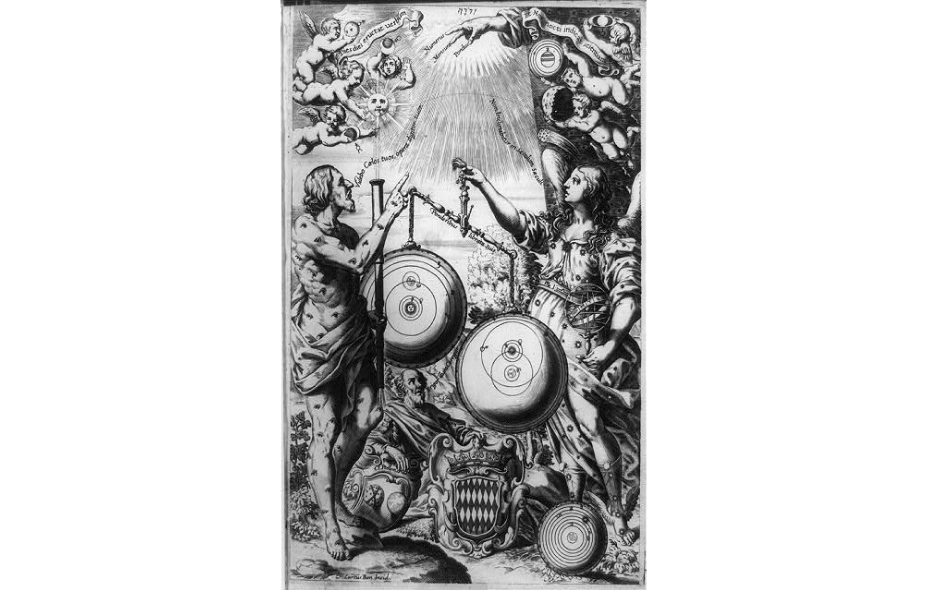
Dr Natarajan then quickly pivoted to modern astronomy, specifically the mapping of the universe- citing the Hubble space telescope as being instrumental (HA). The main goals of astronomy are describing the contents, expansion, and eventual fate of the universe. To illustrate this combination of goals, she cited the example of the Cosmic Microwave Background which is a relic of the time shortly after the Big Bang.
Dr Natarajan's lecture then focused on two particular topics- dark matter and black holes. She contrasted the discovery of these two enigmatic phenomena- the existence of dark matter was determined through empirical observation (gravitational effects on other astronomical objects) and the existence of black holes was determined through theoretical modeling.
The topic shifted to dark matter, which was the subject of her fantastic Secret Science Club North lecture. The universe is composed of approximately 70% dark matter, approximately 25% dark matter, and approximately 5% baryonic matter. The existence of dark matter was first proposed by Fritz Zwicky in order to explain the observed behavior of galaxies in the Coma Cluster. In the 1970s, Vera Rubin and Kent Ford observed unexpectedly steady rates in the rotation of galaxies, evidence that there was a 'halo' of matter around these galaxies that balanced out the greater concentration of baryonic matter at their core. While dark matter has never been observed, it has an impact on dynamics- the motion of stars and galaxies and an impact on light rays. In a solar system, the dominant gravity is that of its star. In a galaxy, there is a lot of 'gravitating' dark matter at the edge. Dark matter is lumped and clumped and smeared all over galaxies, but has no interaction with other matter, except through its mass.
Light is both a wave and a particle, it can be bent through a process known as gravitational lensing. This gravitational lensing can be used to observe far distant astronomical features in galaxy clusters. The current model of the universe posits filaments of dark matter with galaxies at the intersections of filaments. The nature of dark matter is encapsulated in its smoothness- using its lensing effects on observable astronomical features, dark matter can be mapped with a high degree of resolution. It is thought that dark matter is cold, with few collisions between particles... Dr Natarajan noted that she was somewhat disappointed that this was so.
While dark matter has not been observed to interact with baryonic matter, except through gravitational forces, there are attempts to detect it- the Large Underground Xenon experiment is an attempt to detect WIMPS (weakly interacting massive particles), which are considered candidates for dark matter. So far, these haven't been found- we are stuck with cold dark matter, but we don't know what it is.
The topic then shifted to the second major focus of the lecture- how black holes became real. Black holes were predicted mathematically, the mathematical models were borne out observationally, to the extent that gravitational waves were recently detected. In science, mathematical models have to be squared with actual objects. Dr Natarajan wryly noted that the term 'black hole' entered the English lexicon in 1756, to describe the Black Hole of Calcutta, the proverbial place of no return. In 1783, John Michell proposed a dark star, and object so massive that light (which in the original Newtonian model was thought to have mass) could not escape its gravitational field. According to Einstein's Theory of General Relativity, mass bends spacetime, theoretically, an object could be so massive that it effectively 'punctured' spacetime. The term black hole was applied to this astronomical phenomenon by John Wheeler.
The first observational evidence of black holes came in the form of mysterious objects dubbed 'quasars' which have been determined to be X-ray emissions from black holes. Black holes are collapsed stars so massive that light cannot escape their gravity once past the event horizon, so dense that, were the Earth to collapse into a black hole, it would measure one cubic centimeter in volume. According to General Relativity, mass bends the curvature of spacetime into 'holes'- the more mass, the deeper the hole. Black holes are infinitely deep, the laws of physics that we know break down in the vicinity of a black hole. The curvature of spacetime due to gravity was described in Einstein's field equations- Karl Schwartzschild proposed a solution describing slowly rotating spherical objects and New Zealander Roy Kerr proposed a solution modeling gravitational fields around supermassive rotating objects.
Subrahmanyan Chandrasekhar, pondering the fate of stars, formulated the Chandrasekhar limit, the maximum mass of a star which will form a white dwarf- according to the Chandrasekhar's theoretical model, more massive stars will collapse into neutron stars, even more massive ones will collapse into black holes. Jocelyn Bell Burnell, while a graduate student, discovered the first pulsar, which turned out to be a radiation-emitting rotating neutron star, empirical evidence for one of Chandrasekhar's theoretical end-term stars. The first empirical evidence of a stellar mass hole was the discovery of Cygnus X-1, a stellar mass hole which is pulling matter from a blue giant companion star.
More massive by far than stellar mass black holes are supermassive black holes. In 1963, Maarten Schmidt of Caltech discovered the first quasar, an extremely distant, extremely black object which was determined to be a scaled up supermassive feeding black hole... the brightness of the 'quasar' results from a 'flare' of matter ejected from the accretion disk of the black hole at high temperature and high velocity.
Major questions remain about black holes... boiling down to three 'F's'- formation, fueling, and feedback. How do they form? How do they grow? What do they do? Where do black holes reside? Does every galaxy harbor a supermassive black hole at its center? What are the 'seeds' of black holes? Do they result from direct collapse? How do they grow? The formation of a black hole would have to involve a lot of gas- everything would have to be right for one to form. Gravitational waves were discovered emanating from colliding black holes by LIGO, the Laser Interferometer Gravitational-Wave Observatory. LISA, the Laser Interferometer Space Antenna, is a project to develop a more sensitive gravitational wave detector.
As Dr Natarajan wrapped up her lecture, she displayed a NASA animation simulating a stellar mass black hole, a groovy visual accompaniment to a thoroughly groovy lecture:
The lecture was followed by a Q&A in which the Bastard was unable to get a question in. One of the most involved questions involved dark energy, which Dr Natarajan likened to the 'gas pedal of the universe', resulting in the increasing speed of the universe's expansion. She postulated that dark energy is a property of spacetime, but that more research was necessary. In the course of the Q&A, she uttered a line which cannot be stressed enough, so I'm putting in all-caps: NOTHING CAN SUPPLANT THE POWER OF DATA.
Dr Natarajan's return to the Secret Science Club, and her debut at the beautiful Bell House, was triumphant one. Kudos to Dr Natarajan, Dorian and Margaret, and the staff of the beautiful Bell House. For a taste of Dr Natarajan's scientific virtuosity, here's a video of the good doctor giving a brief lecture on the subject at hand:
Also, I'd like to give a hearty high-five to Dr Natarajan for the publication of Mapping the Heavens... congratulations! It's nice to see someone who can so perfectly articulate these cosmological concepts on a level that the layperson can understand. At the end of the lecture, Dr Natarajan addressed the packed house and quipped, "I thought I'd be speaking to ten people." I chided her afterwards by noting that her Symphony Space lecture was delivered to a full house. The good doctor has star power, which is entirely appropriate for an astrophysicist. Again, congratulations are in order.
Subscribe to:
Posts (Atom)