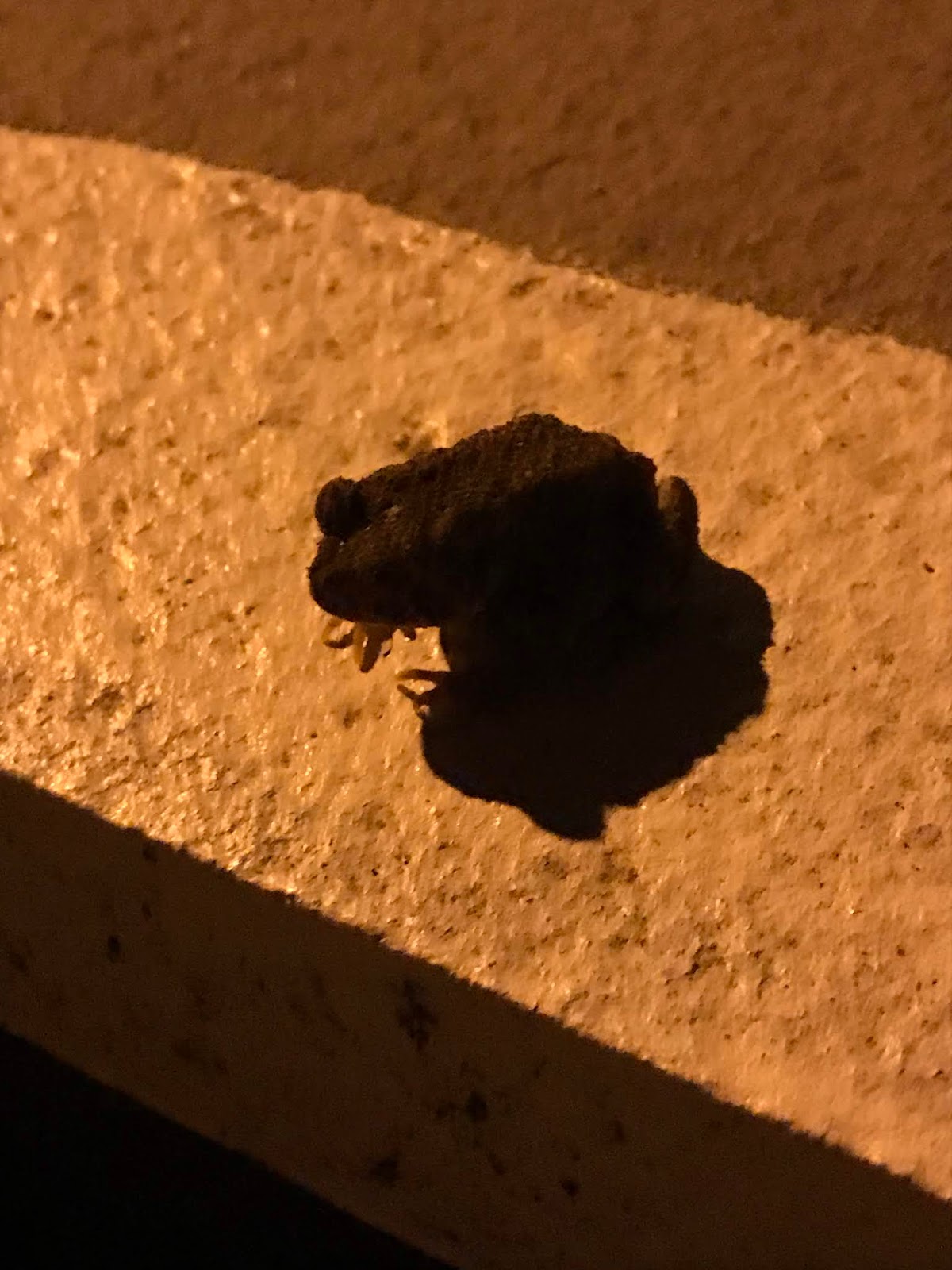
This being spring, the pond at my workplace is a veritable orgy, audibly so. A couple of nights ago, I found this neighbor trying to get in the building, or at least trying to get somewhere:
I had this notion that this toad, a chunk slightly smaller than my fist, was confused by the lights and reflections in the window in front of the building, perhaps thinking it was the reflective surface of the pond. I gently picked it up and placed it in a vegetated section close to the pond. I'd like to think that this time of human social distancing that I was helping to make a batrachian connection... can't achieve amplexus from six feet away.
The edges of each stair in front of the main building at my principal worksite are painted with reflective white paint in order to increase visibility for persons entering or leaving the building. They form a perfect background to highlight an ordinarily camouflaged critter who has succumbed to... you got it... camouflage fail:
This toad toed the line, so to speak. It's hard to 'read' a toad, so I don't know if this particular batrachian is tired, like Rocky Burnette:
I certainly wouldn't want to waste its precious time... time better spent trying to convince princesses to give it a kiss.
Last night, I headed down to the beautiful Bell House, in the Gowanus section of Brooklyn, for this month's Secret Science Club lecture featuring Dr João Xavier, computational biologist and director of Sloan Kettering's X-Lab. Dr Xavier's topic was experimental evolution and swarming bacteria.
My eyes are constantly wide open to the extraordinary fact of existence. Not just human existence, but the existence of life and how this breathtakingly powerful process, which is natural selection, has managed to take the very simple facts of physics and chemistry and build them up to redwood trees and humans.
He followed this up with a beautiful tribute to biodiversity, first showcasing the human diversity of New York City's populace with pictures from the subway system, then showing pictures of animal biodiversity, then expanding his focus to include plants, fungi, and bacteria. Dr Xavier then took a brief digression to note that he entered into the field of biology relatively late- he was initially more interested in math and physics, but eventually felt the call to apply his knowledge of those fields to biology. He followed up this digression with a brief overview of Darwin's theory of evolution by means of natural selection: put succinctly, successful individuals will be 'selected' by natural processes to pass on their traits to their offspring, and this selection will drive the direction in which a species will evolve. The basic mechanism of biological inheritance was formulated by Gregor Mendel, who observed the passing of traits in plant lineages. The central dogma of molecular biology, as formulated by Crick et al. is that DNA is the molecular entity behind evolution. DNA encodes genes which make proteins. DNA can be transcribed- it is copied when a cell divides, and sometimes there are errors in the copying, known as mutations. Most mutations are harmful to an organism, but occasionally they may lead to better survival outcomes. Diversity emerges through mutations, and the fittest organisms tend to propagate.
Dr Xavier then noted that everyone alive today descends from a common ancestor, then he amended this statement to note that every living organism on Earth comes from a common ancestor. He noted that this is a hard-to-grasp concept, so some people refuse to believe it. This refusal to believe led to the creation of the 'Intelligent Design' movement, which posits a director/designer in the evolution of life. The bacterial flagellum was considered the icon of Intelligent Design creationism, but Dr Xavier noted that the proteins behind the flagellum are understood- complex structures look precisely adapted to their environment, they look designed, but their evolution in incremental steps is explainable.
This talk of flagella then segued into the real topic of the lecture- the bacterium Pseudomonas aeruginosa, a human pathogen. Dr Xavier uses Pseudomonas to investigate the fundamental facts about evolution and their direct implications in medicine. Bacterial evolution can be deadly- Dr Xavier recounted a case in which a patient needed a bone marrow transplant, which involved suppressing their immune system. Ten days before the transplant, while the patient's immune system was compromised, the patient developed a Pseudomonas infection which was resistant to most antibiotics. The patient was treated with aztreonam, but the bacteria evolved resistance to this antibiotic through a mutation, sepsis set in, and the patient died. Antibiotics select for resistance against themselves- they kill off non-resistant bacteria, then the small population of resistant bacteria propagates. The evolution of antibiotic resistance is fast, and it happens all the time.
“We are going to die, and that makes us the lucky ones. Most people are never going to die because they are never going to be born. The potential people who could have been here in my place but who will in fact never see the light of day outnumber the sand grains of Arabia. Certainly those unborn ghosts include greater poets than Keats, scientists greater than Newton. We know this because the set of possible people allowed by our DNA so massively exceeds the set of actual people. In the teeth of these stupefying odds it is you and I, in our ordinariness, that are here.We privileged few, who won the lottery of birth against all odds, how dare we whine at our inevitable return to that prior state from which the vast majority have never stirred?”
Bacteria evolve quickly because they reproduce quickly. The Pseudomonas bacteria form a swarming collective, they have motility due to their flagella. Dr Xavier studies this swarming behavior in petri dishes. Separate bacterial swarms in a petri dish repel each other. The bacteria need flagella to swarm, and this is the natural condition of the wild type. A non-swarming, non-flagellated form, known as flgK was developed in the lab. Dr Xavier then showed us a series of videos comparing the spread of swarming wild-type bacteria to the spread of non-swarming mutants:
Parallel experiments were conducted in different petri dishes, and they demonstrated the heritable and stable tendency to evolve into hyperswarming bacteria with multiple flagella, a new feature that evolved in the laboratory. Genome sequencing revealed the precise mutations which caused hyperswarming. Some bacteria evolved an excess of flagella, and too many 'tails' prevented swarming... the right number of flagella was needed. Hyperswarmers, though they move more quickly to exploit new resources, grow more slowly than the ancestral type bacteria- multiple tails require more resources.
Dr Xavier likened the petri dishes with different bacterial strains as to 'fighting arenas' in which the strains were pitted against each other. Different strains were stained red or green, and hyperswarmers were pitted against ancestral types. The hyperswarmers expand quickly and find nutrients, while the non-hyperswarmers are stuck in regions in which nutrients are exhausted. Faster speeds can come with a trade-off, though. Dr Xavier cited the invasive cane toad as an example of such a trade-off... in areas in which the toads are expanding their range, they evolved longer legs which enabled a faster spread. Dr Xavier joked that there was an 'Olympic village of cane toads' down under. The trade-off is that the longer legs, while enabling faster movement, also resulted in more spinal injuries among the leggy toads. In the case of Pseudomonas, hyperswarmers are not found in natural environments or in hospitals- while they can move quickly, they are bad at forming biofilms. In the fighting arena of the petri dish, the slow bacteria will eventually take over- in nature, the fast bacteria don't do well. It's difficult to evolve a change in the structure of the flagellum, the icon of the Intelligent Design movement. Dr Xavier got another dig in at the ID crowd- when the New York Times ran the headline “Watching Bacteria Evolve, with Predictable Results”, a creationist publication describing itself as 'a great tool for countering pro-Darwin propaganda' countered with the rejoinder 'They're still bacteria.' CHECK AND MATE, POINDEXTERS!!!!
Dr Xavier then went on to discuss the use of swarming bacteria to study social behavior- how do social behaviors evolve? Social behaviors can have a different impact on actors and recipients. In mutualism, everyone benefits- actors and recipients. Altruism is costly to the actor and benefits the recipients. Selfishness benefits the actor and is costly to the recipients. In the case of spite, everyone loses. Game theory uses mathematics to analyze behavioral choices. Dr Xavier cited the example of the prisoner game to illustrate game theory:
Kin selection explains many altruistic behaviors- altruism is more likely among relatives. When asked if he would lay down his life to save his brother, biologist J.B.S. Haldane was quoted as saying that he wouldn't, but that he would for two brothers or eight cousins. Altruism makes sense when it results in evolutionary fitness benefits.
Among bacteria, the whole population benefits from swarming, but swarming involves sacrifice among individuals. Non-swarming bacteria tend to consume all available nutrients in their environment until they cannot grow their population. Resources are spent to propagate a swarm, and the tiny contributions of individual bacteria can add up to an impressive spread. Alone, on-swarming bacteria cannot spread, but they can hitchhike along with swarming bacteria. In this cooperative situation, the ratio of swarming to non-swarming bacteria remains stable. Cheating is hard due to metabolic prudence- bacteria cooperate when they have excess metabolic resources to devote to swarming. Dr Xavier ended his lecture by joking that metabolic regulation of good behavior is not only found among bacteria- citing a study of judicial records which suggested that judges at parole hearings tended to become less lenient as they got hungrier, but exhibited renewed leniency after lunch.
The lecture was followed by a Q&A session. Some bastard in the audience, thinking back to Dr Paul Turner's SSC lecture on phage therapy, asked if there had been experiments to use selective pressure to 'breed' less harmful versions of pathogenic bacteria by selecting and propagating less virulent individuals. Dr Xavier replied that this hasn't been attempted, but that it would be possible for less harmful bacteria to out-compete their dangerous relatives. There's no good model for this sort of study, but it could be evolved... of course, as in the example of the introduction of the cane toad to Australia, things could go awry, as organisms don't necessarily behave in the wild as they do in the lab. The Bastard missed a bunch of questions while taking a break to micturate, but when he returned to the main auditorium, the question regarded cancer- cancer cells have an initial propagation advantage over 'normal' cells, but are an evolutionary dead end as they kill their hosts... they are successful for a while, then they fail utterly. He also mentioned the transmissable cancer that is devastating Tasmanian devil populations as a particularly horrific example of this sort of thing.
Once again, the Secret Science Club served up a fantastic lecture. I am particularly struck by the sheer coolness of a Professor Xavier setting up clashes among mutants in a battle arena. The multiple videos of the petri dish battles were gorgeous:
Kudos to Dr Xavier, Margaret and Dorian, and the staff of the beautiful Bell House.
Last night, I headed down to the beautiful Bell House, in the Gowanus section of Brooklyn, for this month's Secret Science Club lecture featuring Dr Frank T. Burbrink of the American Museum of Natural History's Division of Vertebrate Zoology, the Sackler Institute for Comparative Genomics, and the Richard Gilder Graduate School.
Dr Burbink began his lecture by noting that most of science involves contrast, for example control groups vs experimental groups. As a biologist, he is concerned with how organisms evolve, and how they speciate. He is also concerned with the topic of evolutionary hotspots. He described the species as the biologists' 'atom', a basic unit. There are believed to be about ten million non-microbial species on the planet, but it's estimated that only about 20% of species have been delineated. It is difficult to find new species, but it is crucial to understanding biodiversity. It used to be that species were described by how different they look, but this can be misleading- to illustrate this, he displayed photographs of three conspecific rat snakes with different color morphs, then three distantly related but similar looking racer species. He noted that these racer species had diverged around seven million years ago, approximately the same age when chimpanzees and humans diverged.
Speciation generally involves a separation in time and space. When populations become isolated, there is reduced gene exchange. Genetic drift and adaptation to different ecological niches then occur to further divide populations. Computer programs that summarize gene sequences are instrumental in determining the relationships between organisms. DNA can be traced back to a common ancestor, and gene flow (and when it stops) can be modeled. Divergence is a matter of reduced gene flow and adaptation to a new environment. Certain species are wide-ranging and exhibit diverse morphologies- Dr Burbrink gave the example of the milk snake (Lampropeltis triangulum). In areas in which milk snakes overlap with venomous coral snakes, they tend to be more colorful, a case of Batesian mimicry. Dr Burbrink joked that coral snake recognition poems can kill you, morphologies being variable.
Dr Burbrink displayed an image of a snake cladogram similar to this one:
The nodes are divergences. DNA sequencing can be likened to a 'time machine', the timing of divergence can be reconstructed. In the case of the milk snake, the species diverged from its nearest relatives in the Miocene.
In researching the process of speciation, certain topics are of particular interest. How does the rate of speciation change over time? What causes speciation? Factors such as climate change, the opening of ecological niches, and the effects of disease play a role. In the case of the ray-finned fishes, which comprise about thirty percent of vertebrate species, the K-T extinction event which killed off about seventy-six percent of the Earth's species, the effects were relatively insignificant. The morphological changes among these fishes occurred after the asteroid hit. One major controversy among biologists is the question over whether ecological niches can be filled to capacity, so speciation is limited. The current extinction event poses a problem- if species are lost, information useful to reconstructing the 'tree of life' is lost. Deforestation and new pathogens are particularly dangerous- recently observed fungal infections are ravaging amphibian, bat, and snake populations. In a poignant moment, Dr Burbrink displayed a photo contrasting a gorgeous healthy fox snake with one infected by a fungus, then noted that the first snake he caught as a boy in Illinois was a fox snake.
The spread of this fungal infection was modeled using an AI, in an effort to determine how many species could be infected. It is now believed that all snakes, or at least all Nearctic snakes, are at risk. Dr Burbrink noted that we stand to lose a lot if we lose snakes, which control rodent populations and help to suppress Lyme disease. The origin of the fungal infection is unknown, but it is currently limited to Europe and the Nearctic.
The subject of the talk then shifted to Madagascar, which he described as an 'upside down world' and a hotbed of discoveries of snake species. Dr Burbrink delivered an entertaining Madagascar travelogue. He ignores the lemurs, joking that all mammals bite, but only twenty percent of snakes do. He displayed pictures of the Avenue of Baobabs, of rival churches in towns. He displayed a picture of a fossa and a recounted a cautionary tale from a guide, "If it smells blood, it will destroy you!" He described a land with no bridges, river crossings being done with ferries. Camp is then set up, and a lab. The specimens are split between the institution and the authorities on the island. The beer is bad. While the suspension bridges are dodgy, the trails down the sharp karst formations are even more harrowing. He displayed beautiful photos of the plentiful gecko species, numerous chameleons (among them a tiny critter), snakes galore, and a rare Old World iguanid. One of the best sources of genetic material comes from recently road-killed snakes. Dr Burbrink joked about grad students eating jerky while collecting dead snakes. Outreach, while crucial, can be frought... many people believe in black magic, so an illness coinciding with a visit from the snake people can do a lot of harm. One particular arboreal snake, possessing a red tail, is believed to drop from trees, impaling hapless persons or cattle passing beneath. In one field season, the DNA of 730 individual snakes was sequenced and forty new species were found.
It is believed that the snakes of Madagascar arrived at the island from Mozambique twenty million years ago, and are descended from arboreal forebears. The speciation rate is fairly even, with 109 species expected to diverge over twenty million years. Dr Burbrink displayed a graph depicting the speciation rate of snakes on the island and noted that there was a 'dip' vis-a-vis expected numbers. The is speculation regarding the dip, does it represent species which remain to be found? Was there a 'saturation' of available niches? One of his colleagues, who discovered the 'ghost snake' has a knack for coining evocative species names. One particularly interesting snake species has unusual probosces and exhibits sexual dimorphism- males having spear-shaped noses and females having ones shaped like glaives but not glaive-glaive-glaive-guisarme-glaives. Despite the difficulties, a lot of headway is being made in the search for new species.
Dr Burbrink then offered up a quick autobiography, noting that as a youth he was inspired by two guys named Chuck D. He advised the audience to listen to a wide variety of music, to watch transgressive films, to be stable geniuses, and to have cool families-he showed a picture of his wife thrusting her hand into a rat snake hybernaculum in upstate New York (noting that torpid snakes can become active very quickly), and pictures of his older son catching a snake and his younger son holding a giant marine toad. Actually, his advice was pretty good for all endeavors.
The lecture was followed up by a Q&A session. The first questioner totally ninja'ed the Bastard by asking about the evolution of venom production in snakes. Venom pops up all over the snake family tree, with the viperids and elapids being the best-known groups. It is possible that all snakes are venomous to some extent, but that most snake species produce venom that is not harmful to humans (a controversial theory). Another question regarded the snake-infecting fungus- it is possible that it was historically prevalent, but has only recently become dangerous due to environmental factors. The bastard asked about snake cladistics, and snake evolution- all snakes are, biologically speaking, lizards. There are thirty extant lizard groups that have lost their limbs, notably the glass lizards and amphisbaenids. All snakes have a common ancestor and basal snakes had limbs. Among lizard groups, the iguanids, agamids, and chameleons are more closely related to snakes than to other lizard groups such as geckos. Some classification schemes propose lumping snakes and some lizards into one group. The explosion in snake diversity occurred about twenty million years ago, in the Miocene Epoch, and snakes became one of the most successful tetrapod (though they lack legs) groups. The fossil record shows numerous speciation events, but most species go extinct. The fossil record in North America is good, but Madagascar has a poor fossil record- the best known extinct species from Madagascar are the elephant birds, which survived into historic times, pygmy hippos, and an alarmingly sized frog dubbed Beelzebufo. Another question concerned the evolution of limblessness- getting rid of limbs is useful in three means of locomotion- swimming, burrowing, and 'grass swimming'. Another question involved the defining of species- as Dr Burbrink put it 'the million dollar question'. The biological concept of a species is a population that breeds true, with viable offspring that can successfully reproduce. Certain closely related species cannot reproduce because there are portions of the genome, known as genomic islands, which inhibit gene flow. Other closely related species may be prevented from interbreeding due to morphological or ecological differences.
Another fellow asked the derivation of the common name for the milk snake, and Dr Burbrink recounted a common folktale- ignorant lummoxes, seeing the snakes in barns, surmised that the snakes were sucking milk from the teats of cows, rather than hunting for the tasty rats that can infest barns. Dr Burbrink pronounced this folktale udderly ridiculous. He then joked about the color variations among milk snakes, with southern populations being brighter than northern ones... it would suck to mimic a species which isn't there.
A question about hibernation elicited a digression about snakes' ability to reduce their gut size between feedings. They can shrink their guts to a thin cell layer, then rebuild them after ingesting prey. The snakes come out of hibernation active, Dr Burbrink quipped that this would be a good model for astronauts' cryogenic sleep.
Another question concerned the origin of limblessness in snakes, the probable 'locomotive' reason for the group losing its legs. Certain features of snakes suggest an origin as burrowers- a lot of burrowing animals have degenerate eyes. Snake eyes are weird- they focus their eyes by moving the lens back and forth rather than by bending it, and their eyes contain oil drops. It is possible that they were burrowers who regained more functional eyes.
Being a lover of snakes, this lecture was right up my alley, hitting that 'Secret Science Sweet Spot'- that combination of hard science, beautiful imagery, adventure narrative, and personal journey. Dr Burbrink lectured with passion and humor, making a great case for the importance of snakes, the importance of studying snakes and working to protect them. Kudos to the good doctor, the staff of the beautiful Bell House, and Margaret and Dorian. High fives all around! Here's a video of Dr Burbrink giving a lecture on the snakes of Madagascar:
Pour yourself a nice beverage and soak in that science.
West Virginia tends to get tiny toads before New York does, but New York eventually catches up:
I found this little critter at the bottom of the basement stairwell of the building in which I typically work. As I do on a regular basis, I relocated it to a nice pachysandra patch at the top of the stairs. Can't have the little beastie stuck at the bottom of a stairwell which it can't get out of... though there are plenty of delicious ants down there, so it's not a bad place to spend some time. I figured I had to do this toad a favor, because it just might be the child of a friend of mine.
It's been really hot for the last couple of days as the 'heat dome' which has been cooking the Midwest has moved east. The Manager on Duty on the dayshift spent a good portion of the day running jugs of cold water to the folks who had to work today, and handing out refrigerated bottles of water to visitors as soon as they arrived on site. Ginger parked herself in the air-conditioned break room until her end-of-shift meal was forthcoming and she took up rat patrol duties after 5PM. Shortly before sundown, I let her and Fred out and gave them a good brushing, releasing clouds and clouds of hair.
It's still hot out, about 80 degrees Fahrenheit (26.66 Celsius), so even the cold-blooded denizens of the site are enviously eyeing the air-conditioned interior of our main building:
Hey, buddy, I'll let you in, but you've got to get me VIP passes to Toad's.
It's a pretty swampy night here in the NY Metro Area... after a real scorcher of a day, it's still 73 degrees Fahrenheit (22.7 Celsius) out and humid to boot. Scattered thunderstorms dumped a considerable amount of rain on my worksite. Yeah, it's pretty dank and swampy, perfect weather for an amphibious visitor:
This is a handsome American toad(Anaxyrus americanus), sitting on the 'safety' painting on the edge of the front steps. We have a lot of toads on site, much to my delight. Pretty soon, we should have this year's baby toads emerging from the pond. We tend to get them a little later than West Virginia does.
It's been hot and humid here in the NY metro area lately, the sort of weather that causes even guys like me to have a bad hair day. Yesterday, it must have rained hard during the midday hours, because there were residual puddles on the ground. It was a good day for amphibians, and the amphibians were out in force in the evening.
Right outside the building, I saw a frog which, judging buy its size, was probably a common green frog (Rana clamitans) or a small bullfrog (bullfrog (Rana catesbeiana)- in all the confusion, I didn't pay attention to whether or not it had the green frog's dorsolateral ridges. At any rate, it was considerably smaller than this behemoth, which was as big as my fist.
Also outside the building was this particularly dark (compare to these guys) little American toad:
On days like this, the swampy air seems to act as an extension of the onsite body of water. I know I feel kinda bogged down in all this humidity.
In the midst of some really horrible news, here's a bright note- the name Brontosaurus will be restored to an iconic sauropod dinosaur. The name Brontosaurus was in 1879 to a nearly complete fossil dinosaur discovered by Othniel C. Marsh. In 1877, Marsh had given the name Apatosaurus to an incomplete sauropod skeleton he had discovered. In 1903, Elmer S. Riggs determined that Apatosaurus and Brontosaurus were one and the same, and the rules of binomial nomenclature mandate that the earlier name for a genus takes precedence (this can be circumvented in the case of misidentified organisms- for instance, the cane toad was originally lumped into the genus Bufo but now is more commonly included in the genus Rhinella).
I'm happy that the name Brontosaurus has been rescued from its non-official status. Its meaning, "thunder lizard", is too evocative to lose... imagine the rumble that a herd of them would have produced as they traversed the landscape!
As I have noted before, I have a fondness for toads, but not like that. At this time of year, newly metamorphosed little toads emerge from a pond on site (in some communities, traffic is redirected when the toadlings put their tadpolish ways behind them and take to the land. The site I typically work at is toad heaven- there is plenty of green space for my batrachian buddies to live their toadly lives.
Last night, I found a half dozen little toads in the stairwell to one of our buildings. While the area is a perfect place for a toad to establish itself, being cool and shady, and full of delicious bugs, it's a dead end for a small toad- they can get down the stairway but they can't get up. I was able to coax the little fellers onto my hand with a gentle finger nudge, and I relocated them to a pachysandra patch. Here's one of my little transportees:
This is not the first time I've had to do a stairwell intervention, and it probably won't be the last.
The post title is the first line of a couplet that I wrote, when I was writing short bits of doggerel in alarming profusion:
Loads and loads of tiny toads,
Live by the sides of country roads.
The same period of bizarre creative ferment also produced the following:
Crepuscular critters give the jitters,
But creatures of night fill me with fright.
Like I said, I'm tickled pink at this rift within the GOP, with the "could fake it as a moderate" Christie having been a huge favorite among conservatives until his photo ops with the Kenyan usurper. I guess Rand Paul wants to garner that conservative love from those who felt spurned by Christie. I even like the optics of the fight, with the toad-like Christie and the snake-like Paul squaring off like a couple of wingnut wuxia whiners. Even better, the squabbling Christie and Paul remind me of these two guys:
Since I was a small lad, I have always had a fondness (not an overfondness, mind you!) for toads... I also have a fondness for Toad's, but that's not germane to the topic. Tonight, I saw a handsome specimen of the common toad of the Northeastern United States, Anaxyrus americanus (formerly Bufo americanus, but Bufo is more properly applied to them fancy elitist You're-a-Peein' toads), holding court behind my workplace. The site abounds in toads, and sighting them never fails to amuse me. I took this portrait, but it totally fails to capture the pretty, golden eyes of the little beastie:
I didn't want to harass the critter, so I didn't go for a closer picture, and, no, I did not lick the toad in order to get high. Toad-licking is a fool's game and can only lead to heartbreak.
The Big Bad Bald Bastard is a character played by Monsieur _______ of the City of Y______. The role of the Bastard is a handy one to play on subways, walking the streets, and in dive-bars, when being a nerdy, bookish sort is not to one's advantage.