Five years ago, I wrote a post about the odd Celtic custom of Hunting the Wren on December 26th, St Stephen's Day. Of course, the wren (Troglodytes troglodytes) is the king of all birds because it was able to fly higher than the eagle by hiding on its back. The wren is hunted and paraded around by the mighty hunters, who ask for 'payment' until the wren is buried and the hunters' rewards are combined and cooked into a pudding.
I decided to post about this topic again because I heard a great version of John McCutcheon's ballad Christmas in the Trenches on a local college radio by my great and good friend Mary Courtney, the Star of the County Bronx. While looking for a video of a performance of the song, I found a nice video of Irish Christmas music and stories which starts off with Mary singing the Wren Song:
Christmas in the Trenches, references the improbable, impromptu Christmas Truce, a miraculous cessation of fighting on the part of soldiers on the front lines during World War One. Tragically, the truce didn't last long, because a new rotation of troops, ones who hadn't celebrated with their foes, came to the front lines. Mary is a humanitarian as well as a balladeer and folk historian... this is exactly the sort of song which she handles so beautifully.
Showing posts sorted by relevance for query wren. Sort by date Show all posts
Showing posts sorted by relevance for query wren. Sort by date Show all posts
Monday, December 26, 2016


Monday, December 26, 2011
St Stephen's Day
Besides being Boxing Day, December 26th is also the feast of St Stephen, the original Christian martyr. In Ireland, it's also known as Wren Day:
Of course, the wren is the king of all birds because, when it was determined that the king of birds would be the one that flew highest, a wren was piggybacking on the eagle, and when the eagle reached the apex of its flight, the wren took off, flying higher than the eagle.
As you may imagine, St Stephen's Day is a great day to hit the pubs, and I live in the tavern district. What better way to celebrate the stoning of St Stephen than to get stoned, eh?
Now, the best known song about St Stephen's Day in the Anglophone world is Good King Wenceslas, a song about a 10th century Czech king by a 19th century English churchman. How's this for trippy? Tom Jones singing about the bonny Bohemian:
Heh, I've got my own plans for the feast day:
Big Bald Bastard's drinking stout,
On the Feast of Stephen.
Acting like a drunken lout,
Tryin' to keep from heavin'.
Chatting up a local girl,
Trying to play the man-whore.
Says, "Hey, baby let's take a whirl
All around the dance floor!"
I'll never become the sainted king of Bohemia at this rate...
In a serious aside, I really hope I make it out tonight- I've had three consecutive workdays jammed into a forty hour period- Saturday 4PM to Midnight, Sunday 8AM to 4PM, Monday Midnight to 8AM. Sheesh, it's been eight hours on, eight hours off for the last two days- I need to have a talk with the scheduler (he's on vacation all week) about avoiding such madness in the coming year. I know we have a lot of ground to cover, and we're understaffed, but this kind of ass-kicking is unwarranted... I think he makes up the schedules for different sites separately, with no effort of reconcile them. I can sustain this sort of effort for a while, but can't do it without a resultant "crash" anymore. It'll be a St Stephen's Day miracle if I don't sleep straight into Tuesday!
Of course, the wren is the king of all birds because, when it was determined that the king of birds would be the one that flew highest, a wren was piggybacking on the eagle, and when the eagle reached the apex of its flight, the wren took off, flying higher than the eagle.
As you may imagine, St Stephen's Day is a great day to hit the pubs, and I live in the tavern district. What better way to celebrate the stoning of St Stephen than to get stoned, eh?
Now, the best known song about St Stephen's Day in the Anglophone world is Good King Wenceslas, a song about a 10th century Czech king by a 19th century English churchman. How's this for trippy? Tom Jones singing about the bonny Bohemian:
Heh, I've got my own plans for the feast day:
Big Bald Bastard's drinking stout,
On the Feast of Stephen.
Acting like a drunken lout,
Tryin' to keep from heavin'.
Chatting up a local girl,
Trying to play the man-whore.
Says, "Hey, baby let's take a whirl
All around the dance floor!"
I'll never become the sainted king of Bohemia at this rate...
In a serious aside, I really hope I make it out tonight- I've had three consecutive workdays jammed into a forty hour period- Saturday 4PM to Midnight, Sunday 8AM to 4PM, Monday Midnight to 8AM. Sheesh, it's been eight hours on, eight hours off for the last two days- I need to have a talk with the scheduler (he's on vacation all week) about avoiding such madness in the coming year. I know we have a lot of ground to cover, and we're understaffed, but this kind of ass-kicking is unwarranted... I think he makes up the schedules for different sites separately, with no effort of reconcile them. I can sustain this sort of effort for a while, but can't do it without a resultant "crash" anymore. It'll be a St Stephen's Day miracle if I don't sleep straight into Tuesday!
Wednesday, February 18, 2015
Secret Science Club Post Lecture Recap: Here's Looking at You, Brain!
Last night, I headed down to the beautiful Bell House, for this month's Secret Science Club lecture, featuring neurologist and radio host Dr Carl Schoonover of Columbia University. Dr Schoonover's lecture concerned the topic of his book Portraits of the Mind: Visualizing the Brain from Antiquity to the 21st Century, the development of our ability to look at the brain.
Dr Schoonover began the lecture with the observation that researching the structure of the human brain is no easy matter- C. elegans, a nematode with a fondness for English compost heaps, was used to study neural development because it has a simple nervous system of 302 neurons. Neurologists studying the human brain, with its 100 billion neurons, have their work cut out for them. Topics of interest to neurologists are, what part of the brain is connected to mental life and how do the different parts of the brain communicate with each other? One problem with studying the brain is that it appears to be gray undifferentiated matter, resistant to observation.
One of the earliest attempts to map out the brain was Alhazen's Book of Optics, written by Alhazen (not to be confused with Alhazred) in the 11th Century. Earlier guesses about the brain's function were really off-the-mark, Aristotle believed that the heart was responsible for thought, and that the brain merely acted to cool the blood. The physician and anatomist Galen, performed animal dissections that revealed fluid-filled cavities in the brain, which he believed were filled with the "humors" thought to regulate human disposition. Because scholars didn't not actually handle human brains, their view of the brain was distorted- texts were valued over empirical engagement and the "ventricular theory" of the brain held sway for over a millennium.
Leonardo DaVinci was one of the pioneers of studying the physical brain, being dissatisfied with the ventricular model- DaVinci believed that the structure and function of the brain were connected. In order to study the brain, a researcher must denature and manipulate the brain. In order to map out the ventricles of the brain, DaVinci dissected an ox brain (PDF link) and made a wax cast of its ventricles. DaVinci realized that his eyes alone were insufficient to the task of modeling the brain. One modern technique of modeling the brain is to make a resin cast of the brain structure and use acid to "eat away" the actual brain tissue.
In 1543, the anatomist Vesalius published De humani corporis fabrica, a text that drew upon his dissections of human subjects. Vesalius' work represented a turn away from Galen's models- the human body needed to be studied, dissecting animals was not sufficient.
Christoper Wren, the famed architect, studied the structure of the brain, notably injected ink into brains in order to study their structure, producing striking images. The technique of injecting dyes or contrast agents into the brain is still used, in the form of the cerebral angiogram. By the 18th Century, the use of stains hit its stride and a bewildering world of structures was discovered.
In the late 19th Century, Camillo Golgi developed the Golgi method of staining tissue with a silver solution to facilitate the use of light microscopy to study tissues. The Golgi method opened up the complex structure of the brain. The new approach to stained tissues was facilitated by refinements in microscopy, with Zeiss microscopes being of particular importance.
Golgi was unable to fully "atomize" the brain, but his work was built on by Santiago Ramón y Cajal, who wished to be a painter, but was forced by his family to attend medical school. His skill at drawing helped him to depict the structure of the brain. Using the Golgi method, Ramón y Cajal was able to observe the dendritic structure (he likened these structures to "spines") of neurons- the dendrites of the neuron receive incoming information and the axon transmits outgoing information. Ramón y Cajal drew the structures he had observed from memory, and the "maps" of the brain that he drew (including those of such structures as the hippocampus and neocortex are still useful. Golgi and Ramón y Cajal shared the 1906 Nobel Prize in Medicine for their work in neurology.
Electricity is the "lingua franca" of the brain, and the dendritic "spines" observed by Ramón y Cajal, which he guessed played a crucial role in transmission, are connections now known as synapses.
Dr Schoonover then displayed moved on to the use of molecular biology to model the brain. He discussed the use of green fluorescent protein to mark neurons- the neurons are lit from within so that structures can be studied. Other fluorescent proteins yield different colors, so approximately 100 hues can be used to highlight different structures of the brain. This part of the lecture was accompanied by breathtakingly beautiful images of the brain, similar to this gorgeous image of the hippocampus. The use of multiple stains alleviates the "tangle" problem- it's hard to distinguish structures if everything is tagged in the same way. The techniques used to "unravel" the brain's structure have yielded some strikingly beautiful images.
Another method of tagging brain structures utilizes protein antibodies- each antibody reacts to a specific protein so specific molecular "shapes" can be detected. Efforts are now underway to determine the "scaffolding" of the brain- without this structure, the brain would pretty much break down into a goo composed mainly of lipids and water. The glial cells are instrumental in providing the structure of the brain. Antibodies in stains can target glial cells for imaging purposes.
The use of GFP and antibodies depends on an understanding of how nature normally works so that it can be "hijacked" to serve other purposes. These staining methods are useless without the imaging technology. Laser microscopy is now yielding images of the brain over the span of weeks. Dr Schoonover displayed a series of images of the neural "spines" over the course of two weeks, noting the changes in their shapes. He quipped that the brain we woke up with in the morning was anatomically different from the brain we went to bed with.
Synapses are just big enough to see with light microscopes, but they are too small for details to be learned- for that, electron microscopes are needed- abandoning light opens up new vistas. With electron microscopy, the dendritic spines of the neuron and the configuration of synapses become clear.
The 2014 Nobel Prize in Chemistry was awarded for the development of "super-resolved fluorescence microscopy", an optical microscopy technique which "beats light at its own game" in order to view smaller structures. This development signals a return to light microscopy.
The lecture then veered into a quick discussion of the electric nature of the brain. Luigi Galvani famously observed that an electric spark could make a frog's leg twitch. The electrical signals in the nervous system encode information with spikes in voltage. Dr Schoonover described an experiment in which a monkey was given a cup of juice, and its neurons encoded the administration of this reward. The electrical signal was accompanied by a vascular effect- there was increased bloodflow to provided needed oxygen to the neurons. The influx of oxygenated blood caused dark areas to appear in an MRI, producing a "smiley face" image of a happy monkey, an image Dr Schoonover ended his lecture with.
In the Q&A, some bastard in the audience asked if Loligo, with its giant neurons, was still used in neurological studies. Dr Schoonover noted that Loligo was a true workforce back in the 50s, so the aforementioned bastard is hopelessly behind the times.
Here's a video of Dr Schoonover giving a similar lecture, so you can get a taste of the lovely imagery, not the least of which (for those of you who are so inclined) is Dr Schoonover himself:
Once again, the Secret Science Club served up a fantastic lecture. For more on GFP, check out this recap, and for more on Ramón y Cajal, check out this recap. One of these days, I'll label my posts.
Dr Schoonover began the lecture with the observation that researching the structure of the human brain is no easy matter- C. elegans, a nematode with a fondness for English compost heaps, was used to study neural development because it has a simple nervous system of 302 neurons. Neurologists studying the human brain, with its 100 billion neurons, have their work cut out for them. Topics of interest to neurologists are, what part of the brain is connected to mental life and how do the different parts of the brain communicate with each other? One problem with studying the brain is that it appears to be gray undifferentiated matter, resistant to observation.
One of the earliest attempts to map out the brain was Alhazen's Book of Optics, written by Alhazen (not to be confused with Alhazred) in the 11th Century. Earlier guesses about the brain's function were really off-the-mark, Aristotle believed that the heart was responsible for thought, and that the brain merely acted to cool the blood. The physician and anatomist Galen, performed animal dissections that revealed fluid-filled cavities in the brain, which he believed were filled with the "humors" thought to regulate human disposition. Because scholars didn't not actually handle human brains, their view of the brain was distorted- texts were valued over empirical engagement and the "ventricular theory" of the brain held sway for over a millennium.
Leonardo DaVinci was one of the pioneers of studying the physical brain, being dissatisfied with the ventricular model- DaVinci believed that the structure and function of the brain were connected. In order to study the brain, a researcher must denature and manipulate the brain. In order to map out the ventricles of the brain, DaVinci dissected an ox brain (PDF link) and made a wax cast of its ventricles. DaVinci realized that his eyes alone were insufficient to the task of modeling the brain. One modern technique of modeling the brain is to make a resin cast of the brain structure and use acid to "eat away" the actual brain tissue.
In 1543, the anatomist Vesalius published De humani corporis fabrica, a text that drew upon his dissections of human subjects. Vesalius' work represented a turn away from Galen's models- the human body needed to be studied, dissecting animals was not sufficient.
Christoper Wren, the famed architect, studied the structure of the brain, notably injected ink into brains in order to study their structure, producing striking images. The technique of injecting dyes or contrast agents into the brain is still used, in the form of the cerebral angiogram. By the 18th Century, the use of stains hit its stride and a bewildering world of structures was discovered.
In the late 19th Century, Camillo Golgi developed the Golgi method of staining tissue with a silver solution to facilitate the use of light microscopy to study tissues. The Golgi method opened up the complex structure of the brain. The new approach to stained tissues was facilitated by refinements in microscopy, with Zeiss microscopes being of particular importance.
Golgi was unable to fully "atomize" the brain, but his work was built on by Santiago Ramón y Cajal, who wished to be a painter, but was forced by his family to attend medical school. His skill at drawing helped him to depict the structure of the brain. Using the Golgi method, Ramón y Cajal was able to observe the dendritic structure (he likened these structures to "spines") of neurons- the dendrites of the neuron receive incoming information and the axon transmits outgoing information. Ramón y Cajal drew the structures he had observed from memory, and the "maps" of the brain that he drew (including those of such structures as the hippocampus and neocortex are still useful. Golgi and Ramón y Cajal shared the 1906 Nobel Prize in Medicine for their work in neurology.
Electricity is the "lingua franca" of the brain, and the dendritic "spines" observed by Ramón y Cajal, which he guessed played a crucial role in transmission, are connections now known as synapses.
Dr Schoonover then displayed moved on to the use of molecular biology to model the brain. He discussed the use of green fluorescent protein to mark neurons- the neurons are lit from within so that structures can be studied. Other fluorescent proteins yield different colors, so approximately 100 hues can be used to highlight different structures of the brain. This part of the lecture was accompanied by breathtakingly beautiful images of the brain, similar to this gorgeous image of the hippocampus. The use of multiple stains alleviates the "tangle" problem- it's hard to distinguish structures if everything is tagged in the same way. The techniques used to "unravel" the brain's structure have yielded some strikingly beautiful images.
Another method of tagging brain structures utilizes protein antibodies- each antibody reacts to a specific protein so specific molecular "shapes" can be detected. Efforts are now underway to determine the "scaffolding" of the brain- without this structure, the brain would pretty much break down into a goo composed mainly of lipids and water. The glial cells are instrumental in providing the structure of the brain. Antibodies in stains can target glial cells for imaging purposes.
The use of GFP and antibodies depends on an understanding of how nature normally works so that it can be "hijacked" to serve other purposes. These staining methods are useless without the imaging technology. Laser microscopy is now yielding images of the brain over the span of weeks. Dr Schoonover displayed a series of images of the neural "spines" over the course of two weeks, noting the changes in their shapes. He quipped that the brain we woke up with in the morning was anatomically different from the brain we went to bed with.
Synapses are just big enough to see with light microscopes, but they are too small for details to be learned- for that, electron microscopes are needed- abandoning light opens up new vistas. With electron microscopy, the dendritic spines of the neuron and the configuration of synapses become clear.
The 2014 Nobel Prize in Chemistry was awarded for the development of "super-resolved fluorescence microscopy", an optical microscopy technique which "beats light at its own game" in order to view smaller structures. This development signals a return to light microscopy.
The lecture then veered into a quick discussion of the electric nature of the brain. Luigi Galvani famously observed that an electric spark could make a frog's leg twitch. The electrical signals in the nervous system encode information with spikes in voltage. Dr Schoonover described an experiment in which a monkey was given a cup of juice, and its neurons encoded the administration of this reward. The electrical signal was accompanied by a vascular effect- there was increased bloodflow to provided needed oxygen to the neurons. The influx of oxygenated blood caused dark areas to appear in an MRI, producing a "smiley face" image of a happy monkey, an image Dr Schoonover ended his lecture with.
In the Q&A, some bastard in the audience asked if Loligo, with its giant neurons, was still used in neurological studies. Dr Schoonover noted that Loligo was a true workforce back in the 50s, so the aforementioned bastard is hopelessly behind the times.
Here's a video of Dr Schoonover giving a similar lecture, so you can get a taste of the lovely imagery, not the least of which (for those of you who are so inclined) is Dr Schoonover himself:
Once again, the Secret Science Club served up a fantastic lecture. For more on GFP, check out this recap, and for more on Ramón y Cajal, check out this recap. One of these days, I'll label my posts.
Thursday, December 26, 2019
Happy Boxing Day!
I am fortunate to have really good neighbors- my immediate upstairs neighbor is a dream, working hard in house and yard, raising her two kids to be accomplished persons. She herself is a firecracker, a small gal, but mighty- she competes in triathlons, she laughs loud and often, and she doesn't take any guff from anybody. When she found out I was stuck at work on Christmas, she put aside a dinner plate for me:

This being Boxing Day (she's an Armagh gal by birth, a Yonkers gal by choice), she brought down this fine repast and I gave her a bottle of Bailey's (perhaps the best ever use of surplus product) as we exchanged holiday greetings. Calling the day St Stephen's Day is more of a southern thing, and wren hunting is more of a rural thing- it's funny how, for such a small country, there is so much difference in customs throughout Ireland... and Yonkers.
I spent a good portion of the afternoon on an overseas phone call with my older brother, Sweetums. He's doing well, and he related a funny anecdote about how his kids wanted to stay up all night rather than having to get up early for Christmas (it's a longstanding family trait- NONE of us ever wanted to go to sleep, out of concern for missing out on something). In a new, though not atypical, development, they all watched Monty Python's Life of Brian on Christmas Eve, ensuring that the kids would be singing this all day long. My brother's take on it is that, even thought there's some spicy content, there are no explosions or shooting in the film- and his oldest has taken some Latin in school, so he got this joke. I reminded him that watching the film really wasn't any more irreverent than some of the Christmas Eve booze fests we've had over the years. It's good to know that Sweetums is raising the kids right.
It's been a good day connecting with family- the nuclear family and the neighborhood family. That's what Boxing Day is all about, and no wrens had to be harmed.

This being Boxing Day (she's an Armagh gal by birth, a Yonkers gal by choice), she brought down this fine repast and I gave her a bottle of Bailey's (perhaps the best ever use of surplus product) as we exchanged holiday greetings. Calling the day St Stephen's Day is more of a southern thing, and wren hunting is more of a rural thing- it's funny how, for such a small country, there is so much difference in customs throughout Ireland... and Yonkers.
I spent a good portion of the afternoon on an overseas phone call with my older brother, Sweetums. He's doing well, and he related a funny anecdote about how his kids wanted to stay up all night rather than having to get up early for Christmas (it's a longstanding family trait- NONE of us ever wanted to go to sleep, out of concern for missing out on something). In a new, though not atypical, development, they all watched Monty Python's Life of Brian on Christmas Eve, ensuring that the kids would be singing this all day long. My brother's take on it is that, even thought there's some spicy content, there are no explosions or shooting in the film- and his oldest has taken some Latin in school, so he got this joke. I reminded him that watching the film really wasn't any more irreverent than some of the Christmas Eve booze fests we've had over the years. It's good to know that Sweetums is raising the kids right.
It's been a good day connecting with family- the nuclear family and the neighborhood family. That's what Boxing Day is all about, and no wrens had to be harmed.
Wednesday, December 25, 2019
Christmas Cheery via Telecom
I had to work today, being 'essential personnel' in an understaffed department... somebody has to make sure that the place is still standing and the cat is fed. It's a low-key day on the job, and it frees me up for some St Stephen's Day drinking, though I'll pass on hunting the wren. Most of the day, though, I was in communication with family and friends, getting updates on everybody's antics- my goddaughter getting up at 4AM because she was so excited, nephews making pastries for holiday parties. It was a day for recounting funny stories about ruthless Christmas tree shopping and weird run-ins with Cajun carnies. Jokes both clean and ribald (one friend, talking about deserving a spanking, set me up to make the punchline: "Can't spell Christmas without S&M!").
Everybody is doing well, as is to be expected. Myself, I hit a Chinese takeout place on the way to work and had a quick lunch before feeding the cat- for Christmas, I gave her some whole milk (she's one of those cats which has had the stuff throughout her life). I've been the recipient of altogether too much Christmas chocolate, and one of our managers, who will be on vacation for two weeks, wrote a note telling me that I was in charge of distributing the leftover snacks in the employees' kitchen, and I have to confess that I took the choicest stuff for myself. In the interest of full disclosure, I've been eating junk all afternoon, as one does on Christmas. My upstairs neighbor texted me to tell me that she had a ton of food, so she'd prepare a plate for me, so breakfast for tomorrow is in the bag. I have a bottle of Bailey's with her name on it, for her Boxing Day coffee.
Here's hoping that everybody has had a lovely Christmas, free from worry and stress. As a Christmas gift, here's a choral group from Trinidad and Tobago singing the Hallelujah chorus from Handel's Messiah
Watching that, dreaming of a green Christmas seems like a perfectly fine idea, no offense to Irving Berlin.
Everybody is doing well, as is to be expected. Myself, I hit a Chinese takeout place on the way to work and had a quick lunch before feeding the cat- for Christmas, I gave her some whole milk (she's one of those cats which has had the stuff throughout her life). I've been the recipient of altogether too much Christmas chocolate, and one of our managers, who will be on vacation for two weeks, wrote a note telling me that I was in charge of distributing the leftover snacks in the employees' kitchen, and I have to confess that I took the choicest stuff for myself. In the interest of full disclosure, I've been eating junk all afternoon, as one does on Christmas. My upstairs neighbor texted me to tell me that she had a ton of food, so she'd prepare a plate for me, so breakfast for tomorrow is in the bag. I have a bottle of Bailey's with her name on it, for her Boxing Day coffee.
Here's hoping that everybody has had a lovely Christmas, free from worry and stress. As a Christmas gift, here's a choral group from Trinidad and Tobago singing the Hallelujah chorus from Handel's Messiah
Watching that, dreaming of a green Christmas seems like a perfectly fine idea, no offense to Irving Berlin.
Tuesday, November 22, 2016
Secret Science Club Post-Lecture Recap: This Subject's for the Birds!
Last night, I headed down to the beautiful Bell House, in the Gowanus section of Brooklyn, for this month's Secret Science Club lecture featuring evolutionary biologist Dr Rafael Maia of Columbia University. Dr Maia titled his lecture 'The Colorful Sex Lives of Birds'. He noted that he isn't exactly the best birder, often having trouble finding his subjects in the field. He noted that the 'bird nerd' image is somewhat justified, with birders planning their honeymoons around adding to their life lists. He noted that he first became interested in studying birds by watching Jurassic Park, specifically the scene in which Sam Neill lectures an annoying kid who says that stating dinosaurs are like birds is dumb:
Studying birds is studying living dinosaurs, the evolutionary descendants of the dinosaurs which escaped the mass extinction at the end of the Cretaceous.
Charles Darwin observed that evolution occurs through natural selection. First, there is variation among members of a species. Secondly, there is heritability- variations are passed on to offspring. Finally, there is selection- some individuals are better at surviving and will be selected for better reproductive outcomes. To illustrate the concept, Dr Maia showed us a slide of one of Gary Larson's Far Side cartoons:

The lemming with the lifesaver will beat out the other lemmings in the selection process. Darwin knew nothing about genetics when he formulated his theory of evolution by means of natural selection. Darwin also wrote about the expression of emotion in man and animals, speculating whether or not behaviors are heritable and selected for. Is a particular behavior critical for reproductive success or not? Dr Maia showed us a video of the mating dance of the greater bird of paradise (Paradisaea apoda) from the Cornell Ornithology Lab's Birds of Paradise website:
Dr Maia quipped that sex and death are the only things that matter in evolution- reproducing is more important than survival itself. Why do most multicellular organisms have sex, why don't they just clone replicas of themselves? There are benefits to sex, advantages to gene mixing, such as disease resistance. Why are their two sexes, why not ten? There are two problems which must be solved by gametes- mobility and nutrition. Gametes need to move and they need to nurture developing offspring. If all gametes were identical, they would not be able to solve these two problems optimally. Thus, there are two types of gametes- tiny ones adept at moving (sperm) and large ones good at nurturing (ova). Occupying the middle ground is not so advantageous. Metabolically, sperm are cheap to produce but ova are expensive to produce. On the most basic level, the one thing which defines whether an individual is male or female is whether it produces small gametes or big gametes.
One aspect of natural selection is sexual selection, the ability of an organism to successfully reproduce with a mate. Females produce big gametes, which are expensive to produce, so they produce fewer gametes than males do and typically seek fewer mates. Males produce a lot of cheap gametes, so they tend to mate with more partners than females do. For females, sexual selection is weak- there is little variation in reproductive success. Males undergo strong sexual selection, they must mate often for reproductive success. It benefits females to be choosy, while it benefits males to go for quantity. Males tend to have more variation in looks as well as in reproductive success.
In the case of the long-tailed widowbird (Euplectes progne), females tend to prefer males with long tails. Such sexual selection can lead to exaggerated traits- in one study, certain male widowbirds had their tails shortened and others had their tails lengthened with extensions (PDF), with differences in reproductive success resulting.
In the case of Arizona house finches, females prefer to males whose plumage exhibits a greater degree of carotenoids. Carotenoids are derived from the diet and are an important anti-oxidant, put putting pigments in feathers is a luxury- excess pigment is a sign of better health, and most likely better genes.
Dr Maia then showed us a video of the mating dance of the blue manakin (Chiroxiphia caudata), which engages in a competitive group pre-mating behavior known as lekking:
Typically, one alpha male gets to mate with the female, the other males acting as 'wingmen'. The younger, less dominant males learn how to perform the mating dance by observing the alpha male in a joint reproductive effort.
Dr Maia joked that sexual selection among birds can produce crazy behavioral traits and crazy morphological traits, then showed us a video of a club-winged manakin (Machaeropterus deliciosus) beating its wings together over one-hundred times a minute to produce a sexually appealing stridulation:
One of the pitfalls of the traditional view of sexual selection is that it tends to 'erase' the female story, something alluded to in Sarah B. Hrdy's The Woman that Never Evolved, which opens with the sentence, "Biology, it is sometimes thought, has worked against women." While females were often dismissed as passive and ignored in studies of evolution, female behaviors are important in evolutionary success. Most bird species, about ninety percent, are monogamous. In most cases, they are sequentially monogamous, they form pair bonds for a breeding season, but mating for life is not the norm. In contrast, about three percent of mammal species are monogamous. It is thought that monogamy in birds may be due to low variation in sexual selection- males and females have similar selection pressures, even though males tend to be more ornamented than females. Even though monogamy is the norm, extra-pair paternity is found in seventy-five percent of bird species. Extra-pair young are found in about one in five nests, about ten to twenty percent of offspring are merely social offspring, not biological offspring.
The Australian superb fairy-wren (Malurus cyaneus) forms monogamous social pairs (males present females with flower petals in courtship), but both males and females engage in extra-pair copulation. In the case of these birds, females don't necessarily go for the most attractive males, but for neighboring males, favoring early risers (Mr Right-now is preferred to Mr Right). Dr Maia joked that, among fairy-wrens, it's better to be ugly than to be isolated.
Dr Maia noted that there are non-binary sex roles among birds. Among the lek-breeding European ruffs, males fall into three phenotypes- the showy, dominant territorial males which attempt to court multiple females, the less dominant satellite males who opportunistically mate with females while the territorial males are distracted, and the female-mimicking faeder males, which will sneakily mate with females right under the beaks of other males. Among white-throated sparrows (Zonotrichia albicollis), there are two phenotypes, white-striped and tan-striped. Both males and females can be of either morphology. The white form tends to be more aggressive, the tan form exhibits more parental care- most pair bonds are cross-morphology... opposites attract in this case.
There are even birds which exhibit a sex-role reversal, the wattled jacacna (Jacana jacana) being a prime example. Female jacanas are larger than males, have bigger wattles, and tend to be more aggressive. Females are polyandrous, mating with multiple males- they produce a lot of eggs which the males will incubate. Females will even break other females' eggs and mate with the the bereaved fathers. Jacanas inhabit a tough environment, one in which the loss of eggs to predation approaches ninety-percent. For female jacanas, the eggs are not that expensive, and the males do the work of nurturing. Dr Maia stressed that it is not a good deal to overgeneralize when discussing reproductive roles.
Dr Maia then veered into the 'JUST PLAIN NASTY' aspects of bird reproduction. This involves ducks, so here's a huge TRIGGER WARNING for anyone who wishes to avoid discussions of violent, outré sexuality. Male ducks will attack females, often nearly drowning them in order to prevent them from escaping. Male ducks will copulate with other male ducks, even dead ones. Male ducks, unlike most birds, which merely engage in cloaca-to-cloaca sperm transfer, have evolved elaborate 'penes' WARNING: CANNOT UNSEE FOLLOWING VIDEO:
Females have evolved twisty countermeasures to thwart forced insemination.
There is an immense diversity of morphology and behavior, which Dr Maia cited as the overarching basis of his research. He then presented us with a video of a blue-black grassquit's (Volatinia jacarina) leaping display:
The male grassquit defends a small territory, and its leaping displays showcase the color of its plumage.
While humans have three types of cone cells, resulting in trichromatic vision, birds have a fourth type of cone cell that allows them to see into the ultraviolet. Often, the males will have plumage which reflects UV light in order to attract females.
Dr Maia then shifted the topic of his lecture to the ways by which bird plumage derives its colors. Generally speaking, brown and red plumage results from pigments while green and blue plumage results from structural elements which reflect colors. The brown pigments in feathers results from the pigment melanin, which is collected in structures known as melanosomes. The reddish pheomelanin and the brown and black eumelanins form in differently-shaped organelles, which allows paleontologists to make educated guesses about the colors of dinosaur plumage using microscopy. In one dramatic case, paleontologists were able to determine that Anchiornis huxleyi probably had black and white plumage with a reddish crest. Ornamentation preceded flight, with complex plume patterns probably being the norm among dinosaurs. Yellow, orange, and red pigments are due to pigments known as carotenoids. Pigments result in a limited palette, which is insufficient to explain the variety of bird coloration.
The palette of bird colors is vastly expanded by structural colors. There are no known blue pigments, and very few green pigments used by animals. Structural colors result from the reflection of light- Dr Maia likened this effect to the iridescence of soap bubbles. The structure of a feather is complex, with differing pigment layers which absorb, reflect, and refract light. Some wavelengths cancel each other out, some reinforce each other. An expert can predict the structural factors which will result in particular colors. In birds, the brightest colors tend to be structural, as Dr Maia illustrated with this amazing video of a male Costa's hummingbird (Calypte costae) trying to impress a female with his iridescent mantle:
Iridescence is directional, it depends on the angle at which the light hits. Structural elements in the feathers of the dinosaur Microraptor gui reveal that the dinosaur had dark iridescent plumage due to the way in which its melanosomes were layered.
Dr Maia then ticked off some of the benefits of studying structural color in bird plumage, such as a new kind of mirrorless laser, improvements in fiber optics, improved camouflage, even better cosmetics.
There are different types of melanosome arrangements, with flat melanosomes producing less light absorption, hollow melanosomes have a major impact on iridescence, and a combination of flat and hollow melanosomes adding to the color palette. Dr Maia cited the African starlings as having a wide array of melanosome arrangements and the resultant optical complexity. The different color palettes among the starlings, derived from different melanosome morphologies, drive faster speciation and greater diversity.
The lecture was followed by a Q&A session, in which I was beaten to the punch by a gentleman who inquired about brood parasites such as cuckoos and cowbirds... how do they fool their victims? Dr Maia hypothesized that the calls of baby birds are probably similar enough that the adults don't figure out that something is wrong. Some bastard in the audience asked specifically about the hypothesis that ornamentation was correlated with lower parasite counts. Dr Maia reiterated that ornamentation was generally a good indicator of health and good genes, followed by a brief overview of the handicap hypothesis.
All told, this was another fantastic lecture, a feather in the cap of the Secret Science Club. My main interests lie in biology and the study of evolution, so this lecture hit the 'Secret Science Sweet Spot' for me- it was a great overview of bird reproductive strategies and the anatomy of feathers, illustrated by incredible video footage. I'm a bird nerd, and a dino nerd, so Dr Maia knocked it out of the park in my estimation. Kudos to Dr Maia, Margaret and Dorian, and the staff of the beautiful Bell House.
Studying birds is studying living dinosaurs, the evolutionary descendants of the dinosaurs which escaped the mass extinction at the end of the Cretaceous.
Charles Darwin observed that evolution occurs through natural selection. First, there is variation among members of a species. Secondly, there is heritability- variations are passed on to offspring. Finally, there is selection- some individuals are better at surviving and will be selected for better reproductive outcomes. To illustrate the concept, Dr Maia showed us a slide of one of Gary Larson's Far Side cartoons:
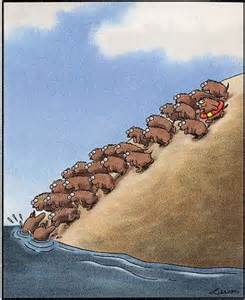
The lemming with the lifesaver will beat out the other lemmings in the selection process. Darwin knew nothing about genetics when he formulated his theory of evolution by means of natural selection. Darwin also wrote about the expression of emotion in man and animals, speculating whether or not behaviors are heritable and selected for. Is a particular behavior critical for reproductive success or not? Dr Maia showed us a video of the mating dance of the greater bird of paradise (Paradisaea apoda) from the Cornell Ornithology Lab's Birds of Paradise website:
Dr Maia quipped that sex and death are the only things that matter in evolution- reproducing is more important than survival itself. Why do most multicellular organisms have sex, why don't they just clone replicas of themselves? There are benefits to sex, advantages to gene mixing, such as disease resistance. Why are their two sexes, why not ten? There are two problems which must be solved by gametes- mobility and nutrition. Gametes need to move and they need to nurture developing offspring. If all gametes were identical, they would not be able to solve these two problems optimally. Thus, there are two types of gametes- tiny ones adept at moving (sperm) and large ones good at nurturing (ova). Occupying the middle ground is not so advantageous. Metabolically, sperm are cheap to produce but ova are expensive to produce. On the most basic level, the one thing which defines whether an individual is male or female is whether it produces small gametes or big gametes.
One aspect of natural selection is sexual selection, the ability of an organism to successfully reproduce with a mate. Females produce big gametes, which are expensive to produce, so they produce fewer gametes than males do and typically seek fewer mates. Males produce a lot of cheap gametes, so they tend to mate with more partners than females do. For females, sexual selection is weak- there is little variation in reproductive success. Males undergo strong sexual selection, they must mate often for reproductive success. It benefits females to be choosy, while it benefits males to go for quantity. Males tend to have more variation in looks as well as in reproductive success.
In the case of the long-tailed widowbird (Euplectes progne), females tend to prefer males with long tails. Such sexual selection can lead to exaggerated traits- in one study, certain male widowbirds had their tails shortened and others had their tails lengthened with extensions (PDF), with differences in reproductive success resulting.
In the case of Arizona house finches, females prefer to males whose plumage exhibits a greater degree of carotenoids. Carotenoids are derived from the diet and are an important anti-oxidant, put putting pigments in feathers is a luxury- excess pigment is a sign of better health, and most likely better genes.
Dr Maia then showed us a video of the mating dance of the blue manakin (Chiroxiphia caudata), which engages in a competitive group pre-mating behavior known as lekking:
Typically, one alpha male gets to mate with the female, the other males acting as 'wingmen'. The younger, less dominant males learn how to perform the mating dance by observing the alpha male in a joint reproductive effort.
Dr Maia joked that sexual selection among birds can produce crazy behavioral traits and crazy morphological traits, then showed us a video of a club-winged manakin (Machaeropterus deliciosus) beating its wings together over one-hundred times a minute to produce a sexually appealing stridulation:
One of the pitfalls of the traditional view of sexual selection is that it tends to 'erase' the female story, something alluded to in Sarah B. Hrdy's The Woman that Never Evolved, which opens with the sentence, "Biology, it is sometimes thought, has worked against women." While females were often dismissed as passive and ignored in studies of evolution, female behaviors are important in evolutionary success. Most bird species, about ninety percent, are monogamous. In most cases, they are sequentially monogamous, they form pair bonds for a breeding season, but mating for life is not the norm. In contrast, about three percent of mammal species are monogamous. It is thought that monogamy in birds may be due to low variation in sexual selection- males and females have similar selection pressures, even though males tend to be more ornamented than females. Even though monogamy is the norm, extra-pair paternity is found in seventy-five percent of bird species. Extra-pair young are found in about one in five nests, about ten to twenty percent of offspring are merely social offspring, not biological offspring.
The Australian superb fairy-wren (Malurus cyaneus) forms monogamous social pairs (males present females with flower petals in courtship), but both males and females engage in extra-pair copulation. In the case of these birds, females don't necessarily go for the most attractive males, but for neighboring males, favoring early risers (Mr Right-now is preferred to Mr Right). Dr Maia joked that, among fairy-wrens, it's better to be ugly than to be isolated.
Dr Maia noted that there are non-binary sex roles among birds. Among the lek-breeding European ruffs, males fall into three phenotypes- the showy, dominant territorial males which attempt to court multiple females, the less dominant satellite males who opportunistically mate with females while the territorial males are distracted, and the female-mimicking faeder males, which will sneakily mate with females right under the beaks of other males. Among white-throated sparrows (Zonotrichia albicollis), there are two phenotypes, white-striped and tan-striped. Both males and females can be of either morphology. The white form tends to be more aggressive, the tan form exhibits more parental care- most pair bonds are cross-morphology... opposites attract in this case.
There are even birds which exhibit a sex-role reversal, the wattled jacacna (Jacana jacana) being a prime example. Female jacanas are larger than males, have bigger wattles, and tend to be more aggressive. Females are polyandrous, mating with multiple males- they produce a lot of eggs which the males will incubate. Females will even break other females' eggs and mate with the the bereaved fathers. Jacanas inhabit a tough environment, one in which the loss of eggs to predation approaches ninety-percent. For female jacanas, the eggs are not that expensive, and the males do the work of nurturing. Dr Maia stressed that it is not a good deal to overgeneralize when discussing reproductive roles.
Dr Maia then veered into the 'JUST PLAIN NASTY' aspects of bird reproduction. This involves ducks, so here's a huge TRIGGER WARNING for anyone who wishes to avoid discussions of violent, outré sexuality. Male ducks will attack females, often nearly drowning them in order to prevent them from escaping. Male ducks will copulate with other male ducks, even dead ones. Male ducks, unlike most birds, which merely engage in cloaca-to-cloaca sperm transfer, have evolved elaborate 'penes' WARNING: CANNOT UNSEE FOLLOWING VIDEO:
Females have evolved twisty countermeasures to thwart forced insemination.
There is an immense diversity of morphology and behavior, which Dr Maia cited as the overarching basis of his research. He then presented us with a video of a blue-black grassquit's (Volatinia jacarina) leaping display:
The male grassquit defends a small territory, and its leaping displays showcase the color of its plumage.
While humans have three types of cone cells, resulting in trichromatic vision, birds have a fourth type of cone cell that allows them to see into the ultraviolet. Often, the males will have plumage which reflects UV light in order to attract females.
Dr Maia then shifted the topic of his lecture to the ways by which bird plumage derives its colors. Generally speaking, brown and red plumage results from pigments while green and blue plumage results from structural elements which reflect colors. The brown pigments in feathers results from the pigment melanin, which is collected in structures known as melanosomes. The reddish pheomelanin and the brown and black eumelanins form in differently-shaped organelles, which allows paleontologists to make educated guesses about the colors of dinosaur plumage using microscopy. In one dramatic case, paleontologists were able to determine that Anchiornis huxleyi probably had black and white plumage with a reddish crest. Ornamentation preceded flight, with complex plume patterns probably being the norm among dinosaurs. Yellow, orange, and red pigments are due to pigments known as carotenoids. Pigments result in a limited palette, which is insufficient to explain the variety of bird coloration.
The palette of bird colors is vastly expanded by structural colors. There are no known blue pigments, and very few green pigments used by animals. Structural colors result from the reflection of light- Dr Maia likened this effect to the iridescence of soap bubbles. The structure of a feather is complex, with differing pigment layers which absorb, reflect, and refract light. Some wavelengths cancel each other out, some reinforce each other. An expert can predict the structural factors which will result in particular colors. In birds, the brightest colors tend to be structural, as Dr Maia illustrated with this amazing video of a male Costa's hummingbird (Calypte costae) trying to impress a female with his iridescent mantle:
Iridescence is directional, it depends on the angle at which the light hits. Structural elements in the feathers of the dinosaur Microraptor gui reveal that the dinosaur had dark iridescent plumage due to the way in which its melanosomes were layered.
Dr Maia then ticked off some of the benefits of studying structural color in bird plumage, such as a new kind of mirrorless laser, improvements in fiber optics, improved camouflage, even better cosmetics.
There are different types of melanosome arrangements, with flat melanosomes producing less light absorption, hollow melanosomes have a major impact on iridescence, and a combination of flat and hollow melanosomes adding to the color palette. Dr Maia cited the African starlings as having a wide array of melanosome arrangements and the resultant optical complexity. The different color palettes among the starlings, derived from different melanosome morphologies, drive faster speciation and greater diversity.
The lecture was followed by a Q&A session, in which I was beaten to the punch by a gentleman who inquired about brood parasites such as cuckoos and cowbirds... how do they fool their victims? Dr Maia hypothesized that the calls of baby birds are probably similar enough that the adults don't figure out that something is wrong. Some bastard in the audience asked specifically about the hypothesis that ornamentation was correlated with lower parasite counts. Dr Maia reiterated that ornamentation was generally a good indicator of health and good genes, followed by a brief overview of the handicap hypothesis.
All told, this was another fantastic lecture, a feather in the cap of the Secret Science Club. My main interests lie in biology and the study of evolution, so this lecture hit the 'Secret Science Sweet Spot' for me- it was a great overview of bird reproductive strategies and the anatomy of feathers, illustrated by incredible video footage. I'm a bird nerd, and a dino nerd, so Dr Maia knocked it out of the park in my estimation. Kudos to Dr Maia, Margaret and Dorian, and the staff of the beautiful Bell House.
Subscribe to:
Posts (Atom)


