Yesterday's post was about a self-taught 'engineer' conducting an experiment in an attempt to prove a pseudoscientific thesis... it was nice to see him using empiricism in his quest for knowledge, though his efforts... uhhhh... fell flat. Today, I am more interested in real science- the CERN crew has been able to create and maintain antimatter for up to twenty-four hours.
One of the mysteries of the universe is the prevalence of matter- if the Big Bang had produced equal amounts of matter and antimatter, the opposite-charged particles would have annihilated each other, resulting in No Universe At All. A small asymmetry at the beginning would have resulted in the current mass (heh heh) asymmetry. It's all very heady stuff, but suffice it to say that real discoveries are being made, and nobody has to plaster themselves onto the desert floor to make them.
Antimatter has come up in a few of the Secret Science Club lectures I have recapped. I imagine it will become a more common subject as physicists better learn how to create and maintain the stuff, even if it really wouldn't be so good for power generation.
Showing posts sorted by relevance for query antimatter. Sort by date Show all posts
Showing posts sorted by relevance for query antimatter. Sort by date Show all posts
Sunday, February 23, 2020


Tuesday, January 30, 2018
Secret Science Club North Post Lecture Recap: A Glorious Ignorance
Last night, I headed down to the scintillating Symphony Space on Manhattan's Upper West Side, for the latest Secret Science Club North presentation, featuring particle physicist Dr Daniel Whiteson of the University of California at Irvine and CERN, teaming up with Dr Jorge Cham, recovering robotics researcher and the genius behind the Piled Higher and Deeper comic. Drs Cham and Whiteson have a new book, We Have No Idea: A Guide to the Unknown Universe. Their presentation concerned the topic of the book and was a celebration of a certain type of ignorance- that ignorance which inspires inquiry, that ignorance which seeks to remedy itself with discovery.
The good doctors first decided to combine their talents a few years back when Dr Whiteson approached Dr Cham to ask if he did commissioned work. They combined forces and produced a video which has been described as the best explanation of the search for the Higgs boson for the layperson:
The video was a distillation of eight hours of conversation between Dr Cham and Dr Whiteson, a brilliant 'editing' job on the part of Dr Cham combined with his charming cartoon art.
The presentation was lovely, a casual tour through millennia of inquiry with a recap of the current state of particle physics. I pretty much just sat back and enjoyed the lecture, which had Dr Whiteson lecturing in front of a screen displaying Dr Cham's art, with Dr Cham improvising comical additions to the background. As such, I figure that the best way to recap the lecture is to present a video of it (seeing as Dr Cham's drawings are an integral part of the program):
I had a lot of fun- the interplay of Drs Whiteson and Cham was funny, and they quickly imparted a fantastic overview of the state of physics to an audience ranging in age from grammar school children to senior citizens, from second graders to PhDs. The talk covered such topics as dark matter and dark energy and particle physics. There were some hilarious moments, such as Dr Whiteson's observation that, even as a kid, he was one to smash rocks together to see what they were made of, and Dr Cham's characterization of his life as a grad student as reminiscent of a video he made of a cockroach-modelling robot on a treadmill occasionally getting smacked by an offscreen aggressor. There was a brief Q&A session afterwards, during which the bastard asked about antimatter, and possible reasons why it is in such short supply compared to regular matter- Dr Whiteson indicated that it is unknown whether there was a higher proportion of matter from the beginning of the universe, and that there might actually be entire sectors of the universe that are composed of antimatter, joking that the residents of such an area would call it matter. There were a lot of questions about dark matter- could it even be considered made of 'particles', is there a fifth force which determines how it interacts with the universe?
The night was a love-fest, I have to note that, in particular, Dr Cham is held in esteem and affection by the world's grad students... my friend Dr Garnier noted that Dr Cham's cartoons are ubiquitous in university offices worldwide. At any rate, the presentation was fun and informative, and I do not hesitate in plugging Dr Cham's and Dr Whiteson's book.
Friday, April 5, 2013
A Glimmer of Light Shed on Dark Matter?
Perhaps the most exciting news this week was the detection of a plethora of positrons in the cosmic ray flux that may be due to the annihilation of dark matter. The positrons (the antimatter equivalent of the humble electron) were detected in the particle streams of the cosmic rays by the international Alpha Magnetic Spectrometer installed on the International Space Station.
In January, I attended a lecture on dark matter, which I posted a recap of. Dark matter is "adjacent" to regular matter, but only interacts with it gravitationally- it is not detectable on the electromagnetic spectrum. There are some theoretical models for dark matter, using such whimsical terms as WIMPs and MACHOs and axions, but nothing substantial is known about the nature of dark matter. Hopefully, the discovery of a stream of positrons amid the general particle flow of the universe represents a glimmer of light shed on dark matter. If this heralds a New Dark Age (hat tip to Smut Clyde, it will be a glorious one.
Postscript: While these results from the International Space Station and CERN represent the best of humanity, international cooperation in the name of scientific inquiry and the furtherance of human knowledge, I have a sinking feeling that more money will be spent dealing with the bellicose posturing of a schlubby schmuck with a bad haircut than was spent on this project.
Wednesday, November 25, 2015
Secret Science Club Post Lecture Recap: Smashing!
On Monday night, I headed down to the beautiful Bell House, in the Gowanus section of Brooklyn, for this month's Secret Science Club lecture, featuring physicist Dr Kyle Cranmer of NYU's Center for Cosmology and Particle Physics and NYU's Center for Data Science. Dr Cranmer was a member of the Large Hadron Collider team which discovered the Higgs boson.
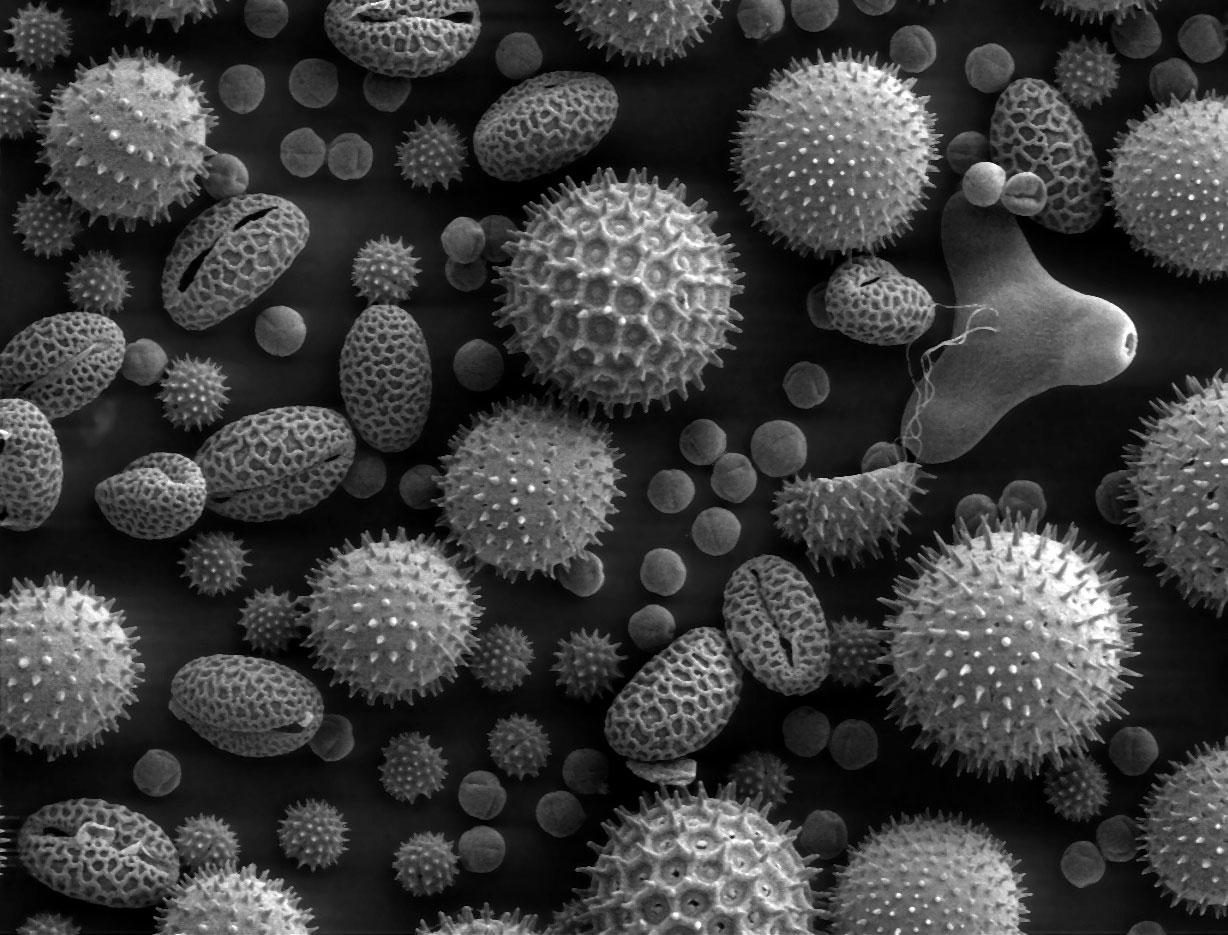
Dr Cranmer began his lecture by displaying an image of a snowflake, which he prized for its beauty and symmetry. While noting that symmetry is not often observed in 'normal' life, as things get smaller, symmetry becomes more common- objects (at this stage, he displayed a scanning electron microscope image of pollen) become more austere, cleaner, more symmetrical. The fundamental particle that makes up 'normal' matter is the atom- each atom is composed of electrons and a nucleus that is made of protons and neutrons, which are made out of quarks, both up quarks and down quarks. Electrons belong to a class of particles known as leptons. Dr Cranmer drolly noted, "Everything you touch is made out of down quarks, up quarks, and electrons.
He then displayed the 'classic' image of an atom, and noted that electrons don't orbit the nucleus of an atom like planets orbit around their sun- a better model for their movement is a cloud probability model. He then displayed a gorgeous image of the hydrogen wave function:

The talk then shifted to the subject of the four fundamental forces of nature... Electromagnetic force, the interaction between magnetism and positive and negative charges- opposite charges attract and same charges repel. The strong force, which holds identically charged protons together in the nucleus of the atom, is stronger than electromagnetic force. The weak force is involved in the interaction between quarks and leptons. Gravity is an attraction between and among masses. Dr Cranmer also delved briefly into Einstein's Theory of General Relativity, mentioning the central importance of an equation:

The universe can be broken down into four forces, one equation, and twelve particles:

One problem that was encountered early on in particle physics is that the equations only worked if the fundamental particles were massless, though it was known that the particles had mass. Physicist Peter Higgs theorized that there was an energy field that permeates the universe (the Higgs field) which every particle 'feels'- different particles are effected in different ways, particles which interact strongly have a lot of mass while particles which are hardly effect have little mass. Dr Cranmer illustrated this principle with a cartoon. The interaction of the particles with the Higgs field gain inertial mass.
Why do particles interact differently with the Higgs field? Fundamental particles can act as waves, the most commonly known example of this being light waves, which are composed of photons. Peter Higgs proposed that there was a particle manifestation of the field, which was dubbed the Higgs boson. In order to test this theory, and to discover whether or not there was a Higgs boson, the biggest particle accelerator in the world was needed. CERN, the European Organization for Nuclear Research, has as its centerpiece a 17 mile long particle accelerator three-hundred feet below ground spanning the Swiss-French border. The ATLAS detectors measure the paths, momentum, and energy of particles, allowing identification to be made. The CMS detector uses a solenoid magnet to bend the paths of particles. Among the gorgeous visuals Dr Cranmer presented was a picture of beautiful transparent lead tungstate.
In the particle accelerator, particles collide and 'lots of stuff' flies off and interacts with the various sensors. Interesting particles show up at the point of collision and decay immediately. The energy of the particle beam, which is steered by electromagnets, rivals that produced by a jumbo jet- it's sufficient to melt copper. Dr Cranmer dryly noted, "You don't want to put your hand in there." Mass and energy being equivalent, new particles are created in collisions. While this occurs rarely, there are forty-million collisions per second. In the quadrillions of collisions which have occurred in the LHC, a few Higgs bosons have been detected. Dr Cranmer compared the search to painting one thousand grains of sand red and then putting them in an Olympic-sized swimming pull filled with sand and then trying to find the red ones. The Higgs boson quickly decays, often into two Z bosons which decay into four leptons. After a statistical 'spike' in the CMS data suggested the existence of the Higgs boson, the discovery of the Higgs was announced on 7/4/2012. In 2013, Peter Higgs and Belgian physicist François Englert won the Nobel Prize in Physics. Dr Cranmer quipped that it's hard to overstate the importance of the discovery of the Higgs boson, but it is possible. He then presented us with a diagram of the standard model of particle physics originally done by David Kaplan- from Dr Cranmer's blog:

The model is self-consistent, but Dr Cranmer noted that there is a problem with the "complete theory of everything", namely it looks like we're done. He then posed the question, "Where do we go now?" His answer, we go from small to large, from the subatomic level to the macro level. He then showed a familiar picture, an image of a galaxy cluster characterized by distorted images caused by light being bent by mass... gravitational lensing. The amount of bending allows us to measure the mass which is causing the bending, and there is a lot more mass than is present in the stars alone. The existence of dark matter can be inferred by its gravitational effects. There is evidence that dark matter forms a 'cosmic web', a scaffolding for the universe in which galaxies and clusters are seeded. Dark matter is not part of the standard model of particle physics.
After the Big Bang, there was a period of inflation, in which the young universe was a hot 'soup' of quarks and gluons. This young, hot, soupy universe was opaque- when it cooled down, atoms began to form and the universe became transparent- this occurred at approximately 13.7 billion years ago as evidenced by cosmic microwave background radiation. Currently, the universe is composed of about 26.8% dark matter, 4.9% 'mundane' matter, and 68.3% dark energy. While telescopes like the Hubble can look farther out and farther back in time, the Primordial Era of the hot, dense, opaque early universe cannot be observed. The LHC probes what the universe was like under those conditions, and the search is on for dark matter, supersymmetry, and extra dimensions.
Dr Cranmer then asked, can we trust extrapolations from the earthly observations to the universe at large? Out conceptual framework is derived from the Theory of General Relativity, Quantum Mechanics, and Field Theory... a combination that can be called 'Relativistic Quantum Field Theory'. Relativity describes the symmetry of space and time. Field theory describes how fields interact with matter. Quantum mechanics describe the wave/particle duality- particles can act as waves, light waves are composed of photons, the Higgs boson is a particle which acts as a wave field.
Dr Cranmer then went on a digression about antimatter- if there are particles, there should be antiparticles. Similarly, if the supersymmetry theory of space and time is correct, there should be superparticles- in theory, one of these 'sparticles' has the properties of dark matter.
The success of the Relativistic Quantum Field Theory is related to spin- particles have spin, which receives a quantum correction- the quantum corrections are expressed in Feynman diagrams. Dr Cranmer described the success of experiments in quantum corrections as 'hitting a hole in one from New York to China. The Higgs boson also receives quantum corrections- corrections which are a quadrillion times the mass of the boson- this is known as the naturalness problem. Questions remain: Why is the Higgs boson so small? Are we missing something? What is the energy scale at which the problem occurs? This renormalization process is akin to adjusting for inflation? The underlying principle to balance the "budget" is supersymmetry- for every boson there's a fermion.
The next question Dr Cranmer posed was, "Does the Higgs boson spell the death of the universe?" The stability of the universe correlates to the ratio of the top mass of the universe and the mass of the Higgs:

As the mass of the universe and the mass of the Higgs increase, the universe could enter a different state, perhaps a state in which atoms cannot exist. The timeframe of this is probably 'kajillions' of years, but it could happen tomorrow. It's possible that this change could result in a 'bubble' universe branching off. It's possible that there is a series of nested universes popping off, a multiverse in which different pockets are connected, but conditions could be radically different. The naturalness problem could be explained by different conditions in different 'pockets'- we can only observe universes which can support life, the anthropic principle. While a lot of physicists are displeased with this model, it's not necessarily wrong. Dr Cranmer likened this to Kepler's nested platonic solids model of the solar system, while it wasn't correct, it wasn't necessarily dumb according to the standards of Kepler's time.
Dr Cranmer ended the LHC portion of the talk by likening CERN's experiments to a menu, with the Higgs boson being an appetizer and Supersymmetry with Dark Matter or Extra Dimensions with Black Holes being the main course. He then briefly touched on extremely energetic particles from space (jokingly referred to as the "Oh My God!" particle) detected by the Fly's Eye Detector. The source of these superenergetic particles can't be too far away, but it is a mystery. In the fluxes of cosmic rays, one of these particles, which typically have the energy of a fastball, per billion square kilometers may hit the earth's surface in a year. The Pierre Auger detector is designed to detect these ultrahigh energy particles. Dr Cranmer then noted that apps could be developed so that every cell phone could be a particle detector, one such app is CRAYFIS.
In the Q&A, the topic of the different interactions with the Higgs field came up- the reason for this is unknown, but there are lots of theories. Some bastard in the audience asked about the implications of the LHC experimental results for quantum entanglement, the so-called 'spooky action at a distance'. When a particle decays, two particles 'fly off', but the angular momentum is conserved. Measuring one of the particles, one can know the state of the other. This doesn't impact the results in the LHC- it's a subtle effect, but it's real. It doesn't drastically change what the particles do, though. Dr Cranmer then riffed on this by mentioning the Black Hole Information Paradox- if something falls into a black hole, what happens to the 'information' that results from its entanglement with another particle? Also in the Q&A, Dr Cranmer talked about the role of dark energy in the expansion of the universe- dark energy 'makes matter allergic to itself'.
Once again, the Secret Science Club dished out another fantastic lecture- kudos to Dr Cranmer, Dorian and Margaret, and the staff of the beautiful Bell House. Here's a special pre-Thanksgiving thanks to everyone.
Subscribe to:
Posts (Atom)