So, in the latest epic thread at Central Snark, a tired Ned wrote:
How has my day been? I read
People say that Murray Lightburn sounds a lot like Morrissey
as “People say that Foghorn Leghorn sounds a lot like Morrissey” and found myself nodding.
While Foghorn never sang for the Smiths, one may get somewhat of an approximation by listening to Mojo Nixon's version of Girlfriend in a Coma:
For the record, my favorite Mojo Nixon (and Skid Roper) tune is the original version of Jesus at McDonald's. My favorite line, "They weren't the kind of couches you want to sit on, they were the kind of couches you want to sleep on."
Oddly enough, while Googling "Foghorn Leghorn" & "Morissey", I found this video, which has nothing to do with Foghorn, Mojo, or Stephen Patrick.
Monday, January 31, 2011


Saturday, January 29, 2011
Storks, Not Orcs!
So, it seems that the little hobbitses of Flores Island had to deal with very large storks as well as Komodo Dragons. The science blogger Laelaps has a post about the storks of Flores, and riffs on Island effect, and the sensationalist accounts in the popular press (with our need for monsters to tantalize our imaginations).
Oddly enough, classical Greek sources describe wars between Pygmies and cranes... who knew what Homer could have known when he composed the Iliad?

Speaking of hobbitses, and islands inhabited by huge, flightless birds, the slayer of things that suck issued a challenge at Snark Central to write a poem about a certain "fat hobbit-hugging bastard":
There is a guy whose medium's film,
From a strange Antipodean land.
Whining that his profit margins kill'm.
And the labour costs are out of hand.
The Queen, being rich, done made him a knight,
But the working folk think he's a dastard.
Yet beard-boy still says the money is tight,
The fat, hobbit-hugging bastard.
Oddly enough, classical Greek sources describe wars between Pygmies and cranes... who knew what Homer could have known when he composed the Iliad?

Speaking of hobbitses, and islands inhabited by huge, flightless birds, the slayer of things that suck issued a challenge at Snark Central to write a poem about a certain "fat hobbit-hugging bastard":
There is a guy whose medium's film,
From a strange Antipodean land.
Whining that his profit margins kill'm.
And the labour costs are out of hand.
The Queen, being rich, done made him a knight,
But the working folk think he's a dastard.
Yet beard-boy still says the money is tight,
The fat, hobbit-hugging bastard.
Friday, January 28, 2011
Gotta Put a Post Up, Preferably a Mood Enhancer
It's not like I often suffer writer's block, but today I have been preoccupied with the news from Egypt, and the nagging fear that the U.S. State Department will intervene in a spectacularly wrong-headed way. I think I need a mood enhancer... a breath of tropical warmth would do on a cold night, while the mountains of snow from yesterday's THUNDERSNOW!!!! harden into dirty gray hillocks. The song Sweet and Dandy by Toots and the Maytals never fails to raise a smile. The song, sweetly sung in patois, is a simple tale, of Ete and Johnson being gently chided for pre-wedding jitters by their families. A truncated version of the song was featured in the movie The Harder They Come. I'm embedding a version with the intro:
My favorite thing about the song is its theme of ordinary people living life well, even though they're not wealthy. I remember talking to the server at a local coffee shop about music, and he ended up playing this on the stereo four times in a row. Luckily, the place wasn't crowded, because our singing along with the disc would have driven away the other customers.
Thursday, January 27, 2011
A Night of Music After the Big Dig-Out
Tonight, at the Slane Public House in Greenwich Village, friend of the bastard and all-around great guy Shane Murphy will be celebrating the release of his new CD, Open Hearth. Anyone in the vicinity of Bleecker and MacDougal Streets would be well advised to give Shane an ear. As an added inducement, the flagship of the Mamoun's Falafel Restaurant empire is right down the street from Slane's.
Without further ado, here's Shane's rendition of the Basque song Txoria Txori:
I have to take a moment to say, in all seriousness, that I am fortunate to know so many really talented, awesome people- if I weren't so lazy about labeling my posts, the "Friend of the Bastard" tag would be a sure indicator of some high-quality entertainment.
Without further ado, here's Shane's rendition of the Basque song Txoria Txori:
I have to take a moment to say, in all seriousness, that I am fortunate to know so many really talented, awesome people- if I weren't so lazy about labeling my posts, the "Friend of the Bastard" tag would be a sure indicator of some high-quality entertainment.
Tuesday, January 25, 2011
Exhuming a Local Legend?
Today, the local CBS affiliate ran a story about a local controversy, the proposed exhumation of local legend, the Leatherman- no, not the one you were thinking of!
The Leatherman was a traveling man who wandered a 365 mile circuit (bounded on the west by the Hudson river, on the east by the Connecticut River) which he typically completed every 34 days. While he was a taciturn, solitary man, he accepted handouts of food and tobacco from individuals along his route. He typically took shelter in caves (I've been in the one at Ward Pound Ridge Reservation, and I always get goosebumps contemplating the smoke-darkened rock walls, and thinking "Somebody lived here).
The Leatherman wore an eccentric wardrobe pieced together from scraps of leather, the ensemble weighing approximately sixty pounds. The identity of the Leatherman was never known, but he was thought to be French, having a French prayer book in his possession at the time of his death. The most popular legend, purely based on speculation, was that he was Jules Bourglay of Lyons, a man who had married a girl above his class, the daughter of a prosperous leather merchant. This legend avers that he bought a stock of leather on speculation right before the price plummeted due to a new manufacturing process, and ruined his father-in-law's business. Disowned by his in-laws, Bourglay was supposed to have sailed to America, and began his solitary, penitent itinerary.
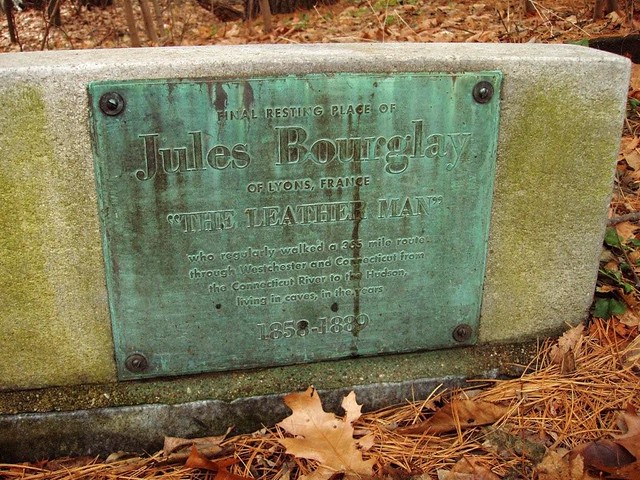
While a spectacular story of financial ruination, lost love, and remorseful rambling makes for a great legend, the truth behind the Leatherman's identity is not known, even though the plaque on his grave in Ossining's Sparta Cemetery bears the name Jules Bourglay.
The plans to exhume his body from the pauper's grave and run some forensic tests on his remains before reburying him in a more suitable spot have, understandably, met with opposition. I am of the opinion that any attempt to increase our knowledge about this fascinating local legend is worthwhile, and trust that the archaeologists who will handle the exhumation will handle the mortal remains in as dignified a matter as possible. I understand the romantic impulse which inspires those who wish to have the Leatherman left alone, but I confess to being a hardnose about these issues.
The most famous picture of the Leatherman gives a nice, detailed view of his eccentric raiment:

The Leatherman was a traveling man who wandered a 365 mile circuit (bounded on the west by the Hudson river, on the east by the Connecticut River) which he typically completed every 34 days. While he was a taciturn, solitary man, he accepted handouts of food and tobacco from individuals along his route. He typically took shelter in caves (I've been in the one at Ward Pound Ridge Reservation, and I always get goosebumps contemplating the smoke-darkened rock walls, and thinking "Somebody lived here).
The Leatherman wore an eccentric wardrobe pieced together from scraps of leather, the ensemble weighing approximately sixty pounds. The identity of the Leatherman was never known, but he was thought to be French, having a French prayer book in his possession at the time of his death. The most popular legend, purely based on speculation, was that he was Jules Bourglay of Lyons, a man who had married a girl above his class, the daughter of a prosperous leather merchant. This legend avers that he bought a stock of leather on speculation right before the price plummeted due to a new manufacturing process, and ruined his father-in-law's business. Disowned by his in-laws, Bourglay was supposed to have sailed to America, and began his solitary, penitent itinerary.
While a spectacular story of financial ruination, lost love, and remorseful rambling makes for a great legend, the truth behind the Leatherman's identity is not known, even though the plaque on his grave in Ossining's Sparta Cemetery bears the name Jules Bourglay.
The plans to exhume his body from the pauper's grave and run some forensic tests on his remains before reburying him in a more suitable spot have, understandably, met with opposition. I am of the opinion that any attempt to increase our knowledge about this fascinating local legend is worthwhile, and trust that the archaeologists who will handle the exhumation will handle the mortal remains in as dignified a matter as possible. I understand the romantic impulse which inspires those who wish to have the Leatherman left alone, but I confess to being a hardnose about these issues.
The most famous picture of the Leatherman gives a nice, detailed view of his eccentric raiment:

Monday, January 24, 2011
Fire in the Subway, Fire on the Number One
Last Saturday was one major ass-kicking... I had to work a graveyard shift, and spent an inordinate amount of time outside in frigid conditions (I was wearing a T-shirt, a hooded sweatshirt, a flannel shirt, and a peacoat, so I was able to cope pretty well). After work, I headed down to Manhattan for my coaching gig, though I was pretty much "starchless" for most of the day, I have to confess. After the day's program was done, I got on the 1 Train so I could return to the Bronx, where my car was parked (I do not drive in Manhattan). At 137th St, the train stopped, and all of the passengers were directed to exit the train. It turns out that there was a fire on the tracks near 168th St, so no trains were running between 137th and Dyckman Ave. Yeah, there was a fire in the subway, fire on the number one. We were told that we could take the Manhattan 5 Bus to 168th St and transfer to the A Train. The buses were packed, so I ended up trudging from 137th to 168th on foot, with a large bag filled with sweaty clothes. UGH, all that because stupid evil muthers throw their litter on the tracks. When I got to 168th, the 1 Train was running again. Fuh-huh-huck, at least I had an interesting walk up Broadway. Suffice it to say, as soon as I dragged my ass through the door, I hit the wall and was asleep within minutes.
It's funny, though, I really can't complain about public transportation. These annoyances are a fairly rare occurrence, and the need to find alternatives is good for the cognitive faculties. Hell, it's not always easy living in a megalopolis, but it's never boring.
It's funny, though, I really can't complain about public transportation. These annoyances are a fairly rare occurrence, and the need to find alternatives is good for the cognitive faculties. Hell, it's not always easy living in a megalopolis, but it's never boring.
Saturday, January 22, 2011
Revenge is a Dish Best Served with a Side of Corn Dodgers
Uh, before you read this, get yourself to the bookstore and pick up a copy of Charles Portis' True Grit... better yet, pick up two or three copies, because you will want to lend the book to friends and family, and you most likely won't get it back. It's a quick read... I can wait. Good, no need to thank me.
I very rarely view films in the theater- most of the recent blockbuster movies have lacked any appeal. That being said, the siren song of a film version of a novel by one of my favorite authors, made by two of favorite filmmakers was enough to lure me into the local multiplex.
While the two film versions of True Grit are about a fourteen-year-old girl's quest to avenge the murder of her father, the novel is about an elderly woman recounting her quest to avenge the murder of her father when she was fourteen (a subtle distinction, but one which gives the novel a power that neither film can quite match).
The novel True Grit is not a Bildungsroman, the character of Mattie Ross is presented (albeit by an elderly Mattie Ross) as a fully developed individual- a hard-bargaining, stiff-necked, precocious character who pursues her goal in single-minded fashion. Throughout her journeying, her attitudes do not seem to change, although change comes to her in a very literal, gruesome fashion.
The geographic setting of the book is explicit, Mattie begins her journey at her family's land holdings in Yell County, Arkansas, near Dardanelle, traveling to Fort Smith, Arkansas, where her father was killed by a hireling, to obtain his body and to commence a manhunt for the killer, who has fled to the Choctaw Nation in the Indian Territories. The action takes place during the presidency of Rutherford B. Hayes, with the events being narrated at the time of Al Smith's presidential campaign. Much like Sergio Leone's Once Upon a Time in the West, which was released in the same year, the book concerns the transition of a lawless frontier to a settled region. In one of the book's asides, Mattie gives a short account of the Permalee boys Harold, Farrell, Carroll, and Darryl: A family of criminal trash! While Harold and Farrell are killed in the mounted affray which forms the narrative's climax, Carroll Permalee lived long enough to be put to death in the Electric Chair, and not long afterward Darryl Permalee was shot to death at the wheel of a motorcar by a bank "dick" and a constable in Mena, Arkansas.
Another major thematic element in the book is the difference between good men and bad, with Mattie's father being "the gentlest, most honorable man who ever lived" while his murderer is a coward, and trash, with a cur nature. Most of the men portrayed in the book occupy a middle ground, with deputy U.S. Marshall Rooster Cogburn, hired by Mattie to bring the killer to justice, having more in common with Sergio Leone's amoral gunmen than with the sanitized heroes of television westerns. Cogburn switches between the roles of a Falstaffian buffoon, a relentless hunter, a ruthless killer, and a protector throughout the book. Even Texas Ranger LaBoeuf, who joins Mattie and Cogburn, is motivated primarily by the prospect of a bounty on the killer's head, and, in a brutal scene, throws Mattie to the ground and thrashes her with a willow switch in order to dissuade her from joining in the manhunt (and, probably, because she has a "saucy manner").
Hanging over the action like a grisly specter is the Civil War, with the particularly bloody frontier war casting a long shadow. Cogburn is portrayed as a former member of Quantrill's Raiders, and the Lawrence Massacre is mentioned in a pointed exchange between Confederate veterans Cogburn and LaBoeuf:
"I was told in Fort Smith that you rode with Quantrill and that border gang."
Rooster made no reply.
La Boeuf said, "I have heard that they were not soldiers at all but murdering thieves."
Rooster said, "I have heard the same thing."
"I heard they murdered women and children at Lawrence, Kansas."
"I have heard that too. It is a damned lie."
"Were you there?"
"Where?"
"The Lawrence raid."
"There has been a lot of lies told about that."
"Do you deny that they shot down soldiers and civilians alike and burned the town?"
"We missed Jim Lane. What army was you in, mister?"
"I was at Shreveport first with Kirby-Smith-"
"Yes, I heard about all them departments. What side was you on?"
"I was in the Army of Northern Virginia, Cogburn, and I don't have to hang my head when I say it."
While the novel's events allow Cogburn a moment of heroic altruism, the novel is not the story of his redemption. In an attempt to follow up on him in later years, Mattie relates that he had gone north to Wyoming with a reckless character named Tom Smith where they were hired by stock owners to terrorize thieves and people called nesters and grangers. It was a sorry business, I am told, and I fear Rooster did himself no credit there in what they called the "Johnson County War." While not named in the novel, it's possible that Rooster could have been one of the heavies in Shane (veiled fanfic reference?).
True Grit is not unrelievedly grim, there are numerous humorous asides (as Mattie admits, she has a "discursive" writing style), and an absurd interlude in the middle of the manhunt. My favorite humorous passage in the book is this brilliant aside, which is side-splittingly funny:
I was sick the next day. I got up and went to breakfast but I could not eat much and my eyes and nose were running so I went back to bed. I felt very low. Mrs. Floyd wrapped a rag around my neck that was soaked in turpentine and smeared with lard. She dosed me with something called Dr. Underwood's Bile Activator. "You will pass blue water for a day or two but do not be alarmed as that is only the medicine working," she said. "It will relax you wonderfully. Grandma Turner and I bless the day we discovered it." The label on the bottle said it did not contain mercury and was commended by physicians and clergymen.
Along with the startling color effect the potion also caused me to be giddy and light-headed. I suspect now that it made use of some such ingredient as codeine or laudanum. I can remember when half the old ladies in the country were "dopeheads."
You have read the book by now, no? If you haven't, you are out of the will. If you have, read it again- you will no doubt find something incredible that you may have missed. True Grit is Charles Portis' best novel, even if it's not quite my favorite.
Oh, and about the corn dodgers? There are plenty of recipes for anyone interested in making up a batch of trail rations or "pigeons".
I very rarely view films in the theater- most of the recent blockbuster movies have lacked any appeal. That being said, the siren song of a film version of a novel by one of my favorite authors, made by two of favorite filmmakers was enough to lure me into the local multiplex.
While the two film versions of True Grit are about a fourteen-year-old girl's quest to avenge the murder of her father, the novel is about an elderly woman recounting her quest to avenge the murder of her father when she was fourteen (a subtle distinction, but one which gives the novel a power that neither film can quite match).
The novel True Grit is not a Bildungsroman, the character of Mattie Ross is presented (albeit by an elderly Mattie Ross) as a fully developed individual- a hard-bargaining, stiff-necked, precocious character who pursues her goal in single-minded fashion. Throughout her journeying, her attitudes do not seem to change, although change comes to her in a very literal, gruesome fashion.
The geographic setting of the book is explicit, Mattie begins her journey at her family's land holdings in Yell County, Arkansas, near Dardanelle, traveling to Fort Smith, Arkansas, where her father was killed by a hireling, to obtain his body and to commence a manhunt for the killer, who has fled to the Choctaw Nation in the Indian Territories. The action takes place during the presidency of Rutherford B. Hayes, with the events being narrated at the time of Al Smith's presidential campaign. Much like Sergio Leone's Once Upon a Time in the West, which was released in the same year, the book concerns the transition of a lawless frontier to a settled region. In one of the book's asides, Mattie gives a short account of the Permalee boys Harold, Farrell, Carroll, and Darryl: A family of criminal trash! While Harold and Farrell are killed in the mounted affray which forms the narrative's climax, Carroll Permalee lived long enough to be put to death in the Electric Chair, and not long afterward Darryl Permalee was shot to death at the wheel of a motorcar by a bank "dick" and a constable in Mena, Arkansas.
Another major thematic element in the book is the difference between good men and bad, with Mattie's father being "the gentlest, most honorable man who ever lived" while his murderer is a coward, and trash, with a cur nature. Most of the men portrayed in the book occupy a middle ground, with deputy U.S. Marshall Rooster Cogburn, hired by Mattie to bring the killer to justice, having more in common with Sergio Leone's amoral gunmen than with the sanitized heroes of television westerns. Cogburn switches between the roles of a Falstaffian buffoon, a relentless hunter, a ruthless killer, and a protector throughout the book. Even Texas Ranger LaBoeuf, who joins Mattie and Cogburn, is motivated primarily by the prospect of a bounty on the killer's head, and, in a brutal scene, throws Mattie to the ground and thrashes her with a willow switch in order to dissuade her from joining in the manhunt (and, probably, because she has a "saucy manner").
Hanging over the action like a grisly specter is the Civil War, with the particularly bloody frontier war casting a long shadow. Cogburn is portrayed as a former member of Quantrill's Raiders, and the Lawrence Massacre is mentioned in a pointed exchange between Confederate veterans Cogburn and LaBoeuf:
"I was told in Fort Smith that you rode with Quantrill and that border gang."
Rooster made no reply.
La Boeuf said, "I have heard that they were not soldiers at all but murdering thieves."
Rooster said, "I have heard the same thing."
"I heard they murdered women and children at Lawrence, Kansas."
"I have heard that too. It is a damned lie."
"Were you there?"
"Where?"
"The Lawrence raid."
"There has been a lot of lies told about that."
"Do you deny that they shot down soldiers and civilians alike and burned the town?"
"We missed Jim Lane. What army was you in, mister?"
"I was at Shreveport first with Kirby-Smith-"
"Yes, I heard about all them departments. What side was you on?"
"I was in the Army of Northern Virginia, Cogburn, and I don't have to hang my head when I say it."
While the novel's events allow Cogburn a moment of heroic altruism, the novel is not the story of his redemption. In an attempt to follow up on him in later years, Mattie relates that he had gone north to Wyoming with a reckless character named Tom Smith where they were hired by stock owners to terrorize thieves and people called nesters and grangers. It was a sorry business, I am told, and I fear Rooster did himself no credit there in what they called the "Johnson County War." While not named in the novel, it's possible that Rooster could have been one of the heavies in Shane (veiled fanfic reference?).
True Grit is not unrelievedly grim, there are numerous humorous asides (as Mattie admits, she has a "discursive" writing style), and an absurd interlude in the middle of the manhunt. My favorite humorous passage in the book is this brilliant aside, which is side-splittingly funny:
I was sick the next day. I got up and went to breakfast but I could not eat much and my eyes and nose were running so I went back to bed. I felt very low. Mrs. Floyd wrapped a rag around my neck that was soaked in turpentine and smeared with lard. She dosed me with something called Dr. Underwood's Bile Activator. "You will pass blue water for a day or two but do not be alarmed as that is only the medicine working," she said. "It will relax you wonderfully. Grandma Turner and I bless the day we discovered it." The label on the bottle said it did not contain mercury and was commended by physicians and clergymen.
Along with the startling color effect the potion also caused me to be giddy and light-headed. I suspect now that it made use of some such ingredient as codeine or laudanum. I can remember when half the old ladies in the country were "dopeheads."
You have read the book by now, no? If you haven't, you are out of the will. If you have, read it again- you will no doubt find something incredible that you may have missed. True Grit is Charles Portis' best novel, even if it's not quite my favorite.
Oh, and about the corn dodgers? There are plenty of recipes for anyone interested in making up a batch of trail rations or "pigeons".
Subscribe to:
Posts (Atom)