I enjoyed the Google doodle celebrating the fiftieth anniversary of the first moon landing, narrated by Michael Collins himself. The Apollo 11 mission occurred shortly after I was born, the day of my christening... family lore has it that some of the attendees were glued to their car radios in the parking lot until they were told to get in the bleepin' church already! I've written a bunch of posts about the moon- musings over the celestial body's beauty, science posts, posts about the Apollo missions themselves. I work nights, the moon literally looms over me much of the time.
That world of fifty years ago seems remote... sure, while the Apollo missions themselves were peaceful, an achievement for humanity as a whole, secondarily an achievement for Americans, the United States was involved in bombing peasants to oblivion in Southeast Asia at the time (the Mekons pointed out this contradiction). The plaque left on the moon by Neil Armstrong and Buzz Aldrin is a beautiful bit of prose, but the mission didn't herald an era of peace:
Rather than heed the Call to Adventure, the excitement of discovery, humanity's leaders decided to become bogged down in greed, fundamentalism, superstition, and tribalism. What should have become a Grand Mission for All Humanity soured, and petty, parochial concerns came to preoccupy Homo sapiens. Scientific inquiry takes a backseat to distortions of data to push corporate agendas, government policies subsidize fossil fuel extraction rather than the development of clean, renewable energy sources. Monkey trials are conducted, flat earthers push their nonsense on social media platforms. I think that, by nature, I tend to be an optimist, but the empirical evidence that has confronted me for the entirety of the twenty-first century causes me to have flashes of pessimism. I'm not the kind of person who dwells on concepts like the Fermi Paradox, but fifty years after one of humankind's most lofty achievements, it seems as if our species is slowly sliding to stagnation, and possible destruction, so that a tiny majority of the Worst Persons on the Planet can engage in an overconsumption that will eventually consume us all.
Dr Frank's talk riffed on the topic of the book- the research behind it came out of being a science writer who specializes in outreach. In the book, he wanted to address climate change denialism. An astronomer looks at what happens to planets undergoing climate change differently than a typical climate scientist. Regarding climate change, the problem can't be solved unless it is understood, and it can't be understood unless its story can be told. Anthropogenic climate change being a recent phenomenon, there is no broad story about it. The story that must be pieced together is: what is the human future on a climate-changing planet? Currently, there is an anthropogenically driven change in the planetary climate state from 'warm and moist' to an unknown state. Climate change will be accompanied by resource depletion, most dangerously, a depletion of potable water.
"Air pollution is no longer confined to isolated places. This generation has altered the composition of the atmosphere on a global scale through radioactive materials and a steady increase in carbon dioxide from the burning of fossil fuels. Entire regional airsheds, crop plant environments, and river basins are heavy with noxious materials. Motor vehicles and home heating plants, municipal dumps and factories continually hurl pollutants into the air we breathe. Each day almost 50,000 tons of unpleasant, and sometimes poisonous, sulfur dioxide are added to the atmosphere, and our automobiles produce almost 300,000 tons of other pollutants. "
Currently, climate change denialism is another aspect of our political polarization.
In 2000 publication, Paul Crutzen and Eugene Stoermer coined the term Anthropocene (PDF) to describe the current geological epoch in which human activity is a fundamental driver of coupled Earth systems. Humans are altering the planet to the extent that researchers a million or two years in the future could be able to detect isotopic evidence of human activity. Humanity is pushing the levers on climate, biodiversity, the nitrogen cycle, and the phosphorous cycle. In 2009, Johan Rockström of the Stockholm Resilience Centre led an effort to describe the planetary boundaries within which humanity could thrive and to foster stability. Dr Frank described the Anthropocene with a wonderful turn of phrase: We have reached a mythic power regarding planetary change.
Dr Frank characterized his fusion of astrobiology and the Anthropocene as the 10,000 light-year view. Astrobiology is the study of life in an astronomical perspective. The difficulty in astrobiological studies is that it involves an N=1 problem because we only know of one life-bearing world. That being said, there were three revolutions in the field: the first being the discovery of exoplanets, the second being the exploration of the solar system, and the third being an exploration of Earth's distant past.
The existence of life on other planets has occupied the human imagination for millennia, with optimists and pessimists vying for public acceptance. Epicurus believed that extraterrestrial life was common while Aristotle believed that Earth is unique. Newton believed in extraterrestrial life, but by 1900, pessimism regarding life beyond Earth was ascendant. In 1995, NASA's Kepler Space Telescope detected the first concrete evidence of an exoplanet. Since then, planets have been found wholesale- almost every star has planets orbiting it, with one in five stars having planets in the Habitable Zone- that region around a star in which liquid water can exist.
The exploration of the solar system has proceeded apace, with all sorts of objects (planets, asteroids, comets) being visited. Climate is the generic status of all planets with an atmosphere, and climate models exist for the other planets of the solar system (PDF). Climate is a universal planetary phenomenon. Mars used to be a blue world, with a vast amount of liquid water. Dr Frank described its current state as hellish, a cold and nasty place, and joked 'bring your blanket!' He then noted that you can change your planet, it might not be the one you grew up on.
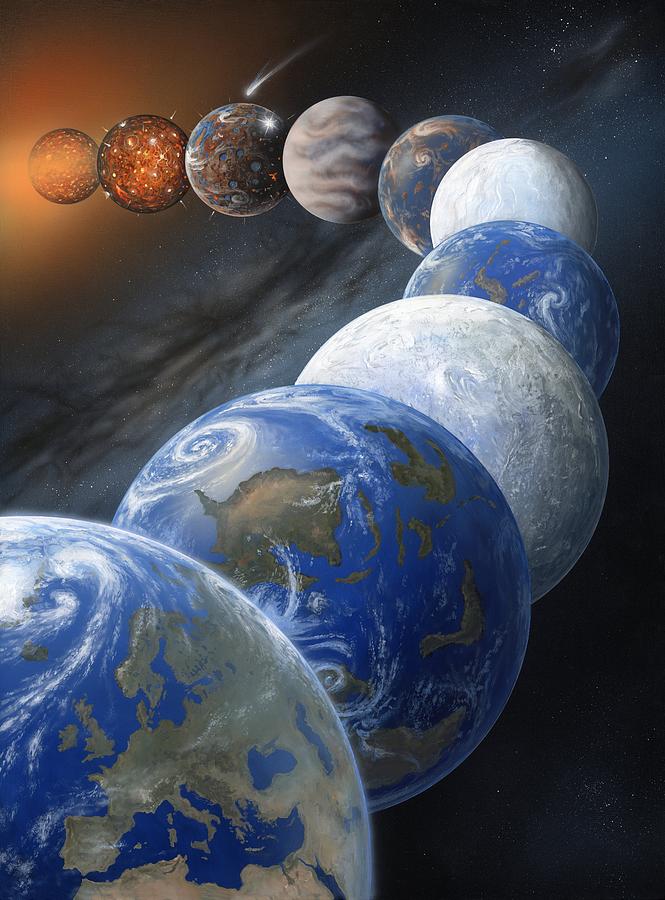
Dr Frank then showed us an image of various planets and asked us to identify them- they all turned out to be artists' conceptions of the stages of Earth's development, much like depicted in this gorgeous painting. At one stage, the Earth was molten. At another stage, before the formation of continents, the only landmasses were cratons. At another stage, it is believed that there was a Snowball Earth. During the Paleocene-Eocene Thermal Maximum, it is believed that Earth had no sea or land ice. Dr Frank quipped that the Earth has worn many masks.
The study of the Earth's past involves the study of many Earth systems: the co-evolution of the atmosphere, cryosphere, hydrosphere, geosphere, and biosphere. The Holocene, the geological epoch which encompasses our current Anthropocene, is one of many interglacial periods. AlL of human history has taken place in this epoch, approximately the last 10,000 years. Dr Frank posed the question, what would you experience if you landed on Earth three billion years ago? The answer is that you would asphyxiate because of a lack of oxygen in the atmosphere. The presence of free oxygen in the atmosphere is due to life- the Great Oxidation Event occurred when cyanobacteria 'farted out' oxygen as a waste product of photosynthesis. Life has changed the atmosphere over and over again. Successful species are numerous, but such success can lead to catastrophes- the cyanobacteria changed the atmosphere enough that it killed most of them off.
In 1979, James Lovelock and Lynn Margulis formulated the Gaia Hypothesis, the idea that the planet changes to maintain life. The hypothesis was controversial due to the notion of a teleological planet, a planet that 'wants' life, even though evolution is a blind processs. The idea of a 'living' planet led to some loopy interpretations in the public imagination, which led to some pushback, but it is undeniable that life plays an enormous role in Earth's systems dynamics. Earth and its life have been evolving together as a coupled system for a long time.
Dr Frank's research involves the study of astrobiological systems to determine if sustainable versions of our type of civilization are possible. Do industrialized civilizations like ours burn out in two hundred years? Astrobiological studies can inform us of new perspectives on our trajectory into and through the Anthropocene. How common are 'anthropocenes'? How fatal are 'anthropocenes'? What is the average lifespan of an industrial civilization? What are the characteristics of planets that survive an 'anthropocene'? Dr Frank urged us to take the prospect of exocivilizations seriously.
At this time, I will leave off the recap for now because bar trivia beckons- what good is learning while intoxicated if one cannot follow it up with showing off intellectually while intoxicated? I will finish this recap tomorrow...
By which I mean today!
Different stars have different characteristics. A star with a different spectrum from our sun would mean that photosynthesis on a planet orbiting it would differ from terrestrial photosynthesis. There are no tools in the toolbox to constrain our models focusing on the co-evolution of civilization and planetary systems. One definition of civilization involves the use of energy by intelligent lifeforms. A problem with studying astrobiology is the bad prosthetic forehead variety of science fiction- aliens provide a snicker factor. The search for extraterrestrial intelligence can be refined, as Dr Frank put it, "This is not your grandfather's SETI." Mentioning the excitement over the discovery of a possible extrasolarian megastructure, he exhorted us: "Consider the possibilities!" Within the next thirty years, we may have data relevant to the possibility of extraterrestrial life. For example, atmospheric signatures of industrial civilization include methane and CFCs.
The theoretical studies of exocivilizations involve a battle between optimists and pessimists. Astronomer Frank Drake formulated the Drake Equation, a theoretical exercise to estimate the possible number of detectable extrasolar civilizations, expressed as:
N is the number of detectable civilizations. R* is the average rate of star formation. Fp is the number of stars with planets. Ne is the number of those stars which have planets which can sustain life. Fl is the number of those planets on which life develops. Fi is the number of those planets which develop intelligent life which can produce civilizations. Fc is the number of those civilizations which have developed detectable communications technologies. L is the duration of time in which those civilizations release detectable signals.
Dr Frank posed the question: What sub-questions in the Drake Equation can be answered? Are we the only instance in cosmic evolution that intelligent life evolved? This ultra-pessimistic view would be a one in ten billion trillion chance. Even a pessimist like Ernst Mayr was ten million times more optimistic than that. Most pessimists would get a universe full of civilizations of two hundred years' duration.
Building world civilizations involves planetary feedback- 'anthropocenes' have probably happened before. We now know enough about planets and how they respond to to anthropocenes to begin how species will drive planetary feedback. Science is about constraining imagination, and the astrobiological/archaeological models are based on the predator/prey population models formulated by Lotka and Volterra:
Predator numbers tend to go up after the amount of prey increases, and crash after the prey numbers crash. Dr Frank used similar equations for population and planetary temperatures- he quipped that planets are machines, push hard enough and they go off. The models used for the equations were based on the population of Easter Island, as detailed in his May 2018 article in The Atlantic. Running multiple scenarios, he determined that there are three main results. The first is a mass die off as population exceeds the planet's carrying capacity. The second is the achievement of sustainability- a soft landing to a steady state is reached. The last is a true collapse, perhaps a runaway Venus scenario.
Dr Frank posed the question, what does the astrobiological perspective change? He joked that he is from New Jersey, so he is naturally combative, then noted that this is not a battle to save the planet- as Lynn Margulis joked: "Gaia is a tough bitch." The planet has been the scene of five known mass extinctions, and the only reason why we are here is because the non-avian dinosaurs went extinct, leaving ecological niches for our ancestors. What are we trying to sustain? What moral imperatives do we invoke to do so? Dr Frank showed the picture of the polar bear stranded on a melting ice flow and noted that it is an apex predator that would easily kill you. He then stated that humans can no longer practice ecological hooliganism. Even if humans are successful in reaching sustainability, there will be no more ice ages. Climate change poses a probably existential threat to the project of civilization, but Earth will survive even if we do not. Ecologically, the Earth's phytoplankton is more important than the charismatic megafauna usually invoked in ecological pleas.
Dr Frank urged activists to stop with the human hate- the goal should be to sustain the climatic conditions that are amenable to the project of civilization. Sustainability goals should balance a technologically advanced, energy intensive, high population with quality of life. 'Hockey Stick' diagrams won't change the narrative, stories are needed and the wrong story is 'we suck'. Cities are ecosystems just like forests, they have just been invented recently. The wrong question to ask is 'did we change climate?' The right question is 'what did we expect?' When oil was discovered, humans did not set out to change the climate, it was a mistake resulting from one particular sort of energy production. Our mistake now is to keep using fossil fuels. Climate scientist Raymond Pierrehumbert characterized climate change as 'Humanity's Final Exam'. Through right action and skillful means, we might just pass it. If we acknowledge that planets have rules, and achieve sustainability, we might create an 'awakened' planet on which the biosphere and civilization can flourish together, and the Gaia hypothesis can be realized.
The lecture was followed by a Q&A session. The first question involved mass extinctions, and Dr Frank noted that the biosphere would be happy to move on without us, and the burden falls on us to 'think like the biosphere' to benefit ourselves. Some bastard in the audience asked the good doctor for his opinion on the theoretical notion that a planet had 'one shot' to produce a high-tech civilization, because a failing civilization would 'spend all the startup capital' and impoverish any successors. Happily, Dr Frank's colleague Gavin Schmidt posed a speculative scenario in which a high tech civilization evolved millions of years before humanity. What sort of evidence would survive, say, thirty-five million years? Could climate change end one civilization and set up the cycle of fossil fuel production for the next civilization? Would a wind powered civilization be possible? What does a planet provide? What would our footprint be millions of years from now? It would be weird isotopic anomalies.
Regarding Mars, it is not Planet B. There is no way to move a mass of population and enough resources to sustain them to the red planet. Dr Frank then joked that we should 'fuck up' Mars- as we are triggering climate change, we are becoming spacefarers, and the price for climate change is the rest of the solar system.
Regarding the lifespan of technological civilizations, Dr Frank joked that, two hundred years ago, anyone traveling more than thirty miles per hour would be falling to their death.
Regarding the Fermi Paradox, Dr Frank noted that SETI funding has been slim, and that, if space were an ocean, we have only looked at at thimble. If there were aliens which could travel at approximately the speed of light, they could have disseminated throughout the galaxy in six thousand years, but if they had visited Earth, any traces would have been lost, so researchers should (shades of Arthur C. Clarke) look on the moon. I have my own theory about the Fermi Paradox.
Asked for the most effective story about climate change, Dr Frank opined that climate change shows us how powerful we are. He advised us not to bother talking to hardcore climate denialists, and noted that carbon dioxide doesn't care who you vote for.
Regarding Easter Island models, he noted that in most cases the population of the island exceeds its carrying capacity... sustainability is almost impossible. Carrying capacity studies for the planet use real climate models, with the parameters being based on energy sources. Even using wind power as a parameter, a two-degree change is expected. He noted that doctors don't only study sick people, and that many models are needed.
Asked about what technologies are needed, Dr Frank noted that we must get off fossil fuels and develop renewables. He noted that, near his Rochester campus, there are four bits of transportation infrastructure: the Erie Canal, a railroad, a highway, and an airport. Infrastructure changes, technologies change.
Dr Frank delivered a really great lecture- while much of it was speculative, it was a valuable intellectual exercise, and a call to action. I particularly dug the almost Lovecraftian evocation of vast periods of time, unburdened by Lovecraftian cosmic indifference and other less pleasant baggage. This was a superfun think piece. Kudos to Dr Frank, Dorian and Margaret, and the staff of the beautiful Bell House. Here is a video of Dr Frank discussing his new book:
Pour yourself a libation and soak in that SCIENCE!
ADDENDUM: Here is a short, sweet video featuring Dr Frank:
I periodically blog about Mars- in fact, Mars came up as a subject of last month's Secret Science Club lecture. I feel that humanity eventually needs to get it's ass together and colonize other planets, or put succinctly:
Learning more about the red planet is crucial for humanity's long-term goals, especially in light of stupid geopolitical events, which are increasingly looking like an explanation for the Fermi Paradox.
One of the great conundrums of astrophysics is the Fermi Paradox, which basically poses the question: "With the vast number of stars in the galaxy, why can't we find evidence of extraterrestrial life?"
I think this week's election pretty much answers the question... rather than seeing a progression in wisdom, technological advancement, and species unity, we've seen a regression into tribalism, hatred, fear, and anti-intellectualism. Even if Vulgarmort doesn't touch off a nuclear war, the energy policy he's probably going to enact will be overly reliant on fossil fuels, a topic I touch upon every so often. Instead of pursuing renewable energy sources, we will probably see another lost decade of climate inaction at a time when urgent action is crucial to the survival of our species.
I have a trepidation that SETI is finally going to intercept one lone, final radio signal from a distant planet: "Make Rigel-5 great again!"
The Big Bad Bald Bastard is a character played by Monsieur _______ of the City of Y______. The role of the Bastard is a handy one to play on subways, walking the streets, and in dive-bars, when being a nerdy, bookish sort is not to one's advantage.