Longtime readers of this blog will know that I am enamored of dinosaurs. I never quite grew out of that dinosaur mania that all young children gain and some of us never lose. Needless to say, I was ecstatic to hear the news that a probable fossil of a dinosaur brain was recently discovered. The fossil, thought to be that of an ornithischian dinosaur related to Iquanodon, appears to be similar to the brains of crocodilians and birds, the closest living relatives of the dinosaurs:
One seemingly odd thing about the dinosaurs is that modern birds are descended from the saurischian, or 'lizard-hipped' dinosaurs rather than the ornithischian or 'bird-hipped' dinosaurs. The bird hip of the ornithischians is thought to have a 'swept back' pubis in order to accommodate big intestines in order to cope with a vegetable diet. The maniraptoran dinosaurs, including the birds, also have backwards pointing pubic bones... if I recall correctly, this is thought to be an adaptation to improve balance.
Modern birds aren't that closely related to the Iquanodon-like dinosaur which had its brain structure preserved, so extrapolating intelligence for this dinosaur is a risky enterprise. That being said, certain birds exhibit a remarkable degree of intelligence. Meanwhile, there is plenty of evidence that dinosaurs cared for their young (in one case of tragic character assassination, Oviraptor was dubbed an 'egg thief' because a specimen was found sitting on its own nest). I personally have no doubt that dinosaurs were not the stupid, ungainly creatures that mammal supremacists deemed them to be through much of the 20th century. The dinosaurs evolved into diverse forms and held their own for hundreds of millions of years and still remain in the form of birds, they had to have something going for them to be so successful for so long.
Showing posts sorted by relevance for query dinosaurs. Sort by date Show all posts
Showing posts sorted by relevance for query dinosaurs. Sort by date Show all posts
Friday, October 28, 2016



Wednesday, January 4, 2017
Revisting 'Dinosaurs Among Us'
On Monday, I returned to the American Museum of Natural History for the last day of the Dinosaurs Among Us exhibit, which I had covered in a previous blog post. As I mentioned in that previous post, one of the centerpieces of the exhibit is a life-sized model of Yutyrannus huali, a thirty-foot long feathered tyrannosaur. There was also a cast of the fossilized skeleton of Yutyrannus, demonstrating the feather impressions.
Among the models I didn't cover in my previous post was Beipiaosaurus inexpectus, one of the unusual Therizinosaurs, herbivorous Maniraptoran dinosaurs with large foreclaws that are thought to have lived in a manner similar to that of the extinct ground sloths.
One non-dinosaur archosaur featured in the exhibit was Effigia okeeffeae, a relative of the crocodilians which, through convergent evolution, resembled the ornithomimid dinosaurs that evolved much later.
Amid the gorgeous reproductions of feathered dinosaurs, there was another interesting specimen was Jeholornis, which had the asymmetrical feathers conducive to flight.
Perhaps the most unusual dinosaur in the exhibit, represented by a small placard, was Yi qi, an oddball dinosaur from the Late Jurassic which, while feathered had membranous wings similar to those of a bat. Yi was probably a glider, and it represents a 'failed experiment' in dinosaurian flight... the fact that flight, or at least gliding, evolved in two vastly different forms in the dinosaur lineage is pretty mind-blowing.
The other displays, displaying evidence of nesting behaviors and casts of brains, didn't fail to amaze on a second visit. One pelvis of an oviraptorid dinosaur provided evidence that these dinosaurs had two oviducts, 'egg tubes', while modern birds have one:

Also, there was a life-sized model of a Velociraptor, resplendent in dove-gray feathers:

These dinosaurs were about the size of a wild turkey, and would not have served well as threats in a Spielberg movie.
This local news story gives a brief snippet of the exhibit. If it arrives in a museum near you, I would advise you to check it out, but in the interest of full disclosure, I am a huge dinosaur nerd.
Among the models I didn't cover in my previous post was Beipiaosaurus inexpectus, one of the unusual Therizinosaurs, herbivorous Maniraptoran dinosaurs with large foreclaws that are thought to have lived in a manner similar to that of the extinct ground sloths.
One non-dinosaur archosaur featured in the exhibit was Effigia okeeffeae, a relative of the crocodilians which, through convergent evolution, resembled the ornithomimid dinosaurs that evolved much later.
Amid the gorgeous reproductions of feathered dinosaurs, there was another interesting specimen was Jeholornis, which had the asymmetrical feathers conducive to flight.
Perhaps the most unusual dinosaur in the exhibit, represented by a small placard, was Yi qi, an oddball dinosaur from the Late Jurassic which, while feathered had membranous wings similar to those of a bat. Yi was probably a glider, and it represents a 'failed experiment' in dinosaurian flight... the fact that flight, or at least gliding, evolved in two vastly different forms in the dinosaur lineage is pretty mind-blowing.
The other displays, displaying evidence of nesting behaviors and casts of brains, didn't fail to amaze on a second visit. One pelvis of an oviraptorid dinosaur provided evidence that these dinosaurs had two oviducts, 'egg tubes', while modern birds have one:
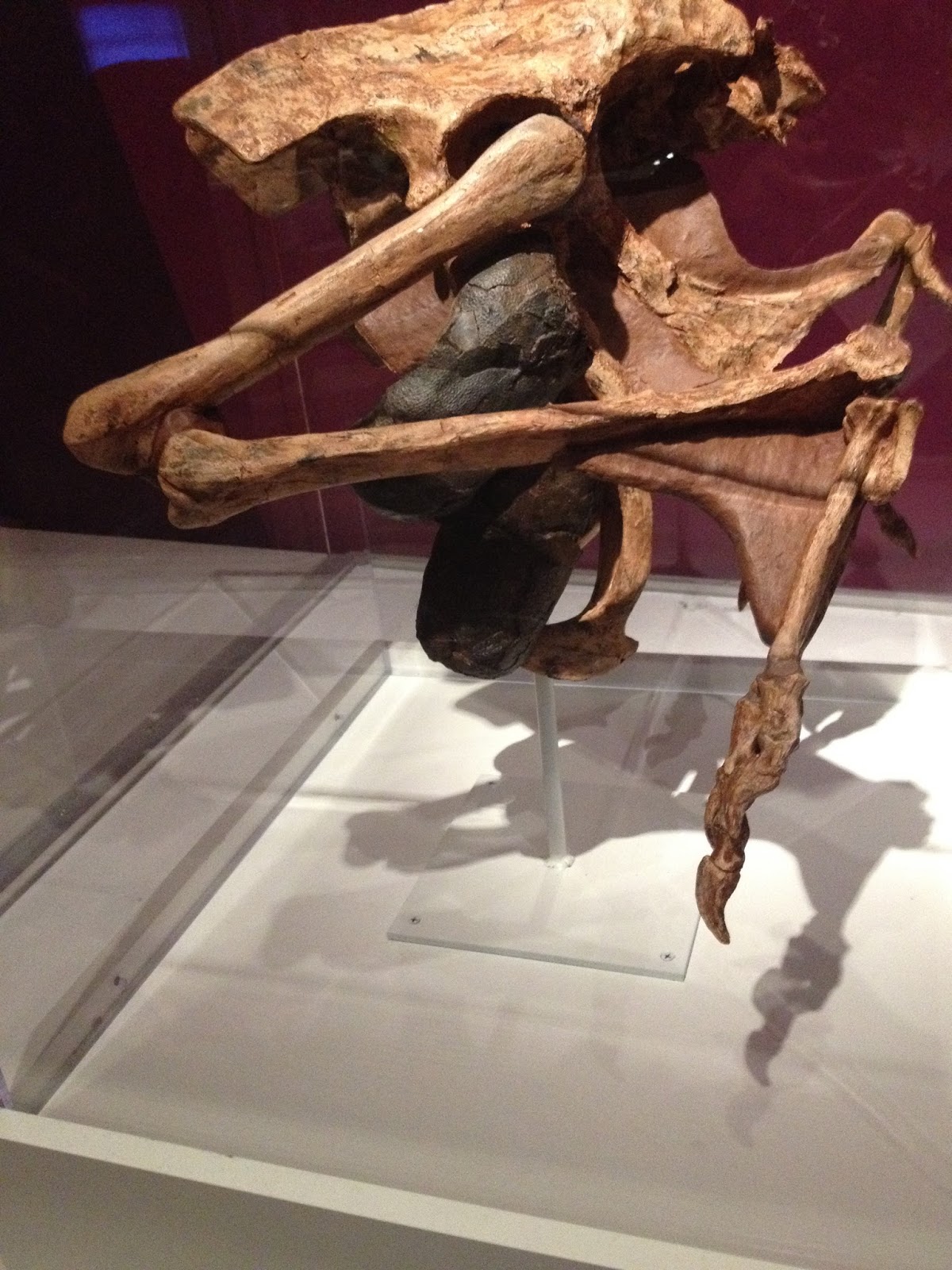
Also, there was a life-sized model of a Velociraptor, resplendent in dove-gray feathers:

These dinosaurs were about the size of a wild turkey, and would not have served well as threats in a Spielberg movie.
This local news story gives a brief snippet of the exhibit. If it arrives in a museum near you, I would advise you to check it out, but in the interest of full disclosure, I am a huge dinosaur nerd.
Sunday, August 7, 2016
The Road to Birddom
This morning, I decided to buck my lazy Sunday morning trend and meet up with some friends at the American Museum of Natural History. I hadn't seen these particular friends in a while, and I was overdue for a renewal of my museum membership. After meeting my friends, we made a beeline for the fourth floor, which houses the dinosaurs. The greatest addition to the museum is a cast of the 122 foot long fossilized skeleton of a titanosaur found so recently that it hasn't received a species name.
After touring the fossil galleries, we headed over to the special exhibition Dinosaurs Among Us, which details the evolution of modern birds from dinosaur ancestors. The exhibit featured gorgeous fossils and models of the various feathered dinosaurs on display, including modern birds.
The largest model was a quilly Yutyrannus huali, a feathered tyrannosaur approximately thirty feet long and estimated at a ton-and-a-half in weight. Tyrannosaurs belong to the Coelurosauria clade (tyrannosaurs are discussed in this Secret Science Club lecture recap). There were numerous models representing smaller feathered dinosaurs, many of them were represented in the wonderful Feathered Dinosaurs exhibit of five years ago, which recreated the environment of China's glorious Liaoning Province fossil beds. Among the mounted specimens of modern birds was a forlorn dodo, extinct ninety years after being introduced to western science.
There were interactive exhibits detailing egg-laying, nesting, and childcare among the crocodilians, dinosaurs, and birds, including casts of dinosaur eggs and embryos and a 'life sized' dinosaur nest for kids to play dinosaur parent on. Among the dinosaur remains in this area were the fossils of two ovaraptosaurs assigned to the species Khaan mckennai and nicknamed 'Sid and Nancy'.
Another feature of the exhibit was a display on the adaptations which helped dinosaurs and birds to succeed, specifically brains and lungs. There was a video of a crow using its reasoning ability to obtain food floating in a U-shaped tube. Bird lungs, derived from the lungs of their dinosaur ancestors, are more efficient than mammalian lungs, with air sacs connected to the lungs via channels running through the hollow bones.
The exhibit also featured some charming activities for kids, including a 'build a bird' simulator, in which players could choose different options (heavy body vs light body, various sized wings and breastbones) to create different animals, ranging from a velociraptor to a penguin, to a strong-flying modern bird. Players would place the various puzzle pieces in the display, then hit a button to display an animation of their creation on a screen... a modern flying bird would reward the player with a nice 'flight' display.
After a few hours spent basking in the museum, it was time to wend my way back to the Bronx, where I had parked the car, and get myself to work. It's been a long day, longer than a typical lazy Sunday, and I'll be dragging my tailfeathers tomorrow, but renewing my membership and hitting this amazing exhibit totally makes it all worthwhile. If the exhibit comes to a museum near you, I highly recommend it, but I am a huge dinosaur nerd, by which I mean a bird nerd.
After touring the fossil galleries, we headed over to the special exhibition Dinosaurs Among Us, which details the evolution of modern birds from dinosaur ancestors. The exhibit featured gorgeous fossils and models of the various feathered dinosaurs on display, including modern birds.
The largest model was a quilly Yutyrannus huali, a feathered tyrannosaur approximately thirty feet long and estimated at a ton-and-a-half in weight. Tyrannosaurs belong to the Coelurosauria clade (tyrannosaurs are discussed in this Secret Science Club lecture recap). There were numerous models representing smaller feathered dinosaurs, many of them were represented in the wonderful Feathered Dinosaurs exhibit of five years ago, which recreated the environment of China's glorious Liaoning Province fossil beds. Among the mounted specimens of modern birds was a forlorn dodo, extinct ninety years after being introduced to western science.
There were interactive exhibits detailing egg-laying, nesting, and childcare among the crocodilians, dinosaurs, and birds, including casts of dinosaur eggs and embryos and a 'life sized' dinosaur nest for kids to play dinosaur parent on. Among the dinosaur remains in this area were the fossils of two ovaraptosaurs assigned to the species Khaan mckennai and nicknamed 'Sid and Nancy'.
Another feature of the exhibit was a display on the adaptations which helped dinosaurs and birds to succeed, specifically brains and lungs. There was a video of a crow using its reasoning ability to obtain food floating in a U-shaped tube. Bird lungs, derived from the lungs of their dinosaur ancestors, are more efficient than mammalian lungs, with air sacs connected to the lungs via channels running through the hollow bones.
The exhibit also featured some charming activities for kids, including a 'build a bird' simulator, in which players could choose different options (heavy body vs light body, various sized wings and breastbones) to create different animals, ranging from a velociraptor to a penguin, to a strong-flying modern bird. Players would place the various puzzle pieces in the display, then hit a button to display an animation of their creation on a screen... a modern flying bird would reward the player with a nice 'flight' display.
After a few hours spent basking in the museum, it was time to wend my way back to the Bronx, where I had parked the car, and get myself to work. It's been a long day, longer than a typical lazy Sunday, and I'll be dragging my tailfeathers tomorrow, but renewing my membership and hitting this amazing exhibit totally makes it all worthwhile. If the exhibit comes to a museum near you, I highly recommend it, but I am a huge dinosaur nerd, by which I mean a bird nerd.
Thursday, May 12, 2022
Woke Culture is Emasculating Dinosaurs!!!
Looks like the woke crowd is at it again, this time ruining dinosaurs! In the American edition of British tabloid The Sun, some schmuck was complaining about an upcoming BBC program depicting a softer T. rex... WARNING: LINK GOES TO SUN. Sure, predatory animals don't spend all of their time killing and eating other animals, but the libs are forcing images of dinosaurs engaging in family life to ruin men.
The conspiracy runs deep, and at least one 4Chan neonazi has detected a Jewish plot in the pushing of LGBT rex:

Ah, yes, the Rootless Cosmopolitans are at it again!
Here's another Brain Genius, commenting on a Vintage Dinosaur Art Facebook page, complaining about how the libs have ruined dinosaurs by discovering fossil evidence which forced a reassessment of what these animals looked like:

This is just a selection of a longer screed which is a farrago of racism, sexism, homophobia, transphobia, fatphobia, and a stubborn refusal to read the most recent research on dinosaurs. The entire manifesto can be heard, read by the hosts of the Minion Death Cult podcast:
That's right, zaftig chicks are ruining dinosaurs, and they're in it with the queers! Being a filthy lib, I've been down with the feathered dinosaur conspiracy for well over a decade.
Wednesday, April 10, 2013
Battle of the Dinosaurs!
If I told you that I found a live-action video of a valiant mother dinosaur defending her young from couple of predatory dinosaurs, would you think I was nuts?
Well, after watching a video, courtesy of Tengrain, of baby wood ducks jumping out of a tree, I found a video of a mother mallard fighting off a couple of rapacious crows which were trying to make a meal out of her ducklings:
Of course, just as everyone knows that the burrow owl lives in a burrow in the ground, everyone knows that birds are maniraptoran dinosaurs. Now, work with me... pretend that you don't know the scale of the dinosaurs involved in this epic battle. Good, now pretend that it's a mother Edmontosaurus (ignore the fact that mamma duck is a saurischian, despite her hip shape) defending her young from a couple of tyrannosaurs. Voila! Battle of the dinosaurs!
Stephen Spielberg, eat your heart out!
Well, after watching a video, courtesy of Tengrain, of baby wood ducks jumping out of a tree, I found a video of a mother mallard fighting off a couple of rapacious crows which were trying to make a meal out of her ducklings:
Of course, just as everyone knows that the burrow owl lives in a burrow in the ground, everyone knows that birds are maniraptoran dinosaurs. Now, work with me... pretend that you don't know the scale of the dinosaurs involved in this epic battle. Good, now pretend that it's a mother Edmontosaurus (ignore the fact that mamma duck is a saurischian, despite her hip shape) defending her young from a couple of tyrannosaurs. Voila! Battle of the dinosaurs!
Stephen Spielberg, eat your heart out!
Wednesday, August 29, 2018
Secret Science Club Post-Lecture Recap: Vampire Hell Ants of the Cretaceous
Last night, I headed down to the beautiful Bell House, in the Gowanus section of Brooklyn, for this month's Secret Science Club lecture featuring paleontologist and entomologist Dr Phillip Barden of the New Jersey Institute of Technology and the American Museum of Natural History. Dr Barden specializes in the study of fossils of social insects such as termites and ants.
Dr Barden began his lecture with a short definition of paleontology. Paleontologists ask two main questions: What is the history of life on Earth? How does evolution work? Paleontologists study finite events, such as the extinction of the non-avian dinosaurs. Life on Earth is 3.7 billion years old, with humans occupying a miniscule span of time. Most life is extinct, almost everything that has ever lived is now dead. Dr Barden asked the audience to picture a fossil, immediately following this up with the admonition that not every fossil is dinosaur remains. Some of the most famous non-dinosaur fossils are trilobite and ammonite fossils. There are also environmental remains of organisms, such as footprints. His concentration is the study of fossil insects.
Eighty percent of animal species are insects, While dinosaurs, being charismatic megafauna, attract most of the public's attention, there are spectacular insect fossils, such as that of Meganeura, a dragonfly-esque creature with a wingspan attaining over two feet which hunted in the Carboniferous skies, which had a higher oxygen content than our modern atmosphere- insects breath through treachea, so the surface area of these tubes limit body size. Dr Barden also displayed a fossil of a Jurassic Era lacewing which resembled a butterfly.
The best-preserved insect fossils are encased in amber, fossilized tree resin (NOT SAP!). Resin is secreted when a tree is injured, forming 'scabs' in which organisms can be trapped. When subjected to heat and pressure through geological processes, it becomes polymerized- Dr Barden joked that amber is 'OG Plastic'. Amber, known to the ancient Greeks as 'elektros', produces electric sparks when rubbed. Insects trapped in amber are preserved in three dimensions. Dr Barden accompanied this portion of the lecture with gorgeous photographs of amber-trapped insects, such as two ants trapped in amber while fighting (evidence of a social structure).
Amber is distributed worldwide, with particularly nice Cretaceous amber being found in New Jersey. Dr Barden showed us photos of various amber sources, such as an amber deposit in a Gujarati lignite mine (the remains of a forest compacted and rendered into coal), excavated amber mines in the Dominican Republic, and Baltic amber which is typically found on beaches or 'fished' from the sea. Amber is often fashioned into jewelry, sometimes including fossilized animal remains.
Dr Barden then showed us the 'Mr DNA' clip (though not the Mr DNA you were thinking of) from Jurassic Park, noting that the stand-in for the giant prehistoric mosquito in the amber walkingstick ornament is actually a crane fly and chiding anyone who killed a harmless crane fly as a 'giant mosquito'):
Dr Barden noted that the book Jurassic Park was released in 1990, and that in 1992, it was reported that DNA was extracted from an Oligo-Miocene termite, but that this study posed a problem of reproducibility. DNA from bones has a half-life of 521 years and that new techniques for DNA extraction are constantly sought.
Dr Barden continued to display images of amber encased animal remains, such as a thumb-sized, feathered dinosaur tail found in Myanmar, a tick attached to a dinosaur feather, and an ant queen (the wings identify it as such) transporting a symbiotic mealybug in her mandibles- mealybugs excrete honeydew, which ants consume. Another fossil was that of a lacewing larva with spines for collecting camouflaging detritus. Dr Barden noted that there are about as many ant fossils as there are dinosaur fossils, but that only he and a French paleontologists are studying them- he joked that his job prospects are good. Among these fossil ants was one the size of a hummingbird.
Dr Barden stated that the oldest ants were not like was expected- early ants were thought to be wasplike, having similar body plans. The oldest ants discovered were more like basal Hymenoptera than wasps, with the similarities in body resulting from adaptive radiation.
Dr Barden conducted 3D imaging of ant fossils at the Advanced Photon Source at Argonne National Laboratory, fluorescing specimens while rotating them to provide the three-dimensional images. He joked that he was the guy putting bugs in the machine. As a comedic aside, he displayed a stupid tweet by a Kardashian: Do ants have dicks? He then displayed a photo of a drone ant fossilized in amber, then zoomed in, showing us a dick pic of a 20 million year old ant.
The topic of the lecture then shifted to the vampire hell ants of the post title. Haidomyrmex scimitarus was a Cretaceous Era ant found in an amber deposit in Myanmar. A detailed reconstruction using animations based off CT scans of this ant suggested that it used its mandibles to impale other insects, and grooves in the mouthparts hint that these ants consumed the hemolymph of the impaled. Dibs on "Hemolymph of the Impaled" for the name of my Doom Metal band. The queen ant was found outside of the nest, and lacked fat storage, indicating that the queen had to forage like a common worker. The generic name Haidomyrmex is a combination of 'Hades' and the Greek term for 'ant', so Dr Barden decided to make 'Hell Ant' the popular term for these insects- he asked the audience members to 'hashtag' #hellant. Another similar 'hell ant', Ceratomyrmex had a horn as well as the impaling jaws. Then, a scan of an ant dubbed Linguamyrmex vladi revealed that the horn was so dense as to suggest that the horn contained sequestered metal, leading to such lurid headlines as: 'Meet the vampire ant from hell with huge jaws and a metal horn.' Dr Braden then displayed a succession of increasingly lurid and 'clickbaity' headlines about this ant. The good doctor then displayed an articulated model of this ant's head, about the size of an American football.
The hell ants thrived for about twenty-million years, during the Cretaceous Era. It is not known what happened to this diverse clade of ants. The earliest ants were social, there is evidence of different specialized castes among early ants. About fifty million years ago, ants became more abundant, ants now currently compose 50-80% of insects in tropical tree communities. The hell ants don't seem to have been all that ecologically impactful. There are many Cretaceous ant fossils. There is a gap in the fossil record until the Eocene, a sort of 'black box' from which only modern ants emerge, while having diverse behaviors, extant ants have similar body forms. Divergent forms, such as the hell ants, disappeared. Dr Braden likened this emergence from a 'black box' to the K-T extinction event, from which one lineage of dinosaurs, the birds, emerged.
Dr Barden posed a question: Does extinction mean failure? He displayed a picture of the thylacine, a wolf-shaped marsupial that was killed off by humans (as an aside, I am obliged to plug SSC goddess Margaret Mittelbach's Carnivorous Nights: On the Trail of the Tasmanian Tiger, co-written with SSC alum Michael Crewdson- it's a great book by good friends, a funny, sad, and informative read). Dr Barden offered his three measures of evolutionary success: Diversity of species (beetles, with over 350,000 species, are very successful), Ecological Impact (South African harvester ant foraging territories can be seen in satellite images, such is their ability to reshape their environment), and Longevity (Neandertals were around for 430,000 years while modern Homo sapiens has been around for about 300,000 years). Certain taxons were extremely successful- about twenty thousand trilobite species are known, which indicates that there were probably many more. The impact of the dinosaurs on other evolutionary lineages is difficult to understate. The hell ants were around for about twenty-one million years, great apes a mere eight million. We only see about .01, much of the evolutionary legacy is hidden.
The lecture was followed by a Q&A session, as always. The first question regarded the phenotype of the hell ants- the 'archtecture' of the hell ant lineage has been lost, no traces last into modern ant lineages. The next question was, why did the hell ants go extinct? While this is unknown, it could be that their social structure was outcompeted by the social structure of modern ants which supplanted them. Perhaps the hell ants were 'painted into a corner' evolutionarily. Another question regarded evidence of the large structures which ants and termites build- fossil remains of these structures have been found, and Dr Barden likened this evidence to an 'extended phenotype' which provides clues to the behavior of the insects themselves. Regarding the gaps in the fossil record, new amber deposits have been found in Alaska and compression fossils have been found in Alberta- gradually, the 'black box' is being filled in. Regarding the half life of DNA, while DNA sequences degrade, partial genomes provide information valuable to researchers. Some Bastard in the audience asked about molecular evidence from insects trapped in amber- can inferences be made about pigmentation or the composition of venoms? Dr Barden noted that coloration is often preserved in amber, and stingers are often present in fossil insects, but no molecular structures for pigments or poisons have been found. Regarding prey items of hell ants, they have been found in association with a larva of an insect and a cockroach like insect. The musculature of an insect, useful in computer modelling, can be inferred from bulges in the interior of the exoskeleton, to which muscles, inside the skeleton, are attached. Regarding the caste system of social insects, insects from the same species have the same genome but different gene expression- while a worker has a lifespan of 1-3 years, a queen may live as long as twenty years- transcriptomes play a role in this sort of development. The earliest known modern style ant dates back to the Cretaceous, about ninety-two million years ago, and was found in New Jersey- the lineage probably split off from other ant lineages about 120 million years ago. Finally, asked about his application of the species concept, Dr Barden indicated that, due to the nature of his work, he applied the paleontological species concept, largely working off whether specimens look similar or different.
Once again, the Secret Science Club delivered a fantastic lecture. I make no bones about loving the life sciences the most, so this lecture was right up my alley, or allele... Dr Barden hit what I call the 'Secret Science Sweet Spot'- the lecture was specific, extremely informative about recent discoveries, accompanied by gorgeous images of fossils, and leavened with humor. I call it a grand slam. Kudos to Dr Barden, the staff of the Beautiful Bell House, and Margaret and Dorian for another great monthly event. It was also great to see both the NJIT 'swarm lab' crowd with Dr Garnier and the AMNH crowd, represented by Dr Hekkala and her husband, in attendance. High fives to everyone!
Poking around the t00bz, I found a fun video of Dr Barden giving a tour of the AMNH insect collections to a budding young entomologist:
I only have one quibble, and that's because bugs suck. The video, however, is great. Pour yourself a nice beverage, and watch two cool young dudes talk about SCIENCE!
Dr Barden began his lecture with a short definition of paleontology. Paleontologists ask two main questions: What is the history of life on Earth? How does evolution work? Paleontologists study finite events, such as the extinction of the non-avian dinosaurs. Life on Earth is 3.7 billion years old, with humans occupying a miniscule span of time. Most life is extinct, almost everything that has ever lived is now dead. Dr Barden asked the audience to picture a fossil, immediately following this up with the admonition that not every fossil is dinosaur remains. Some of the most famous non-dinosaur fossils are trilobite and ammonite fossils. There are also environmental remains of organisms, such as footprints. His concentration is the study of fossil insects.
Eighty percent of animal species are insects, While dinosaurs, being charismatic megafauna, attract most of the public's attention, there are spectacular insect fossils, such as that of Meganeura, a dragonfly-esque creature with a wingspan attaining over two feet which hunted in the Carboniferous skies, which had a higher oxygen content than our modern atmosphere- insects breath through treachea, so the surface area of these tubes limit body size. Dr Barden also displayed a fossil of a Jurassic Era lacewing which resembled a butterfly.
The best-preserved insect fossils are encased in amber, fossilized tree resin (NOT SAP!). Resin is secreted when a tree is injured, forming 'scabs' in which organisms can be trapped. When subjected to heat and pressure through geological processes, it becomes polymerized- Dr Barden joked that amber is 'OG Plastic'. Amber, known to the ancient Greeks as 'elektros', produces electric sparks when rubbed. Insects trapped in amber are preserved in three dimensions. Dr Barden accompanied this portion of the lecture with gorgeous photographs of amber-trapped insects, such as two ants trapped in amber while fighting (evidence of a social structure).
Amber is distributed worldwide, with particularly nice Cretaceous amber being found in New Jersey. Dr Barden showed us photos of various amber sources, such as an amber deposit in a Gujarati lignite mine (the remains of a forest compacted and rendered into coal), excavated amber mines in the Dominican Republic, and Baltic amber which is typically found on beaches or 'fished' from the sea. Amber is often fashioned into jewelry, sometimes including fossilized animal remains.
Dr Barden then showed us the 'Mr DNA' clip (though not the Mr DNA you were thinking of) from Jurassic Park, noting that the stand-in for the giant prehistoric mosquito in the amber walkingstick ornament is actually a crane fly and chiding anyone who killed a harmless crane fly as a 'giant mosquito'):
Dr Barden noted that the book Jurassic Park was released in 1990, and that in 1992, it was reported that DNA was extracted from an Oligo-Miocene termite, but that this study posed a problem of reproducibility. DNA from bones has a half-life of 521 years and that new techniques for DNA extraction are constantly sought.
Dr Barden continued to display images of amber encased animal remains, such as a thumb-sized, feathered dinosaur tail found in Myanmar, a tick attached to a dinosaur feather, and an ant queen (the wings identify it as such) transporting a symbiotic mealybug in her mandibles- mealybugs excrete honeydew, which ants consume. Another fossil was that of a lacewing larva with spines for collecting camouflaging detritus. Dr Barden noted that there are about as many ant fossils as there are dinosaur fossils, but that only he and a French paleontologists are studying them- he joked that his job prospects are good. Among these fossil ants was one the size of a hummingbird.
Dr Barden stated that the oldest ants were not like was expected- early ants were thought to be wasplike, having similar body plans. The oldest ants discovered were more like basal Hymenoptera than wasps, with the similarities in body resulting from adaptive radiation.
Dr Barden conducted 3D imaging of ant fossils at the Advanced Photon Source at Argonne National Laboratory, fluorescing specimens while rotating them to provide the three-dimensional images. He joked that he was the guy putting bugs in the machine. As a comedic aside, he displayed a stupid tweet by a Kardashian: Do ants have dicks? He then displayed a photo of a drone ant fossilized in amber, then zoomed in, showing us a dick pic of a 20 million year old ant.
The topic of the lecture then shifted to the vampire hell ants of the post title. Haidomyrmex scimitarus was a Cretaceous Era ant found in an amber deposit in Myanmar. A detailed reconstruction using animations based off CT scans of this ant suggested that it used its mandibles to impale other insects, and grooves in the mouthparts hint that these ants consumed the hemolymph of the impaled. Dibs on "Hemolymph of the Impaled" for the name of my Doom Metal band. The queen ant was found outside of the nest, and lacked fat storage, indicating that the queen had to forage like a common worker. The generic name Haidomyrmex is a combination of 'Hades' and the Greek term for 'ant', so Dr Barden decided to make 'Hell Ant' the popular term for these insects- he asked the audience members to 'hashtag' #hellant. Another similar 'hell ant', Ceratomyrmex had a horn as well as the impaling jaws. Then, a scan of an ant dubbed Linguamyrmex vladi revealed that the horn was so dense as to suggest that the horn contained sequestered metal, leading to such lurid headlines as: 'Meet the vampire ant from hell with huge jaws and a metal horn.' Dr Braden then displayed a succession of increasingly lurid and 'clickbaity' headlines about this ant. The good doctor then displayed an articulated model of this ant's head, about the size of an American football.
The hell ants thrived for about twenty-million years, during the Cretaceous Era. It is not known what happened to this diverse clade of ants. The earliest ants were social, there is evidence of different specialized castes among early ants. About fifty million years ago, ants became more abundant, ants now currently compose 50-80% of insects in tropical tree communities. The hell ants don't seem to have been all that ecologically impactful. There are many Cretaceous ant fossils. There is a gap in the fossil record until the Eocene, a sort of 'black box' from which only modern ants emerge, while having diverse behaviors, extant ants have similar body forms. Divergent forms, such as the hell ants, disappeared. Dr Braden likened this emergence from a 'black box' to the K-T extinction event, from which one lineage of dinosaurs, the birds, emerged.
Dr Barden posed a question: Does extinction mean failure? He displayed a picture of the thylacine, a wolf-shaped marsupial that was killed off by humans (as an aside, I am obliged to plug SSC goddess Margaret Mittelbach's Carnivorous Nights: On the Trail of the Tasmanian Tiger, co-written with SSC alum Michael Crewdson- it's a great book by good friends, a funny, sad, and informative read). Dr Barden offered his three measures of evolutionary success: Diversity of species (beetles, with over 350,000 species, are very successful), Ecological Impact (South African harvester ant foraging territories can be seen in satellite images, such is their ability to reshape their environment), and Longevity (Neandertals were around for 430,000 years while modern Homo sapiens has been around for about 300,000 years). Certain taxons were extremely successful- about twenty thousand trilobite species are known, which indicates that there were probably many more. The impact of the dinosaurs on other evolutionary lineages is difficult to understate. The hell ants were around for about twenty-one million years, great apes a mere eight million. We only see about .01, much of the evolutionary legacy is hidden.
The lecture was followed by a Q&A session, as always. The first question regarded the phenotype of the hell ants- the 'archtecture' of the hell ant lineage has been lost, no traces last into modern ant lineages. The next question was, why did the hell ants go extinct? While this is unknown, it could be that their social structure was outcompeted by the social structure of modern ants which supplanted them. Perhaps the hell ants were 'painted into a corner' evolutionarily. Another question regarded evidence of the large structures which ants and termites build- fossil remains of these structures have been found, and Dr Barden likened this evidence to an 'extended phenotype' which provides clues to the behavior of the insects themselves. Regarding the gaps in the fossil record, new amber deposits have been found in Alaska and compression fossils have been found in Alberta- gradually, the 'black box' is being filled in. Regarding the half life of DNA, while DNA sequences degrade, partial genomes provide information valuable to researchers. Some Bastard in the audience asked about molecular evidence from insects trapped in amber- can inferences be made about pigmentation or the composition of venoms? Dr Barden noted that coloration is often preserved in amber, and stingers are often present in fossil insects, but no molecular structures for pigments or poisons have been found. Regarding prey items of hell ants, they have been found in association with a larva of an insect and a cockroach like insect. The musculature of an insect, useful in computer modelling, can be inferred from bulges in the interior of the exoskeleton, to which muscles, inside the skeleton, are attached. Regarding the caste system of social insects, insects from the same species have the same genome but different gene expression- while a worker has a lifespan of 1-3 years, a queen may live as long as twenty years- transcriptomes play a role in this sort of development. The earliest known modern style ant dates back to the Cretaceous, about ninety-two million years ago, and was found in New Jersey- the lineage probably split off from other ant lineages about 120 million years ago. Finally, asked about his application of the species concept, Dr Barden indicated that, due to the nature of his work, he applied the paleontological species concept, largely working off whether specimens look similar or different.
Once again, the Secret Science Club delivered a fantastic lecture. I make no bones about loving the life sciences the most, so this lecture was right up my alley, or allele... Dr Barden hit what I call the 'Secret Science Sweet Spot'- the lecture was specific, extremely informative about recent discoveries, accompanied by gorgeous images of fossils, and leavened with humor. I call it a grand slam. Kudos to Dr Barden, the staff of the Beautiful Bell House, and Margaret and Dorian for another great monthly event. It was also great to see both the NJIT 'swarm lab' crowd with Dr Garnier and the AMNH crowd, represented by Dr Hekkala and her husband, in attendance. High fives to everyone!
Poking around the t00bz, I found a fun video of Dr Barden giving a tour of the AMNH insect collections to a budding young entomologist:
I only have one quibble, and that's because bugs suck. The video, however, is great. Pour yourself a nice beverage, and watch two cool young dudes talk about SCIENCE!
Sunday, November 15, 2020
Get Chuck Tingle on the Line!
I figured I'd take a break from the stupid, bad news of the day, and post about an awesome subject... the first discovery of a dinosaur poophole/peehole/sexhole. Yep, paleontologists have found fossil evidence of a dinosaur cloaca, that Swiss army knife of a hole that birds and crocodilians, the closest living relatives of dinosaurs, use for the elimination bodily wastes and for reproductive purposes.
The cloaca in question belonged to a psittacosaur, a parrot-beaked, hornless relative of the celebrated Triceratops. Paleontologists can even surmise the color of the beasts' hide by studying the shape of melanosomes, which are pigment-bearing cells. Psittacosaurus was determined to be brown, with a lighter underbelly... no technicolor dinosaur here!
The discovery of an impression of a dinosaur cloaca now raises questions about... uhhhhhh... how dinos did it... Some birds just perform a brief cloacal contact to transfer sperm, others have large, alarming dongs that ballistically launch out of the males' cloacas. It's probable that large dinosaurs, had titanic tallywhackers to compensate for their lack of maneuverability during coitus... tortoises have improbably large dicks, one would imagine that similarly encumbered dinosaurs would be just as comically hung. It looks like Chuck Tingle was right all along!
Tuesday, November 22, 2016
Secret Science Club Post-Lecture Recap: This Subject's for the Birds!
Last night, I headed down to the beautiful Bell House, in the Gowanus section of Brooklyn, for this month's Secret Science Club lecture featuring evolutionary biologist Dr Rafael Maia of Columbia University. Dr Maia titled his lecture 'The Colorful Sex Lives of Birds'. He noted that he isn't exactly the best birder, often having trouble finding his subjects in the field. He noted that the 'bird nerd' image is somewhat justified, with birders planning their honeymoons around adding to their life lists. He noted that he first became interested in studying birds by watching Jurassic Park, specifically the scene in which Sam Neill lectures an annoying kid who says that stating dinosaurs are like birds is dumb:
Studying birds is studying living dinosaurs, the evolutionary descendants of the dinosaurs which escaped the mass extinction at the end of the Cretaceous.
Charles Darwin observed that evolution occurs through natural selection. First, there is variation among members of a species. Secondly, there is heritability- variations are passed on to offspring. Finally, there is selection- some individuals are better at surviving and will be selected for better reproductive outcomes. To illustrate the concept, Dr Maia showed us a slide of one of Gary Larson's Far Side cartoons:

The lemming with the lifesaver will beat out the other lemmings in the selection process. Darwin knew nothing about genetics when he formulated his theory of evolution by means of natural selection. Darwin also wrote about the expression of emotion in man and animals, speculating whether or not behaviors are heritable and selected for. Is a particular behavior critical for reproductive success or not? Dr Maia showed us a video of the mating dance of the greater bird of paradise (Paradisaea apoda) from the Cornell Ornithology Lab's Birds of Paradise website:
Dr Maia quipped that sex and death are the only things that matter in evolution- reproducing is more important than survival itself. Why do most multicellular organisms have sex, why don't they just clone replicas of themselves? There are benefits to sex, advantages to gene mixing, such as disease resistance. Why are their two sexes, why not ten? There are two problems which must be solved by gametes- mobility and nutrition. Gametes need to move and they need to nurture developing offspring. If all gametes were identical, they would not be able to solve these two problems optimally. Thus, there are two types of gametes- tiny ones adept at moving (sperm) and large ones good at nurturing (ova). Occupying the middle ground is not so advantageous. Metabolically, sperm are cheap to produce but ova are expensive to produce. On the most basic level, the one thing which defines whether an individual is male or female is whether it produces small gametes or big gametes.
One aspect of natural selection is sexual selection, the ability of an organism to successfully reproduce with a mate. Females produce big gametes, which are expensive to produce, so they produce fewer gametes than males do and typically seek fewer mates. Males produce a lot of cheap gametes, so they tend to mate with more partners than females do. For females, sexual selection is weak- there is little variation in reproductive success. Males undergo strong sexual selection, they must mate often for reproductive success. It benefits females to be choosy, while it benefits males to go for quantity. Males tend to have more variation in looks as well as in reproductive success.
In the case of the long-tailed widowbird (Euplectes progne), females tend to prefer males with long tails. Such sexual selection can lead to exaggerated traits- in one study, certain male widowbirds had their tails shortened and others had their tails lengthened with extensions (PDF), with differences in reproductive success resulting.
In the case of Arizona house finches, females prefer to males whose plumage exhibits a greater degree of carotenoids. Carotenoids are derived from the diet and are an important anti-oxidant, put putting pigments in feathers is a luxury- excess pigment is a sign of better health, and most likely better genes.
Dr Maia then showed us a video of the mating dance of the blue manakin (Chiroxiphia caudata), which engages in a competitive group pre-mating behavior known as lekking:
Typically, one alpha male gets to mate with the female, the other males acting as 'wingmen'. The younger, less dominant males learn how to perform the mating dance by observing the alpha male in a joint reproductive effort.
Dr Maia joked that sexual selection among birds can produce crazy behavioral traits and crazy morphological traits, then showed us a video of a club-winged manakin (Machaeropterus deliciosus) beating its wings together over one-hundred times a minute to produce a sexually appealing stridulation:
One of the pitfalls of the traditional view of sexual selection is that it tends to 'erase' the female story, something alluded to in Sarah B. Hrdy's The Woman that Never Evolved, which opens with the sentence, "Biology, it is sometimes thought, has worked against women." While females were often dismissed as passive and ignored in studies of evolution, female behaviors are important in evolutionary success. Most bird species, about ninety percent, are monogamous. In most cases, they are sequentially monogamous, they form pair bonds for a breeding season, but mating for life is not the norm. In contrast, about three percent of mammal species are monogamous. It is thought that monogamy in birds may be due to low variation in sexual selection- males and females have similar selection pressures, even though males tend to be more ornamented than females. Even though monogamy is the norm, extra-pair paternity is found in seventy-five percent of bird species. Extra-pair young are found in about one in five nests, about ten to twenty percent of offspring are merely social offspring, not biological offspring.
The Australian superb fairy-wren (Malurus cyaneus) forms monogamous social pairs (males present females with flower petals in courtship), but both males and females engage in extra-pair copulation. In the case of these birds, females don't necessarily go for the most attractive males, but for neighboring males, favoring early risers (Mr Right-now is preferred to Mr Right). Dr Maia joked that, among fairy-wrens, it's better to be ugly than to be isolated.
Dr Maia noted that there are non-binary sex roles among birds. Among the lek-breeding European ruffs, males fall into three phenotypes- the showy, dominant territorial males which attempt to court multiple females, the less dominant satellite males who opportunistically mate with females while the territorial males are distracted, and the female-mimicking faeder males, which will sneakily mate with females right under the beaks of other males. Among white-throated sparrows (Zonotrichia albicollis), there are two phenotypes, white-striped and tan-striped. Both males and females can be of either morphology. The white form tends to be more aggressive, the tan form exhibits more parental care- most pair bonds are cross-morphology... opposites attract in this case.
There are even birds which exhibit a sex-role reversal, the wattled jacacna (Jacana jacana) being a prime example. Female jacanas are larger than males, have bigger wattles, and tend to be more aggressive. Females are polyandrous, mating with multiple males- they produce a lot of eggs which the males will incubate. Females will even break other females' eggs and mate with the the bereaved fathers. Jacanas inhabit a tough environment, one in which the loss of eggs to predation approaches ninety-percent. For female jacanas, the eggs are not that expensive, and the males do the work of nurturing. Dr Maia stressed that it is not a good deal to overgeneralize when discussing reproductive roles.
Dr Maia then veered into the 'JUST PLAIN NASTY' aspects of bird reproduction. This involves ducks, so here's a huge TRIGGER WARNING for anyone who wishes to avoid discussions of violent, outré sexuality. Male ducks will attack females, often nearly drowning them in order to prevent them from escaping. Male ducks will copulate with other male ducks, even dead ones. Male ducks, unlike most birds, which merely engage in cloaca-to-cloaca sperm transfer, have evolved elaborate 'penes' WARNING: CANNOT UNSEE FOLLOWING VIDEO:
Females have evolved twisty countermeasures to thwart forced insemination.
There is an immense diversity of morphology and behavior, which Dr Maia cited as the overarching basis of his research. He then presented us with a video of a blue-black grassquit's (Volatinia jacarina) leaping display:
The male grassquit defends a small territory, and its leaping displays showcase the color of its plumage.
While humans have three types of cone cells, resulting in trichromatic vision, birds have a fourth type of cone cell that allows them to see into the ultraviolet. Often, the males will have plumage which reflects UV light in order to attract females.
Dr Maia then shifted the topic of his lecture to the ways by which bird plumage derives its colors. Generally speaking, brown and red plumage results from pigments while green and blue plumage results from structural elements which reflect colors. The brown pigments in feathers results from the pigment melanin, which is collected in structures known as melanosomes. The reddish pheomelanin and the brown and black eumelanins form in differently-shaped organelles, which allows paleontologists to make educated guesses about the colors of dinosaur plumage using microscopy. In one dramatic case, paleontologists were able to determine that Anchiornis huxleyi probably had black and white plumage with a reddish crest. Ornamentation preceded flight, with complex plume patterns probably being the norm among dinosaurs. Yellow, orange, and red pigments are due to pigments known as carotenoids. Pigments result in a limited palette, which is insufficient to explain the variety of bird coloration.
The palette of bird colors is vastly expanded by structural colors. There are no known blue pigments, and very few green pigments used by animals. Structural colors result from the reflection of light- Dr Maia likened this effect to the iridescence of soap bubbles. The structure of a feather is complex, with differing pigment layers which absorb, reflect, and refract light. Some wavelengths cancel each other out, some reinforce each other. An expert can predict the structural factors which will result in particular colors. In birds, the brightest colors tend to be structural, as Dr Maia illustrated with this amazing video of a male Costa's hummingbird (Calypte costae) trying to impress a female with his iridescent mantle:
Iridescence is directional, it depends on the angle at which the light hits. Structural elements in the feathers of the dinosaur Microraptor gui reveal that the dinosaur had dark iridescent plumage due to the way in which its melanosomes were layered.
Dr Maia then ticked off some of the benefits of studying structural color in bird plumage, such as a new kind of mirrorless laser, improvements in fiber optics, improved camouflage, even better cosmetics.
There are different types of melanosome arrangements, with flat melanosomes producing less light absorption, hollow melanosomes have a major impact on iridescence, and a combination of flat and hollow melanosomes adding to the color palette. Dr Maia cited the African starlings as having a wide array of melanosome arrangements and the resultant optical complexity. The different color palettes among the starlings, derived from different melanosome morphologies, drive faster speciation and greater diversity.
The lecture was followed by a Q&A session, in which I was beaten to the punch by a gentleman who inquired about brood parasites such as cuckoos and cowbirds... how do they fool their victims? Dr Maia hypothesized that the calls of baby birds are probably similar enough that the adults don't figure out that something is wrong. Some bastard in the audience asked specifically about the hypothesis that ornamentation was correlated with lower parasite counts. Dr Maia reiterated that ornamentation was generally a good indicator of health and good genes, followed by a brief overview of the handicap hypothesis.
All told, this was another fantastic lecture, a feather in the cap of the Secret Science Club. My main interests lie in biology and the study of evolution, so this lecture hit the 'Secret Science Sweet Spot' for me- it was a great overview of bird reproductive strategies and the anatomy of feathers, illustrated by incredible video footage. I'm a bird nerd, and a dino nerd, so Dr Maia knocked it out of the park in my estimation. Kudos to Dr Maia, Margaret and Dorian, and the staff of the beautiful Bell House.
Studying birds is studying living dinosaurs, the evolutionary descendants of the dinosaurs which escaped the mass extinction at the end of the Cretaceous.
Charles Darwin observed that evolution occurs through natural selection. First, there is variation among members of a species. Secondly, there is heritability- variations are passed on to offspring. Finally, there is selection- some individuals are better at surviving and will be selected for better reproductive outcomes. To illustrate the concept, Dr Maia showed us a slide of one of Gary Larson's Far Side cartoons:
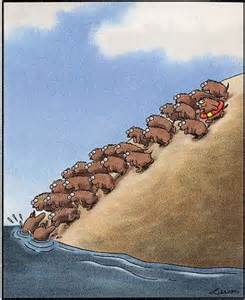
The lemming with the lifesaver will beat out the other lemmings in the selection process. Darwin knew nothing about genetics when he formulated his theory of evolution by means of natural selection. Darwin also wrote about the expression of emotion in man and animals, speculating whether or not behaviors are heritable and selected for. Is a particular behavior critical for reproductive success or not? Dr Maia showed us a video of the mating dance of the greater bird of paradise (Paradisaea apoda) from the Cornell Ornithology Lab's Birds of Paradise website:
Dr Maia quipped that sex and death are the only things that matter in evolution- reproducing is more important than survival itself. Why do most multicellular organisms have sex, why don't they just clone replicas of themselves? There are benefits to sex, advantages to gene mixing, such as disease resistance. Why are their two sexes, why not ten? There are two problems which must be solved by gametes- mobility and nutrition. Gametes need to move and they need to nurture developing offspring. If all gametes were identical, they would not be able to solve these two problems optimally. Thus, there are two types of gametes- tiny ones adept at moving (sperm) and large ones good at nurturing (ova). Occupying the middle ground is not so advantageous. Metabolically, sperm are cheap to produce but ova are expensive to produce. On the most basic level, the one thing which defines whether an individual is male or female is whether it produces small gametes or big gametes.
One aspect of natural selection is sexual selection, the ability of an organism to successfully reproduce with a mate. Females produce big gametes, which are expensive to produce, so they produce fewer gametes than males do and typically seek fewer mates. Males produce a lot of cheap gametes, so they tend to mate with more partners than females do. For females, sexual selection is weak- there is little variation in reproductive success. Males undergo strong sexual selection, they must mate often for reproductive success. It benefits females to be choosy, while it benefits males to go for quantity. Males tend to have more variation in looks as well as in reproductive success.
In the case of the long-tailed widowbird (Euplectes progne), females tend to prefer males with long tails. Such sexual selection can lead to exaggerated traits- in one study, certain male widowbirds had their tails shortened and others had their tails lengthened with extensions (PDF), with differences in reproductive success resulting.
In the case of Arizona house finches, females prefer to males whose plumage exhibits a greater degree of carotenoids. Carotenoids are derived from the diet and are an important anti-oxidant, put putting pigments in feathers is a luxury- excess pigment is a sign of better health, and most likely better genes.
Dr Maia then showed us a video of the mating dance of the blue manakin (Chiroxiphia caudata), which engages in a competitive group pre-mating behavior known as lekking:
Typically, one alpha male gets to mate with the female, the other males acting as 'wingmen'. The younger, less dominant males learn how to perform the mating dance by observing the alpha male in a joint reproductive effort.
Dr Maia joked that sexual selection among birds can produce crazy behavioral traits and crazy morphological traits, then showed us a video of a club-winged manakin (Machaeropterus deliciosus) beating its wings together over one-hundred times a minute to produce a sexually appealing stridulation:
One of the pitfalls of the traditional view of sexual selection is that it tends to 'erase' the female story, something alluded to in Sarah B. Hrdy's The Woman that Never Evolved, which opens with the sentence, "Biology, it is sometimes thought, has worked against women." While females were often dismissed as passive and ignored in studies of evolution, female behaviors are important in evolutionary success. Most bird species, about ninety percent, are monogamous. In most cases, they are sequentially monogamous, they form pair bonds for a breeding season, but mating for life is not the norm. In contrast, about three percent of mammal species are monogamous. It is thought that monogamy in birds may be due to low variation in sexual selection- males and females have similar selection pressures, even though males tend to be more ornamented than females. Even though monogamy is the norm, extra-pair paternity is found in seventy-five percent of bird species. Extra-pair young are found in about one in five nests, about ten to twenty percent of offspring are merely social offspring, not biological offspring.
The Australian superb fairy-wren (Malurus cyaneus) forms monogamous social pairs (males present females with flower petals in courtship), but both males and females engage in extra-pair copulation. In the case of these birds, females don't necessarily go for the most attractive males, but for neighboring males, favoring early risers (Mr Right-now is preferred to Mr Right). Dr Maia joked that, among fairy-wrens, it's better to be ugly than to be isolated.
Dr Maia noted that there are non-binary sex roles among birds. Among the lek-breeding European ruffs, males fall into three phenotypes- the showy, dominant territorial males which attempt to court multiple females, the less dominant satellite males who opportunistically mate with females while the territorial males are distracted, and the female-mimicking faeder males, which will sneakily mate with females right under the beaks of other males. Among white-throated sparrows (Zonotrichia albicollis), there are two phenotypes, white-striped and tan-striped. Both males and females can be of either morphology. The white form tends to be more aggressive, the tan form exhibits more parental care- most pair bonds are cross-morphology... opposites attract in this case.
There are even birds which exhibit a sex-role reversal, the wattled jacacna (Jacana jacana) being a prime example. Female jacanas are larger than males, have bigger wattles, and tend to be more aggressive. Females are polyandrous, mating with multiple males- they produce a lot of eggs which the males will incubate. Females will even break other females' eggs and mate with the the bereaved fathers. Jacanas inhabit a tough environment, one in which the loss of eggs to predation approaches ninety-percent. For female jacanas, the eggs are not that expensive, and the males do the work of nurturing. Dr Maia stressed that it is not a good deal to overgeneralize when discussing reproductive roles.
Dr Maia then veered into the 'JUST PLAIN NASTY' aspects of bird reproduction. This involves ducks, so here's a huge TRIGGER WARNING for anyone who wishes to avoid discussions of violent, outré sexuality. Male ducks will attack females, often nearly drowning them in order to prevent them from escaping. Male ducks will copulate with other male ducks, even dead ones. Male ducks, unlike most birds, which merely engage in cloaca-to-cloaca sperm transfer, have evolved elaborate 'penes' WARNING: CANNOT UNSEE FOLLOWING VIDEO:
Females have evolved twisty countermeasures to thwart forced insemination.
There is an immense diversity of morphology and behavior, which Dr Maia cited as the overarching basis of his research. He then presented us with a video of a blue-black grassquit's (Volatinia jacarina) leaping display:
The male grassquit defends a small territory, and its leaping displays showcase the color of its plumage.
While humans have three types of cone cells, resulting in trichromatic vision, birds have a fourth type of cone cell that allows them to see into the ultraviolet. Often, the males will have plumage which reflects UV light in order to attract females.
Dr Maia then shifted the topic of his lecture to the ways by which bird plumage derives its colors. Generally speaking, brown and red plumage results from pigments while green and blue plumage results from structural elements which reflect colors. The brown pigments in feathers results from the pigment melanin, which is collected in structures known as melanosomes. The reddish pheomelanin and the brown and black eumelanins form in differently-shaped organelles, which allows paleontologists to make educated guesses about the colors of dinosaur plumage using microscopy. In one dramatic case, paleontologists were able to determine that Anchiornis huxleyi probably had black and white plumage with a reddish crest. Ornamentation preceded flight, with complex plume patterns probably being the norm among dinosaurs. Yellow, orange, and red pigments are due to pigments known as carotenoids. Pigments result in a limited palette, which is insufficient to explain the variety of bird coloration.
The palette of bird colors is vastly expanded by structural colors. There are no known blue pigments, and very few green pigments used by animals. Structural colors result from the reflection of light- Dr Maia likened this effect to the iridescence of soap bubbles. The structure of a feather is complex, with differing pigment layers which absorb, reflect, and refract light. Some wavelengths cancel each other out, some reinforce each other. An expert can predict the structural factors which will result in particular colors. In birds, the brightest colors tend to be structural, as Dr Maia illustrated with this amazing video of a male Costa's hummingbird (Calypte costae) trying to impress a female with his iridescent mantle:
Iridescence is directional, it depends on the angle at which the light hits. Structural elements in the feathers of the dinosaur Microraptor gui reveal that the dinosaur had dark iridescent plumage due to the way in which its melanosomes were layered.
Dr Maia then ticked off some of the benefits of studying structural color in bird plumage, such as a new kind of mirrorless laser, improvements in fiber optics, improved camouflage, even better cosmetics.
There are different types of melanosome arrangements, with flat melanosomes producing less light absorption, hollow melanosomes have a major impact on iridescence, and a combination of flat and hollow melanosomes adding to the color palette. Dr Maia cited the African starlings as having a wide array of melanosome arrangements and the resultant optical complexity. The different color palettes among the starlings, derived from different melanosome morphologies, drive faster speciation and greater diversity.
The lecture was followed by a Q&A session, in which I was beaten to the punch by a gentleman who inquired about brood parasites such as cuckoos and cowbirds... how do they fool their victims? Dr Maia hypothesized that the calls of baby birds are probably similar enough that the adults don't figure out that something is wrong. Some bastard in the audience asked specifically about the hypothesis that ornamentation was correlated with lower parasite counts. Dr Maia reiterated that ornamentation was generally a good indicator of health and good genes, followed by a brief overview of the handicap hypothesis.
All told, this was another fantastic lecture, a feather in the cap of the Secret Science Club. My main interests lie in biology and the study of evolution, so this lecture hit the 'Secret Science Sweet Spot' for me- it was a great overview of bird reproductive strategies and the anatomy of feathers, illustrated by incredible video footage. I'm a bird nerd, and a dino nerd, so Dr Maia knocked it out of the park in my estimation. Kudos to Dr Maia, Margaret and Dorian, and the staff of the beautiful Bell House.
Saturday, February 19, 2011
Post Lecture Recap: Hail to the King, Baby!
Alright, you primates, here's a blast from the past, the Cretaceous, even! Thursday night's lecture was all about the care and feeding morphology and descent of the tyrannosaurs. Stephen Brusatte of the American Museum of Natural History and Columbia University delivered a barn-burner of a lecture, one of the best in an amazing series.
The lecture began with a discussion of Tyrannosaurus rex, and an image of the iconic "Sue" of Chicago's Field Museum. Mr. Brusatte (he's working on his doctorate) listed the characteristics of T. rex, such as the huge, deep, robust skull (the nasal bones of which are fused, unlike those of most other predatory dinosaurs), and regions for the attachment of massive muscles. In the image below, the "space" in the mid-region of the skull is the antorbital fenestra, which reduces the weight of the skull. The "keyhole" shaped opening behind it is the orbit (known technically as the "eyehole"). The teeth are not blade-shaped, but are sharpened pegs, which combined with the incredible bite force, were capable of crushing bone. CT scans of the skulls of T. rex indicate that the animal had well-developed olfactory lobes, suggesting a good sense of smell. T. rex also had binocular vision- the animal had highly developed sensory organs, and wasn't the pea-brained brute of popular conception.

While the tyrannosaurids had long hind limbs, T. rex was almost certainly not a fast runner(sorry dinosaur/car chase fans!). Studies of tyrannosaur histology indicate rapid growth rates (as much as four pounds a day in some genera), which suggest a high metabolism.
The tyrannosaurs are a member of the coelurosaur clade, and evolved from smaller forms with proportionally smaller skulls and larger forelimbs. Primitive tyrannosaurs were extant as far back as the Jurassic Period Another relatively primitive genus Dryptosaurus (formerly Laelaps) had large forelimbs for a tyrannosaur (make sure you check out the painting by the brilliant Charles R. Knight in the Dryptosaurus link.
A recent discovery of Raptorex, a mini-tyrannosaur with the characteristic robust skull and tiny forelimbs of it's huge relatives, demonstrates that the increase in skull size and forelimb reduction could have evolved separately from the gigantism of the late Cretaceous tyrannosaurs. The evolution of extremely large tyrannosaurs was probably a result of the decline of large theropod lineages. Another recently discovered tyrannosaur, Dilong paradoxus exhibited evidence of feathers. Another recently discovered tyrannosaur, Alioramus altai, while closely related to late Cretaceous forms, had a lower, longer skull... oh, hell, I'll let the guy who described it tell you about it. Take my word for it, he's a guy you'd want to have a beer with.
I've been rambling on for a bit, so I'll pick up the pace...
In the Q&A session, the issue of feathers was raised- since feathers evolved before flight, their primary purpose was probably either insulation or display. Some bastard asked if the large theropods of the southern continent of Gondwana showed evidence of the sensory sophistication of the tyrannosaurs. While their skulls haven't been studied in as much detail, they probably weren't as sophisticated in this regard as the tyrants. The tyrannosaurs were limited in range to the Laurasian (Northern Hemisphere continent. The issue of dinosaur sex came up, but the mechanics of Mesozoic lovin' are still a mystery, so throw Rule 34 to the wind, and do an image search (good luck!). Paleontologist Mary Schweitzer has figured out a means to determine if a dinosaur is an ovulating female by seeking out a particular bone type peculiar to ovulating female birds.
To get away from the tyrannosaurs, the tyrants weren't the only dinosaurs to have drastically, almost comically, reduced forelimbs. Carnotaurus was mentioned briefly, but the crowd just wasn't that into it.
All told, the lecture was an amazing one. I was also privileged to ride the subway to Union Square in the company of Stephen Brusatte, who is an all-around great guy.
The lecture began with a discussion of Tyrannosaurus rex, and an image of the iconic "Sue" of Chicago's Field Museum. Mr. Brusatte (he's working on his doctorate) listed the characteristics of T. rex, such as the huge, deep, robust skull (the nasal bones of which are fused, unlike those of most other predatory dinosaurs), and regions for the attachment of massive muscles. In the image below, the "space" in the mid-region of the skull is the antorbital fenestra, which reduces the weight of the skull. The "keyhole" shaped opening behind it is the orbit (known technically as the "eyehole"). The teeth are not blade-shaped, but are sharpened pegs, which combined with the incredible bite force, were capable of crushing bone. CT scans of the skulls of T. rex indicate that the animal had well-developed olfactory lobes, suggesting a good sense of smell. T. rex also had binocular vision- the animal had highly developed sensory organs, and wasn't the pea-brained brute of popular conception.

While the tyrannosaurids had long hind limbs, T. rex was almost certainly not a fast runner(sorry dinosaur/car chase fans!). Studies of tyrannosaur histology indicate rapid growth rates (as much as four pounds a day in some genera), which suggest a high metabolism.
The tyrannosaurs are a member of the coelurosaur clade, and evolved from smaller forms with proportionally smaller skulls and larger forelimbs. Primitive tyrannosaurs were extant as far back as the Jurassic Period Another relatively primitive genus Dryptosaurus (formerly Laelaps) had large forelimbs for a tyrannosaur (make sure you check out the painting by the brilliant Charles R. Knight in the Dryptosaurus link.
A recent discovery of Raptorex, a mini-tyrannosaur with the characteristic robust skull and tiny forelimbs of it's huge relatives, demonstrates that the increase in skull size and forelimb reduction could have evolved separately from the gigantism of the late Cretaceous tyrannosaurs. The evolution of extremely large tyrannosaurs was probably a result of the decline of large theropod lineages. Another recently discovered tyrannosaur, Dilong paradoxus exhibited evidence of feathers. Another recently discovered tyrannosaur, Alioramus altai, while closely related to late Cretaceous forms, had a lower, longer skull... oh, hell, I'll let the guy who described it tell you about it. Take my word for it, he's a guy you'd want to have a beer with.
I've been rambling on for a bit, so I'll pick up the pace...
In the Q&A session, the issue of feathers was raised- since feathers evolved before flight, their primary purpose was probably either insulation or display. Some bastard asked if the large theropods of the southern continent of Gondwana showed evidence of the sensory sophistication of the tyrannosaurs. While their skulls haven't been studied in as much detail, they probably weren't as sophisticated in this regard as the tyrants. The tyrannosaurs were limited in range to the Laurasian (Northern Hemisphere continent. The issue of dinosaur sex came up, but the mechanics of Mesozoic lovin' are still a mystery, so throw Rule 34 to the wind, and do an image search (good luck!). Paleontologist Mary Schweitzer has figured out a means to determine if a dinosaur is an ovulating female by seeking out a particular bone type peculiar to ovulating female birds.
To get away from the tyrannosaurs, the tyrants weren't the only dinosaurs to have drastically, almost comically, reduced forelimbs. Carnotaurus was mentioned briefly, but the crowd just wasn't that into it.
All told, the lecture was an amazing one. I was also privileged to ride the subway to Union Square in the company of Stephen Brusatte, who is an all-around great guy.
Sunday, November 24, 2013
Before the Reign of Tyrants
Christmas came early this year, with the discovery of a giant carnivorous dinosaur from the Cretaceous Period. Dubbed Siats meekerorum, the beast was a large allosaurid dinosaur. The Allosauroidea dominated the large predator niche for much of the Jurassic period and the early Cretaceous period. Siats is specifically a Neovenatorid allosaur. The Neovenatorids are currently considered a sister group with the Carcharodontosaurids, a allosauroid group which achieved staggering size in the southern hemisphere.
While much of the news coverage implies that Siats bullied or terrorized the early tyrannosaurs, I have to note that the tyrannosaurs eventually supplanted the allosauroids in North America in striking fashion. The tyrannosaurs belong to the coelurosaur clade, the coelurosaurs are best defined as theropod dinosaurs more closely related to birds than they are to carnosaurs such as the allosaurs (including Siats). Before the tyrannosaurids were recognized as coelurosaurs, most small carnivorous dinosaurs were lumped in with the coelurosaurs much as most large carnivores were lumped in with the carnosaurs, they were considered to have evolved from allosaurid ancestry. The tyrannosaur lineage started out as small, gracile carnivores such as Dilong paradoxis, a primitive, feathered tyrannosaur from the early Cretaceous.
Siats represents a late survival of the allosaurs, its discovery sheds a little light on a transitional period before the tyrannosaurs basically locked up the large predator niche in the late Cretaceous northern hemisphere. For a dinosaur nut like myself, this is most exciting news.
While much of the news coverage implies that Siats bullied or terrorized the early tyrannosaurs, I have to note that the tyrannosaurs eventually supplanted the allosauroids in North America in striking fashion. The tyrannosaurs belong to the coelurosaur clade, the coelurosaurs are best defined as theropod dinosaurs more closely related to birds than they are to carnosaurs such as the allosaurs (including Siats). Before the tyrannosaurids were recognized as coelurosaurs, most small carnivorous dinosaurs were lumped in with the coelurosaurs much as most large carnivores were lumped in with the carnosaurs, they were considered to have evolved from allosaurid ancestry. The tyrannosaur lineage started out as small, gracile carnivores such as Dilong paradoxis, a primitive, feathered tyrannosaur from the early Cretaceous.
Siats represents a late survival of the allosaurs, its discovery sheds a little light on a transitional period before the tyrannosaurs basically locked up the large predator niche in the late Cretaceous northern hemisphere. For a dinosaur nut like myself, this is most exciting news.
Saturday, November 23, 2019
A Charming Time-Travel Fantasy
Being very cognizant of my need to maintain my nerd credentials, one of the websites I frequent is the Tor science fiction site. One of their recent posts concerned a movie I hadn't heard of, a Czechoslovakian (therefore, somewhat old) science-fantasy film titled Cesta do pravěku, directed by Karel Zeman. The film begins with an adolescent boy finding a fossilized trilobite, and musing about seeing a live one, precipitating a dream sequence concerning of a Verne-esque voyage upstream and back through time in a 'magic cave'. It's a bit like the cast of Stand by Me starring in a less violence-fraught production of Jurassic Park. It's a leisurely paced film with a likeable ensemble, portraying plucky, resourceful kids engaged in a scholarly expedition. It's really a travelogue, with time, rather than distance, comprising the journey, and is a nice precursor to the BBC's wonderful Walking with Dinosaurs and Walking with Beasts series.
The prehistoric animals portrayed in the film are modeled after the paleoart of Zdeněk Burian, a personal favorite of mine (his paintings are gorgeous). The portrayal of these animals is woefully outdated, but comported with the science of the time. The dinosaurs look a bit hokey as well... the movie really shines when it depicts the mammals, and one terrible bird, of the Cenozoic Era- the models are more detailed than the dinosaur models, the action more convincing. The film nicely showcases such unsung prehistoric critters as Deinotherium and Uintatherium.
It's a fun watch for a paleo-enthusiast, and a nice low-key adventure/travel film... perfect for watching on a chilly Sunday morning in November after a night of drinking pivo
The prehistoric animals portrayed in the film are modeled after the paleoart of Zdeněk Burian, a personal favorite of mine (his paintings are gorgeous). The portrayal of these animals is woefully outdated, but comported with the science of the time. The dinosaurs look a bit hokey as well... the movie really shines when it depicts the mammals, and one terrible bird, of the Cenozoic Era- the models are more detailed than the dinosaur models, the action more convincing. The film nicely showcases such unsung prehistoric critters as Deinotherium and Uintatherium.
It's a fun watch for a paleo-enthusiast, and a nice low-key adventure/travel film... perfect for watching on a chilly Sunday morning in November after a night of drinking pivo
Friday, January 8, 2016
Dance, Dinos, Dance!
I was as happy as a schoolkid with a new crush when I read about the discovery of evidence that dinosaurs performed mating dances similar to those performed by their avian descendents. Just imagine a pair of forty-one foot (12.5 meter) long Acrocanthosauruses cavorting like cranes:
I can imagine the earth shaking under the impacts of such a dance.
Of course, this evidence is not conclusive, though it is highly suggestive. It's possible that these scrapes don't represent mating dances. Perhaps dinosaurs danced to demonstrate their victory over alien monster threats:
Can I get some grant money to watch kaiju films? I promise I won't drink all of it away, just a lot of it.
I can imagine the earth shaking under the impacts of such a dance.
Of course, this evidence is not conclusive, though it is highly suggestive. It's possible that these scrapes don't represent mating dances. Perhaps dinosaurs danced to demonstrate their victory over alien monster threats:
Can I get some grant money to watch kaiju films? I promise I won't drink all of it away, just a lot of it.
Wednesday, August 7, 2013
Getting to Know the Family
I was excited to read that the largely complete fossil remains of an ancient proto-mammal lineage previously known from scattered dental remains were found in Outer Mongolia.
The fossil of Megaconus, as the critter was named, was characterized by a furry pelt, but it had a primitive middle ear- the three tiny "bones" in the mammalian ear are derived from bones in the original reptilian jaw, and Megaconus retains this primitive condition. The discovery of this mammaliform specimen indicates that furry mammal ancestors are approximately as old as the dinosaurs, both lineages dating to the late Triassic. For those who aren't total paleontology nerds, the iconic Dimetrodon, which dates back to the Permian, is actually more closely related to we humans than it is to dinosaurs.
The discovery of a largely complete proto-mammal of this age is an awesome boon to those who study evolution. It's nice to get a good idea of what your great, great, great, great, great, great (need I go on?) grand-uncle looks like. Hey, how about a nice musical number from They Might Be Giants, relevant to this subject?
Here's Part 1 of a video series on the evolution of the mammals:
Getting to know the family is such a pleasure!
The fossil of Megaconus, as the critter was named, was characterized by a furry pelt, but it had a primitive middle ear- the three tiny "bones" in the mammalian ear are derived from bones in the original reptilian jaw, and Megaconus retains this primitive condition. The discovery of this mammaliform specimen indicates that furry mammal ancestors are approximately as old as the dinosaurs, both lineages dating to the late Triassic. For those who aren't total paleontology nerds, the iconic Dimetrodon, which dates back to the Permian, is actually more closely related to we humans than it is to dinosaurs.
The discovery of a largely complete proto-mammal of this age is an awesome boon to those who study evolution. It's nice to get a good idea of what your great, great, great, great, great, great (need I go on?) grand-uncle looks like. Hey, how about a nice musical number from They Might Be Giants, relevant to this subject?
Here's Part 1 of a video series on the evolution of the mammals:
Getting to know the family is such a pleasure!
Wednesday, May 8, 2013
Today, I Am a Sad Eight Year Old
Via Monsieur Edroso, I learned that Ray Harryhausen died yesterday. Sadly, I had no idea he had still been with us as of yesterday morning. Mr Harryhausen was a towering figure in the cinematic special-effects world, taking up the torch of Willis O'Brien and passing it to just about everybody in the special effects industry. The redoubtable Smut Clyde linked to John Coulthart's post, which pointed out Ray Harryhausen's mastery of pencil-and-charcoal, which drew inspiration from the works of Gustave Doré. Harryhausen was a masterful sculptor, and his grasp of anatomy gave his fanciful creations a patina of realism.
Ray Harryhausen's movies were always a treat when they were featured on the local television station's "4:30 Movie". Harryhausen's interpretations of Greek myths, along with the contemporaneous children's retellings by the D'Aulaires, inspired at least two generations of dreamers. Ray Harryhausen's ouvre helped to popularize the now-ubiquitous fantasy genre. Without Ray, would the "Star Wars", "Harry Potter", and "Game of Thrones" franchises have been the smash hits they are?
Enough of my weepy-eyed yapping, the best way to pay homage to the man is to post some videos of his work. I'm going to post some of my personal favorites (Roy posted the famous "skeleton battle" from 1963's Jason and the Argonauts, so I'll leave that wonderful scene out of this post).
Here is a great sequence involving a phorusrhacid attack a castaways' campsite in 1961's Mysterious Island:
The scene from Jason and the Argonauts in which Talos awakens has the perfect amount of creepiness for a children's matinee:
The most eye-popping visual affect in 1974's Golden Voyage of Sinbad was Caroline Munro's décolletage, but Ray's sequence involving an animated statue of Kali is pretty nifty:
In 1969's Valley of Gwangi, Ray animated two dinosaurs fighting, which is almost as cool as two dinosaurs actually fighting:
The Dragon-vs-Cyclops fight from 1958's Seventh Voyage of Sinbad is perhaps the coolest monster fight of them all:
Rest in peace, Ray, you made afternoon matinees memorable, and cinema fantastic.
POSTSCRIPT: It hit me after posting this... Mysterious Island, with its bird attack, crab attack, giant bee scene, and cephalopod scene, could have been titled Attack of the Giant Delicious Things. It could be interpreted as a piece of cinematic food porn to rival Tampopo or Big Night.
Ray Harryhausen's movies were always a treat when they were featured on the local television station's "4:30 Movie". Harryhausen's interpretations of Greek myths, along with the contemporaneous children's retellings by the D'Aulaires, inspired at least two generations of dreamers. Ray Harryhausen's ouvre helped to popularize the now-ubiquitous fantasy genre. Without Ray, would the "Star Wars", "Harry Potter", and "Game of Thrones" franchises have been the smash hits they are?
Enough of my weepy-eyed yapping, the best way to pay homage to the man is to post some videos of his work. I'm going to post some of my personal favorites (Roy posted the famous "skeleton battle" from 1963's Jason and the Argonauts, so I'll leave that wonderful scene out of this post).
Here is a great sequence involving a phorusrhacid attack a castaways' campsite in 1961's Mysterious Island:
The scene from Jason and the Argonauts in which Talos awakens has the perfect amount of creepiness for a children's matinee:
The most eye-popping visual affect in 1974's Golden Voyage of Sinbad was Caroline Munro's décolletage, but Ray's sequence involving an animated statue of Kali is pretty nifty:
In 1969's Valley of Gwangi, Ray animated two dinosaurs fighting, which is almost as cool as two dinosaurs actually fighting:
The Dragon-vs-Cyclops fight from 1958's Seventh Voyage of Sinbad is perhaps the coolest monster fight of them all:
Rest in peace, Ray, you made afternoon matinees memorable, and cinema fantastic.
POSTSCRIPT: It hit me after posting this... Mysterious Island, with its bird attack, crab attack, giant bee scene, and cephalopod scene, could have been titled Attack of the Giant Delicious Things. It could be interpreted as a piece of cinematic food porn to rival Tampopo or Big Night.
Friday, July 15, 2011
A Typical Member of the Family
My brother, Sweetums, told me a story about one of his sons that simultaneously cracked me up and swelled me up with pride. Yeah, his boys are typical members of the family.
Before packing the kids off to bed, my brother told them to put away the stuff that had be strewn all over the floor. In the interests of fair play, he divided up the labor by telling N. to pick up the blocks and the toy trains, and he told boy T. to pick up the books and the dinosaurs.
After the boys had been given their orders, he gave them some time to perform the task at hand. When he came back to inspect the room, he found a dime-store Dimetrodon on the floor. He told boy T., "You didn't pick up that Dimetrodon."
Boy T. responded, "You told me to pick up the dinosaurs, Dimetrodon isn't a dinosaur."
Yeah, the boy fits right in with the rest of the family.
Before packing the kids off to bed, my brother told them to put away the stuff that had be strewn all over the floor. In the interests of fair play, he divided up the labor by telling N. to pick up the blocks and the toy trains, and he told boy T. to pick up the books and the dinosaurs.
After the boys had been given their orders, he gave them some time to perform the task at hand. When he came back to inspect the room, he found a dime-store Dimetrodon on the floor. He told boy T., "You didn't pick up that Dimetrodon."
Boy T. responded, "You told me to pick up the dinosaurs, Dimetrodon isn't a dinosaur."
Yeah, the boy fits right in with the rest of the family.
Tuesday, January 3, 2017
Adiós, Archosaurs!
I'm going to preface this post by saying that I am not antisocial- I have a job which often involves interacting with the public, I have friends and acquaintances from a diverse array of backgrounds, who I have met through a diverse array of activities. That being said, I typically prefer to go to museums alone. When you go to a museum with a bunch of people, you spend time figuring out what you want to see, and if you decide to split the party, you spend time figuring out a rendezvous point and you spend time traveling to said rendezvous point. Don't get me wrong, I love to go to museums with people, but when I really want a museum experience, I go alone... this is precisely why I have a membership to the American Museum of Natural History- I have the luxury of attending the museum every single day of its operation, should I wish to go.
Yesterday, I spent a few hours nerding out at the museum. It was the final day of both the Dinosaurs Among Us and the Crocs exhibits. I attended both of these exhibits with friends, and had a great time watching their kids learning about these creatures, but I wanted a solo archosaur immersion for a few hours. Birds and crocodiles are both archosaurs, the birds being the descendants of dinosaurs and the crocodilians being distant cousins. I missed some details of the exhibits in my previous visits, which is precisely why I attend these exhibits multiple times... membership has its benefits, besides being able to waltz past the long general admission lines. I will post addenda to my older posts over the next couple of days.
I would do it tonight, but I'm headed out for bar trivia night... as I wrote, I'm not antisocial.
Yesterday, I spent a few hours nerding out at the museum. It was the final day of both the Dinosaurs Among Us and the Crocs exhibits. I attended both of these exhibits with friends, and had a great time watching their kids learning about these creatures, but I wanted a solo archosaur immersion for a few hours. Birds and crocodiles are both archosaurs, the birds being the descendants of dinosaurs and the crocodilians being distant cousins. I missed some details of the exhibits in my previous visits, which is precisely why I attend these exhibits multiple times... membership has its benefits, besides being able to waltz past the long general admission lines. I will post addenda to my older posts over the next couple of days.
I would do it tonight, but I'm headed out for bar trivia night... as I wrote, I'm not antisocial.
Saturday, September 6, 2014
Song for Dreadnoughtus
This week's number one paleontology story was the discovery of Dreadnoughtus schrani, an astonishingly complete fossil Titanosaur. The importance of the Dreadnoughtus fossil lies in the fact that it is seventy percent complete. Most fossil finds are fragmentary, and Titanosaur remains recently found in Argentina hint at animals up to 130 feet in length. The Titanosaurs were the last of the long-necked Sauropod dinosaurs, and most remains come from Gondwana, specifically South America.
Here's a short, somewhat dry (I prefer these to the "Fieri'd" up "extreme" sort) video about the differences between Titanosaurs and other Sauropod lineages, concentrating on the genus Saltasaurus:
Me being me, and thus snarky, here's a little long-distance dedication to Dreadnoughtus:
Yeah, of course I know that dinosaurs aren't lizards, but reading over the estimated weights for Dreadnoughtus, the line "and you should see the way it shits" popped immediately into my snarky, snarky mind.
Here's a short, somewhat dry (I prefer these to the "Fieri'd" up "extreme" sort) video about the differences between Titanosaurs and other Sauropod lineages, concentrating on the genus Saltasaurus:
Me being me, and thus snarky, here's a little long-distance dedication to Dreadnoughtus:
Yeah, of course I know that dinosaurs aren't lizards, but reading over the estimated weights for Dreadnoughtus, the line "and you should see the way it shits" popped immediately into my snarky, snarky mind.
Saturday, January 30, 2010
Technicolor Dinosaurs are All the Rage!
A team of researchers from the University of Bristol, working with Chinese colleagues, has analyzed impressions of melanosomes (color bearing organelles) in a fossil of "feathered" dinosaur Sinosauropteryx, and have determined that it most likely had an orange-and-white striped tail. If only the original discoverers of Sinosauropteryx had known this, they could have named the animal Creamsiclesaurus or Coatisaurus. My joy is only tempered by some... uh... misgivings should it be discovered that Tyrannosaurus had a green-and-purple color scheme.
As a corollary, science is fun, the researchers who decided to use a scanning electron microscope to seek out impressions of microscopic organelles are not only brilliant, but they are cool. Could the boring trolls at the Discovery Institute, with their bogus claims of "irreducible complexity" and their "teach the controversy" lawsuits, ever hope to match real scientists?
Edit: Looking at the post, I should have named it, "The Golden Age of Orange Dinosaurs", but I don't want to change a post title so precipitously.
As a corollary, science is fun, the researchers who decided to use a scanning electron microscope to seek out impressions of microscopic organelles are not only brilliant, but they are cool. Could the boring trolls at the Discovery Institute, with their bogus claims of "irreducible complexity" and their "teach the controversy" lawsuits, ever hope to match real scientists?
Edit: Looking at the post, I should have named it, "The Golden Age of Orange Dinosaurs", but I don't want to change a post title so precipitously.
Sunday, August 16, 2020
Bucket Brigade
Next Tuesday will mark two weeks since tropical storm Isaias hit the area, taking down a lot of trees, blocking roads, and downing power lines. Lingering power outages remained until a couple of days ago, and there are still trees and branches precariously dangling over roadways. Convoys of bucket trucks have been a feature on the local roadways, dispatched to the locales where problems remain.
Last night, while running an errand at Stop-and-Shop before working the graveyard shift, I saw an entire brigade of bucket trucks parked in the lot the supermarket shares with a hotel:

Truck-obsessed five year old me would have been sent over the moon by the sight of so much heavy equipment, arrayed like the closest equivalents we now have to the dinosaurs that also obsessed me (and still do). Older, staider me was sent over the moon by the site of so much heavy equipment deployed to get our infrastructure back in order.
For the record, our company e-mail still hasn't been restored since a post-Isaias power outage and generator malfunction (not to mention the fact that our IT guys are working remotely). At least I sent in my expense reports before this problem came up, by which I mean came down.
Tuesday, May 11, 2010
National Day of Mourning for Groovy Van Drivers
Noted fantasy artist and unapologetic ass-man Frank Frazetta died yesterday, leaving behind legions of horny teenaged fans, and a legacy of reproductions airbrushed on the sides of vans with shag-carpeted interiors. In the mid-fifties to the early sixties, one of Frank's gigs was drawing for Al Capp's Li'l Abner, which provided him a ample opportunities for displaying his penchant for drawing well-nigh ridiculously voluptuous women.
In 1966, his cover for a Lancer Books reissue of some early pulp tales (packaged with some dodgy later pastiches) about a Cimmerian adventurer catapulted both Frazetta and said Cimmerian into the pop culture stratosphere. Oh, and did we mention he was an unapologetic ass man?
I'd say, "Rest in peace", but I think Frank's version of heaven would be a jungle world populated by ravenous dinosaurs, savage beastmen, and, of course, well-nigh ridiculously voluptuous women.
And to all of those who never had a chance to commission a Frazetta masterpiece to grace the side of your van, there's always Boris Vallejo.
Author's Note: One of my college roommates and I would periodically stage mock arguments about the relative merits of Frazetta vs. Vallejo. We'd also stage mock "Coot or Grebe" arguments in the vicinity of non-Anseriform waterfowl.
In 1966, his cover for a Lancer Books reissue of some early pulp tales (packaged with some dodgy later pastiches) about a Cimmerian adventurer catapulted both Frazetta and said Cimmerian into the pop culture stratosphere. Oh, and did we mention he was an unapologetic ass man?
I'd say, "Rest in peace", but I think Frank's version of heaven would be a jungle world populated by ravenous dinosaurs, savage beastmen, and, of course, well-nigh ridiculously voluptuous women.
And to all of those who never had a chance to commission a Frazetta masterpiece to grace the side of your van, there's always Boris Vallejo.
Author's Note: One of my college roommates and I would periodically stage mock arguments about the relative merits of Frazetta vs. Vallejo. We'd also stage mock "Coot or Grebe" arguments in the vicinity of non-Anseriform waterfowl.
Subscribe to:
Posts (Atom)