Showing posts sorted by relevance for query bird. Sort by date Show all posts

Tuesday, April 6, 2021

Secret Science Club Zoom Lecture: This Subject Is for the Birds, Literally

 Tonight, my great and good friends of the Secret Science Club are presenting a Zoom lecture by naturalist and field researcher Scott Weidensaul, author of A World on the Wing: The Global Odyssey of Migratory Birds.

As a child growing up in Pennsylvania, he became obsessed with the Appalachian Mountains, raptors, and migration.  In the 1990s, he traveled throughout North America studying migration patterns, and he recently has traveled the world

North America has lost about a third of its birds in recent decades.

Grassland birds, such as bobolinks and meadowlarks, are particularly hard hit.  Waterfowl have rebounded due to efforts to protect and restore wetlands.  If we put the same time, effort, and money to restoring grasslands, these birds should rebound as well.  Progress is being made to restore migratory bird populations, and our ability to crunch massive amounts of data has revolutionized research.  Miniaturized tracking devices also help, some are small enough to place on migratory butterflies.  We also have better ideas about bird physiology- some of these birds can spend months on the wing while they migrate.

Not all birds migrate, but the dusky grouse migrates uphill in the Rockies by foot.  The semipalmated sandpiper migrates thousands of miles to and from its Canadian breeding grounds.  To compare birds to even the most elite human athletes is to shame the birds.  The sandpipers gorge on crustaceans called Corophium, stocking up on Omega-3 fatty acids before migratiing.  Most birds migrate at night, using celestial navigation.  Birds also have magnetic sense, with a form of quantum entanglement (spooky action at a distance), using a visual pigment called cryptochrome, which becomes magnetized, allowing the birds to sense the Earth's magnetic field.  Every goose pooping on the golf course has this magnetic sense.

Just about everything humans can do, birds can do better, certain birds, such as bar-headed geese, can fly higher than the 'death zone' for human climbers.  Birds have a respiratory system superior to mammals' lungs- their lungs are attached to air sacs accessed through hollow bones.  Bar-headed geese have special hemoglobin which allows them to fly at excessive altitudes.

Alpine swifts migrate to Africa for the winter, flying from Switzerland to western Africa without stopping for two hundred days.  Common swifts fly continuously for ten months, feeding on the wing on flying insects.  Great frigatebirds, being native to the Galapagos, have little fear of humans, and are easy to have transmitters affixed to.  The birds are not waterproof, so they fly nonstop to hunt fish- they undergo unihemispheric sleep on the wing, and after feeding their young, sleep on the nest for long periods.  Even the migratory birds in our yards, such as warblers, undergo unihemispheric sleep.  The birds need food resources at both ends of their migratory route.  Certain birds, such as bar-tailed godwits, engage in hyperphagia, overeating, for days before migrating, and their digestive systems atrophy for the trip, and regrow their guts when they arrive.  The most important foraging sites for bar-tailed godwits are mudflats on the Yellow Sea, which teem with invertebrate life.  The loss of these habitats to the construction of seawalls and aquatic farms are injurious to birds, a twenty-one mile long seawall in South Korea resulted in habitat loss which decreased the red knot population by one-fifth.  The spoon- billed sandpiper, which migrates from Eastern Russia to the Chinese coast, is down to a population of about 400.

Conservation efforts are underway on the Yellow Sea coast, with the authoritarian government of China halting all development on the mudflats.  Certain sites are now UNESCO sites.

Bird trapping is also a problem, with birds such as the yellow-breasted bunting, once among the most abundant songbirds, experiencing catastrophic population decline.  If they go extinct, this would be the equivalent to the extinction of the passenger pigeon.  Bird trapping in the Mediterranean is rampant, with about eleven million migratory songbirds being killed in Egypt, France (where the ortolan bunting is a prized dish), and Italy.  The 'black hole' of  bird loss is Cyprus, where up to three million birds are trapped, usually using birdlime, a sticky substance smeared on twigs, which can trap birds.  In Cyprus, the birds are plucked and fried in an illegal dish called ambelopoulia.  Much of the poaching has occurred on British military bases, with local police, at considerable risk, using drones to catch poachers, and British conservationists send anti-poaching specialists.  Scott Weidensaul had to wear a bulletproof vest while observing these personnel.

Climate change is the biggest problem facing birds, changing distribution patterns.  He doesn't care if you believe in climate change, the birds do.  Many species of birds have changed their migration schedules due to warming.  Some birds, such as fox sparrows and eastern phoebes, have show flexibility in migration, but most of these are short or mid-distance migrants.  Long-distance, such as black-throated green warblers, are adversely effected by climate change.  Certain birds, such as pied flycatchers, time their migration to exploit the emergence of caterpillars, but the caterpillars emerge earlier now.  North American birds, not having to cross a desert and a sea, are less affected.  

Climate change doesn't cause uniform warming- in portions of the Canadian Arctic, falls and winters are colder, but summers are much hotter, so insects emerge earlier so chicks can starve.  The Audobon Society modeled bird habitats and determined that scarlet tanagers will lose about ninety percent of their oak-and-beech forests  by 2080, and the habitats won't be able to shift to keep up with warming.

Advances in computing power can help in bird conservation.  Doppler radar stations can be used to monitor bird migration, even allowing determination of bird size, direction of travel, and the calculation of bird numbers per cubic meter.  Shifts in migration can be shown.  Radar data allowed researchers to determine that 2.9 billion birds have been lost.  Radar cannot determine taxonomy, so birders on the ground, using the E-bird system, can verify what species of birds are migrating.  Using this data, optimal habitats, such as pop-up wetlands on farmland, can be created- payment to farmers would be cheaper than buying land outright.  City lights can confuse birds that navigate by starlight, drawing them to cities.  Automated alerts to building owners can inform them to dim lights as large flocks of migrating birds approach.  Urban bird habitats in city parks can also be more effective than buying undeveloped land.  GPS units that transmit data cellularly can track birds, with Project SNOWstorm being an effort to track snowy owls.

Small songbirds and migratory insects and bats can be tracked with the Motus system, and numerous local projects are expanding the receiver station network.

This is an amazing time, and a terrifying time, for migration.  It's easy to despair, but there is hope that the challenges of migratory birds can be met.  Scott Weidensaul cited the Amur falcon migration from Siberia and Eastern China to Southern Africa.  Nagaland, in eastern India, is a state characterized by conflict between a local Burmese ethnic population espousing a Baptist Christian religion, it was discovered that falcons that typically gorge on breeding termites before migrating were being trapped by farmers whose fields had been flooded by the construction of a dam.  The starving farmers literally believed that the falcons were manna from heaven.  There was an outcry among the international press, leading to an effort by conservationists and the hungry Naga to stop the hunt overnight, with former poachers guarding nesting sites, and efforts to jumpstart a tourism industry, which is difficult to put into place due to Nagaland's remoteness and an anti-India insurgency.  Mr Weidensaul painted a picture of bad roads, bandits, and Baptist headhunters.  Tourists are arriving, but the tourist economy is not as egalitarian as the falcon trapping economy.  Trappers-become-tour guides don't have equal access to prime roosting grounds or the ability to install western style facilities for tourists.  Roads bring development, logging, and hunting- they are the worst threats to birds... but they would be a boon for Nagaland ecotourism and conservation.  Strides have been made, but how sustainable are they?

Every bird that makes that leap into migration is ordinary, and extraordinary.  They have evolved amazing systems to navigate the migration process, but it's not enough now, the birds need our help.

The lecture was followed by a Q&A session.  The first involved the evolution of migration patterns. Scott believes that this is an incremental process, migration is genetically coded, and some birds are born with 'bad software', with some taking riskier routes, such as oceanic routes, but success among a few would be selected for.  During the Ice Age, sea levels were lower, so now overseas routes would have been overland on a geological time scale.

Another question involved the use of birds as climate change 'surveyors'.  Cornell's eBird program has gathered data, and almost no migration routes have been unchanged by temperature change and shifting wind patterns.  The difficulty for birds is that they tend to depend on stable weather patterns, which are being perturbed.

Another question involved the banning of DDT, which decimated raptor and common loon populations.  Bald eagle populations have quadrupled over the past couple of decades, which does have a ripple effect on other bird populations, such as tern populations.

How do magnetic pole shifts affect birds?  Birds' magnetic senses aren't cued to polarity.  There might be some confusion, but birds don't function as compasses, and should be able to handle things well.

How do scientists band birds?  Banding is the most effective and least effective method of tracking birds.  Marking birds as individuals is crucial for determining migration, longevity, and mating practices.  Most birds return to nesting spots and overwintering spots.  If you find a dead bird, check for a band- the return on banding is pretty slim, only a fraction of the bands are recovered.  GPS locators are more effective.  Birds can be netted using audio lures and the geolocators can be evaluated.  One great thrush in Denali park has been tracked to the upper Orinoco over seven migration seasons.  Other thrushes living in proximity in Denali shared a similar proximity in southern Argentina.

How did the COVID-19 pandemic effect bird migration?  Differences in observed migration was probably more due to increased observation rather than decreased activity.  People suddenly started noticing nature, started observing birds.

There are migratory birds, semi-migratory birds, irruptive birds that migrate due to changing food availability.  

Scott plugged the Cornell Lab of Ornithology and its Merlin Bird ID app.

Another question involved Ducks Unlimited- whatever your opinion of duck hunting is, duck hunters have raised a lot of money to preserved wetlands.  There is enlightened self interest involved, but the effectiveness cannot be denied.  The single largest anthropogenic factor in bird deaths is the domesticated cat- keep the cats inside, they kill billions of birds each year.  Trap, neuter, and release programs maintain large predator colonies- keep your cats inside.

Some Bastard in the audience (and another person in the chat), asked how even apartment dwellers can help birds.  Plant native plants, especially ones with fruits with a lipid content.  Choose your coffee well, pay more for certified shade-grown, bird-friendly coffee sown in forest habitats, subsidize small farmers who grow their coffee bushes under native forest canopy.  Look for the Smithsonian label.  Certain co-ops are engaged in reforestation efforts, improving bird habitats.

Migratory birds can carry pathogens, such as avian influenzas, which are carried by waterfowl such as gulls.  Birds can also be used as sentinels for pathogens, such as West Nile virus, which decimated many wild bird populations.

Another city dweller asked for resources about city-living birds.  Migratory songbirds don't typically migrate in large flocks, but they make calls to avoid collisions.  Rooftop antennae, available for about twenty dollars, could pick up migration calls to give a more granular picture of birds in transit, giving a detailed picture of the night sky.

The lecture was fantastic, accompanied by wonderful pictures.  It was sobering, but Mr Weidensaul challenged us, and gave us hope.  Kudos to this Pulitzer prize finalist, and Margaret and Dorian.  For a taste of this lecture, here is a lecture by Mr Weidensaul from last Fall:

Saturday, July 15, 2017

Can't Save Them All

When I arrived on the job today, one of my co-workers, a sensitive artistic woman, greeted me with a dilemma... she had found a distrait bird in front of our main building. Acting on the instinct of providing a 'nest' for an injured bird, she had placed it in a cardboard box lined with paper towels:


The bird, a white-breasted nuthatch (Sitta carolinensis) looked to be in rough shape. It had a tendency to shiver and to occasionally flop over. My friend had called a couple of wildlife rehabilitators to ask for assistance, but had to leave messages with them because they were unavailable. I took the box with the bird from her (I am fond of nuthatches, they are comical little birds which often climb head downward along one of our wooden outbuildings, looking for tasty bugs) and tried to figure out how best to deal with the little thing. I figured I'd see if I could get it to drink from a drip-feeder improvised from a wet paper towel (having no eyedropper in my office) and eat a bit of cat-kibble (not having sunflower seeds or peanuts available). Sadly, the bird expired while I was trying to figure out how to provide sustenance for it.

About an hour after she had left, my co-worker returned to see how the bird was doing- the whole situation weighed on her so much that she had to return to see how the bird was doing. I broke the bad news to her, and then we had a talk about how birds which have ended up on the ground are often sick to begin with. I told her that she had done everything correctly to the best of her knowledge, and how I had tried to get some water and food into the bird. She had heard back from one of the rehabilitation experts, who pretty much told her the same thing I did, even down to the whole 'try to feed it sunflower seeds or cat food' bit. This is a prime season for animal injuries, so all of the local wildlife rehabilitation experts have their hands full. My friend is an idealistic woman, but she's also a realist, so she took the news of the bird's death in stride... she did a yeoperson's job, but even a yeoperson can't save them all.

Friday, March 23, 2012

A Bird in the Hand

There are two schools of thought regarding bird photography... you can purchase a high quality camera, set up a feeder, and improvise a blind so you can get great photos, or you can just grab a bird and take a picture of it with your cell phone camera:


This afternoon, a crazy red-bellied woodpecker (Melanerpes carolinus) flew into one of our buildings and got into a bit of trouble with my friend and co-worker Fred. Being a bird fancier, I robbed my little piratical friend of his sport, and grabbed the boid. Sorry, Fred- stick to the meeses, and we're cool.

Luckily, I had my cell-phone relatively handy, so I was able to snap a picture. The last time I had to grab a bird, my phone was in my left pocket, the bird (a mourning dove) in my left hand, so I was unable to snap a pic. That time, a co-worker's husband saw the proceedings, and started calling me "The Bird Whisperer". Every couple of years, it seems I play this role.

UPDATE: My standard joke regarding this picture is that it depicts my only game of "Angry Birds"- you grab a bird and he gets real angry. That being said, I think the cat was angrier that day.

Tuesday, November 22, 2016

Secret Science Club Post-Lecture Recap: This Subject's for the Birds!

Last night, I headed down to the beautiful Bell House, in the Gowanus section of Brooklyn, for this month's Secret Science Club lecture featuring evolutionary biologist Dr Rafael Maia of Columbia University. Dr Maia titled his lecture 'The Colorful Sex Lives of Birds'. He noted that he isn't exactly the best birder, often having trouble finding his subjects in the field. He noted that the 'bird nerd' image is somewhat justified, with birders planning their honeymoons around adding to their life lists. He noted that he first became interested in studying birds by watching Jurassic Park, specifically the scene in which Sam Neill lectures an annoying kid who says that stating dinosaurs are like birds is dumb:


Studying birds is studying living dinosaurs, the evolutionary descendants of the dinosaurs which escaped the mass extinction at the end of the Cretaceous.

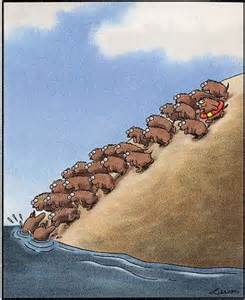
Charles Darwin observed that evolution occurs through natural selection. First, there is variation among members of a species. Secondly, there is heritability- variations are passed on to offspring. Finally, there is selection- some individuals are better at surviving and will be selected for better reproductive outcomes. To illustrate the concept, Dr Maia showed us a slide of one of Gary Larson's Far Side cartoons:


The lemming with the lifesaver will beat out the other lemmings in the selection process. Darwin knew nothing about genetics when he formulated his theory of evolution by means of natural selection. Darwin also wrote about the expression of emotion in man and animals, speculating whether or not behaviors are heritable and selected for. Is a particular behavior critical for reproductive success or not? Dr Maia showed us a video of the mating dance of the greater bird of paradise (Paradisaea apoda) from the Cornell Ornithology Lab's Birds of Paradise website:


Dr Maia quipped that sex and death are the only things that matter in evolution- reproducing is more important than survival itself. Why do most multicellular organisms have sex, why don't they just clone replicas of themselves? There are benefits to sex, advantages to gene mixing, such as disease resistance. Why are their two sexes, why not ten? There are two problems which must be solved by gametes- mobility and nutrition. Gametes need to move and they need to nurture developing offspring. If all gametes were identical, they would not be able to solve these two problems optimally. Thus, there are two types of gametes- tiny ones adept at moving (sperm) and large ones good at nurturing (ova). Occupying the middle ground is not so advantageous. Metabolically, sperm are cheap to produce but ova are expensive to produce. On the most basic level, the one thing which defines whether an individual is male or female is whether it produces small gametes or big gametes.

One aspect of natural selection is sexual selection, the ability of an organism to successfully reproduce with a mate. Females produce big gametes, which are expensive to produce, so they produce fewer gametes than males do and typically seek fewer mates. Males produce a lot of cheap gametes, so they tend to mate with more partners than females do. For females, sexual selection is weak- there is little variation in reproductive success. Males undergo strong sexual selection, they must mate often for reproductive success. It benefits females to be choosy, while it benefits males to go for quantity. Males tend to have more variation in looks as well as in reproductive success.

In the case of the long-tailed widowbird (Euplectes progne), females tend to prefer males with long tails. Such sexual selection can lead to exaggerated traits- in one study, certain male widowbirds had their tails shortened and others had their tails lengthened with extensions (PDF), with differences in reproductive success resulting.

In the case of Arizona house finches, females prefer to males whose plumage exhibits a greater degree of carotenoids. Carotenoids are derived from the diet and are an important anti-oxidant, put putting pigments in feathers is a luxury- excess pigment is a sign of better health, and most likely better genes.

Dr Maia then showed us a video of the mating dance of the blue manakin (Chiroxiphia caudata), which engages in a competitive group pre-mating behavior known as lekking:


Typically, one alpha male gets to mate with the female, the other males acting as 'wingmen'. The younger, less dominant males learn how to perform the mating dance by observing the alpha male in a joint reproductive effort.

Dr Maia joked that sexual selection among birds can produce crazy behavioral traits and crazy morphological traits, then showed us a video of a club-winged manakin (Machaeropterus deliciosus) beating its wings together over one-hundred times a minute to produce a sexually appealing stridulation:


One of the pitfalls of the traditional view of sexual selection is that it tends to 'erase' the female story, something alluded to in Sarah B. Hrdy's The Woman that Never Evolved, which opens with the sentence, "Biology, it is sometimes thought, has worked against women." While females were often dismissed as passive and ignored in studies of evolution, female behaviors are important in evolutionary success. Most bird species, about ninety percent, are monogamous. In most cases, they are sequentially monogamous, they form pair bonds for a breeding season, but mating for life is not the norm. In contrast, about three percent of mammal species are monogamous. It is thought that monogamy in birds may be due to low variation in sexual selection- males and females have similar selection pressures, even though males tend to be more ornamented than females. Even though monogamy is the norm, extra-pair paternity is found in seventy-five percent of bird species. Extra-pair young are found in about one in five nests, about ten to twenty percent of offspring are merely social offspring, not biological offspring.

The Australian superb fairy-wren (Malurus cyaneus) forms monogamous social pairs (males present females with flower petals in courtship), but both males and females engage in extra-pair copulation. In the case of these birds, females don't necessarily go for the most attractive males, but for neighboring males, favoring early risers (Mr Right-now is preferred to Mr Right). Dr Maia joked that, among fairy-wrens, it's better to be ugly than to be isolated.

Dr Maia noted that there are non-binary sex roles among birds. Among the lek-breeding European ruffs, males fall into three phenotypes- the showy, dominant territorial males which attempt to court multiple females, the less dominant satellite males who opportunistically mate with females while the territorial males are distracted, and the female-mimicking faeder males, which will sneakily mate with females right under the beaks of other males. Among white-throated sparrows (Zonotrichia albicollis), there are two phenotypes, white-striped and tan-striped. Both males and females can be of either morphology. The white form tends to be more aggressive, the tan form exhibits more parental care- most pair bonds are cross-morphology... opposites attract in this case.

There are even birds which exhibit a sex-role reversal, the wattled jacacna (Jacana jacana) being a prime example. Female jacanas are larger than males, have bigger wattles, and tend to be more aggressive. Females are polyandrous, mating with multiple males- they produce a lot of eggs which the males will incubate. Females will even break other females' eggs and mate with the the bereaved fathers. Jacanas inhabit a tough environment, one in which the loss of eggs to predation approaches ninety-percent. For female jacanas, the eggs are not that expensive, and the males do the work of nurturing. Dr Maia stressed that it is not a good deal to overgeneralize when discussing reproductive roles.

Dr Maia then veered into the 'JUST PLAIN NASTY' aspects of bird reproduction. This involves ducks, so here's a huge TRIGGER WARNING for anyone who wishes to avoid discussions of violent, outré sexuality. Male ducks will attack females, often nearly drowning them in order to prevent them from escaping. Male ducks will copulate with other male ducks, even dead ones. Male ducks, unlike most birds, which merely engage in cloaca-to-cloaca sperm transfer, have evolved elaborate 'penes' WARNING: CANNOT UNSEE FOLLOWING VIDEO:


Females have evolved twisty countermeasures to thwart forced insemination.

There is an immense diversity of morphology and behavior, which Dr Maia cited as the overarching basis of his research. He then presented us with a video of a blue-black grassquit's (Volatinia jacarina) leaping display:


The male grassquit defends a small territory, and its leaping displays showcase the color of its plumage.

While humans have three types of cone cells, resulting in trichromatic vision, birds have a fourth type of cone cell that allows them to see into the ultraviolet. Often, the males will have plumage which reflects UV light in order to attract females.

Dr Maia then shifted the topic of his lecture to the ways by which bird plumage derives its colors. Generally speaking, brown and red plumage results from pigments while green and blue plumage results from structural elements which reflect colors. The brown pigments in feathers results from the pigment melanin, which is collected in structures known as melanosomes. The reddish pheomelanin and the brown and black eumelanins form in differently-shaped organelles, which allows paleontologists to make educated guesses about the colors of dinosaur plumage using microscopy. In one dramatic case, paleontologists were able to determine that Anchiornis huxleyi probably had black and white plumage with a reddish crest. Ornamentation preceded flight, with complex plume patterns probably being the norm among dinosaurs. Yellow, orange, and red pigments are due to pigments known as carotenoids. Pigments result in a limited palette, which is insufficient to explain the variety of bird coloration.

The palette of bird colors is vastly expanded by structural colors. There are no known blue pigments, and very few green pigments used by animals. Structural colors result from the reflection of light- Dr Maia likened this effect to the iridescence of soap bubbles. The structure of a feather is complex, with differing pigment layers which absorb, reflect, and refract light. Some wavelengths cancel each other out, some reinforce each other. An expert can predict the structural factors which will result in particular colors. In birds, the brightest colors tend to be structural, as Dr Maia illustrated with this amazing video of a male Costa's hummingbird (Calypte costae) trying to impress a female with his iridescent mantle:


Iridescence is directional, it depends on the angle at which the light hits. Structural elements in the feathers of the dinosaur Microraptor gui reveal that the dinosaur had dark iridescent plumage due to the way in which its melanosomes were layered.

Dr Maia then ticked off some of the benefits of studying structural color in bird plumage, such as a new kind of mirrorless laser, improvements in fiber optics, improved camouflage, even better cosmetics.

There are different types of melanosome arrangements, with flat melanosomes producing less light absorption, hollow melanosomes have a major impact on iridescence, and a combination of flat and hollow melanosomes adding to the color palette. Dr Maia cited the African starlings as having a wide array of melanosome arrangements and the resultant optical complexity. The different color palettes among the starlings, derived from different melanosome morphologies, drive faster speciation and greater diversity.

The lecture was followed by a Q&A session, in which I was beaten to the punch by a gentleman who inquired about brood parasites such as cuckoos and cowbirds... how do they fool their victims? Dr Maia hypothesized that the calls of baby birds are probably similar enough that the adults don't figure out that something is wrong. Some bastard in the audience asked specifically about the hypothesis that ornamentation was correlated with lower parasite counts. Dr Maia reiterated that ornamentation was generally a good indicator of health and good genes, followed by a brief overview of the handicap hypothesis.

All told, this was another fantastic lecture, a feather in the cap of the Secret Science Club. My main interests lie in biology and the study of evolution, so this lecture hit the 'Secret Science Sweet Spot' for me- it was a great overview of bird reproductive strategies and the anatomy of feathers, illustrated by incredible video footage. I'm a bird nerd, and a dino nerd, so Dr Maia knocked it out of the park in my estimation. Kudos to Dr Maia, Margaret and Dorian, and the staff of the beautiful Bell House.

Thursday, October 4, 2012

Big Bird, Big Government

Working the graveyard shift is a mixed blessing. I'm sorry I missed out on the entertaining live-blogging of the debate, but I did have an opportunity to not only hear the debate, but to read some of the post-debate dissection of the debate...

Attention! Your attention, please! A newsflash has this moment arrived from the Sesame Front. The forces of Republicanism in 2012 have won a glorious victory. I am authorized to say that the war against PBS is within measurable distance of its end.

The general consensus among media types is that Mitt Romney "won" the first debate in the 2012 campaign, but my takeaway is that his victory will turn out to be a Pyrrhic one.

Mitt never really delivered any telling blows against President Obama in this general snoozefest of a debate. Mitt avoided talking about specific points in his tax plan. Indeed, he avoided specificity on most topics. The fact checkers will be parsing the debate performances of both candidates, while the public spaces out about the facts and figures. Romney's "victory" was due to a largely passive performance on the part of the president... hopefully this was a rope-a-dope tactic on the president's part, a gambit to make Mitt underestimate him before landing some devastating blows during the foreign policy portion of the debates.

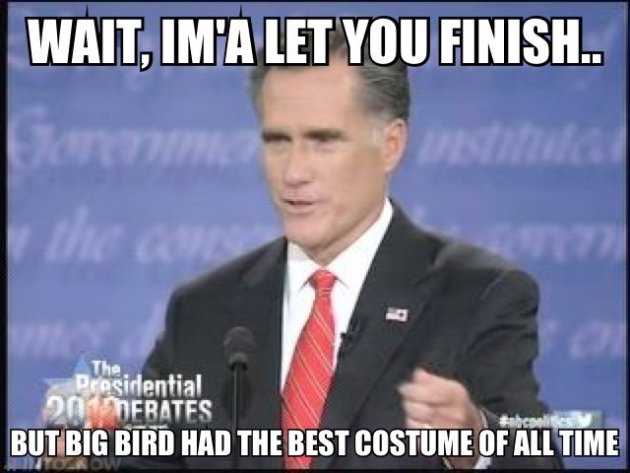
Now, for the main reason why I think that Mitt's vague "victory" was a hollow one- the one feature of Romney's performance that will capture the imagination of wags was his declaration of love for Big Bird (who is just the right height), though said love would best be described as creepy and stalkerish, seeing that Mitt wants to cut funding for PBS, the "home" of Big Bird. Already, the meme-generators are hard at work generating facetious images of Mitt. Some of these images are pretty damn devastating. Who the hell is going to remember Mitt's evasive generalizations about his fiscal policies once the social media wags start pushing the Big Bird narrative?

Poor Mitt, he may have won a doubleplusgood victory against Barack Obama in debate round one, but he lost the meme war against Big Bird. It won't be long before one of Mitt's team members tells Wolf Blitzer, "We have always been at war with Sesame Street."

Saturday, June 15, 2013

Airshow

This morning, I was making the rounds of my workplace in order to prepare the site for the day shift. In the course of my walkabout, I startled a black crowned night heron which frequents the site. As soon as the night heron took off, a smaller bird (it looked like a grackle to me, but the distance was considerable) began an aerial chase. The smaller bird relentlessly pursued the heron for a good two minutes, the chase encompassing a distance of perhaps a quarter-mile, taking in the perimeter of a small pond on site.

I knew that songbirds often mob predators such as hawks, and have witnessed such an occurrence on numerous occasions, but I'd never seen a wading bird receive such a mobbing. The chase ended when the heron finally landed on the shore of the pond, and the smaller bird took off.

All told, an excellent show was put on by these two avian adversaries, followed up by a fly-by of my personal favorite on-site bird, our cheeky resident belted kingfisher. Bravo, birdies!

Sunday, August 7, 2016

The Road to Birddom

This morning, I decided to buck my lazy Sunday morning trend and meet up with some friends at the American Museum of Natural History. I hadn't seen these particular friends in a while, and I was overdue for a renewal of my museum membership. After meeting my friends, we made a beeline for the fourth floor, which houses the dinosaurs. The greatest addition to the museum is a cast of the 122 foot long fossilized skeleton of a titanosaur found so recently that it hasn't received a species name.

After touring the fossil galleries, we headed over to the special exhibition Dinosaurs Among Us, which details the evolution of modern birds from dinosaur ancestors. The exhibit featured gorgeous fossils and models of the various feathered dinosaurs on display, including modern birds.

The largest model was a quilly Yutyrannus huali, a feathered tyrannosaur approximately thirty feet long and estimated at a ton-and-a-half in weight. Tyrannosaurs belong to the Coelurosauria clade (tyrannosaurs are discussed in this Secret Science Club lecture recap). There were numerous models representing smaller feathered dinosaurs, many of them were represented in the wonderful Feathered Dinosaurs exhibit of five years ago, which recreated the environment of China's glorious Liaoning Province fossil beds. Among the mounted specimens of modern birds was a forlorn dodo, extinct ninety years after being introduced to western science.

There were interactive exhibits detailing egg-laying, nesting, and childcare among the crocodilians, dinosaurs, and birds, including casts of dinosaur eggs and embryos and a 'life sized' dinosaur nest for kids to play dinosaur parent on. Among the dinosaur remains in this area were the fossils of two ovaraptosaurs assigned to the species Khaan mckennai and nicknamed 'Sid and Nancy'.

Another feature of the exhibit was a display on the adaptations which helped dinosaurs and birds to succeed, specifically brains and lungs. There was a video of a crow using its reasoning ability to obtain food floating in a U-shaped tube. Bird lungs, derived from the lungs of their dinosaur ancestors, are more efficient than mammalian lungs, with air sacs connected to the lungs via channels running through the hollow bones.

The exhibit also featured some charming activities for kids, including a 'build a bird' simulator, in which players could choose different options (heavy body vs light body, various sized wings and breastbones) to create different animals, ranging from a velociraptor to a penguin, to a strong-flying modern bird. Players would place the various puzzle pieces in the display, then hit a button to display an animation of their creation on a screen... a modern flying bird would reward the player with a nice 'flight' display.

After a few hours spent basking in the museum, it was time to wend my way back to the Bronx, where I had parked the car, and get myself to work. It's been a long day, longer than a typical lazy Sunday, and I'll be dragging my tailfeathers tomorrow, but renewing my membership and hitting this amazing exhibit totally makes it all worthwhile. If the exhibit comes to a museum near you, I highly recommend it, but I am a huge dinosaur nerd, by which I mean a bird nerd.

Tuesday, August 13, 2013

Feathered Foundling

This post is dedicated to Mr John Gray, who opens up his heart and his home to take in strays.

As regular readers of my blog know, my job is not a normal 9-to-5 gig at all. Well, that goes for most of my co-workers as well. Sunday night, when I arrived to work the Monday graveyard shift, my co-worker **REDACTED** greeted me with some excitement and told me that he had something he had to show me at once. Something which wasn't an emergency, but something of interest. He led me to one of the sheds on site and introduced me to George:


At some time on Sunday, a wild turkey (Meleagris gallopavo silvestris) (PDF link) showed up on site. The bird, a young male (the horn-like projection on the head or "snood", the dewlap, and the "beard" on his breast indicate that he's a boy), was so tame that he'd approach humans, so the Manager on Duty surmised that the bird had been taken and hand reared by someone who decided that he was getting too big to keep, and decided to "dump" it over our fence. Our property is spacious and verdant, and there have been previous incidents of unwanted animals, usually chickens, being heaved over the fence.

After the day shift left, my co-worker **REDACTED** received a call from his son, who was instructed by mom to run some errands, but needed to borrow some cash from dad. After the cash exchange and the supermarket run, the father-and-son team managed to herd the bird into one of our sheds for shelter during the night. The son dubbed the bird "George" (I didn't know he was old enough to know this meme).

George found a nice roost in the shed and settled down for the night. When it got light out, I headed out to the shed to check up on him. Here's a closeup of George's head, so you can see his varicoloured skin:


George generally looked healthy, but his tailfeathers and wing primaries were ragged, perhaps from confinement in a cage:


Before heading out to the shed, I grabbed some wind-fallen apples and cut them into chunks, which he eagerly gobbled up from my hand:


I left a note with the day shift so they knew to expect a turkey in the shed, and noted that he liked apple chunks. When I got to work at quarter to eleven, I noticed a cut-up apple near the shed, and am sure that they took a shine to him. Meanwhile, my co-worker **REDACTED** has made some calls to wildlife rehabilitators and tried to determine if any nature center would be able to take him in. He will probably need some acclimatization to the wild, but I think he could be relocated to one of our locations where there is a sizable flock of wild turkeys.

If it were feasible to ship George to Wales, I have no doubt John would welcome him to the farm.

POSTSCRIPT: When I work the graveyard shift, one of the last duties I have to perform is opening up the site for the day shift and for the influx of visitors. While performing these tasks, I checked out the log that the day shift keeps (it's in another building on site, so I didn't check it beforehand) and there's a note that George has been taken to the Bear Mountain Trailside Museum and Zoo. It's nice to know that he'll have a good home, shared with other rehabbed birds, and that he will be a marvel and a joy to the visitors. I sure hope a whole lot of kids will be charmed by him, just as I was.

Thursday, May 19, 2016

I'm not Walking on Eggshells

Last Sunday, on the job, I got 'killdeered'... while walking through a field, I was confronted by a small, noisy plover (Charadrius vociferus) that was doing its best impression of an injured bird. It's a sham performance, an ostentatious play-acting of physical distress inspired by evolutionary distress, the fear that a predator would find the bird's precious eggs. The display looked a lot like this:


Last night, while walking through the same field, I encountered the same bird, which started the same display. Being fond of these noisy, comical birds, which look like slightly malfunctioning windup toys, with their ultrafast gait and sudden stops, I immediately shifted into investigative mode. I proceeded through the field at an excruciatingly slow pace... it was like an inversion of navigating a minefield- a methodical creep while scanning for the slightest hint of anything out of the ordinary, not because of a fear of one's own destruction, but for a concern to avoid the destruction of an innocent family of charming neighbors. I was cast in the role of an unwilling Godzilla, liable to stomp on a happy home. My patience paid off, I was able to discover the minimalist excuse of a nest, scratched into a bare spot of ground:


I marked the vicinity of the spot by jamming a stick into the ground vertically, then placing two sticks parallel on the ground, flanking the nest. I left a note for one of the daytime managers, who has a soft spot in his heart for animals, so he could let everybody on the day shift know to give this particular spot a wide birth so as not to trample on these precious treasures, hidden so well in plain sight.

Wednesday, May 11, 2022

Pretty Is the Head Which Wears the Crown

I am fortunate in working at sites which encompass a lot of green space, representing a variety of environments.  In particular, we are blessed with a wonderful variety of birds.  For the past two years, we have had some of my personal favorites in residence, such as this gorgeous creature:


The picture is not great, it's difficult to take a mid-distance photograph against the reflective surface of the water, but the subject is amazing.  That is a black-crowned night heron (Nycticorax nycticorax), easily identifiable by virtue of its black crown, which trails two long white tassels.  These birds tend to be less shy than other wading birds.  Years ago, my favorite bird ever was a black-crowned night heron which would take up a position near a waterfall in the Bronx River, about a meter from the well-traveled biking/jogging/walking trail.  The prospects of a good meal outweigh all of the weird bipedal mammals in the vicinity.

This bird has found a spot in the local brook in which there's an inflow from the pond on our premises.  It's a good spot to hunt for critters washed downstream, so I am looking forward to seeing this bird in the coming months.

Tuesday, April 1, 2014

Drama in the Sky

This afternoon, I hauled my carcass to Tibbett's Brook Park for what passes for fresh air in the megalopolis and some sunshine (living at night isn't helping my complexion). In the course of rambling around the pond, I saw (gasp!) an osprey flying overhead:


I noticed something trailing from the bird's legs, which it was attempting to dislodge with a complicated set of aerial maneuvers. Thankfully, the bird was able to dislodge the thing, which turned out to be (yeah, you probably guessed it) a plastic bag:


The damn thing was too far from the shore to fish out of the pond. Thankfully, NYC, our big neighbor to the south, seems to be moving quickly toward forcing stores to charge ten cents per plastic bag, to reduce this waste that will outlive our nation (the Atlantic has its own floating garbage gyre now).

On a happy note, there is at least one osprey in Tibbett's Brook Park. At the mothership, the subject of DDT came up- DDT use led to severe declines in osprey populations. Seeing an osprey today was a happy coincidence.

Sadly, I missed the one shot which would have been best for this post. After its aerobatics to dislodge the plastic bag, the bird took a plunge into the water and emerged carrying what appeared to be a "liberated" goldfish (judging by the color) in its talons. Hopefully, the osprey will establish residency in the park... if that happens, I'll have to apologize to the wood ducks for not considering them my Tibbett's favorites anymore.

Sunday, January 3, 2016

Binging on Not-Quite-Nostalgia

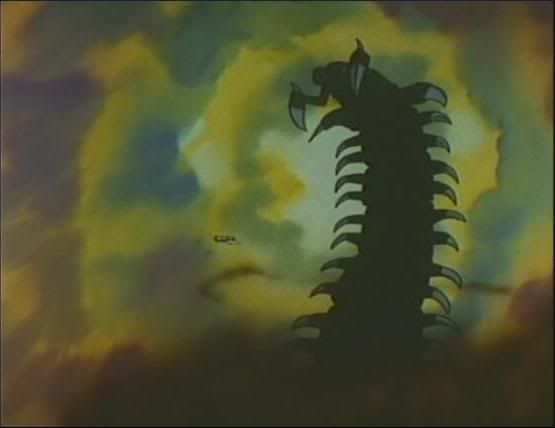
The current rage in the entertainment world is 70s Science-Fantasy nostalgia. I admit to being susceptible to the phenomenon myself... no, I haven't seen the new "Star Wars" movie, I'll probably get around to it later this month when the crowds thin out. I'm currently binge-watching the original Science Ninja Team Gatchaman, a Japanese superhero cartoon that aired from 1972-1974. If I were the type to label my posts, I'd label this one with a "Helping Smut" tag, because the redoubtable Smut Clyde admitted in a comment on a recent post:

I do not know this Gatchaman.

Now, Smut is the sort of guy who'd give this guy a run for his money in the "science fiction superfan" category, so I was a bit stunned to hear that Smut wasn't familiar with Gatchaman. Well, to tell the full truth, I wasn't really familiar with Gatchaman per se until recently... let me back things up a bit to explain.

In 1977, an American television producer named Sandy Frank attended a media conference in which he viewed a Japanese animated series about a five-person superhero team which he figured he could adapt for American television to capitalize on the post-Star Wars science-fantasy trend. The episodes, imported from Japan in non-sequential order, were severely edited to remove violent and "suggestive" content to conform to "kid friendly" American television standards, and diced and spliced to "paper over" continuity errors. In an effort to "Star Wars-fy the series by ten percent or so" and clear up plot ambiguities, additional animated sequences of a "cute robot" sidekick/advisor/narrator were added in, and the original superhero series was re-imagined as a space opera, complete with added footage showing the team traveling through space. Thus, the seminal 1978 American anime adaptation Battle of the Planets was born, complete with a new introduction and theme song by Bastard fave Hoyt Curtain. The intro pretty much sums up the series, a planet hopping galactic adventure featuring five young superheroes (voiced by such stalwarts as Casey Kasem and Janet Waldo, with Keye Luke also being a notable member of the cast) dressed in bird-themed costumes, kicking alien ass:


The show certainly made an impression on me and my friends (a friend of mine recently joked that she had a crush on the "bad boy" second-in-command character when she was a kid), featuring incredible design elements and memorable action sequences. It was also a complete butchery of the original series, something which I learned from a Japanese-born high school classmate of mine (I still have a couple of old copies of Weekly Shonen Jump he gave me). Not having the foresight to see that nothing would truly go away in the coming internet age, I asked him to reveal the differences between the original and the kid-friendly, post Star Wars American re-imaging, and was surprised to discover that the original series took place entirely on Earth, with an occasional foray into Earth-orbit, with the "aliens" of the original series being a human terrorist organization and the superhero team bearing the awesome moniker of "Science Ninja Team Gatchaman".

I hadn't thought of this series for years, but was reminded of it during the pre-Christmas drive to New York to Virginia with my brother and his family, when the main soundtrack to the road trip was the kids' favorite CD, a compilation of original music from various anime... one of the songs, a pretty pop number sung by a children's chorus, particularly stood out:


I recognized the name "Gatchaman" in the chorus, and I figured I'd have to hunt down the original series on the t00bz, where nothing ever fades away. I found a bunch of episodes dubbed into English in 2005, with all of the formerly bowdlerized content restored and I've been watching at least two episodes a day during quiet moments. The original series has a few themes that I don't recall in the original "space opera" American dub- environmental conservation, international unity, and the ideal of world peace and prosperity are promulgated by the series narrator and protagonists. I have to note here that Godzilla vs. the Smog Monster, with its environmentalist theme was released in 1971, making me wonder if there was a strong environmentalist movement in Japan at the time- at any rate, I really need to embed the totally groovy English version of the Godzilla vs the Smog Monster theme song (it's my blog, I can do what I want):


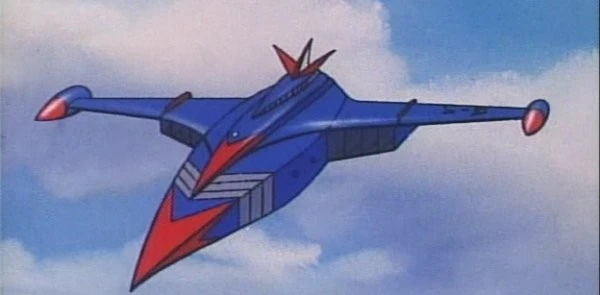
The heroes of the series, the eponymous Science Ninja Team, are four teenagers and one child of about ten, all trained in various "Science Ninja Techniques" by their mentor/adoptive father/Svengali Dr Nambu of the International Science Organization. The kids are tricked out in bird style- avian-themed superhero outfits with beaked helmets and bullet-and-explosion resistant "feathered" capes, the entire ensemble transforming into groovy teenage street clothes complete with bell bottoms and t-shirts bearing the wearer's rank (I'm one of five kids, it's a pity nobody released "G-Force" T-shirts back in 1978). The Science Ninja Team is the investigative unit and special forces team of the ISO, under Dr Nambu's authority (one plot point in early episodes is the need of the team to gain authorization to fire missiles). The kids are individually armed with outlandish signature weapons like razor-edged jet boomerangs, explosive bolas, and yo-yo bombs, and each has a signature vehicle which can be integrated into the team's supersonic, submersible superplane, the God Phoenix. The God Phoenix itself has an "ultimate" weapon, it can transform into a flaming flyer using the Science Ninja Technique: Firebird. Unlike the ultimate "Blazing Sword of "Voltron", which was used in every single episode, the "Firebird" isn't used in every "Gatchaman" episode. In most of the episodes, infiltration is portrayed as superior to frontal assault... these kids are "shadow warriors" after all, despite the brightly colored costumes.

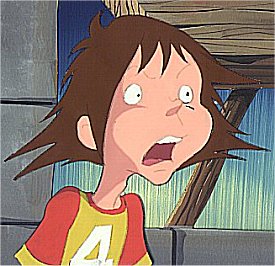
The team members themselves are the typical Five Man Band featured in a lot of anime- with Ken the Eagle being the earnest hero, Jo the Condor being the passionate hothead who longs to push the big red missile button, Jun the Swan being the level-headed female electronics and demolitions expert, Jinpei the Swallow being the little guy, and Ryu the Owl being the Big Guy.

The villains of the series belong to Galactor, a crime syndicate/terrorist group headed by Leader X, a mysterious figure which relays its plans to its human second-in-command, Berg Kattse, a villain that even the Joker would advise to "get some help". Berg Katse is gloriously kinky, a fop decked out in a vulpine mask, lip gloss, purple double-breasted tunic, and red thigh-high hooker boots:


The various lieutenants of Galactor wear outlandish outfits, such as ant costumes with Elizabethan ruffs and gull masks. Each of them comes to a bad end, either being blown up by the Science Ninja Team or being executed by the insane Berg Katse for their failure. The mooks are a mix of terrorists, criminals, brainwashed captives, with the children of long-time members raised up to be elite soldiers. While most of them are mowed down by the heroes with impunity, there are a couple of episodes which achieve a genuine pathos by touching on the lives of the children raised in the organization, with no real chance of an alternative. The central mysteries of the show involve the identities of Leader X and Berg Katse, and the reason for Galactor's virtually unlimited resources and extremely advanced technology (it seems like they are years ahead of the ISO in this area). In one episode, they seem to realize that their organization has a serious ninja gap with the ISO, so they also train a bird-themed ninja squad.

While the series pretty much started out as a "monster of the week" show, with the typical plot being Galactor's use of mecha (usually animal shaped) to steal natural resources. As the episodes progress, certain threads are expanded on, with the typical "monster robot _____ heist" plot being used less frequently. A common theme in mid-series episodes is Galactor's attempts to foil the International Science Organization's attempts to develop non-polluting energy and to design clean, livable communities. One particular theme that runs through several episodes is the development of a "Mantle Project" to run cities with geothermal power and to reduce the danger posed by earthquakes and volcanic eruptions. As the plots become more complex, cumulative character development takes place- we learn the reason for Jo's thirst for revenge against Galactor, and of Ken's yearning to know more about the fate of his father, a test pilot who disappeared while on a mission. Jun and Jinpei's relationship as adopted siblings is expanded on, and Ryu's family life (he is the only non-orphan on the team) comes into play. In several episodes, internal tensions among the team members come up, though cohesion eventually wins the day. I'm forty-two episodes (out of 105) in now, and Jo has the most complex character arc.

The visuals in the series are gorgeous, with lovely backgrounds and clean lines. The character design ranges from realistic to stylized (the "big eyes, small mouth" style common to anime), to cartoonish (it seems that the younger the character, the less realistic the design). The various mechanical designs in the show are lavishly rendered. The version of the show that I'm watching is the 2005 English dub, which hilariously has the kids using 70s slang like "groovy" and "dyn-o-mite", and on at least one occasion, Ken urges the team to "stay fresh and frosty" in a time of peril. The salty language of original is kept, with the characters sometimes saying "damnit". In one episode, Ken observes a dangerous volcanic eruption, saying, "Holy hot shit the lava's flowing right towards the city." I don't remember that from the first English dub!

Regarding the portrayal of the characters, I have to note that Jun, the female member of the team, is portrayed as a full equal, perhaps the smartest and most competent member of the team. There is an element of fanservice to the character- while kicking ass, or being thrown around the God Phoenix by shock waves or risky maneuvers, there is almost invariably a panty shot. I'm not really a big fan of cartoon titillation (though I can't say I'm 100% against it), and it seems innocent enough, but it happens with some frequency in the show. In the grand scheme of things, I think the overall character portrayal outweighs the occasional up-skirt shot, and the guys are portrayed in skin-tight uniforms, after all...

Watching the original series is not-quite-nostalgia, it's about 75% distinguishable as the series I watched as a kid, but there are some interesting revelations... it's kind of like having an old school friend of yours tell you that he wore lacy panties under his jeans throughout his high school years and, oh, he had a side job kicking the crap out of gangsters. It's a lot of fun recalling certain scenes from the old series and then having my expectations upended.

Some of the plots are really weird, with one of my all-time favorites being "The Gluttonous Monster Ibukron", which involves a scheme by Berg Katse to steal the world's sugar supply in order to sow confusion:


Another trippy episode is "The Neon Giant that Smiles in the Dark", which comes across as a tribute to "Scooby Doo", complete with jokey ending:


I'm glad I finally took the time to track down this series, which was one of the landmarks of America's import of Japanese animation. As I noted before, it's not quite a nostalgia trip. The series is a blast, a glorious mashup of American superhero comics, James Bond films, and kaiju movies. The soundtrack is outstanding, with great incidental music and instantly recognizable themes for the various characters. I wonder what would have happened if it had been imported to the U.S. before the Star Wars craze... oddly enough, there wasn't any merchandising that I recall here in the 'States, and the current models are priced for collectors, often costing several hundreds of dollars. I imagine I would have gone nuts if I'd seen a similar toy under the Christmas tree back in '76 or '7.

I almost want to apologize for this post, I can see your eyes glazing over in my mind's eye... I'm not an otaku, I swear! I have a life. Just now, though, it involves watching sixty-five more episodes of Science Ninja Team Gatchaman. NERD GO!!!!!

Wednesday, February 17, 2010

Park of Horrors?

Every winter, when the Hudson River freezes up north, the bald eagle population of the upper Hudson Valley migrates to more southerly open water, sometimes as far south as the north end of Manhattan. As Haliaeetus leucocephalus is my totem bird (much like the naked mole rat is my totem rodent, with it's glabrousness), I make at least one winter pilgrimage each year to see the majestic eagles by the mighty Hudson (layin' it on thick here). This year, I made the trip twice- the first time seeing a perching juvenile and an adult in flight (both in Croton Point Park in Croton-on-Hudson). My second eagle watching trip took place, appropriately enough, on Presidents' Day. I started off by driving to Charles Point Park on the Peekskill/Buchanan border- immediately north of the Indian Point nuclear power plant* (the park's Fleischmann's Pier is a major destination for local eagle watchers). I saw a juvenile eagle and an adult eagle sitting on ice floes in the middle of the river- too far to get a photograph. My next planned destination was George's Island Park in Montrose, but some friendly eagle watchers informed me that they had just come from there, and no birds were to be seen. I decided to hit Route 9 (the road starts off as Broadway- yes, that Broadway- and extends to the Canadian border) and head south to Croton Point Park, and spied a magnificent juvenile eagle flying overhead. I didn't see any eagles at Croton Point Park, but I did happen to see some pretty outré things...

Croton Point Park is a "capped" landfill that juts into the Hudson River like a claw. One can occasionally discern its origins by coming across an old brick or cinder block by the strand. Well, on my trips to the park, I came across more than old cinder blocks.

Here's a dead sturgeon, inexplicably perched on an ice floe, how the sturgeron got there, I really don't know (not all of these will rhyme, I can't be arsed poetasting here):


Here we have the wing of a bird, judging from the size of the wing and the colors of the plumage, I would guess that it belonged to a red-tailed hawk:


Finally, we have yet another eldritch shrine or fetish object. This one looks as if it had been constructed by a troop of girl scouts who worship Cthulhu. It is covered in shiny plasic beads, and the white object at the top is the mandible of a canid. The prominent "G", if I am correct, would stand for Great Old Ones:


Now, who's up for an overnight camping trip in Croton Point Park?

Postscript: I never did get any beautiful pictures of majestic, soaring eagles... that's more of a job for a guy like Thunder.

Sunday, July 12, 2015

Bright Early Mourning?

Yesterday, I had a close encounter with a fledgling bird that was trying out its wings. The little thing took off when it saw me round a corner, but only flew a couple of feet before it perched and regarded me with a bright onyx eye:


Judging from its size and the shape of its bill, I'd have to guess that it is a fledgling mourning dove (Zenaida macroura. If you aren't familiar with Aunt Snow's blog, it's named in honor of a mourning dove sighting. The doves are common around here, and they are lovely, shy creatures. On one memorable occasion, I got closer to one than I did yesterday- in fact, I grabbed an exhausted one which had gotten into a greenhouse at work so I could release it outdoors. Luckily, it was unhurt, and was able to fly off. Unluckily, I had my phone in the pocket corresponding to the hand with which I had grabbed the bird, so I couldn't take a photograph of it, a mistake which I made sure not to repeat.

Sunday, May 3, 2020

Noisy Neighbor, Protective Parent

In a comment on my last post, reader Anathema Device mentioned the plovers that play chicken with the cars in the neighborhood. The timing of the comment was fortuitous, because I've got plover content... After last night's shift change, I walked through the parking lot so I could close off the exit, and while walking on a median, I was chided by a loud, irate parent. Yep, it's perhaps my favorite season, killdeer (Charadrius vociferus) season, and the local killdeer had scraped out their comically inept nest on the median. Immediately, I went into 'killdeer nest detection' mode, and inched along, bearing the angry chattering, until I'd located the precious eggs.

When dawn arrived, I located two traffic cones in order to mark the location the nest, which as you can see, is a perfunctory affair:


Sure, enough, there were the typical four perfect eggs, camouflaged as rocks, and nestled between two exposed tree roots:


Killdeer are famous for their 'broken wing' behavior, feigning injury to lure predators from their nests. When dealing with large herbivores, who pose no threat to an adult bird, but a terrible, though inadvertent, trampling hazard to a nest, the birds straight up charge and stand their ground, seemingly fearless. Since I wasn't making any threatening overtures, but was perilously close to the nest as I flanked it with the cones, this brave bird remained at my feet, so close that the red rims of its eyes are visible in this photograph:


If all goes well, and I'm looking at YOU, local raccoon population, we'll have four adorable, noisy fuzzballs on stilts running around the site in a month and a half or so.

Sunday, December 4, 2016

This Is Why Sitcoms Aren't Educational

Today, I am working in a site I don't work at all that often... it's sort of in the hinterlands, although still well within the 'commute to New York City' radius. I arrived at work shortly before sundown, and was greeted by one of the resident turkeys flying to roost in the branches of a tall oak tree for the night:


Upon closer look, I saw the rest of the flock (for the record, a bunch of domesticated turkeys is known as a rafter or gang) could be spied roosting in the same tree, about fifty or sixty feet above the ground:


As God is my witness, I know turkeys can fly:


Of course, these are the lean, muscular wild turkeys (Meleagris gallopavo)... to be fair to the WKRP writers, the overfed, overbred domesticated turkeys would probably plummet to the earth unlike their wild forebears.

In the interest of full disclosure, I failed to photograph the other bird which immediately caught my eye when I arrived, the first bald eagle I've seen this season... I did get to see it take wing and fly off over the adjacent tributary of the Hudson.

Legend has it that the turkey was in the running to be our national bird, alongside the bald eagle. Just imagine, if things had gone otherwise, we might be getting e-mailed pictures of crying turkeys from our wingnut acquaintances.

Saturday, April 19, 2014

Lunacy on the Job

Despite the fact that I will be ribbed for this, I am happy to report that there is a loon on the premises at work. This afternoon, I found a common loon (in contrast, I'm an uncommon loon) fishing in a small body of water on site:


Here's another shot (poorly focused... I blame the phone!) to show the distinctive white breast:


Again, this is the first time I've seen a common loon on site... indeed the first time I've seen one in the area (I am very familiar with loons from the "great pond" by the family vacation home in Maine). The bird is merely stopping here in the middle of migrating to the great northern lakes, but the enchanting quality the bird lends to the site will linger for a long time in my mind.

Two loons in one week... pretty amazing!

Friday, October 28, 2016

Get a Brain, Moranodon!

Longtime readers of this blog will know that I am enamored of dinosaurs. I never quite grew out of that dinosaur mania that all young children gain and some of us never lose. Needless to say, I was ecstatic to hear the news that a probable fossil of a dinosaur brain was recently discovered. The fossil, thought to be that of an ornithischian dinosaur related to Iquanodon, appears to be similar to the brains of crocodilians and birds, the closest living relatives of the dinosaurs:


One seemingly odd thing about the dinosaurs is that modern birds are descended from the saurischian, or 'lizard-hipped' dinosaurs rather than the ornithischian or 'bird-hipped' dinosaurs. The bird hip of the ornithischians is thought to have a 'swept back' pubis in order to accommodate big intestines in order to cope with a vegetable diet. The maniraptoran dinosaurs, including the birds, also have backwards pointing pubic bones... if I recall correctly, this is thought to be an adaptation to improve balance.

Modern birds aren't that closely related to the Iquanodon-like dinosaur which had its brain structure preserved, so extrapolating intelligence for this dinosaur is a risky enterprise. That being said, certain birds exhibit a remarkable degree of intelligence. Meanwhile, there is plenty of evidence that dinosaurs cared for their young (in one case of tragic character assassination, Oviraptor was dubbed an 'egg thief' because a specimen was found sitting on its own nest). I personally have no doubt that dinosaurs were not the stupid, ungainly creatures that mammal supremacists deemed them to be through much of the 20th century. The dinosaurs evolved into diverse forms and held their own for hundreds of millions of years and still remain in the form of birds, they had to have something going for them to be so successful for so long.