Predictably, the Trump Maladministration ousted EPA scientists from academia and replaced them with fossil fuel and chemical industry flacks back in 2017, so this is a corrective measure. Of course, when Republicans do this, it's not political- only Democrats are so churlish to politicize science (or morals, or 'family values' or...). GOP representatives James Comer and Ralph Norman had the gall to write this to EPA chief Michael Regan:
“Traditionally science advisory boards are bipartisan panels used to provide advice to the administrator. Unfortunately, it appears the Biden administration is continuing to purge officials in the government who do not share its political beliefs. The midterm firing of science advisory board members within the first months of a new administration .... raises serious concerns about the politicization of the EPA.”
Here is where I note that the same 'researchers' who are trying to cast doubt on the connection between climate change and the burning of fossil fuels were the monsters who tried to obfuscate the link between cigarette smoking and cancer. There's no need to give these prevaricators a seat at the table when discussing such a crisis as global climate change. They just aren't good faith actors, and they would do their level best to derail any discussion of climate crisis mitigation.
Joe Biden has the Herculean task of cleaning out the Augean Stable that Former Guy turned the government into, and thankfully he's willing to do the necessary work. Starting with four dozen hired guns posing as scientists gives me hope that he is up to the challenge.
Even more importantly, President Biden signaled his commitment to science by elevating the role of Science Advisor to a cabinet position. The only thing that would make me more excited would be Biden's formation of a Science Ninja Team:
Last night, I headed down to the beautiful Bell House, in the Gowanus section of Brooklyn, for this month's Secret Science Club lecture. This lecture featured the triumphant return of Dr Priyamvada Natarajan, of Yale University's departments of astronomy and physics, the Niels Bohr Institute in Copenhagen, and the University of Delhi, India, to the Secret Science Club event horizon. In 2014, Dr Natarajan kicked off the Secret Science Club North with a lecture about dark matter. Last night, Dr Natarajan's lecture was in support of her new book, Mapping the Heavens: The Radical Scientific Ideas That Reveal the Cosmos.
After a brief autobiographical introduction, detailing her childhood in India and her education at MIT and Cambridge University's Trinity College, Dr Natarajan gave a brief overview of science. Science is in the business of rethinking ideas- discarding or refining them as needed. She characterized the current time as a "golden age of cosmology", an amazing confluence of theory and technology, with astronomical discoveries occurring every day. Dr Natarajan described science as the arc of acceptance of radical ideas and stressed the need to demystify the techniques of science, which is the best way to understand nature and to make sense of the universe. Initially, there tends to be pushback towards new ideas, until a preponderance of data convinces skeptics. Fundamental to science is the interplay of ideas and instruments.
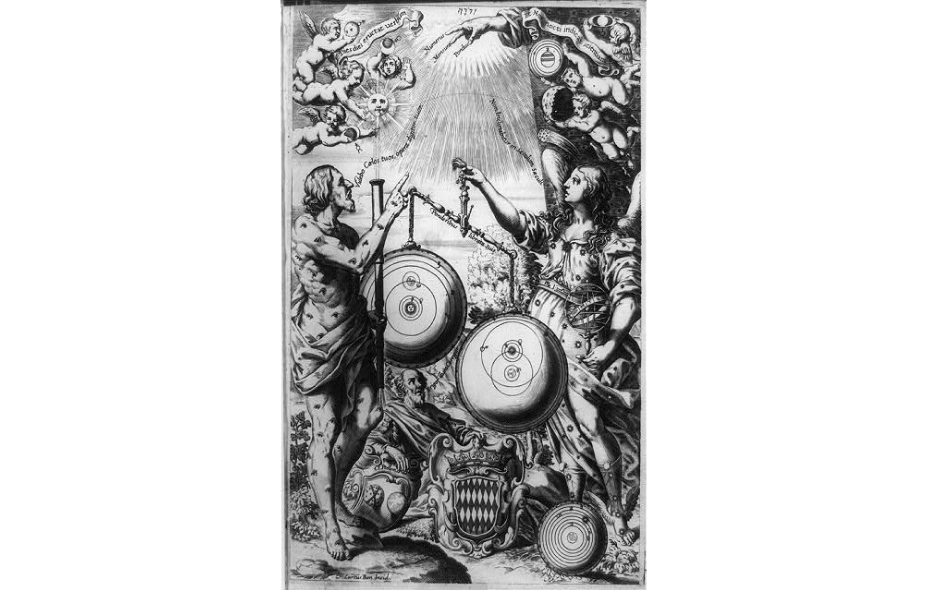
Dr Natarajan gave a brief overview of the history of astronomy, displaying images of the Nebra sky disc and the Venus tablet of Ammisaduqa as early astronomical artifacts. She then displayed an image from Riccioli's Almagestrum Novum depicting the muse Urania discarding the Ptolemaic cosmology and weighing the semi-geocentric model of Tycho Brahe (with the planets orbiting the sun and the whole orbiting the earth, which Riccioli favored) against the wholly heliocentric Copernican model:
Dr Natarajan then quickly pivoted to modern astronomy, specifically the mapping of the universe- citing the Hubble space telescope as being instrumental (HA). The main goals of astronomy are describing the contents, expansion, and eventual fate of the universe. To illustrate this combination of goals, she cited the example of the Cosmic Microwave Background which is a relic of the time shortly after the Big Bang.
Dr Natarajan's lecture then focused on two particular topics- dark matter and black holes. She contrasted the discovery of these two enigmatic phenomena- the existence of dark matter was determined through empirical observation (gravitational effects on other astronomical objects) and the existence of black holes was determined through theoretical modeling.
The topic shifted to dark matter, which was the subject of her fantastic Secret Science Club North lecture. The universe is composed of approximately 70% dark matter, approximately 25% dark matter, and approximately 5% baryonic matter. The existence of dark matter was first proposed by Fritz Zwicky in order to explain the observed behavior of galaxies in the Coma Cluster. In the 1970s, Vera Rubin and Kent Ford observed unexpectedly steady rates in the rotation of galaxies, evidence that there was a 'halo' of matter around these galaxies that balanced out the greater concentration of baryonic matter at their core. While dark matter has never been observed, it has an impact on dynamics- the motion of stars and galaxies and an impact on light rays. In a solar system, the dominant gravity is that of its star. In a galaxy, there is a lot of 'gravitating' dark matter at the edge. Dark matter is lumped and clumped and smeared all over galaxies, but has no interaction with other matter, except through its mass.
Light is both a wave and a particle, it can be bent through a process known as gravitational lensing. This gravitational lensing can be used to observe far distant astronomical features in galaxy clusters. The current model of the universe posits filaments of dark matter with galaxies at the intersections of filaments. The nature of dark matter is encapsulated in its smoothness- using its lensing effects on observable astronomical features, dark matter can be mapped with a high degree of resolution. It is thought that dark matter is cold, with few collisions between particles... Dr Natarajan noted that she was somewhat disappointed that this was so.
While dark matter has not been observed to interact with baryonic matter, except through gravitational forces, there are attempts to detect it- the Large Underground Xenon experiment is an attempt to detect WIMPS (weakly interacting massive particles), which are considered candidates for dark matter. So far, these haven't been found- we are stuck with cold dark matter, but we don't know what it is.
The topic then shifted to the second major focus of the lecture- how black holes became real. Black holes were predicted mathematically, the mathematical models were borne out observationally, to the extent that gravitational waves were recently detected. In science, mathematical models have to be squared with actual objects. Dr Natarajan wryly noted that the term 'black hole' entered the English lexicon in 1756, to describe the Black Hole of Calcutta, the proverbial place of no return. In 1783, John Michell proposed a dark star, and object so massive that light (which in the original Newtonian model was thought to have mass) could not escape its gravitational field. According to Einstein's Theory of General Relativity, mass bends spacetime, theoretically, an object could be so massive that it effectively 'punctured' spacetime. The term black hole was applied to this astronomical phenomenon by John Wheeler.
The first observational evidence of black holes came in the form of mysterious objects dubbed 'quasars' which have been determined to be X-ray emissions from black holes. Black holes are collapsed stars so massive that light cannot escape their gravity once past the event horizon, so dense that, were the Earth to collapse into a black hole, it would measure one cubic centimeter in volume. According to General Relativity, mass bends the curvature of spacetime into 'holes'- the more mass, the deeper the hole. Black holes are infinitely deep, the laws of physics that we know break down in the vicinity of a black hole. The curvature of spacetime due to gravity was described in Einstein's field equations- Karl Schwartzschild proposed a solution describing slowly rotating spherical objects and New Zealander Roy Kerr proposed a solution modeling gravitational fields around supermassive rotating objects.
Major questions remain about black holes... boiling down to three 'F's'- formation, fueling, and feedback. How do they form? How do they grow? What do they do? Where do black holes reside? Does every galaxy harbor a supermassive black hole at its center? What are the 'seeds' of black holes? Do they result from direct collapse? How do they grow? The formation of a black hole would have to involve a lot of gas- everything would have to be right for one to form. Gravitational waves were discovered emanating from colliding black holes by LIGO, the Laser Interferometer Gravitational-Wave Observatory. LISA, the Laser Interferometer Space Antenna, is a project to develop a more sensitive gravitational wave detector.
As Dr Natarajan wrapped up her lecture, she displayed a NASA animation simulating a stellar mass black hole, a groovy visual accompaniment to a thoroughly groovy lecture:
The lecture was followed by a Q&A in which the Bastard was unable to get a question in. One of the most involved questions involved dark energy, which Dr Natarajan likened to the 'gas pedal of the universe', resulting in the increasing speed of the universe's expansion. She postulated that dark energy is a property of spacetime, but that more research was necessary. In the course of the Q&A, she uttered a line which cannot be stressed enough, so I'm putting in all-caps: NOTHING CAN SUPPLANT THE POWER OF DATA.
Dr Natarajan's return to the Secret Science Club, and her debut at the beautiful Bell House, was triumphant one. Kudos to Dr Natarajan, Dorian and Margaret, and the staff of the beautiful Bell House. For a taste of Dr Natarajan's scientific virtuosity, here's a video of the good doctor giving a brief lecture on the subject at hand:
Also, I'd like to give a hearty high-five to Dr Natarajan for the publication of Mapping the Heavens... congratulations! It's nice to see someone who can so perfectly articulate these cosmological concepts on a level that the layperson can understand. At the end of the lecture, Dr Natarajan addressed the packed house and quipped, "I thought I'd be speaking to ten people." I chided her afterwards by noting that her Symphony Space lecture was delivered to a full house. The good doctor has star power, which is entirely appropriate for an astrophysicist. Again, congratulations are in order.
The president is an ignoramus and, like most ignoramuses, has an inflated view of his own cognitive abilities. The fact that he doesn't even seem to care that there is no-one guiding a coherent science policy is rather depressing to me, though at least he isn't putting fundamentalist loons in charge of science policy... yet.
The current rage in the entertainment world is 70s Science-Fantasy nostalgia. I admit to being susceptible to the phenomenon myself... no, I haven't seen the new "Star Wars" movie, I'll probably get around to it later this month when the crowds thin out. I'm currently binge-watching the original Science Ninja Team Gatchaman, a Japanese superhero cartoon that aired from 1972-1974. If I were the type to label my posts, I'd label this one with a "Helping Smut" tag, because the redoubtable Smut Clyde admitted in a comment on a recent post:
I do not know this Gatchaman.
Now, Smut is the sort of guy who'd give this guy a run for his money in the "science fiction superfan" category, so I was a bit stunned to hear that Smut wasn't familiar with Gatchaman. Well, to tell the full truth, I wasn't really familiar with Gatchaman per se until recently... let me back things up a bit to explain.
In 1977, an American television producer named Sandy Frank attended a media conference in which he viewed a Japanese animated series about a five-person superhero team which he figured he could adapt for American television to capitalize on the post-Star Wars science-fantasy trend. The episodes, imported from Japan in non-sequential order, were severely edited to remove violent and "suggestive" content to conform to "kid friendly" American television standards, and diced and spliced to "paper over" continuity errors. In an effort to "Star Wars-fy the series by ten percent or so" and clear up plot ambiguities, additional animated sequences of a "cute robot" sidekick/advisor/narrator were added in, and the original superhero series was re-imagined as a space opera, complete with added footage showing the team traveling through space. Thus, the seminal 1978 American anime adaptation Battle of the Planets was born, complete with a new introduction and theme song by Bastard fave Hoyt Curtain. The intro pretty much sums up the series, a planet hopping galactic adventure featuring five young superheroes (voiced by such stalwarts as Casey Kasem and Janet Waldo, with Keye Luke also being a notable member of the cast) dressed in bird-themed costumes, kicking alien ass:
The show certainly made an impression on me and my friends (a friend of mine recently joked that she had a crush on the "bad boy" second-in-command character when she was a kid), featuring incredible design elements and memorable action sequences. It was also a complete butchery of the original series, something which I learned from a Japanese-born high school classmate of mine (I still have a couple of old copies of Weekly Shonen Jump he gave me). Not having the foresight to see that nothing would truly go away in the coming internet age, I asked him to reveal the differences between the original and the kid-friendly, post Star Wars American re-imaging, and was surprised to discover that the original series took place entirely on Earth, with an occasional foray into Earth-orbit, with the "aliens" of the original series being a human terrorist organization and the superhero team bearing the awesome moniker of "Science Ninja Team Gatchaman".
I hadn't thought of this series for years, but was reminded of it during the pre-Christmas drive to New York to Virginia with my brother and his family, when the main soundtrack to the road trip was the kids' favorite CD, a compilation of original music from various anime... one of the songs, a pretty pop number sung by a children's chorus, particularly stood out:
I recognized the name "Gatchaman" in the chorus, and I figured I'd have to hunt down the original series on the t00bz, where nothing ever fades away. I found a bunch of episodes dubbed into English in 2005, with all of the formerly bowdlerized content restored and I've been watching at least two episodes a day during quiet moments. The original series has a few themes that I don't recall in the original "space opera" American dub- environmental conservation, international unity, and the ideal of world peace and prosperity are promulgated by the series narrator and protagonists. I have to note here that Godzilla vs. the Smog Monster, with its environmentalist theme was released in 1971, making me wonder if there was a strong environmentalist movement in Japan at the time- at any rate, I really need to embed the totally groovy English version of the Godzilla vs the Smog Monster theme song (it's my blog, I can do what I want):
The heroes of the series, the eponymous Science Ninja Team, are four teenagers and one child of about ten, all trained in various "Science Ninja Techniques" by their mentor/adoptive father/Svengali Dr Nambu of the International Science Organization. The kids are tricked out in bird style- avian-themed superhero outfits with beaked helmets and bullet-and-explosion resistant "feathered" capes, the entire ensemble transforming into groovy teenage street clothes complete with bell bottoms and t-shirts bearing the wearer's rank (I'm one of five kids, it's a pity nobody released "G-Force" T-shirts back in 1978). The Science Ninja Team is the investigative unit and special forces team of the ISO, under Dr Nambu's authority (one plot point in early episodes is the need of the team to gain authorization to fire missiles). The kids are individually armed with outlandish signature weapons like razor-edged jet boomerangs, explosive bolas, and yo-yo bombs, and each has a signature vehicle which can be integrated into the team's supersonic, submersible superplane, the God Phoenix. The God Phoenix itself has an "ultimate" weapon, it can transform into a flaming flyer using the Science Ninja Technique: Firebird. Unlike the ultimate "Blazing Sword of "Voltron", which was used in every single episode, the "Firebird" isn't used in every "Gatchaman" episode. In most of the episodes, infiltration is portrayed as superior to frontal assault... these kids are "shadow warriors" after all, despite the brightly colored costumes.
The team members themselves are the typical Five Man Band featured in a lot of anime- with Ken the Eagle being the earnest hero, Jo the Condor being the passionate hothead who longs to push the big red missile button, Jun the Swan being the level-headed female electronics and demolitions expert, Jinpei the Swallow being the little guy, and Ryu the Owl being the Big Guy.
The villains of the series belong to Galactor, a crime syndicate/terrorist group headed by Leader X, a mysterious figure which relays its plans to its human second-in-command, Berg Kattse, a villain that even the Joker would advise to "get some help". Berg Katse is gloriously kinky, a fop decked out in a vulpine mask, lip gloss, purple double-breasted tunic, and red thigh-high hooker boots:
The various lieutenants of Galactor wear outlandish outfits, such as ant costumes with Elizabethan ruffs and gull masks. Each of them comes to a bad end, either being blown up by the Science Ninja Team or being executed by the insane Berg Katse for their failure. The mooks are a mix of terrorists, criminals, brainwashed captives, with the children of long-time members raised up to be elite soldiers. While most of them are mowed down by the heroes with impunity, there are a couple of episodes which achieve a genuine pathos by touching on the lives of the children raised in the organization, with no real chance of an alternative. The central mysteries of the show involve the identities of Leader X and Berg Katse, and the reason for Galactor's virtually unlimited resources and extremely advanced technology (it seems like they are years ahead of the ISO in this area). In one episode, they seem to realize that their organization has a serious ninja gap with the ISO, so they also train a bird-themed ninja squad.
While the series pretty much started out as a "monster of the week" show, with the typical plot being Galactor's use of mecha (usually animal shaped) to steal natural resources. As the episodes progress, certain threads are expanded on, with the typical "monster robot _____ heist" plot being used less frequently. A common theme in mid-series episodes is Galactor's attempts to foil the International Science Organization's attempts to develop non-polluting energy and to design clean, livable communities. One particular theme that runs through several episodes is the development of a "Mantle Project" to run cities with geothermal power and to reduce the danger posed by earthquakes and volcanic eruptions. As the plots become more complex, cumulative character development takes place- we learn the reason for Jo's thirst for revenge against Galactor, and of Ken's yearning to know more about the fate of his father, a test pilot who disappeared while on a mission. Jun and Jinpei's relationship as adopted siblings is expanded on, and Ryu's family life (he is the only non-orphan on the team) comes into play. In several episodes, internal tensions among the team members come up, though cohesion eventually wins the day. I'm forty-two episodes (out of 105) in now, and Jo has the most complex character arc.
The visuals in the series are gorgeous, with lovely backgrounds and clean lines. The character design ranges from realistic to stylized (the "big eyes, small mouth" style common to anime), to cartoonish (it seems that the younger the character, the less realistic the design). The variousmechanicaldesigns in the show are lavishly rendered. The version of the show that I'm watching is the 2005 English dub, which hilariously has the kids using 70s slang like "groovy" and "dyn-o-mite", and on at least one occasion, Ken urges the team to "stay fresh and frosty" in a time of peril. The salty language of original is kept, with the characters sometimes saying "damnit". In one episode, Ken observes a dangerous volcanic eruption, saying, "Holy hot shit the lava's flowing right towards the city." I don't remember that from the first English dub!
Regarding the portrayal of the characters, I have to note that Jun, the female member of the team, is portrayed as a full equal, perhaps the smartest and most competent member of the team. There is an element of fanservice to the character- while kicking ass, or being thrown around the God Phoenix by shock waves or risky maneuvers, there is almost invariably a panty shot. I'm not really a big fan of cartoon titillation (though I can't say I'm 100% against it), and it seems innocent enough, but it happens with some frequency in the show. In the grand scheme of things, I think the overall character portrayal outweighs the occasional up-skirt shot, and the guys are portrayed in skin-tight uniforms, after all...
Watching the original series is not-quite-nostalgia, it's about 75% distinguishable as the series I watched as a kid, but there are some interesting revelations... it's kind of like having an old school friend of yours tell you that he wore lacy panties under his jeans throughout his high school years and, oh, he had a side job kicking the crap out of gangsters. It's a lot of fun recalling certain scenes from the old series and then having my expectations upended.
Some of the plots are really weird, with one of my all-time favorites being "The Gluttonous Monster Ibukron", which involves a scheme by Berg Katse to steal the world's sugar supply in order to sow confusion:
Another trippy episode is "The Neon Giant that Smiles in the Dark", which comes across as a tribute to "Scooby Doo", complete with jokey ending:
I'm glad I finally took the time to track down this series, which was one of the landmarks of America's import of Japanese animation. As I noted before, it's not quite a nostalgia trip. The series is a blast, a glorious mashup of American superhero comics, James Bond films, and kaiju movies. The soundtrack is outstanding, with great incidental music and instantly recognizable themes for the various characters. I wonder what would have happened if it had been imported to the U.S. before the Star Wars craze... oddly enough, there wasn't any merchandising that I recall here in the 'States, and the current models are priced for collectors, often costing several hundreds of dollars. I imagine I would have gone nuts if I'd seen a similar toy under the Christmas tree back in '76 or '7.
I almost want to apologize for this post, I can see your eyes glazing over in my mind's eye... I'm not an otaku, I swear! I have a life. Just now, though, it involves watching sixty-five more episodes of Science Ninja Team Gatchaman. NERD GO!!!!!
Dr Kalirai began his talk by asking, what is our place in the universe? His quick answer was that it depends on when an individual asked that question. He followed up with a quick overview of the history of astronomy, beginning with the ancient Egyptians, who aligned their pyramids with the circumpolar stars and used astronomical observation to determine the times of planting and harvest. He then moved on to a quick discussion of Greek philosophers and mathematicians, such as Pythagoras and Aristotle, who believed that earthly standards could be applied to celestial bodies. He singled out Hipparchus as an avid mapper of the changing positions of celestial bodies, and Ptolemy, whose geocentric model of the universe held sway for fifteen-hundred years, until Copernicus publicized his heliocentric model. Copernicus' model was corroborated by Galileo's discovery of moons orbiting Jupiter. By shifting the center of the universe away from the Earth, our position in the universe was considerably diminished.
In 1920, the Great Debate between Harlow Shapley and Heber Curtis regarding the nature of spiral nebulae took place- Shapely believed that spiral nebulae were formations within the Milky Way, which comprised the totality of the universe, while Curtis believed that spiral nebulae were additional galaxies outside the Milky Way, which would necessitate a vastly larger universe and a Milky Way which was merely one galaxy among many. Edwin Hubble was able to determine that spiral nebulae lay outside the Milky Way by observing a certain type of star in several nebulae, indicating that they lay outside our galaxy.
The next great leap forward in astronomy would require a telescope in space, outside of Earth's atmosphere- in 1946, Lyman Spitzer wrote a paper titled, "Astronomical Advantages of an Extra-Terrestrial Observatory". Within fifty years, the Hubble space telescope was sent into orbit, science fiction became science fact. Dr Kalirai then proceeded to show us some wonderful images from Hubble depicting the life of stars such as the explosion of a star and the end of a supernova. Stars are largely composed of hydrogen and helium- the heavier elements were formed in the core of stars and are disseminated throughout the universe by the explosion of older stars. The Earth formed in a region 'polluted' by supernovae, and we are all made of stars. He also showed lovely images of the Hubble Deep Field, which gave us a glimpse of the thousands and thousands of galaxies in the universe.
The talk then shifted to the topic of Einstein's Theory of General Relativity. In 1905, Albert Einstein published his Special Theory of Relativity. The two main postulates of Special Relativity are that the laws of physics are independent of a frame of reference and that light has a constant speed independent of the direction and motion of its source. According to Special Relativity, time and space are one (physicists speak of spacetime), and that time slows down for objects in motion (time dilation). Special Relativity was thought to apply only to systems in which there is no acceleration, in which speed is constant.
Dr Kalirai then noted that there are five basic pieces of evidence that backed General Relativity. First, the gravity of the sun bends light from objects behind it, an effect observed by astronomer Arthur Eddington during a solar eclipse in 1919, during which it was observed that stars behind the sun could be seen. The second piece of evidence is the observed precession (rotation) of Mercury, which deviates from the precession predicted by Newtonian models. The third piece of evidence supporting General Relativity is gravitational lensing- the bending of light from distant sources by intervening mass (the subject of the first Secret Science Club North lecture was the use of gravitational lensing to infer the presence of masses of dark matter). The fourth piece of evidence in support of General Relativity is stellar life cycles and black holes. Small stars, approximately the size of our sun, will form white dwarfs at the end of their 'lifespans'- these stars expand to form red giants, then lose their outer layers, with the core remaining, a small star remnant about the size of the Earth with a mass approximating that of our sun. Stars with higher mass will end up as pulsars, superdense neutron stars which emit beams of radiation that appear to pulse due to rotation. The largest stars will collapse to form black holes, which are so dense that their escape velocity exceeds the speed of light, so that not even light can escape their gravitational forces. The fifth piece of evidence supporting General Relativity is dark matter and dark energy- Einstein believed in a static universe and postulated a cosmological constant in order to 'hold back gravity' in order to allow his equations to account for it. When Edwin Hubble discovered that the universe is expanding, Einstein is reported to have labeled the cosmological constant his 'greatest blunder'. Dark energy is believed to compose 70% of the universe and is postulated to cause the acceleration of the expansion of the universe.
Dr Kalirai then tied the two major threads of the lecture together, talking about the need for improved telescopes to improve our observation of the universe in order to increase our knowledge. He talked about the James Webb Space Telescope project, which involves sending a telescope with a mirror array the size of a tennis court to a position a million miles away from Earth. The resolution provided by the telescope will exceed that of the Hubble. He also brought up the Wide Field Infrared Survey Telescope, which is supposed to explore the nature of both dark energy and exoplanets. Besides the 100th anniversary of General Relativity and the 25th anniversary of the Hubble, it's the 20th anniversary of the discovery of the first exoplanet. He noted that the Hubble Telescope was limited by its size- he likened its use to peering through a drinking straw. The Wide Field Infrared Survey Telescope will be able to observe a field one hundred times that provided by the Hubble. It is hoped that the WFIRST will allow us to transition from finding exoplanets to learning about exoplanets- using spectra to determine the composition of planetary atmospheres. Another desired result of the use of these telescopes is to search for the first light of the first stars.
All told, Dr Kalirai's lecture was a slam-dunk... he really tied together an introduction to General Relativity and research projects which will expand on our knowledge of astrophysics, the experimental data which corroborated Einstein's theoretical framework. The audience skewed both older and younger than the typical Secret Science Club crowd, with many senior citizens and a sprinkling of children. Only a handful of the Brooklyn regulars were on hand. The main Symphony Space auditorium was about 80% full, and the Q&A session was lively. After the lecture, I had a nice, brief discussion with Dr Kalirai about the use of these telescopes to give us a better idea of the larger structure of the universe- the clusters of galaxies and the tendrils of dark matter which trail from galaxy to galaxy. Dr Kalirai indicated that much of our theories about this structure were extrapolated from the Hubble Deep Field images- we're basically peering through the soda straw and making predictions about that. Any widening of the field will widen our knowledge.
Once again, the Secret Science Club delivered a great program- Dr Kalirai was an engaging, charismatic speaker, a true populizer of science, able to convey complex astrophysical information to a lay audience. Here is a video of him delivering a lecture on our place in the universe:
The lecture begins about ten minutes into the embedded video... pour yourself a nice cold beverage and approximate that Secret Science Club vibe.
I have to hand it to Dorian and Margaret of the Secret Science Club- they have been extremely busy this month. Today, I'll be heading down for the third Secret Science Club event of the month. Here's a hearty high-five and a heartfelt thanks to these two pillars of science popularization. How about an appropriate song to accompany a science pilgrim on his subway ride to Brooklyn? I've never heard this particular version of Science Friction by XTC, dating to 1976, but it has a rawness that the band sadly grew out of:
There won't be any science friction at the beautiful Bell House, that I can guarantee!
David and his assistant John began with a series of experiments demonstrating classical mechanics. His first "stunt" was the classic demonstration of inertia with the tablecloth trick. He demonstrated Newton's Second Law by lining up a sponge, a wood block, and a lead brick on a table, and hitting each with a hammer- launching the sponge into the audience, the wood block off the table, and hardly moving the lead brick at all. Force equalling mass times acceleration, an equal force was able to "accelerate" the lower mass objects more than the higher mass objects. He demonstrated Newton's Third Law (for every action, there is an opposite and equal reaction) by propelling himself on a cart with a cannister of carbon dioxide. Ah, enough of my yapping, here's a video of a physics demonstration- David Maiullo is the muscular gentleman in the T-shirt:
One of the highlights of the demonstration dealt with a visualization of sound waves WITH FIRE!!!!!
Here's David's "singing bowl" demonstration:
I had the benefit of watching these demonstrations at the beautiful Bell House, while quaffing pints of beer. Beer, science, and FIRE!!!! Hell, he even "popped" hydrogen-filled balloons with a blowtorch... FOR SCIENCE!!!! What could possibly be better?
David Maiullo has been tapped to host the upcoming series Humanly Impossible on the National Geographic channel. Show the man some L-U-V because he's an all-around great guy. Plus, he's doing the Good Work, bringing his demonstrations to university-level physics classes, elementary school classes, and beer-guzzling nightclub patrons. His current assistant, John, is finishing up his degree in science education and will be teaching high school physics in the fall. Hopefully, he'll get a spinoff show, maybe a sitcom about a young physics teacher.
I have to say, also, that while I am totes het, David and John are pretty damn hunky- they're the kind of hunky science guys that one usually associates with the casts of science-fiction thrillers or the faculties of New Zealand universities. I am saying this in totally hetero fashion, mind you.
This post is going to be a quick one before I head down to Brooklyn for this month's Secret Science Club lecture featuring my great and good friend Dr Evon Hekkala. For the record, Dr Hekkala's 2013 lecture was one of my favorite Secret Science Club lectures- it really hit that 'secret science sweet spot', being a heady blend of hard science lecture, adventure narrative, and science/conservation advocacy. In the subsequent years, I have come to know and love Dr Hekkala and her husband- they reliably show up at pro-science events such as lectures and the March for Science. I can't say enough about how awesome they are.
Dr Levesque has studied the birth and death of the most massive stars. The Last Stargazers is her first popular science book. She noted that 2020 was a difficult year for releasing books, and noted that, at a library association meeting, the topic of the importance of first lines in books are extremely important. She joked that the first line of her book is: "Have you tried turning it off and on again?" It was uttered to her while she was a 24 year old grad student working at the Mauna Kea observatory on her PhD thesis on the topic of the environments where stars were dying. There was an unsettling 'bloonk' noise, and the technician noted that she thought it was okay, because she didn't hear the crash of the mirror falling off its supports. In a worst-case scenario, the secondary mirror would crash into the huge primary mirror (about nine meters in diameter).
She was the astronomer in charge and she'd heard horror stories about the destruction of telescopes, such as the Green Bank radio telescope in West Virginia. She knew that leaving the telescope would mean giving up research time if it were a false alarm, but if there was a worse case scenario, she would have presided over the breaking of the world's largest piece of glass.
Dr Levesque noted that images of space are beautiful and fire the public imagination. She briefly touched on the image of the astronomer as a man in a white lab coat, an image she wants to supplant. She wanted to be a scientist ever since she was a six year-old. The summer after her second year as a physics student in MIT, she worked at the Kitt Peak observatory. She was advised by her professors' colleagues to make sure to drink coffee, but not too much, to remember to order a nighttime lunch, and was warned that there were scorpions that matched the color of the carpets. She listened to stories of lightning strikes and raccoon run-ins, and was itching to make stories of her own. These stories of behind the scenes adventures make up her book.
Dr Levesque had adventures of her own while writing the book, visiting telescopes and labs she'd worked in before, interviewing fellow astronomers. She's not an investigative reporter, but she figured out how to glean stories from researchers, and piece together a common thread
What is your most memorable observing story, whether firsthand or tenth-hand? She wanted not only anecdotes, but legends of the field, such as the Green Bank collapse. One major topic of interest was a 2007 discovery by the Parkes Observatory in Australia of weird radio bursts, a strange signal to encounter. The data was filed away to be researched later. A lot of things give off latent radio signals, such as cell phones, spark plugs, all sorts of electronics. A grad student, Emily Petrov, decided to research these mysterious signals, dubbed Perytons. A lot of these Perytons occurred around lunchtime, so the microwave was considered suspect. The scientists acted like astronomers, not hungry people opening the microwave a bit early, which was detected by the radio telescope as a Peryton... except for the initial burst, which was determined to come from Elsewhere. These fast radio bursts occasionally occur, and might emanate from dying stars.
In the case of the LIGO gravitational-wave observatory, which uses miniscule (1/1000th of the diameter of a proton) 'squishing' of the arms of the observatory to detect gravitational waves. The sensors are good at filtering out signals from trucks or footsteps, but one hot summer, suspicious readings were apparent- due to iced over pipes of liquid nitrogen. Local ravens were pecking the ice condensed on the pipes as a source of water in the eastern Washington desert. The raven was caught in the act, and measures were taken to prevent these peckings from occurring in the future.
What would surprise people the most about our jobs? One major thing is that the telescopes now in use typically don't have eyepieces. Also, the job is more exciting than most people would realize. Dr Levesque mentioned the SOFIA flying observatory, a plant-mounted infrared telescope. Infrared light often doesn't reach the Earth's surface, it bounces off of atmospheric water vapor. SOFIA is above that layer, and Dr Levesque used the telescope to research dying stars. She noted how excited six year old her would have been about the prospect of flying in an experimental plane over Antarctica and seeing the Southern Lights. She talked with astronomers who did research at the South Pole and up in Svallbard. She talked about astronomers using weather balloon mounted telescopes. She mentioned George Carruthers, inventor of ultraviolet cameras, including one transported on Apollo 16 to the moon. She also mentioned Doug Geisler, who on May 18, 1980 at the U of Washington's Manastash Ridge observatory, having a lovely clear night... the next day, he woke in the midst of an ash cloud resulting from the Mt St Helens eruption, which resulted in a lost night of observation.
How has astronomy changed since you began observing? The biggest answer was improving technology. Up until the 1980s, images were made using thin glass plates covered in silver nitrate. Kodak would send many plates, but they had to be cut to size and tweaked to improve image quality before being inserted into telescope cameras one-by-one. Amazing research was conducted using these plates. Astronomers using these glass plates figured out the shape of the universe. Now, digital images are created, the difference is incomparable, with dust being visible, and the shape of a galaxy's arms being detailed beautifully. The work of astronomers has differed- astronomers used to have to apply for observation time, and travel to observatories. Now, telescopes such as the Vera C. Rubin Observatory under construction in Chile, will be taking continual images of the night sky through an automated process. Dr Levesque and her colleagues don't have to apply to use the data, they can just log in and download data. The adventure and experience will be differed, involving fewer scorpions and raccoon encounters
Dr Levesque brought up the topic of Thorne-Zytkow objects, binary stars orbiting each other, in the process of dying. One star will collapse into a neutron star and get swallowed by the companion, which transforms into a red giant with a core replaced by the neutron star. Dr Levesque's team discovered a potential Thorne–Żytkow object using the Las Campanas observatory in Chile.
This wouldn't have been discovered using the pre-programmed Rubin observatory, but the Rubin observatory can provide data which can prove to be Thorne-Zytkow objects. Giant observators such as Rubin are needed, as are smll mountaintop observatories, SOFIA type creative telescopes, and radio telescopes. Curious stargazers are needed as well as computational processes. We must combine these approaches to continue the process of discovery.
The lecture was followed by a Q&A session. The first question involved the depiction of celestial phenomena in art, such as a 1054 supernova depicted on a cave painting, the supernova that resulted in the Crab Nebula. Are any of these telescopes open to the public? Kitt Peak observatory in Arizona and Mauna Kea were open to the public during the day, but nighttime visits are off-limits because of light polution from headlights. Another question involved Vera Rubin's discovery of dark matter through observational methods- at the time, women couldn't be lead researchers, though they had made many astronomical discoveries at the time- Vera Rubin noted gravitational anomalies that proved dark matter existed. Regarding the imaging of a black hole, the discovery was made by 'a telescope the size of the entire planet', an array of radio telescopes worldwide that obtained that fuzzy donut picture that everybody loves.
Some Bastard in the audience asked about the James Webb Space Telescope, infrared telescope in space, in a cold, dark place far from Earth. This telescope will be invaluable for studying dying stars. Recently, Betelgeuse dimmed because it puffed off a cloud of dust that is bright in infrared. This is going to fill an important niche in studying dying stars, it's the telescope that might find evidence of extrasolar life, it will look further and further back in time than other telescopes. All astronomers are excited about the 'first light' from this telescope.
Another question involved the collapse of the Arecibo radio telescope in Puerto Rico. She had never visited Arecibo, though it was on her list. She received a lot of anecdotes about Arecibo, but it collapsed the year after she released the book. It was an unparalleled tragedy in the astronomical world... Arecibo detected the first evidence of planets around other stars. It's the dream of many astronomers to rebuild the observatory.
Another question involved the role of time as well as distance- the universe is about 13.8 billion years old... the naked eye can see objects 400 light years away, from 400 years ago. As telescopes become more powerful, they reveal the universe at older time periods.
How about extraterrestrials? Every astronomer dreams of discovering it. Even Dr Levesque had a moment when she encountered a weird signal at an observatory in the Netherlands, but then realized that the signal was stronger closer to the admin building, so it was probably someone heating up a stroopwaffel or sending a fax. She joked that the best phrase in science is not "Eureka!", but "That's weird!" There are people working on the alien issue, and if they ever discover evidence of aliens, they won't be able to keep it secret.
What pending discoveries is Dr Levesque excited about? The possibility of detecting life, even intelligent life... Observing black holes... Gravitational wave detction... The ability to go from 'we found this one weird thing' to a data driven approach.
How about multi-telescope arrays, interferometry (the use of interference to make multiple telescopes act as one) has to involve closely tracking multiple telescopes such as the Event Horizon Telescope under difficult conditions (such as shifting ice near an Antarctic telescope). Astronomers dream of setting up an observatory on the Moon and syncing it up with a terrestrial telescope.
How about crowdsourcing science with programs such as Zooniverse, in which citizen scientists can identify different galaxies, such as spiral or elliptical galaxies. A new form of galaxy was distinguished by citizen scientists.
Where in the universe would Dr Levesque want to go? She can't pick one place, she wants to discover all sorts of weird stars, but she would love to visit Betelgeuse and that Thorne-Zytkow object she discovered.
Another question involved light pollution, which is an unfortunate occurrence. There was also the topic of Starlink satellites interfering with observations of the night sky. These passing satellites rob astronomers of data, producing radio light as well as reflecting visible light. Astronomers have no say in the regulation of satellite launches, and want to fix the problem of running out of space in space, fundamentally changing the appearance of the night sky.
Another question involved the observed expansion of the universe- distant galaxies appear to be speeding away from us, with more distant galaxies moving at a faster rate. This discovery was made by Edwin Hubble, using those glass plates. The best way to determine the possible fate of the universe is through using the Hubble Space Telescope to measure the expansion. This conundrum has been extremely contentious among astrophysicists, and some evidence (numbers not agreeing) suggests that the expansion might have changed over time.
Regarding getting involved in science, Dr Levesque suggested taking all of the math and computer science you can. For astronomical observations, a simple pair of binoculars and astronomy apps on your phone are a good start- no need for expensive telescopes.
Who is regulating what goes up into space, if not scientists. The FCC regulates it, though Dr Levesque notes that there is a conflict of interests. Scientists and people driven by profits should both be involved. The American Astronomical Society should get involved to sort out this chaotic situation (a rich enough person can launch a car into space).
Once again, the Secret Science Club has dished out a fantastic lecture. Dr Levesque's enthusiasm for the topic was infectious, and she hit what I call the 'Secret Science Sweet Spot', that blend of hard science, adventure narrative, and advocacy. Kudos to Dr Levesque, and Dorian and Margaret for a fun, informative program. For a taste of the Secret Science Club experience, here is a video of Dr Levesque lecturing on this topic:
Pour yourself a nice beverage and soak in that SCIENCE!!!
Last night, I headed down to the beautiful Bell House, in the Gowanus section of Brooklyn, for this month's Secret Science Club lecture, which featured the triumphant return (I have to confess that my lecture recaps became much more serious when I started taking notes- the SSC really forced me to become a better, more responsible writer) of astrophysicist Dr Charles Liu of The City University of New York College of Staten Island and the Hayden Planetarium and Department of Astrophysics of the American Museum of Natural History.
Dr Liu began his lecture by joking about whether he describes himself as an astronomer or an astrophysicist- if he's sitting on a plane next to someone he wants to talk to, he describes himself as an astronomer... if he doesn't want to talk to them, he describes himself as an astrophysicist. He noted that yesterday was the last day of finals at school, so he wanted to give us a 'holiday sampler', starting with the astrophysical significance of the Winter Solstice- simply the day on which Earth's northern hemisphere receives the least amount of sunlight, but not necessarily the day on which the sunrise was latest or the sunset the earliest. He noted that the increasing darkness before the solstice tended to worry many ancient peoples, so they created special commemorations of the day, such as Saturnalia, which involved societal role reversals, gambling, and merrymaking (Dr Liu likened it to Mardi Gras). Most of the winter solstice holidays in the northern hemisphere involve the use of artificial lights amid the darkness of the solstice. Dr Liu quipped that these holidays are all due to astronomy.
Dr Liu then showed one of those gorgeous photos of Pluto and noted that he did not vote for the demotion of the dwarf planet. He noted that the New Horizon probe's closest flyby of Pluto occurred in 2015, but that the data from the probe has still been coming in throughout 2016, and the final data dump will soon occur. Pluto has a highly elliptical orbit and is currently moving farther away from the sun. Pluto is getting colder, and its atmosphere is precipitating to the surface. Pluto has a varied geology. Earth's geology is largely driven by the heat from the planet's interior, while Pluto's may be largely driven by the cold- Pluto's atmosphere has distinct layers of haze which form as atmospheric gases freeze into ice crystals. Dr Liu joked that Pluto is cool in the hot sense as well as in the cold sense, and noted that Pluto is cool no matter what its designation is, and he exhorted us to enjoy the beautiful new discoveries.
Dr Liu then gave us an overview of LIGO, the Laser Interferometer Gravitational-Wave Observatory. Spacetime 'ripples' much like the surface of a pond- the fluctuations in spacetime were predicted by Einstein when he formulated his theory of general relativity. LIGO uses two antennae arrays, one in Washington state and one is Louisiana, to detect fluctuations. LIGO operated for ten years without any 'action', at the cost of hundreds of millions of dollars. After ten years, additional funding was approved, and the antenna arrays were improved and gravitational waves were detected in 2015. The two detectors received the results about 1/1000th of a second apart, a ripple of spacetime with the dimension of an entire planet created a distortion the width of an atomic nucleus. The LIGO team is favored to win the Nobel Prize in Physics- a whole area of physics, gravitational waves, has now been solved. The source of the gravitational waves detected by LIGO was a set of two colliding black holes which are circling each other wan will collapse/combine into one black hole. Dr Liu tasked us with imagining the immense amount of power which will be released in this collapse as mass is converted into energy- a mass one three-thousandth of Earth would produce more energy than that our sun would produce in a billion years. Dr Liu joked that astronomers are cool, because they get to hang out, contemplating explosions powerful enough to destroy entire solar systems.
Dr Liu then mentioned the upcoming James Webb Space Telescope project. He noted that the Hubble Space Telescope is twenty-seven years old, and that it was recently saved due to public outcry- with the telescope's gyroscopes being serviced weeks before they would have failed, providing seven more years of perfect performance, though Dr Liu warned us that the Hubble could go at any time. The James Webb Space Telescope is designed to have different capabilities than the Hubble- it will be situated in a solar orbit at the L2 Lagrange Point. The James Webb Space Telescope will be able to operate twenty-four hours a day, seven days a week, and will have an umbrella-like sunshield. The JWST will be able to observe light in the infrared, visible, and ultraviolet wavelengths. Dr Liu gave the audience some career advice- the Panoply of Space Telescope Awesomeness will require staffing, so brush up on your resumes.
Dr Liu went on to discuss the upcoming Daniel K. Inouye Solar Telescope project, named in honor of the late senator from Hawaii. The DKIST, located on Maui, is scheduled to begin operations in 2019 and is designed to observe the sun in the ultraviolet and infrared spectra, using solar-adaptive optics. It is designed to observe solar spicules. Dr Liu joked that the DKIST project is also hiring, and gleefully noted that the is a really exciting time in the field of astronomy.
Dr Liu then opened up a question and answer period, which he jokingly referred to as his own 'final exam' for the semester. He had audience members write questions on pieces of paper which were then passed up to him. Some bastard in the audience asked him to sing his black hole song from his previous lecture. The first question concerned the number of black holes in the universe, which Dr Liu said was increasing. Someone else asked if we could be wrong about gravity- Dr Liu said maybe, but gravity is a fundamental force of the universe, so no matter whether one adheres to string theory or a holographic model of the universe, our understanding of gravity is not disproven. In order to change the fundamentals of science, one has to show that everything is wrong, as Einstein showed that Newton was wrong because he didn't see enough of the universe. Dr Liu told us not to worry about these sort of things.
The next question dealt with climate change- Dr Liu indicated that climate always changes, but that natural changes occur over thousands of years. Humans have been altering the climate at an accelerated pace. Dr Liu noted that we had to worry about the short-term problems caused by climate change, but warned against grandiose geoengineering projects which could have long-ranging consequences. He noted that our main focus should be on carbon sequestration and helping poor people to survive natural disasters due to climate change. He said that we should solve the problem using the things we know rather than going off into unknown territory with geoengineering.
Dr Liu also noted that all science is important- using the example of climate science, he reminded the audience that oceanic science, earth science, and space science all contributed important knowledge to our understanding of global warming. Our understanding of the greenhouse effect was derived from studying Venus and Mars. All fields of study are parts of one whole- science is not a zero sum game and all scientists should work together. He also noted that scientists needed to be lobbyists in order to secure funding for research.
The next question regarded terraforming Mars- Dr Liu was of the opinion that it would take at least one thousand years to make Mars as liveable as Earth. Regarding his favorite molecule, Dr Liu joked that it was the beer molecule.
Another question regarded black holes- is there something on the other side of a black hole, such as a white geyser or a budding new universe? Dr Liu noted that there is no evidence for this sort of thing, and told us to think of a black hole as a sort of cosmic 'hernia'- the matter absorbed by a black hole kinda just 'hangs off of' the universe. While Stephen Hawking predicted that Hawking radiation would be released from black holes, there is no evidence of any white geysers, and there is no evidence for any other 'big bangs' than the original one.
When asked about SpaceX and the dream of colonizing Mars, Dr Liu noted that Elon Musk is a great salesman, then he exhorted us, 'Think big, and don't bet against humanity.'
Asked about how space junk is cleaned up, Dr Liu joked that there are no garbagemen in space, but noted that orbits decay, debris re-enters the atmosphere, and burns up. Asked about navigating through an asteroid field, Dr Liu noted that the average distance between asteroids is one million miles- sorry, Han Solo, no hotshot piloting is needed. Another questioner asked how the James Webb Space Telescope would be maintained, and Dr Liu noted that it wouldn't be- it works or it doesn't. He then went into a tangent about the Large Synoptic Survey Telescope under construction in Chile... it will have an array of 320 megapixel cameras to photograph the entire sky every night for ten years in order to build up a database of celestial objects- he noted that LSST will operate from 2023 to 2033 and asked if any of us were considering a career change.
Asked about the coolest thing about astronomy, Dr Liu joked, it puts a roof over my head and feeds my family. He then told us that, no matter how bad a day he's had, he's certain that the Earth won't be destroyed in the next five billion years. He said that what matters is today, and that although he's seen bad things, to think about the good things. He gave a passionate soliloquy- we live in a place, not just Brooklyn, where we can disagree without killing each other, without hating each other, we can even love each other. Be vigilant, be careful, speak up, but we will be fine in the end. Today will change the course of the future, but look to the stars... when things are crazy down here, look up. He then quoted from Robert Frost's poem Choose Something Like a Star:
O Star (the fairest one in sight),
We grant your loftiness the right
To some obscurity of cloud—
It will not do to say of night,
Since dark is what brings out your light.
Some mystery becomes the proud.
But to be wholly taciturn
In your reserve is not allowed.
Say something to us we can learn
By heart and when alone repeat.
Say something! And it says, 'I burn.'
But say with what degree of heat.
Talk Fahrenheit, talk Centigrade.
Use language we can comprehend.
Tell us what elements you blend.
It gives us strangely little aid,
But does tell something in the end.
And steadfast as Keats' Eremite,
Not even stooping from its sphere,
It asks a little of us here.
It asks of us a certain height,
So when at times the mob is swayed
To carry praise or blame too far,
We may choose something like a star
To stay our minds on and be staid.
After the written Q&A session, Dr Liu continued with an oral Q&A. Some bastard in the audience asked him to consider CERN with an astronomer's eye- what would be his dream discovery from Switzerland? Dr Liu stated that it would be the discovery of a graviton. While one can infer the existence of a graviton, such a particle would be one-billionth the mass of the lightest particle known. In order to discover one, a particle accelerator would have to increase in size and power, and the odds of a particle accelerator the size of Europe being built are slim.
Asked about dark matter, Dr Liu noted that it is observed through its gravitational effects, and that for every pound of baryonic matter in the universe, there are four or five pounds of dark matter. Dr Liu compared dark matter to the headlights of a vehicle- we can see the headlights and infer the mass of a car behind them.
Asked about the multiverse, Dr Liu noted that it could exist, but there would be a zero-percent chance that we could visit it using any current knowledge. He then quipped, 'Our universe is plenty big.' When asked how far back in time we can look, he noted that the cosmic horizon equals the age of the universe (13.8 billion years) times the speed of light. Looking out is looking back in time- it takes eight minutes for the light of the sun to reach the Earth, so we see the sun as it was eight minutes ago.
Asked about the role of the public in funding science, Dr Liu characterized scientific societies as 'the tail that wags the dog' and joked that people loved the Hubble Space Telescope because the beautiful images it produced ended up as their screen savers. When asked about which Star Trek series he loved best, Dr Liu cried, it's like choosing between his children, then noted that, while TNG had the best episodes, it wasn't the best series, and that Voyager had its charms.
The last question concerned energy in the expanding universe- as the universe expands, the energy goes up. There is an inherent amount of energy in each cubic inch of space, and there is something counteracting gravity- the universe is accelerating in its expansion. As the energy increases, the amount of matter stays the same- we don't know where this energy comes from. As cosmologically abhorrent as the cosmological constant appears to be, it's what the universe tells us must be. Dr Liu then noted that a Dark Energy Survey is underway... I think I'm going to update my resume.
Once again, the Secret Science Club dished out a fantastic lecture, a sort of 'Astrophysics Greatest Hits of 2016' survey, or a 'State of Space Science Survey'. Dr Liu is a passionate, humorous advocate for astrophysics and, yes, he did sing the black hole song to the tune of Day-O, with audience participation, of course. Kudos to Dr Liu, Margaret and Dorian, and the staff of the beautiful Bell House.
Here's a great video of Dr Liu doing what he does best- advocating for science with passion, wit, and charm:
I'd say that the good doctor passed his end-of-semester final exam with flying colors... in a range from the infrared to the ultraviolet.
Mr Bretos began his lecture by noting that Americans are presented with a lot of misinformation about Cuba. He stated that while Cuba certainly does not have an ideal society, there are good things happening on the island. He stressed that problems are caused when countries refuse to talk.
Mr Bretos recounted a quick family history- his parents were sent to the United States during Operation 'Peter Pan', and their parents had to emigrate at a later date. When he first arrived in Cuba in 1999, he was petrified, but his Cuban colleagues embraced him and his work not only engaged his passion for conservation, but it also brought him closer to his roots. He currently works with an international three-person team, with one Cuban colleague and another based in Costa Rica. He joked that fish don't know politics.
Mr Bretos stated that the biggest problem facing Cuba's marine life is overfishing. Much of Cuba's territorial waters are protected, because Fidel Castro was an avid SCUBA diver (the CIA even tried to undo him with a tainted wetsuit). In particular, Castro set aside Jardines de la Reina as a protected site. Mr Bretos stressed the importance of science breaking down barriers between the United States and Cuba, using the term 'manatee diplomacy' to describe this joint scientific effort. He then showed an edited version of a CNN documentary about the cooperation between Cuban and American marine biologists.
Mr Bretos informed us that protecting Cuban coral reefs is crucial to the health of reefs throughout the Atlantic. Coral reefs in Florida are in trouble due to an influx of chemicals- fertilizer runoff, spilled motorboat fuel, even sunscreen residue in the waters. Marine resources migrate, larval organisms flow with the currents of the Gulf Stream. Mr Bretos said that, as a Floridian, he has a selfish interest in protecting the healthier reefs of Cuba because the health of Florida's reefs depends on the health of the reefs to the South.
Mr Bretos noted that Cuba is already changing since the White House announced a thaw in relations on 12/17/14. He said that no Cuban wants Cuba to become the next Cancún, but that building renovations are already occurring, and people are coming to terms with the once hard-to-imaging ending of the embargo. He used the analogy of the critically endangered Cuban crocodile (Crocodylus rhombifer) to underscore the challenges of this change- the Cuban crocodile can interbreed with the more common, but still endangered, American crocodile (Crocodylus acutus) and are in danger of genetic dilution. The only pure Cuban crocodiles are bred in crocodile farms.
Change will bring mass tourism, and Cuba needs to get it right. While science-based policy has worked for Cuba, can it cope with scale? Florida receives about 92 million tourists a year, while Cuba receives a mere 3 million, a figure which could very well increase by 5 to 6 million. Change will take a while, because there is still very little commercialization in Cuba, but people-to-people tourism is growing, with private residences run as tourist lodging (casas particulares) popping up throughout the country. Mr Bretos advised us that most trips to Cuba must involve educational exchange... one can't just drink rum and hit the beach.
Mr Bretos described his work as building bridges through conservation. Cuba has been likened to an 'accidental Eden', having avoided the development and tourism that have threatened other Caribbean islands. While Cuba's marine resources are relatively pristine, the interior hasn't fared so well. Cuba underwent three deforestation events due to the growing of sugarcane and the construction of sugar processing plants. Much of the deforested land has been overrun by an invasive African bush known as the marabú (Dichrostachys cinerea) since the 1990s when many farmers left the land and moved to the cities. Despite the deforestation and the growth of invasive species, Cuba is characterized by a high degree of endemism- about 50% of Cuba's plants are endemic, as are such animals as the shrewlike Cuban solenodon (Solenodon cubanus), the adaptable Cuban hutia (Capromys pilorides), and the bee-hummingbird (Mellisuga helenae)- the world's smallest bird.
Cuba has three thousand miles of coastline, the reefs are in good condition because of low tourism and progressive policy regarding reef protection. Reefs are low-nutrient ecosystems, and are very vulnerable to nitrogen-based fertilizers. While there was a brief period during which Russian advisors attempted to modernize Cuba's sugarcane production with artificial fertilizers, the fall of the USSR brought this to an end. Today, Cuban agriculture is 'organic' by necessity- the farmers simply cannot afford the fertilizer and pesticides. Cuban farmers are savvy, though, and a good deal of urban agriculture takes place.
The three major foci of Mr Bretos' work are research, science diplomacy, and educational travel/sustainable tourism. Quick, in-and-out tourism isn't good for Cubans, Mr Bretos joked that it is good for Canadians, though. Cuban tourism should be low scale and low intensity, with visitors staying in small family run casas particulares. Culturally and biologically, Cuba and the USA are closely linked, and tourism should acknowledge those connections.
In 1999, to determine the biological connections between Cuba and the US, Mr Bretos conducted an experiment which he has vowed never to repeat- he released 1,900 glass vials off the southern shore of Cuba, each containing a note asking the finder to inform him of the date and location at which the vial was found. While coral larvae are relatively short-lived, fish and lobster larvae are hardier... it's probable that most surviving coral larvae end up in the vicinity of the Yucatán while lobster larvae could make the passive journey to Florida's shores. Mr Bretos contrasted a map of Atlantic Ocean currents, illustrating Cuba's being interconnected to the rest of the Caribbean and the Gulf of Mexico, with an old Eastern Airlines map, in which Cuba was glaringly absent. He noted the time lost, the science lost, and the opportunities lost in the years in which the US and Cuba were diplomatically silent.
He then noted that working with the Cuban authorities is fun but frustrating- much of Cuban society is insular and bureaucratic. There are advantages to this- lands and waterways are centrally owned, science drives policy, the Cuban government is committed to protecting 25% of the country by 2020, with 16% of the country already protected. Cuba's three thousand miles of coastline are characterized by diverse biomes. Cuba has low population density, making conservation easier. Cuba has a strong scientific history, the Cuban Academy of Sciences was founded in 1861. Througout the late 20th century, Cuban scientists collaborated with their Russian colleagues, but Mr Bretos joked that they preferred working with Americans because the Russians always listed their names last in academic papers. There are disadvantages as well, primarily low pay- a typical marine biologist makes $25 per month, while the curse of marine biology is its high cost.
The subject of the talk then shifted to Cuba's coral reefs, with a focus on the Proyecto Tres Golfos, a study of benthic ecosystems in three of Cuba's gulfs, the Gulf of Guanahacabibes on the northwestern coast of Cuba, and the Gulf of Batabano and the Gulf of Ana Maria on the south shore. The southern gulfs are biologically diverse, being shallower than the northern waters. One of the major goals of the Proyecto Tres Golfos is to measure reef health over time. In order to determine the growth of coral over time, core samples are drilled out- the resultant holes are then plugged with concrete and the coral polyps grow back. If the holes aren't plugged, bacteria can cause problems to the coral colony. Mr Bretos related a funny story about Cuban ingenuity- his team didn't have a concrete plug for the first core sample they drilled, so a plug was improvised with a prophylactic device filled with concrete. The core samples from coral colonies can be 'read' like tree rings, and the history of the temperature and salinity of the water, and their effects on reef health, can be determined. In one particular instance, a 1.4 meter coral core sample proved to be 227 years old, allowing researchers to model climatic conditions over more than two centuries (by analyzing elemental ratios). In the case of elkhorn coral (Acropora palmata), the Cuban population is healthier than the Floridian population, which is effected by bleaching. The elkhorn corals of Cuba's southern waters are healthier than those of the northern waters.
The next topic of discussion was the green turtle, (Chelonia mydas), a herbivorous sea turtle which primarily feeds on sea grass. While Cubans do not eat turtle eggs, they do eat the meat of turtles, and females who return to shore to lay eggs are particularly vulnerable, and their deaths involve the destruction of their eggs. As part of the conservation effort, the beaches of Guanahacabibes are protected throughout the laying season and the incidence of turtle poaching has dropped from 30-35 turtles per year to 4-5 turtles annually. Cuba is a major nesting ground for not only green turtles but loggerhead (Caretta caretta) and hawksbill (Eretmochelys imbricata) turtles, with Cayo Largo being an important location. In 2012, a satellite tracking program was instituted, because it's impossible to protect turtles until you know where they go... for the record, two of the tagged green turtles made a beeline for Florida, then veered west toward Nicaragua. Loggerheads are more common in Florida's waters but do spend time off Cuba's shores.
The turtle discussion was followed up by a look at the problem of invasive lionfish in Atlantic waters. The lionfish are venomous, and have no predators in their unnatural environment, and some jerk(s) released them off North America's eastern seaboard. They then spread north along the US coast before spreading south throughout the entire Carribbean and Gulf of Mexico. It was hoped that the healthy ecosystem of Los Jardines de la Reina, with its population of large predatory fish, would be a site of biotic resistance to the lionish invasion, but two studies of predation on lionfish (by groupers, for instance) were contradictory. In continuous reefs, lionfish are very difficult to remove, but they can be eliminated from small 'patch' reefs. Lionfish are destructive, and stomach content studies need to be conducted to see what native organisms they imperil.
Mr Bretos then turned to a more optimistic subject- the creation of the Trinational Institute for Marine Science, a joint venture of the three nations bordering the Gulf of Mexico- the United States, Mexico, and Cuba. The Trinational Institute looks at fisheries and conservation in a regional context, and one of its ventures is a 'sister park' initiative stretching from the Florida Keys to Guanahacabibes. Protecting the marine environment is the easiest avenue for cooperation between the US and Cuba... science builds bridges.
Tourism has risen 17% in Cuba in the past year, and there is an expected wave of tourists. More tourism means more pressure on the environment. Cuba has instituted environmental protection laws... In 1995, Ley 81, which mandates that Cuba remains the most environmentally sound country in the Caribbean, was passed. Ley 212 prohibits construction in coastal areas without approval from seven government agencies. The System of Protected Areas includes 15% of the insular shelf, 35% of coral reefs, 31% of seagrass beds, 27% of mangrove swamps, and 16 fish spawning sites.
Mr Bretos ended his talk with a simultaneously encouraging and worrying image, a photograph of a Carnival Cruise Lines ship sailing into Havana's harbor. After a brief digression about a Cuban policy of allowing Cuban-Americans to enter Cuba by plane, but prohibiting them from entering by boat (a policy which only took two weeks to change, which is lightning speed in Cuba's bureaucracy), he noted that the all-inclusive nature of cruises tends to limit currency from flowing to the locals. Cuba needs hard currency, and it doesn't have the luxury of being able to refuse US tourist dollars. That being said, the revenue must end up in the hands of local people. In one instance, a village of turtle hunters (since 1961, turtles were seen as a resource, and there was a commercial sea turtle fishery until 1991, when turtle hunting was banned) transitioned into ecotourism, and casas particulares opened up in the town.
Mr Bertos' passion for conservation was evident throughout his talk, as was his pleasure in being able to find his roots in the country his parents had left as children. In the Q&A, some bastard in the audience asked him if the BP Gulf Oil Spill had effected Cuba's waters, and Mr Bretos indicated that any effects were minimal, most of the oil and dispersants flowed elsewhere in the Gulf of Mexico. There were three attempts to drill for oil off the northwestern coast of Cuba, but they were unproductive. Regarding coral bleaching, one factor that may be protecting Cuba's coral is hurricanes, which lower water temperatures, which reduces bleaching. Another question regarded dive centers in Cuba- the biggest problem facing Cuba's marine life is overfishing. This problem may be offset by fostering tourism, with fisherman being able to shift their focus to the new industry. Cuba has no real export market for fish, they are caught for local consumption. Dr Bretos suggested a 'best practices' workshop for dive operators. Other questions regarded Cuba's mineral wealth- the island had nickel mines, but they are not productive anymore. Internet access is spotty, but if conditions improve, the educated Cuban population could start a decent tech industry. Regarding defections, the two individuals he knew who defected to the US did so because they were financially unable to work as marine biologists. Another individual asked about the Cuban ivory-billed woodpecker, but the search for surviving specimens is inconclusive. A question about apex predators in Cuban waters was answered- there are sharks in Los Jardines de la Reina, but they are rare elsewhere. Last year, Cuba instituted a shark management plan. A question about the effects of fertilizers on coral elicited the response that nitrogen isotopes in coral near agricultural runoff is the key to finding out the bad effects of nitrogenous fertilizers on reefs. The Florida aquifer is like a giant underground river that runs from south to north, draining into Florida Bay and dumping nitrogen and phosphorous on unsuspecting marine life. The final question regarded Mr Bretos' personal history as a conservationist... he had wanted to be a conservationist since the age of 16, and pursued research in Panama and Australia. He noted that conservation is 'people work', not just biological research. As someone who had the privilege of sitting through his lecture, I'll have to note that he's very, very good at people work, and the turtles and coral and fishes are benefiting.
Kudos to Mr Bertos, Dorian and Margaret, and the staff of Symphony Space. The Secret Science Club North has once again delivered a fantastic night of entertainment and education.
The Big Bad Bald Bastard is a character played by Monsieur _______ of the City of Y______. The role of the Bastard is a handy one to play on subways, walking the streets, and in dive-bars, when being a nerdy, bookish sort is not to one's advantage.