Showing posts sorted by relevance for query climate change. Sort by date Show all posts

Tuesday, June 19, 2018

Secret Science Club Post-Lecture Recap: Astrobiology and the Anthropocene

Last night, I headed down to the beautiful Bell House, in the Gowanus section of Brooklyn, for this month's Secret Science Club lecture featuring astrophysicist Dr Adam Frank of the University of Rochester. Dr Frank is the host of NPR's 13.7: Cosmos And Culture and has recently released a book, Light of the Stars: Alien Worlds and the Fate of the Earth.

Dr Frank's talk riffed on the topic of the book- the research behind it came out of being a science writer who specializes in outreach. In the book, he wanted to address climate change denialism. An astronomer looks at what happens to planets undergoing climate change differently than a typical climate scientist. Regarding climate change, the problem can't be solved unless it is understood, and it can't be understood unless its story can be told. Anthropogenic climate change being a recent phenomenon, there is no broad story about it. The story that must be pieced together is: what is the human future on a climate-changing planet? Currently, there is an anthropogenically driven change in the planetary climate state from 'warm and moist' to an unknown state. Climate change will be accompanied by resource depletion, most dangerously, a depletion of potable water.

The effects of increasing carbon dioxide levels has been a source of concern since at least the 1960s, with President Johnson making this declaration in a special message to Congress in 1965:


"Air pollution is no longer confined to isolated places. This generation has altered the composition of the atmosphere on a global scale through radioactive materials and a steady increase in carbon dioxide from the burning of fossil fuels. Entire regional airsheds, crop plant environments, and river basins are heavy with noxious materials. Motor vehicles and home heating plants, municipal dumps and factories continually hurl pollutants into the air we breathe. Each day almost 50,000 tons of unpleasant, and sometimes poisonous, sulfur dioxide are added to the atmosphere, and our automobiles produce almost 300,000 tons of other pollutants. "


Currently, climate change denialism is another aspect of our political polarization.

In 2000 publication, Paul Crutzen and Eugene Stoermer coined the term Anthropocene (PDF) to describe the current geological epoch in which human activity is a fundamental driver of coupled Earth systems. Humans are altering the planet to the extent that researchers a million or two years in the future could be able to detect isotopic evidence of human activity. Humanity is pushing the levers on climate, biodiversity, the nitrogen cycle, and the phosphorous cycle. In 2009, Johan Rockström of the Stockholm Resilience Centre led an effort to describe the planetary boundaries within which humanity could thrive and to foster stability. Dr Frank described the Anthropocene with a wonderful turn of phrase: We have reached a mythic power regarding planetary change.

Dr Frank characterized his fusion of astrobiology and the Anthropocene as the 10,000 light-year view. Astrobiology is the study of life in an astronomical perspective. The difficulty in astrobiological studies is that it involves an N=1 problem because we only know of one life-bearing world. That being said, there were three revolutions in the field: the first being the discovery of exoplanets, the second being the exploration of the solar system, and the third being an exploration of Earth's distant past.

The existence of life on other planets has occupied the human imagination for millennia, with optimists and pessimists vying for public acceptance. Epicurus believed that extraterrestrial life was common while Aristotle believed that Earth is unique. Newton believed in extraterrestrial life, but by 1900, pessimism regarding life beyond Earth was ascendant. In 1995, NASA's Kepler Space Telescope detected the first concrete evidence of an exoplanet. Since then, planets have been found wholesale- almost every star has planets orbiting it, with one in five stars having planets in the Habitable Zone- that region around a star in which liquid water can exist.

The exploration of the solar system has proceeded apace, with all sorts of objects (planets, asteroids, comets) being visited. Climate is the generic status of all planets with an atmosphere, and climate models exist for the other planets of the solar system (PDF). Climate is a universal planetary phenomenon. Mars used to be a blue world, with a vast amount of liquid water. Dr Frank described its current state as hellish, a cold and nasty place, and joked 'bring your blanket!' He then noted that you can change your planet, it might not be the one you grew up on.

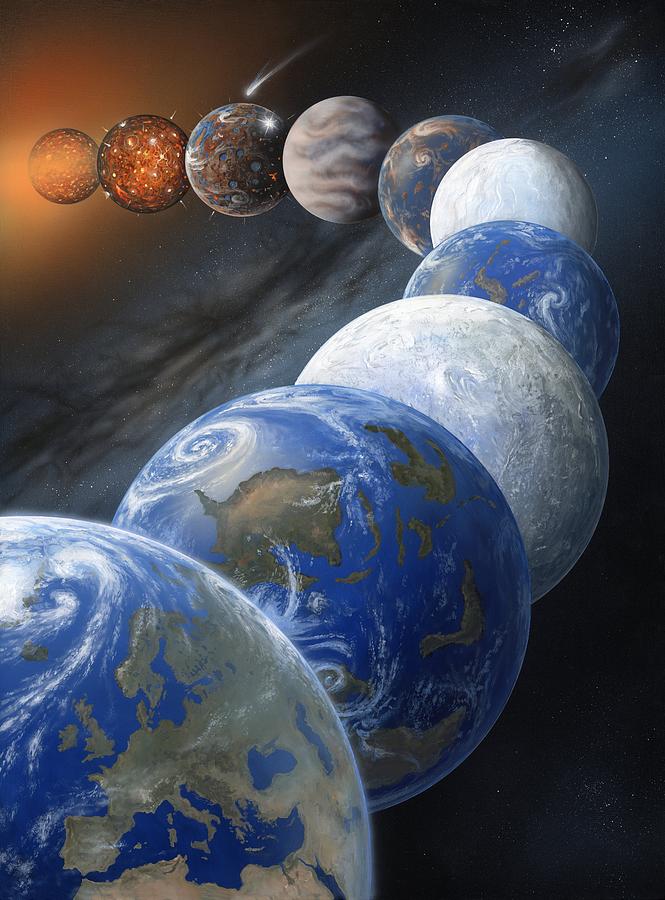
Dr Frank then showed us an image of various planets and asked us to identify them- they all turned out to be artists' conceptions of the stages of Earth's development, much like depicted in this gorgeous painting. At one stage, the Earth was molten. At another stage, before the formation of continents, the only landmasses were cratons. At another stage, it is believed that there was a Snowball Earth. During the Paleocene-Eocene Thermal Maximum, it is believed that Earth had no sea or land ice. Dr Frank quipped that the Earth has worn many masks.

The study of the Earth's past involves the study of many Earth systems: the co-evolution of the atmosphere, cryosphere, hydrosphere, geosphere, and biosphere. The Holocene, the geological epoch which encompasses our current Anthropocene, is one of many interglacial periods. AlL of human history has taken place in this epoch, approximately the last 10,000 years. Dr Frank posed the question, what would you experience if you landed on Earth three billion years ago? The answer is that you would asphyxiate because of a lack of oxygen in the atmosphere. The presence of free oxygen in the atmosphere is due to life- the Great Oxidation Event occurred when cyanobacteria 'farted out' oxygen as a waste product of photosynthesis. Life has changed the atmosphere over and over again. Successful species are numerous, but such success can lead to catastrophes- the cyanobacteria changed the atmosphere enough that it killed most of them off.

In 1979, James Lovelock and Lynn Margulis formulated the Gaia Hypothesis, the idea that the planet changes to maintain life. The hypothesis was controversial due to the notion of a teleological planet, a planet that 'wants' life, even though evolution is a blind processs. The idea of a 'living' planet led to some loopy interpretations in the public imagination, which led to some pushback, but it is undeniable that life plays an enormous role in Earth's systems dynamics. Earth and its life have been evolving together as a coupled system for a long time.

Dr Frank's research involves the study of astrobiological systems to determine if sustainable versions of our type of civilization are possible. Do industrialized civilizations like ours burn out in two hundred years? Astrobiological studies can inform us of new perspectives on our trajectory into and through the Anthropocene. How common are 'anthropocenes'? How fatal are 'anthropocenes'? What is the average lifespan of an industrial civilization? What are the characteristics of planets that survive an 'anthropocene'? Dr Frank urged us to take the prospect of exocivilizations seriously.

At this time, I will leave off the recap for now because bar trivia beckons- what good is learning while intoxicated if one cannot follow it up with showing off intellectually while intoxicated? I will finish this recap tomorrow...

By which I mean today!

Different stars have different characteristics. A star with a different spectrum from our sun would mean that photosynthesis on a planet orbiting it would differ from terrestrial photosynthesis. There are no tools in the toolbox to constrain our models focusing on the co-evolution of civilization and planetary systems. One definition of civilization involves the use of energy by intelligent lifeforms. A problem with studying astrobiology is the bad prosthetic forehead variety of science fiction- aliens provide a snicker factor. The search for extraterrestrial intelligence can be refined, as Dr Frank put it, "This is not your grandfather's SETI." Mentioning the excitement over the discovery of a possible extrasolarian megastructure, he exhorted us: "Consider the possibilities!" Within the next thirty years, we may have data relevant to the possibility of extraterrestrial life. For example, atmospheric signatures of industrial civilization include methane and CFCs.

The theoretical studies of exocivilizations involve a battle between optimists and pessimists. Astronomer Frank Drake formulated the Drake Equation, a theoretical exercise to estimate the possible number of detectable extrasolar civilizations, expressed as:


N is the number of detectable civilizations. R* is the average rate of star formation. Fp is the number of stars with planets. Ne is the number of those stars which have planets which can sustain life. Fl is the number of those planets on which life develops. Fi is the number of those planets which develop intelligent life which can produce civilizations. Fc is the number of those civilizations which have developed detectable communications technologies. L is the duration of time in which those civilizations release detectable signals.

Dr Frank posed the question: What sub-questions in the Drake Equation can be answered? Are we the only instance in cosmic evolution that intelligent life evolved? This ultra-pessimistic view would be a one in ten billion trillion chance. Even a pessimist like Ernst Mayr was ten million times more optimistic than that. Most pessimists would get a universe full of civilizations of two hundred years' duration.

Building world civilizations involves planetary feedback- 'anthropocenes' have probably happened before. We now know enough about planets and how they respond to to anthropocenes to begin how species will drive planetary feedback. Science is about constraining imagination, and the astrobiological/archaeological models are based on the predator/prey population models formulated by Lotka and Volterra:


Predator numbers tend to go up after the amount of prey increases, and crash after the prey numbers crash. Dr Frank used similar equations for population and planetary temperatures- he quipped that planets are machines, push hard enough and they go off. The models used for the equations were based on the population of Easter Island, as detailed in his May 2018 article in The Atlantic. Running multiple scenarios, he determined that there are three main results. The first is a mass die off as population exceeds the planet's carrying capacity. The second is the achievement of sustainability- a soft landing to a steady state is reached. The last is a true collapse, perhaps a runaway Venus scenario.

Dr Frank posed the question, what does the astrobiological perspective change? He joked that he is from New Jersey, so he is naturally combative, then noted that this is not a battle to save the planet- as Lynn Margulis joked: "Gaia is a tough bitch." The planet has been the scene of five known mass extinctions, and the only reason why we are here is because the non-avian dinosaurs went extinct, leaving ecological niches for our ancestors. What are we trying to sustain? What moral imperatives do we invoke to do so? Dr Frank showed the picture of the polar bear stranded on a melting ice flow and noted that it is an apex predator that would easily kill you. He then stated that humans can no longer practice ecological hooliganism. Even if humans are successful in reaching sustainability, there will be no more ice ages. Climate change poses a probably existential threat to the project of civilization, but Earth will survive even if we do not. Ecologically, the Earth's phytoplankton is more important than the charismatic megafauna usually invoked in ecological pleas.

Dr Frank urged activists to stop with the human hate- the goal should be to sustain the climatic conditions that are amenable to the project of civilization. Sustainability goals should balance a technologically advanced, energy intensive, high population with quality of life. 'Hockey Stick' diagrams won't change the narrative, stories are needed and the wrong story is 'we suck'. Cities are ecosystems just like forests, they have just been invented recently. The wrong question to ask is 'did we change climate?' The right question is 'what did we expect?' When oil was discovered, humans did not set out to change the climate, it was a mistake resulting from one particular sort of energy production. Our mistake now is to keep using fossil fuels. Climate scientist Raymond Pierrehumbert characterized climate change as 'Humanity's Final Exam'. Through right action and skillful means, we might just pass it. If we acknowledge that planets have rules, and achieve sustainability, we might create an 'awakened' planet on which the biosphere and civilization can flourish together, and the Gaia hypothesis can be realized.

The lecture was followed by a Q&A session. The first question involved mass extinctions, and Dr Frank noted that the biosphere would be happy to move on without us, and the burden falls on us to 'think like the biosphere' to benefit ourselves. Some bastard in the audience asked the good doctor for his opinion on the theoretical notion that a planet had 'one shot' to produce a high-tech civilization, because a failing civilization would 'spend all the startup capital' and impoverish any successors. Happily, Dr Frank's colleague Gavin Schmidt posed a speculative scenario in which a high tech civilization evolved millions of years before humanity. What sort of evidence would survive, say, thirty-five million years? Could climate change end one civilization and set up the cycle of fossil fuel production for the next civilization? Would a wind powered civilization be possible? What does a planet provide? What would our footprint be millions of years from now? It would be weird isotopic anomalies.

Regarding Mars, it is not Planet B. There is no way to move a mass of population and enough resources to sustain them to the red planet. Dr Frank then joked that we should 'fuck up' Mars- as we are triggering climate change, we are becoming spacefarers, and the price for climate change is the rest of the solar system.

Regarding the lifespan of technological civilizations, Dr Frank joked that, two hundred years ago, anyone traveling more than thirty miles per hour would be falling to their death.

Regarding the Fermi Paradox, Dr Frank noted that SETI funding has been slim, and that, if space were an ocean, we have only looked at at thimble. If there were aliens which could travel at approximately the speed of light, they could have disseminated throughout the galaxy in six thousand years, but if they had visited Earth, any traces would have been lost, so researchers should (shades of Arthur C. Clarke) look on the moon. I have my own theory about the Fermi Paradox.

Asked for the most effective story about climate change, Dr Frank opined that climate change shows us how powerful we are. He advised us not to bother talking to hardcore climate denialists, and noted that carbon dioxide doesn't care who you vote for.

Regarding Easter Island models, he noted that in most cases the population of the island exceeds its carrying capacity... sustainability is almost impossible. Carrying capacity studies for the planet use real climate models, with the parameters being based on energy sources. Even using wind power as a parameter, a two-degree change is expected. He noted that doctors don't only study sick people, and that many models are needed.

Asked about what technologies are needed, Dr Frank noted that we must get off fossil fuels and develop renewables. He noted that, near his Rochester campus, there are four bits of transportation infrastructure: the Erie Canal, a railroad, a highway, and an airport. Infrastructure changes, technologies change.

Dr Frank delivered a really great lecture- while much of it was speculative, it was a valuable intellectual exercise, and a call to action. I particularly dug the almost Lovecraftian evocation of vast periods of time, unburdened by Lovecraftian cosmic indifference and other less pleasant baggage. This was a superfun think piece. Kudos to Dr Frank, Dorian and Margaret, and the staff of the beautiful Bell House. Here is a video of Dr Frank discussing his new book:


Pour yourself a libation and soak in that SCIENCE!

ADDENDUM: Here is a short, sweet video featuring Dr Frank:


Now, that's a quick shot of SCIENCE!

Wednesday, October 29, 2014

Secret Science Club Post Lecture Recap: Sandy Anniversary

Last night, I headed down to the beautiful Bell House in the Gowanus section of Brooklyn for this month's Secret Science Club lecture. This month's lecture featured physicist and atmospheric scientist Dr Adam Sobel of Columbia University. Two years ago, Dr Sobel delivered a lecture on the science of Superstorm Sandy in the aftermath of the storm. On the two-year anniversary of Sandy, he returned to the Bell House to discuss people's reactions to scientific predictions.

Dr Sobel jumped right into the topic, showing a slide depicting the October 24th GFS forecast, a deterministic model of weather conditions. This particular model showed that the jetstream had dipped far south, and the 10/24 model produced by the European Centre for Medium-Range Weather Forecasts was an accurate model of the actual course of the storm. On the Wednesday before the storm hit the NY metro area, models indicated uncertainty about the eventual landfall- storms are chaotic systems so slight changes in the characteristics will result in larger eventual changes. On Thursday, the five-day forecast produced by the National Hurricane Center was dead-on. Dr Sobel noted that weather forecasts are great scientific achievements resulting from steady progress. Better computers allow forecasters to make better models, therefore they make better predictions.

When Sandy made landfall, it was a post-tropical storm- it was by no means a weaker storm, but it lacked the symmetry typical of tropical cyclones. Tropical storms are symmetrical and are warm at their center, they gain their energy from the warmth of the ocean. Winter storms are asymmetrical and get their energy from the jet stream- the temperature difference between the pole and the equator give them energy. Sandy was cold at the center- the storm was a merging of a tropichttp://www.nydailynews.com/news/national/national-hurricane-center-warning-system-article-1.1308130al storm and a winter storm. The wind speed was 65 knots, which placed it firmly in Category 1 of the Saffir-Simpson scale. The storm was vast, with a huge area of winds and a worse storm surge. Because the storm was post-tropical, the National Hurricane Center did not issue hurricane watches or warnings north of Virginia. Under NOAA's rules, a hurricane advisory could not be issued due to the nature of the storm, a policy which has been changed. Gale warnings were made, though. On 10/27, then-mayor Michael Bloomberg held a press conference urging New Yorkers to stay indoors and to avoid low-lying areas, while warning of MTA shutdowns.

Sandy was characterized by its dramatic storm surge, basically a slow pileup of water. While the local officials did many things right, they did not issue evacuation orders on Saturday due to the lack of hurricane advisories. Dr Sobel noted that the water gets high no matter what the storm is called. NOAA's current policy is to issue hurricane warnings even if dangerous storms are not technically hurricanes.

On Sunday, 10/28, evacuation orders were given for evacuation zone "A" and the transit system was shut down. There were attempts to protect infrastructure- the electrical signals in threatened subway tunnels were ripped out and certain adits to the system were boarded up. There was a partial pre-emptive shutdown of the power grid. No evacuation orders were given to nursing homes.

Ultimately, Sandy resulted in 117 deaths in the U.S. and 50-65 billion dollars in economic damage. Most of the loss of life occurred in low-lying areas such as barrier islands, which Dr Sobel characterized as "glorified sand dunes". Among the slides depicting the destruction wrought by the storm, a picture of Mantoloking, NJ was particularly scary, as was a photo of the Hoboken, NJ PATH station.

A perusal of the NYC inundation map reveals that every area that flooded was wetlands, landfill, or barrier islands. Dr Sobel noted that the original coastline of lower Manhattan was Water St. He wryly noted that the idea that there would be flooding in Lower Manhattan shouldn't have been shocking.

Two of the worst-hit areas were Breezy Point in Queens, which was ravaged by a wildfire as well as by flooding, and Staten Island's Oakwood Beach.

Half of Manhattan was affected by a power outage and there was substantial flooding as a result of a fourteen foot storm surge. Gasoline supply chains were disrupted for weeks in the region.

Wise short-term decisions that saved many lives and much property were made, such as zone A evacuations and the measures taken to protect the subway system. The region's infrastructure, though was unprepared to withstand the storm... the South Ferry subway station, renovated in 2009, was totaled, needing $600 million dollars in repairs.

Dr Sobel then went over damage estimates from old storms, mentioning a 1992 nor'easter which flooded PATH stations. In 2011, Hurricane Irene resulted in flooding, mainly in New England and upstate New York.

Sandy was a rare event, but no scientific assessment indicated that it was an impossible event. The timing of Sandy was particularly bad- the fourteen foot storm surge coincided with a five foot high tide. In contrast, the thirteen foot storm surge from the 1821 hurricane which hit NYC hit during low tide.

Dr Sobel then brought up the role of availability bias in our reaction to storms. If a particular issue isn't pressing, people tend not to pay much attention to it. If something happens all the time, there's no need to really think about our responses to it, it becomes the "new normal". It often takes catastrophic events to inspire actions meant to mitigate damage.

He brought up the Dutch response to the 1953 Delta Flood which resulted in approximately 1800 deaths and massive economic damage. The Dutch government responded with the "Delta Works", a system of flood barriers. The Thames flood barrier was modeled on the Dutch Delta works. In 1938, the hurricane known as the Long Island Express slammed into the Northeast, resulting in approximately 600 deaths. The estuary cities of Stamford, CT, New Bedford, MA, and Providence, RI were flooded. In the 1960's a hurricane barrier was built to protect Stamford.

Dr Sobel touched on plans to protect New York City from flooding, asking "What will happen post-Sandy?" He brought up PlaNYC, a blueprint for stability and resiliency for the city. He noted that there were no plans for great storm surge barriers in New York harbor- the plan relies on local flood walls and the elevation of infrastructure.

The lecture then moved on to the topic of climate change. Dr Sobel noted the Bloomberg headline: "It's Global Warming, Stupid." He noted that it's hard to pin one storm on climate change. Human influence is not clearly detected in any upward trend in storms- there is a lot of natural variability. Currently, it is thought that climate change may result in fewer tropical cyclones, but that the intensity of storms is likely to increase, on average. Little is known about storms like Sandy, which was peculiar due to its route and its tropical/winter storm hybridization. There is a clear link between global warming and sea level rise, though. This has a bearing on flooding- in the old Saffir-Simpson hurricane scale, each category of storm was typically categorized by three feet of storm surge. Sandy, however, was characterized by Category 1 winds and a Category 3 storm surge. With climate change, it's not unreasonable to jack up storm surge predictions one category. With sea-level rise, weaker storms will still result in higher surges.

Dr Sobel then stated that willful denialism of climate change is the most acute problem that we face in reacting to storms. Denialism makes taking long-term steps and unfamiliar risks to deal with storms. Availability bias is as much of a hindrance as a help. We can't wait for the problem to be compounded, though. He then ran down a quick summary of long-term predictions about weather events- the effect of climate change on tornadoes is largely unknown, but heat waves will definitely be more frequent, as will be coastal flooding. Climate change will probably simultaneously result in more droughts and more flooding. We will probably have fewer snowstorms.

The Q&A after the lecture was short and fast, and the Bastard in the audience didn't get to blurt out a question (for the record, he also had to pee like a racehorse by lecture's end). There was an interesting question about the lack of tropical cyclones in the Southeast Pacific and the South Atlantic- the climate is just not right for cyclones to form, a cold sea surface and strong wind shear combine to prevent this from occurring.

After the lecture, Dr Sobel was signing copies of his new book, Storm Surge: Hurricane Sandy, Our Changing Climate, and Extreme Weather of the Past and Future. The lecture itself was another triumph for the Secret Science Club- a timely exploration of a topic which has been on the minds of many New Yorkers, two years after one of the worst disasters the region has ever faced.

Tuesday, July 27, 2021

Secret Science Club Zoom Lecture: The Worst Chowder Ever!

Tonight, my great and good friends of the Secret Science Club are presenting a topical lecture by marine ecologist and zoologist Dr Christopher Harley of the University of British Columbia at Vancouver, who made the headlines recently when he discovered the mass die-off of tidal organisms due to the recent PNW heatwave.  Dr Harley's website is a good resource for coastal ecology.

Dr Harley began his lecture by thanking Margaret and Dorian for a chance to step back from frantically cataloging the damage done by the heat wave, with the assistance of his student.  He titled his lecture 'Well that Stunk', describing the die-off as a pungent event... if someone had dumped a wheelbarrow of mussels on your front lawn, and they rotted for a few days, you'd get some idea of the stench.  This was an unprecedented event in the PNW.  A friend of his described it as the new smell of climate change

Why should we be concerned about climate change?  There are a lot of things we care about that are effected by it?  Dr Harley cited such organisms as red sea urchins and abalones, which are valuable commodities.  Kelp and sea grass are secondarily important- they provide habitats for organisms and protect the coasts from wave erosion.  He also cited the wonderful biodiversity in the tide pools of the Pacific- he was hooked into marine biology by hermit crabs.  As a human, he gets a charge out of nature, and will work to preserve it.

Rocky shores, and marine benthic systems in general, are ideal for studying the effects of climate change.  These coastal organisms already live at the limits of their environments.  The interactions of the organisms in this environment are important- organisms such as mussels and barnacles compete for space, sea stars clear mussels to provide niches for barnacles.  The combination of environmental and predatory factors results in patterns- there are usually bands of shellfish beds, kelp beds, and grassy areas.  These bands can be studied to determine changes, such as temperature changes.

There is a zone where the horn of plenty algae thrives, typically between a layer where the barnacles thrive and where the mussels and grazers thrive.  The algae can be moved higher up where the barnacles are, but it will die of lack of hydration.  Moved lower, the grazers will devour it. Studying the upper limit of the horn of plenty on Tatoosh island, it was discovered that the limit was stable until about 1993, then dropped, stabilizing at a lower level around 2000.  Successive summers of excessive temperatures caused this change.  Around 2005, the limit lowered again due to heat exposure.  Is the limit dropping, or is it being squeezed, possibly to nothing?

In the 1950s, a marine botanist named Tom Widowson measured the different bands of organisms on the coast.  Dr Harley obtained his doctoral thesis to obtain old data, he joked that the thesis "smells like old knowledge",  Dr Harley was put into contact with Dr Widowson, who game him Google map coordinates for all of his research sites.  He was able to correlate the upper limit of the barnacles and the upper and lower limits of mussels with temperatures, and found that the upper limits of both barnacles and mussels were lower, but the lower limit of the mussels didn't change much, so the habitat of the mussels has been squeezed to about half of its former extent.  

Climate change has been going on for a long time, and organisms have been responding to it.  Without the data of scientists such as Dr Widowson, these changes might not have been apparent.  Climate change is well underway, what can we expect next?  Organisms can be brought to labs, and temperatures can be manipulate to see what temperatures will kill them.  Dr Harley prefers field work, he studies organisms in a system.  One study involves the use of black and white tiles to manipulate temperatures on a micro level (white reflecting light, black absorbing it).  On a larger scale, heat can be provided by propane camp heaters, which are suspended over seaweed beds to raise temperatures.  In another study, propane turkey fryer kits were used to warm up tide pools.

In general, these experiments warm areas three degrees Celsius, the extent to which the climate is predicted to be warmer by the end of the century.  What should we expect to see happen to these organisms in eighty years.  With the heat wave in June, Dr Harley wasn't prepared for the die-off.  On the first day, he was on a science outreach boat trip, and on visiting a beach, didn't think to photograph the mussel beds.  On the second day, he smelled it before he saw it, and knew that a tragedy was unfolding.  On the third day, he went out with a grad student, and the conditions were unsafe for working under sunny conditions.  While the air temperatures spiked to over 100F, exposed organisms on coastal rocks baked.  Temperatures were 28C above normal, high temperature records were shattered.  In Lytton, BC, the all-time temp record was shattered by 8 degrees- these records are usually shattered by fractions of degrees.  On the coast, rock temperatures were measured at 52.5C (126.5F).  On the black mussel shells, he obtained  temperatures of 134F (56.7C).

Dr Harley did not foresee this occurrence.  He walked, crunching on dead organisms, over the cemetery of an ecosystem he loves.  He showed a gallery of the slain- mussels, crabs, whelks, clams.  Barnacles (he joked that they look like James Bond villain lairs, being 'little volcanoes with trapdoors that reveal the feet, not doomsday devices) suffered incredibly.  Mussels were the poster children of the die-off.  Dr Harley showed a picture of dead mussels, still full of meat.  Thermal images showed temperatures ranging up to 56.7C (134F).  

Dr Harley noted patterns.  Near his house, the carnage was relatively light- only about 20% of the mussels died.  It was a north-facing beach with small mussels.   One of the worst hit areas was a mussel bed on Galliano Island.  The angle of incoming sunlight played a role in the die-off, with 90 degree angle sunlight being particularly deadly.  Mussels in the shade were safe. The coastal seaweed was also affected, rockweed (bladderwort) was killed.  The rockweed provides habitats for other organisms.

How extensive was the die-off?  Dr Harley and his team is expanding the scope of the initial study, along with scientists in Washington, indigenous foragers, seafood harvesting companies.  The Strait of Georgia, and Puget Sound were hit hard.  San Juan Island was relatively unscathed.  Inland waterways without access to cold water were hit hardest.  There are a lot of gaps, so information has to be collected.

How many animals died?  Dr Harley showed a picture of 100 dead barnacles, easily fitting in the palm of his hand.  He calculated the amount of good barnacle habitat in the Strait of Georgia, and determined how many dead barnacles could have died, perhaps ten billion dead barnacles.  With the mussels, snails, worms, and crabs that live in these habitats, Dr Harley is certain that billions of animals died.

Was there any good news?  Hermit crabs might be one of the few winners in the short term- they are mobile enough to avoid dangerous conditions, they had a real estate boom, they are scavengers so they feasted, and they are subject to temperature sensitive parasites which might have died.  Other species, such as sea grass, certain clams and oysters, and sea anemones, did okay.  Some mussels had refuges, sea stars did okay.

What are the ripple effecs of the die-off?  Migrating birds like the surf scoter rely on mussels, will they have enough this winter when they fly through?  What abut juvenile salmon that need cover?  Without filter feeders, will water quality be impacted?

What are the long-term prospects for the BC coast?  Fast growing species with good dispersal, such as barnacles and mussels, may recover in a few years.  Rockweed may take longer.  The problem is that heat waves will be more common.  Species from warmer waters will have a hard time dispersing up the coastline, but invasive species from Asia will thrive.  The ecosystem may soon look more like Southern Japan than California.

What can we do?  We can pressure politicians to fight global warming.  We can make choices to conserve energy?  Local conservation efforts can be formed, allowing better chances for regeneration.

The lecture was followed by a Q&A.  The first question regarded food shortages.  Local indigenous groups will face serious food insecurity risks due to die-offs.  Droughts on the prairies would be more dangerous on a global scale.  Which is more ecologically dangerous?  Changes in average temperature or changes in highs?  Changes in average temperature should effect growth.  Max temperatures are more significant in mass death events.  Eelgrass and kelp are prime habitats for larval organisms, anything which adversely effects them pose dangers to the food web.

Dr Harley stated that working with physiologists is helpful- he is working with researchers studying Dengue fever and notes that the information he obtains studying the rocky coast has utility to studying the African savannah.  

What can citizen scientists do?  Simply taking photos can help scientists determine the limits of where organisms live.  There are more citizens than scientists.  People have been contacting him about preservation efforts, such as cloth tents to shade mussel beds, or using pumps on boats to mist coastal areas- these efforts just aren't practical for protecting wide stretches of coastline.

Why not seed species from the south by hand?  This is being done with forests- southern genotypes are warmth adapted.  Marine larvae are more mobile, so this hasn't been discussed as much.  This assisted migration is risky, such as the introduction of cane toads to Australia.

Climate change is providing selection pressure, on an evolutionarily significant scale, which will most likely result in lower genetic diversity.  Dorian joked about a 'planet of the hermit crabs' situation.

Some bastard in the audience asked about ocean acidification- he has studied this subject for years, using turban shell snails as a subject- the shells have yearly growth rings, and the snails are growing slower in acidified conditions.  Oyster larvae are sensitive to ocean acidification, which worries oyster farmers.  The acidification and temperature change could form a one-two punch.  The die-off has ensured that his grant money in the foreseeable future will fund warming research.

Another question involved the benefits to invasive species from global warming- most boats coming into British Columbia arrive from warmer ports, so warming gives them an advantage.  Also, if native organisms are continually shocked by disasters, they are less resistant.

Another questioner asked about the dangers of seafloor mining- there are manganese nodules on the ocean floor which can be dredged up.  This poses danger to poorly known ecosystems such as glass sponge reefs.  Can it be done in an environmentally responsible way?  This requires a lot of study.

The final question was, how screwed are we climactically?  Can coastal ecosystems recover?  He recounts students coming up to him with tears in their eyes.  The oceans will go on without us, but they won't look like they do now.  Coral reefs are forming in the Carolinas, the Mediterranean is looking more like the Red Sea.  Ecosystems are resilient, warmth adapted organisms will expand their ranges.  Dr Harley is hopeful, but things are changing fast, and it would be nice to apply the brakes.

Dr Harley's lecture was entertaining and informative, and it was most certainly topical.  Kudos to Dr Harley, and Dorian and Margaret for another fantastic Secret Science Club presentation.  Here is a news presentation which encapsulates the heart of this lecture:


It was a sobering lecture, delivered by an engaging lecturer, which is a perfect example of the Secret Science Club experience.

Friday, September 20, 2019

Duty Now for the Future

The heartening story of the day has got to be the Students' Climate Strike, which brought perhaps as many as a quarter-million people to Manhattan to join activist Greta Thunberg in demanding action on the ongoing climate change crisis. The climate strike spanned the globe, and involved millions of protestors. The young and earnest were challenging the old and corrupt to change the course which will render this planet unfit for human habitation. They will be inheriting an overheated Earth because corporate oligarchs refuse to look beyond next quarter's profits.

I've been blogging for almost ten years, and nothing has been done about the looming climate disaster- things are even regressing as the Dotard is rolling back energy efficiency standards for lightbulbs and is trying to nullify California's auto emissions standards. At the precise moment that humanity needs to get its act together regarding carbon emissions, the United States government is seeking to increase them, perhaps as a way to 'pwn the libs'... it's creating a suicide pact as a means to troll.

The young activists are wiser than the foolish, greedy elders who are pushing the narrative that climate change isn't real, and it isn't anthropogenic, and there's nothing that can be done about climate change anyway (yeah, I know that those are contradictory, but propaganda doesn't make those distinctions). They are going to live in a world long after David Koch croaked, and I don't think they are going to go home without becoming politically involved. They are not old enough to vote yet, but I trust them to kick out the fossil fuel fossils, I just hope they aren't too late. They have been failed by their elders, but they will be the ones to end up saving us.

Post title taken from Devo's second album title... how about a selection from Akron's weirdest?


I'd take a wiggly world over a broiling one, any day.

Tuesday, April 6, 2021

Secret Science Club Zoom Lecture: This Subject Is for the Birds, Literally

 Tonight, my great and good friends of the Secret Science Club are presenting a Zoom lecture by naturalist and field researcher Scott Weidensaul, author of A World on the Wing: The Global Odyssey of Migratory Birds.

As a child growing up in Pennsylvania, he became obsessed with the Appalachian Mountains, raptors, and migration.  In the 1990s, he traveled throughout North America studying migration patterns, and he recently has traveled the world

North America has lost about a third of its birds in recent decades.

Grassland birds, such as bobolinks and meadowlarks, are particularly hard hit.  Waterfowl have rebounded due to efforts to protect and restore wetlands.  If we put the same time, effort, and money to restoring grasslands, these birds should rebound as well.  Progress is being made to restore migratory bird populations, and our ability to crunch massive amounts of data has revolutionized research.  Miniaturized tracking devices also help, some are small enough to place on migratory butterflies.  We also have better ideas about bird physiology- some of these birds can spend months on the wing while they migrate.

Not all birds migrate, but the dusky grouse migrates uphill in the Rockies by foot.  The semipalmated sandpiper migrates thousands of miles to and from its Canadian breeding grounds.  To compare birds to even the most elite human athletes is to shame the birds.  The sandpipers gorge on crustaceans called Corophium, stocking up on Omega-3 fatty acids before migratiing.  Most birds migrate at night, using celestial navigation.  Birds also have magnetic sense, with a form of quantum entanglement (spooky action at a distance), using a visual pigment called cryptochrome, which becomes magnetized, allowing the birds to sense the Earth's magnetic field.  Every goose pooping on the golf course has this magnetic sense.

Just about everything humans can do, birds can do better, certain birds, such as bar-headed geese, can fly higher than the 'death zone' for human climbers.  Birds have a respiratory system superior to mammals' lungs- their lungs are attached to air sacs accessed through hollow bones.  Bar-headed geese have special hemoglobin which allows them to fly at excessive altitudes.

Alpine swifts migrate to Africa for the winter, flying from Switzerland to western Africa without stopping for two hundred days.  Common swifts fly continuously for ten months, feeding on the wing on flying insects.  Great frigatebirds, being native to the Galapagos, have little fear of humans, and are easy to have transmitters affixed to.  The birds are not waterproof, so they fly nonstop to hunt fish- they undergo unihemispheric sleep on the wing, and after feeding their young, sleep on the nest for long periods.  Even the migratory birds in our yards, such as warblers, undergo unihemispheric sleep.  The birds need food resources at both ends of their migratory route.  Certain birds, such as bar-tailed godwits, engage in hyperphagia, overeating, for days before migrating, and their digestive systems atrophy for the trip, and regrow their guts when they arrive.  The most important foraging sites for bar-tailed godwits are mudflats on the Yellow Sea, which teem with invertebrate life.  The loss of these habitats to the construction of seawalls and aquatic farms are injurious to birds, a twenty-one mile long seawall in South Korea resulted in habitat loss which decreased the red knot population by one-fifth.  The spoon- billed sandpiper, which migrates from Eastern Russia to the Chinese coast, is down to a population of about 400.

Conservation efforts are underway on the Yellow Sea coast, with the authoritarian government of China halting all development on the mudflats.  Certain sites are now UNESCO sites.

Bird trapping is also a problem, with birds such as the yellow-breasted bunting, once among the most abundant songbirds, experiencing catastrophic population decline.  If they go extinct, this would be the equivalent to the extinction of the passenger pigeon.  Bird trapping in the Mediterranean is rampant, with about eleven million migratory songbirds being killed in Egypt, France (where the ortolan bunting is a prized dish), and Italy.  The 'black hole' of  bird loss is Cyprus, where up to three million birds are trapped, usually using birdlime, a sticky substance smeared on twigs, which can trap birds.  In Cyprus, the birds are plucked and fried in an illegal dish called ambelopoulia.  Much of the poaching has occurred on British military bases, with local police, at considerable risk, using drones to catch poachers, and British conservationists send anti-poaching specialists.  Scott Weidensaul had to wear a bulletproof vest while observing these personnel.

Climate change is the biggest problem facing birds, changing distribution patterns.  He doesn't care if you believe in climate change, the birds do.  Many species of birds have changed their migration schedules due to warming.  Some birds, such as fox sparrows and eastern phoebes, have show flexibility in migration, but most of these are short or mid-distance migrants.  Long-distance, such as black-throated green warblers, are adversely effected by climate change.  Certain birds, such as pied flycatchers, time their migration to exploit the emergence of caterpillars, but the caterpillars emerge earlier now.  North American birds, not having to cross a desert and a sea, are less affected.  

Climate change doesn't cause uniform warming- in portions of the Canadian Arctic, falls and winters are colder, but summers are much hotter, so insects emerge earlier so chicks can starve.  The Audobon Society modeled bird habitats and determined that scarlet tanagers will lose about ninety percent of their oak-and-beech forests  by 2080, and the habitats won't be able to shift to keep up with warming.

Advances in computing power can help in bird conservation.  Doppler radar stations can be used to monitor bird migration, even allowing determination of bird size, direction of travel, and the calculation of bird numbers per cubic meter.  Shifts in migration can be shown.  Radar data allowed researchers to determine that 2.9 billion birds have been lost.  Radar cannot determine taxonomy, so birders on the ground, using the E-bird system, can verify what species of birds are migrating.  Using this data, optimal habitats, such as pop-up wetlands on farmland, can be created- payment to farmers would be cheaper than buying land outright.  City lights can confuse birds that navigate by starlight, drawing them to cities.  Automated alerts to building owners can inform them to dim lights as large flocks of migrating birds approach.  Urban bird habitats in city parks can also be more effective than buying undeveloped land.  GPS units that transmit data cellularly can track birds, with Project SNOWstorm being an effort to track snowy owls.

Small songbirds and migratory insects and bats can be tracked with the Motus system, and numerous local projects are expanding the receiver station network.

This is an amazing time, and a terrifying time, for migration.  It's easy to despair, but there is hope that the challenges of migratory birds can be met.  Scott Weidensaul cited the Amur falcon migration from Siberia and Eastern China to Southern Africa.  Nagaland, in eastern India, is a state characterized by conflict between a local Burmese ethnic population espousing a Baptist Christian religion, it was discovered that falcons that typically gorge on breeding termites before migrating were being trapped by farmers whose fields had been flooded by the construction of a dam.  The starving farmers literally believed that the falcons were manna from heaven.  There was an outcry among the international press, leading to an effort by conservationists and the hungry Naga to stop the hunt overnight, with former poachers guarding nesting sites, and efforts to jumpstart a tourism industry, which is difficult to put into place due to Nagaland's remoteness and an anti-India insurgency.  Mr Weidensaul painted a picture of bad roads, bandits, and Baptist headhunters.  Tourists are arriving, but the tourist economy is not as egalitarian as the falcon trapping economy.  Trappers-become-tour guides don't have equal access to prime roosting grounds or the ability to install western style facilities for tourists.  Roads bring development, logging, and hunting- they are the worst threats to birds... but they would be a boon for Nagaland ecotourism and conservation.  Strides have been made, but how sustainable are they?

Every bird that makes that leap into migration is ordinary, and extraordinary.  They have evolved amazing systems to navigate the migration process, but it's not enough now, the birds need our help.

The lecture was followed by a Q&A session.  The first involved the evolution of migration patterns. Scott believes that this is an incremental process, migration is genetically coded, and some birds are born with 'bad software', with some taking riskier routes, such as oceanic routes, but success among a few would be selected for.  During the Ice Age, sea levels were lower, so now overseas routes would have been overland on a geological time scale.

Another question involved the use of birds as climate change 'surveyors'.  Cornell's eBird program has gathered data, and almost no migration routes have been unchanged by temperature change and shifting wind patterns.  The difficulty for birds is that they tend to depend on stable weather patterns, which are being perturbed.

Another question involved the banning of DDT, which decimated raptor and common loon populations.  Bald eagle populations have quadrupled over the past couple of decades, which does have a ripple effect on other bird populations, such as tern populations.

How do magnetic pole shifts affect birds?  Birds' magnetic senses aren't cued to polarity.  There might be some confusion, but birds don't function as compasses, and should be able to handle things well.

How do scientists band birds?  Banding is the most effective and least effective method of tracking birds.  Marking birds as individuals is crucial for determining migration, longevity, and mating practices.  Most birds return to nesting spots and overwintering spots.  If you find a dead bird, check for a band- the return on banding is pretty slim, only a fraction of the bands are recovered.  GPS locators are more effective.  Birds can be netted using audio lures and the geolocators can be evaluated.  One great thrush in Denali park has been tracked to the upper Orinoco over seven migration seasons.  Other thrushes living in proximity in Denali shared a similar proximity in southern Argentina.

How did the COVID-19 pandemic effect bird migration?  Differences in observed migration was probably more due to increased observation rather than decreased activity.  People suddenly started noticing nature, started observing birds.

There are migratory birds, semi-migratory birds, irruptive birds that migrate due to changing food availability.  

Scott plugged the Cornell Lab of Ornithology and its Merlin Bird ID app.

Another question involved Ducks Unlimited- whatever your opinion of duck hunting is, duck hunters have raised a lot of money to preserved wetlands.  There is enlightened self interest involved, but the effectiveness cannot be denied.  The single largest anthropogenic factor in bird deaths is the domesticated cat- keep the cats inside, they kill billions of birds each year.  Trap, neuter, and release programs maintain large predator colonies- keep your cats inside.

Some Bastard in the audience (and another person in the chat), asked how even apartment dwellers can help birds.  Plant native plants, especially ones with fruits with a lipid content.  Choose your coffee well, pay more for certified shade-grown, bird-friendly coffee sown in forest habitats, subsidize small farmers who grow their coffee bushes under native forest canopy.  Look for the Smithsonian label.  Certain co-ops are engaged in reforestation efforts, improving bird habitats.

Migratory birds can carry pathogens, such as avian influenzas, which are carried by waterfowl such as gulls.  Birds can also be used as sentinels for pathogens, such as West Nile virus, which decimated many wild bird populations.

Another city dweller asked for resources about city-living birds.  Migratory songbirds don't typically migrate in large flocks, but they make calls to avoid collisions.  Rooftop antennae, available for about twenty dollars, could pick up migration calls to give a more granular picture of birds in transit, giving a detailed picture of the night sky.

The lecture was fantastic, accompanied by wonderful pictures.  It was sobering, but Mr Weidensaul challenged us, and gave us hope.  Kudos to this Pulitzer prize finalist, and Margaret and Dorian.  For a taste of this lecture, here is a lecture by Mr Weidensaul from last Fall:

Wednesday, May 27, 2015

Whine All You Want, the Guy is Right

The latest post-tempest tempest in a teapot was set off by Bill Nye, who had the temerity to connect the recent Texas flooding to climate change. As is usual these days, the "controversy" was initiated by a "tweet": Billion$$ in damage in Texas & Oklahoma. Still no weather-caster may utter the phrase Climate Change.

Put in layperson's terms, warming fosters evaporation, and allows the atmosphere to retain more water vapor (also a greenhouse effect contributor), leading to increased precipitation. Even the typical conservative "durr hurr, why did the Northeast get so much snow if the planet is warming?" bit is foolish- climate change can intensify snowstorms... it still gets below freezing, and more atmospheric water vapor can mean more snow.

Besides the ad hominem attacks on Nye, the general consensus among the twits was that Nye is an "alarmist". Hell, people have died, the flooding continues- is that not an alarm? Too bad the dupes of the Fossil Fuel Industry and its PR flacks refuse to wake up. As the redoubtable Smut Clyde once noted, the rubes will use the last can of petrol to burn the last climate scientist at the stake. I hope that our coleopterous successors are better stewards of the planet.

As a postscript, let's check out what the loons who have tossed Occam's Razor out the window have to say about the Texas floods: yep, Obama's using HAARP to attack Texas... that perfidious Kenyan is using his weather smurfing machine to soften Texas up before the Jade Helm jackboots trample Texas freedom. Yeah, that antenna array up in Alaska has a greater capacity to change climate than the fucktons of pollutants we're constantly emitting, now that's scientificismication.

Tuesday, March 29, 2022

Secret Science Club Zoom Discussion Recap

Tonight, my great and good friends of the Secret Science Club are presenting a discussion about dwindling insect populations between Guardian environmental correspondent Oliver Milman and New Yorker contributing author and environmentalist Bill McKibben.  This topic is near-and-dear to my heart because I am a Big Bug Guy.  Oliver Milman's new book is The Insect Crisis: The Fall of the Tiny Empires that Run the World.

Bill McKibben noted that the topic of this talk is grim, but necessary.  He noted that the prologue to the book seems like a tribute to Rachel Carson's Silent Spring.  He noted that the book somewhat takes the shine off of modernity, and that while the topics are grim things, they are not fated things.  He asked Mr Milman about entomologists and citizen scientists chronicling the decline of insect populations throughout the globe... Mr Milman noted that insects seemed so 'legion' that their numbers were n98% mologists, the few people who kept count, had been trapping insects in nature reserves, noted that the weight of trapped insects dropped by 76%.  Since the fall of the Berlin Wall, Germany had lost three-quarters of its insects.

In Puerto Rico, an entomologist found that 98% of insects seemed to have dropped, judging from his glue traps, and the numbers dropped by about 80% in the canopy.

A Danish naturalist decided to experiment by driving around in a beat-up car and checking the windshield for smashed insects, and the numbers had dropped dramatically.

The biological crisis is multiform- about 90% of tigers have disappeared, sea ice is down dramatically, and insect populations have dropped 70,80,90 percent.  Our insect studies are heavily weighted toward North America and Europe.  Beetle populations in the US are down, bumblebee populations are in decline, and the monarch butterfly migration in California is down to about one percent of what it used to be.  We know enough to be alarmed, but we need to act more quickly than we are for the climate crisis.

What are the causes?  Pesticides, particularly neonicotinoid pesticides, play a major role.  DDT effected birds' eggshells, but neonicotinoids are seven thousand times more toxic to bees than DDT.  Neonicotinoids are water soluble, so they end up in the groundwater.  Big Ag even sells seeds coated in neonicotinoids, which then end up in the plants themselves.  These pesticides also kill slugs and end up in human bodies through ingestion of foods.  Neonics don't discriminate, they kill beneficial insects as well as pests.  Insect predators are wiped out, reducing their ability to regulate ecosystems.  These insects, such as wasps, also function as pollinators.  If insect pollination were eliminated, starvation would ensue.  Rice and corn are wind-pollinated, but most fruits are insect pollinated.  Cherry production in many areas is reduced due to reduced pollinator populations.  Clearing forest to create farmland would aggravate the climate crisis, more intensive cultivation would result in more toxic farmland.

European farmers have not suffered from the discontinuation of neonics, they are also planting wildflowers throughout their fields, providing biodiverse habitats for insects.  In the US, the producers of pesticides have a lot of clout with their lobbyists.  These are extremely wealthy corporations with a lot of power over farmers.  

Just getting rid of neonics doesn't get insects out of the woods- climate change also poses grave threats.  The symbol of climate change is an image of a sad polar bear, but insects, usually seen as survivors, may be more vulnerable than most creatures.  With a warming of 3%, many insects, which have limited mobility, will be pushed out of their temperature comfort range.  Other insects, many of them deleterious to humans, are expanding their range, such as the mosquitos which transmit Dengue fever.  We won't lose all insects, we're just changing the composition of populations- we'll lose bees and butterflies and gain cockroaches and mosquitos, which thrive in warm, damp environments full of human waste products.  In the US, ticks are also increasing their ranges- Mr McKibben quipped that humans aren't always at the top of the food change.  

Mr Milman noted that humans are scrambling the seasons- birds nest earlier, plants bud earlier.  Many insect and bird populations are being thrown off by the plants not being in sync with them.  

Mr McKibben waxed lyrical about the incredible organisms at risk, such as the monarch butterflies profiled in a book by his wife.  He cited the behaviors of ants and bees, and wondered why so many humans have a learned revulsion toward insects.  Mr Milman asked a cultural question- what colors our attitudes toward insects, which kindergardners tend to be fascinated by.  People are 'bugged' by others, and are disgusted by 'creepy crawlies'.  Often, our interactions with insects involve a swatter.  Mr Milman noted that he had ants in his kitchen while he was writing the book.  He waxed lyrical about the hive 'intelligence' of bees, which are an organized strata of life which upholds the rest of us.

In the case of monarchs, as their wintering grounds warm, they retreat further up the mountains they shelter in.  If we lose them, we lose beauty, even more than utility.

The two gentlemen opened the conversation to questions- how do scientists use non-lethal methods to count insects?  They often gassed forests, and there is also the windshield count.  There are probably emerging techniques, but Mr Milman isn't aware of them.  He noted that scientists aren't driving the killing of insects.  Mr Milman describe working on the book and noting that pollination is so important that there are bee brokers (one only had to work two months per year) and bee thieves.  Wild bees are suffering even more than domesticated bees.  He joked about being stung in the face by a bee, and having beekeepers laugh at him.  

Post Maria, there was a lot of habitat loss in Puerto Rico- were population counts made both before and after the storm?  This topic is discussed in the book, a tale of damaged equipment/

Some Bastard in the audience asked about the role of invasive species on insect populations.  Invasive plants can crowd out native plants that native insects need.  Ironically, the most successful invasive species in North America is the honeybee.  50K honeybees can live in a hive, and they are voracious- they can outcompete native bumblebees.  

How about the importance of cultivating native plants?  This is an aesthetic issue, people like beautiful, tidy things, having a revulsion to weeds.  Our obsession with well-manicured lawns, the most intensively irrigated crop in the US, creates biological deserts- close-cropped, poisoned with herbicides and pesticides... Mr Milman urged us to 'let things go a bit', plant wildflowers, stop cutting plants.  Mr McKibben urged us to get to a wild place, the hear the background hum of life.  Dorian urged us to get rid of 'Vanity Ag'.  

One of the best features of the night was a question from a child who asked what we could do to help, besides doing things she was doing, like planting beneficial plants.  Mr Milman noted that he's not all gloom, and that insects are great survivors.  If we give them a bit of a chance, they will bounce back.  He talked of milkweed plantings and rooftop gardens. If you have a yard, plant a variety of things and create oases for insects. Mr McKibben told her to tell others to read Charlotte's Web, so we can learn about our friends in the dark corners of the room.

Another question involved an upcoming food insecurity crisis due to falling pollinator populations.  In China, teams of hand-pollinators are pollinating fruit trees.  Mr Milman noted that the notion of robot pollinators is fanciful- they are no real substitutes.  Regarding the eating of insects, Mr Milman noted that insects are a good source of proteins, and can be raised in shipping containers with low environmental impact.  Eating insects shouls be beneficial.

An evolutionary biologist in the audience asked about adaptions to climate change- Mr Milman noted that monarch butterflies have evolved larger, stronger wings as their food sources become more distant.  

Is the US catching up with Europe in the banning of toxins?  No.  Neonics banned in Europe won't be banned in the US for at least the next 15 years.  Mr Milman noted about a lack of a precautionary principle in the US- products are often rolled out before we find out if they are safe.  Mr McKibben noted that Europe's regulation of pesticides is due to political power- if the power of corporations isn't curbed, no changes will be forthcoming here.  Both Mr Milman and Mr McKibben noted that 'fossil fuel industry' and 'Big Ag' could be interchanged.  Mr McKibben noted that agricultural states have oversized political power due to the composition of the Senate.

To what extent does organic farming help insects?  It's better than industrial farming.  Regenerative farming, diversifying crops to reduce monoculture, would help far more.  Mr Milman quipped that we're producing a 'world full of chips', spraying less chemicals would be good, but creative biodiverse farmland would be better.

Another question came from an individual who researches wild bees in the Catskills- what sort of data would provide the most impact when it comes to advocacy for harmonious coexistence with insects?  Mr Milman noted that people like bees, and cited Bavaria as a farming location which enacted a great bee protection referendum- reducing monoculture, discontinuing pesticide use, bringing back hedgerows.  He urged the questioner to keep on banging the drum about bees, noting that any Mars colonization effort would have to involve bringing bees along.  Mr McKibben noted that the Catskills and Adirondacks are New York's gift to biodiversity.

Development boxes in insect populations, reducing genetic diversity.  Insects in cities now tend to do better than rural insects due to greater diversity of plants in yards than in crop fields.

Another question involved the eradication of mosquito populations using genetic engineering- as bad as mosquitos are, they do provide sustenance for bird, bat, and amphibian species, and pollinate some plants.  Often, when we tamper with nature, it blows up in our face due to unintended circumstances.

The final question to Mr Milman was, how do you maintain a positive outlook?  He noted that his day job is writing about climate change.  He maintains some hope, but is worried about the speed of change, and our difficulty in countering it in time.

Once again, the Secret Science Club has dished a fantastic program.  Kudos to Margaret and Dorian, and Messers Milman and McKibben,  I like to talk about the 'Secret Science Sweet Spot', and tonight's discussion hit that spot, with its combination of scientific fact and advocacy.

For a taste of the Secret Science Club experience, here is Mr Milman discussing his book:

Pour yourself a nice beverage, and imbibe that heady mix of science and activism.

Sunday, November 25, 2012

Belated Post Lecture Recap: The Science of Sandy

Last Tuesday, I headed down to the beautiful Bell House in the Gowanus section of Brooklyn for the latest Secret Science Club lecture featuring physicist and atmospheric scientist Dr Adam Sobel of Columbia University and the Lamont-Doherty Earth Observatory. The subject of the lecture was Superstorm Sandy, a topic very much on the minds of lecture attendees.

The key to understanding Superstorm Sandy is the chronology of the storm- the "Frankenstorm" which hit the Mid-Atlantic states. This storm was a combination of post-tropical storm Sandy and a winter storm, which could be likened the "parents" of the superstorm which made landfall centered on the Jersey Shore. If one were to search for "grandparents", one would have to discuss two climatic systems, the Madden-Julian Oscillation (a tropical system of eastward-progessing fluctuations in the amount of rainfall from the Western Indian Ocean to the Atlantic) and the North Atlantic Oscillation (which, true to its name, deals with atmospheric pressure fluctuations between Iceland and the Azores). Due to the North Atlantic Oscillation, the polar jet stream moves- a postive condition drives the jet stream northward, a negative condition drives the jet stream southward, bringing cold air to the Atlantic seaboard.

In Mid-October, an active Madden-Julian Oscillation moved into the Atlantic Ocean and the North Atlantic Oscillation pushed the jet stream southward. The conditions were conducive to both tropical and winter storms. Additionally, on 10/20/2012, a "blocking high", an area of high pressure which remains largely stationary, formed in the Western North Atlantic. Such blocking highs in this region prevent winter storms from moving east.

On 10/22, the National Hurricane Center named Tropical Depression 18, which was subsequently upgraded to Tropical Storm Sandy.

On 10/24, Sandy hit Jamaica as a category 1 hurricane. On 10/25, it hit Cuba as a category 2 hurricane.

Many computer models of the track of a storm are run due to the vagaries of chaos theory- small changes in one region of the atmosphere can result in large changes in weather elsewhere. In the case of Sandy, European computer models accurately predicted the track of the storm.

When Sandy made landfall in the mid-Atlantic states, it was a post-tropical storm interacting with an extratropical storm (the "winter storm" blocked from moving east by the stationary area of high pressure in the western North Atlantic). This interaction resulted in a condition known as the Fujiwhara Effect, which causes the vortices of two cyclones to orbit a mutual center and, sometimes, to merge. In the case of Sandy, the storms merged and the resultant storm was pushed ashore. When Sandy made landfall, it was not a hurricane (cyclones are typically symmetrical, while winter storms are asymetrical, usually comma-shaped)... Sandy had a high degree of asymmetry and was a vast storm... the windfield of the storm was approximately one thousand miles across. When Sandy hit landfall in New Jersey, no hurricane force winds were observed. The horrendous damage associated with Sandy was due to storm surge- high sustained winds pushed ocean water onto the shore.

Sandy's unprecedented storm surge was largely due to the unusual sharp westward angle of the storm track. Storm winds are stronger to the right of the track, and the onshore winds were associated with a very large wind field- this was the worst possible situation in terms of storm surge. Most cyclones which hit the New York metro area move up the cost and weaken, storms which take Sandy's track are exceptionally unusual. In terms of historic hurricane landfalls, Sandy's angle was unique. Stochastic models indicate that a category one hurricane making landfall at the angle which Sandy made landfall is a once-every-700-years event.

Tidal gauges at the Battery (the southern tip of Manhattan) indicated a three-meter storm surge on top of a five-foot tide (sorry about the mixed measurement metaphors). This was the highest storm surge ever recorded at this location.

As to whether climate change "caused" sandy, no single weather event can be attributed to climate change. As far as trends go, the best models give result in mixed predictions about whether the number of cyclones will change. Worldwide, there are typically 90-100 cyclones every year. While some models indicate that this number may even drop, there is much confidence that the most intense storms will become stronger. Of course, Sandy was not an intense storm when it made landfall, it was a category one storm rendered destructive by its size and the angle at which it hit. The distorted jet stream which resulted in the blocking high which prevented Sandy and its accompanying winter storm from moving eastward is associated with the loss of sea ice. The most simple link between climate change and the destruction resulting from Sandy is a rise in sea level. In the past century, the sea level in the NY metro area has risen a foot, largely due to the land subsiding post-Ice Age, and partially due to thermal expansion of the sea water.

In the Q&A, some bastard in the audience asked why, in light of atmospheric pressures lower than any recorded for the latitude, Sandy did not result in stronger winds. Because Sandy was such a vast storm, the pressure "contours" were wide- a smaller storm would have had smaller "contours", so the winds would have blown with greater velocity.

Once again, the Secret Science Club delivered a top-notch lecture, and a timely one. Sandy still looms large in the public's mind, and Dr Sobel's lecture did a lot to demystify the storm, even if such demystification didn't provide comfort to those who suffered loss.

Thursday, December 22, 2016

Secret Science Club Lecture Recap: Astrophysics Endterm Exam

Last night, I headed down to the beautiful Bell House, in the Gowanus section of Brooklyn, for this month's Secret Science Club lecture, which featured the triumphant return (I have to confess that my lecture recaps became much more serious when I started taking notes- the SSC really forced me to become a better, more responsible writer) of astrophysicist Dr Charles Liu of The City University of New York College of Staten Island and the Hayden Planetarium and Department of Astrophysics of the American Museum of Natural History.

Dr Liu began his lecture by joking about whether he describes himself as an astronomer or an astrophysicist- if he's sitting on a plane next to someone he wants to talk to, he describes himself as an astronomer... if he doesn't want to talk to them, he describes himself as an astrophysicist. He noted that yesterday was the last day of finals at school, so he wanted to give us a 'holiday sampler', starting with the astrophysical significance of the Winter Solstice- simply the day on which Earth's northern hemisphere receives the least amount of sunlight, but not necessarily the day on which the sunrise was latest or the sunset the earliest. He noted that the increasing darkness before the solstice tended to worry many ancient peoples, so they created special commemorations of the day, such as Saturnalia, which involved societal role reversals, gambling, and merrymaking (Dr Liu likened it to Mardi Gras). Most of the winter solstice holidays in the northern hemisphere involve the use of artificial lights amid the darkness of the solstice. Dr Liu quipped that these holidays are all due to astronomy.

Dr Liu then showed one of those gorgeous photos of Pluto and noted that he did not vote for the demotion of the dwarf planet. He noted that the New Horizon probe's closest flyby of Pluto occurred in 2015, but that the data from the probe has still been coming in throughout 2016, and the final data dump will soon occur. Pluto has a highly elliptical orbit and is currently moving farther away from the sun. Pluto is getting colder, and its atmosphere is precipitating to the surface. Pluto has a varied geology. Earth's geology is largely driven by the heat from the planet's interior, while Pluto's may be largely driven by the cold- Pluto's atmosphere has distinct layers of haze which form as atmospheric gases freeze into ice crystals. Dr Liu joked that Pluto is cool in the hot sense as well as in the cold sense, and noted that Pluto is cool no matter what its designation is, and he exhorted us to enjoy the beautiful new discoveries.

Dr Liu then gave us an overview of LIGO, the Laser Interferometer Gravitational-Wave Observatory. Spacetime 'ripples' much like the surface of a pond- the fluctuations in spacetime were predicted by Einstein when he formulated his theory of general relativity. LIGO uses two antennae arrays, one in Washington state and one is Louisiana, to detect fluctuations. LIGO operated for ten years without any 'action', at the cost of hundreds of millions of dollars. After ten years, additional funding was approved, and the antenna arrays were improved and gravitational waves were detected in 2015. The two detectors received the results about 1/1000th of a second apart, a ripple of spacetime with the dimension of an entire planet created a distortion the width of an atomic nucleus. The LIGO team is favored to win the Nobel Prize in Physics- a whole area of physics, gravitational waves, has now been solved. The source of the gravitational waves detected by LIGO was a set of two colliding black holes which are circling each other wan will collapse/combine into one black hole. Dr Liu tasked us with imagining the immense amount of power which will be released in this collapse as mass is converted into energy- a mass one three-thousandth of Earth would produce more energy than that our sun would produce in a billion years. Dr Liu joked that astronomers are cool, because they get to hang out, contemplating explosions powerful enough to destroy entire solar systems.

Dr Liu then mentioned the upcoming James Webb Space Telescope project. He noted that the Hubble Space Telescope is twenty-seven years old, and that it was recently saved due to public outcry- with the telescope's gyroscopes being serviced weeks before they would have failed, providing seven more years of perfect performance, though Dr Liu warned us that the Hubble could go at any time. The James Webb Space Telescope is designed to have different capabilities than the Hubble- it will be situated in a solar orbit at the L2 Lagrange Point. The James Webb Space Telescope will be able to operate twenty-four hours a day, seven days a week, and will have an umbrella-like sunshield. The JWST will be able to observe light in the infrared, visible, and ultraviolet wavelengths. Dr Liu gave the audience some career advice- the Panoply of Space Telescope Awesomeness will require staffing, so brush up on your resumes.

Dr Liu went on to discuss the upcoming Daniel K. Inouye Solar Telescope project, named in honor of the late senator from Hawaii. The DKIST, located on Maui, is scheduled to begin operations in 2019 and is designed to observe the sun in the ultraviolet and infrared spectra, using solar-adaptive optics. It is designed to observe solar spicules. Dr Liu joked that the DKIST project is also hiring, and gleefully noted that the is a really exciting time in the field of astronomy.

Dr Liu then opened up a question and answer period, which he jokingly referred to as his own 'final exam' for the semester. He had audience members write questions on pieces of paper which were then passed up to him. Some bastard in the audience asked him to sing his black hole song from his previous lecture. The first question concerned the number of black holes in the universe, which Dr Liu said was increasing. Someone else asked if we could be wrong about gravity- Dr Liu said maybe, but gravity is a fundamental force of the universe, so no matter whether one adheres to string theory or a holographic model of the universe, our understanding of gravity is not disproven. In order to change the fundamentals of science, one has to show that everything is wrong, as Einstein showed that Newton was wrong because he didn't see enough of the universe. Dr Liu told us not to worry about these sort of things.

The next question dealt with climate change- Dr Liu indicated that climate always changes, but that natural changes occur over thousands of years. Humans have been altering the climate at an accelerated pace. Dr Liu noted that we had to worry about the short-term problems caused by climate change, but warned against grandiose geoengineering projects which could have long-ranging consequences. He noted that our main focus should be on carbon sequestration and helping poor people to survive natural disasters due to climate change. He said that we should solve the problem using the things we know rather than going off into unknown territory with geoengineering.

Dr Liu also noted that all science is important- using the example of climate science, he reminded the audience that oceanic science, earth science, and space science all contributed important knowledge to our understanding of global warming. Our understanding of the greenhouse effect was derived from studying Venus and Mars. All fields of study are parts of one whole- science is not a zero sum game and all scientists should work together. He also noted that scientists needed to be lobbyists in order to secure funding for research.

The next question regarded terraforming Mars- Dr Liu was of the opinion that it would take at least one thousand years to make Mars as liveable as Earth. Regarding his favorite molecule, Dr Liu joked that it was the beer molecule.

Another question regarded black holes- is there something on the other side of a black hole, such as a white geyser or a budding new universe? Dr Liu noted that there is no evidence for this sort of thing, and told us to think of a black hole as a sort of cosmic 'hernia'- the matter absorbed by a black hole kinda just 'hangs off of' the universe. While Stephen Hawking predicted that Hawking radiation would be released from black holes, there is no evidence of any white geysers, and there is no evidence for any other 'big bangs' than the original one.

When asked about SpaceX and the dream of colonizing Mars, Dr Liu noted that Elon Musk is a great salesman, then he exhorted us, 'Think big, and don't bet against humanity.'

Asked about how space junk is cleaned up, Dr Liu joked that there are no garbagemen in space, but noted that orbits decay, debris re-enters the atmosphere, and burns up. Asked about navigating through an asteroid field, Dr Liu noted that the average distance between asteroids is one million miles- sorry, Han Solo, no hotshot piloting is needed. Another questioner asked how the James Webb Space Telescope would be maintained, and Dr Liu noted that it wouldn't be- it works or it doesn't. He then went into a tangent about the Large Synoptic Survey Telescope under construction in Chile... it will have an array of 320 megapixel cameras to photograph the entire sky every night for ten years in order to build up a database of celestial objects- he noted that LSST will operate from 2023 to 2033 and asked if any of us were considering a career change.

Asked about the coolest thing about astronomy, Dr Liu joked, it puts a roof over my head and feeds my family. He then told us that, no matter how bad a day he's had, he's certain that the Earth won't be destroyed in the next five billion years. He said that what matters is today, and that although he's seen bad things, to think about the good things. He gave a passionate soliloquy- we live in a place, not just Brooklyn, where we can disagree without killing each other, without hating each other, we can even love each other. Be vigilant, be careful, speak up, but we will be fine in the end. Today will change the course of the future, but look to the stars... when things are crazy down here, look up. He then quoted from Robert Frost's poem Choose Something Like a Star:


O Star (the fairest one in sight),
We grant your loftiness the right
To some obscurity of cloud—
It will not do to say of night,
Since dark is what brings out your light.
Some mystery becomes the proud.
But to be wholly taciturn
In your reserve is not allowed.
Say something to us we can learn
By heart and when alone repeat.
Say something! And it says, 'I burn.'
But say with what degree of heat.
Talk Fahrenheit, talk Centigrade.
Use language we can comprehend.
Tell us what elements you blend.
It gives us strangely little aid,
But does tell something in the end.
And steadfast as Keats' Eremite,
Not even stooping from its sphere,
It asks a little of us here.
It asks of us a certain height,
So when at times the mob is swayed
To carry praise or blame too far,
We may choose something like a star
To stay our minds on and be staid.


After the written Q&A session, Dr Liu continued with an oral Q&A. Some bastard in the audience asked him to consider CERN with an astronomer's eye- what would be his dream discovery from Switzerland? Dr Liu stated that it would be the discovery of a graviton. While one can infer the existence of a graviton, such a particle would be one-billionth the mass of the lightest particle known. In order to discover one, a particle accelerator would have to increase in size and power, and the odds of a particle accelerator the size of Europe being built are slim.

Asked about dark matter, Dr Liu noted that it is observed through its gravitational effects, and that for every pound of baryonic matter in the universe, there are four or five pounds of dark matter. Dr Liu compared dark matter to the headlights of a vehicle- we can see the headlights and infer the mass of a car behind them.

Asked about the multiverse, Dr Liu noted that it could exist, but there would be a zero-percent chance that we could visit it using any current knowledge. He then quipped, 'Our universe is plenty big.' When asked how far back in time we can look, he noted that the cosmic horizon equals the age of the universe (13.8 billion years) times the speed of light. Looking out is looking back in time- it takes eight minutes for the light of the sun to reach the Earth, so we see the sun as it was eight minutes ago.

Asked about the possibility of faster-than-light travel, Dr Liu said that we would have to think beyond the four-dimensional universe and noted that Mexican physicist Miguel Alcubierre speculated the use of a bubble outside of spacetime which would allow apparent FTL travel.

Asked about the role of the public in funding science, Dr Liu characterized scientific societies as 'the tail that wags the dog' and joked that people loved the Hubble Space Telescope because the beautiful images it produced ended up as their screen savers. When asked about which Star Trek series he loved best, Dr Liu cried, it's like choosing between his children, then noted that, while TNG had the best episodes, it wasn't the best series, and that Voyager had its charms.

The last question concerned energy in the expanding universe- as the universe expands, the energy goes up. There is an inherent amount of energy in each cubic inch of space, and there is something counteracting gravity- the universe is accelerating in its expansion. As the energy increases, the amount of matter stays the same- we don't know where this energy comes from. As cosmologically abhorrent as the cosmological constant appears to be, it's what the universe tells us must be. Dr Liu then noted that a Dark Energy Survey is underway... I think I'm going to update my resume.

Once again, the Secret Science Club dished out a fantastic lecture, a sort of 'Astrophysics Greatest Hits of 2016' survey, or a 'State of Space Science Survey'. Dr Liu is a passionate, humorous advocate for astrophysics and, yes, he did sing the black hole song to the tune of Day-O, with audience participation, of course. Kudos to Dr Liu, Margaret and Dorian, and the staff of the beautiful Bell House.

Here's a great video of Dr Liu doing what he does best- advocating for science with passion, wit, and charm:


I'd say that the good doctor passed his end-of-semester final exam with flying colors... in a range from the infrared to the ultraviolet.