A couple of weeks ago, in a thread at the mothership, Smut Clyde had this to say about Fritz Leiber's Our Lady of Darkness:
The way BBBB feels about “Face in the Frost” is how I feel about Fritz Leiber’s “Our Lady of Darkness”, his homage to CAS.
With a recommendation like that (I've lauded The Face in the Frost more times than I can remember at this point), I figured I'd have to revisit the novella, because it had been ages since I'd read it. I'm most familiar with Leiber's Nehwon stories, featuring his swashbuckling duo Fafhrd and the Gray Mouser and lately I'd read his tributes to H.P. Lovecraft (with whome Leiber corresponded), such as The Terror from the Depths and the touching To Arkham and the Stars- the latter story subverts the whole "cosmic evil" theme of Lovecraft's mythos and ends on a sentimental, optimistic note.
Anyway, it had been a while since I'd read any of Fritz Leiber's contemporary urban dark fantasy, so I got my hands on Our Lady of Darkness. The novella is Fritz Leiber's "love letter" to the City of San Francisco and to the "Weird Tale" author Clark Ashton Smith. The protagonist is an author who is just getting over a long bout of alcoholism after the death of his wife. During his "hazy" days, he acquired two extremely rare volumes from a used bookstore- the first being a journal which may belong to Smith, the second being Megapolisomancy, an exceedingly rare book (the reason for its rarity is explained in the narrative) that posits an occult "science" of urban development:
He handed her the one that had been open, saying, "That's just about the most fascinating book of pseudoscience I've ever seen—it has some genuine insights mixed with the hokum. No date, but printed about 1900, I'd judge."
"'Megapolisomancy,'" she pronounced carefully. "Now what would that be? Telling the future from . . . from cities?"
"From big cities," he said, nodding.
"Oh, yes, the mega."
He went on. "Telling the future and all other sorts of things. And apparently making magic, too, from that knowledge. Though de Castries calls it a 'new science,' as if he were a second Galileo. Anyhow, this de Castries is very much concerned about the 'vast amounts' of steel and paper that are being accumulated in big cities. And coal oil (kerosene) and natural gas. And electricity, too, if you can believe it—he carefully figures out just how much electricity is in how many thousands of miles of wire, how many tons of illuminating gas in tanks, how much steel in the new skyscrapers, how much paper for government records and yellow journalism, and so on."
"My-oh-my," Cal commented. "I wonder what he'd think if he were alive today."
"His direst predictions vindicated, no doubt. He did speculate about the growing menace of automobiles and gasoline, but especially electric cars carrying buckets of direct electricity around in batteries. He came so close to anticipating our modern concern about pollution—he even talks of 'the vast congeries of gigantic fuming vats' of sulphuric acid needed to manufacture steel. But what he was most agitated about was the psychological or spiritual (he calls them 'paramental') effects of all that stuff accumulating in big cities, its sheer liquid and solid mass."
"A real proto-hippie," Cal put it. "What sort of man was he? Where did he live? What else did he do?"
"There's absolutely no indication in the book of any of those things," Franz told her, "and I've never turned up another reference to him. In his book he refers to New England and eastern Canada quite a bit, and New York City, but only in a general way. He also mentioned Paris (he had it in for the Eiffel Tower) and France a few times. And Egypt."
In the course of the novella, the protagonist becomes obsessed with observing the Sutro Tower and Corona Heights, where he spies a mysterious brown-clad figure which he originally takes to be a "robed hierophant"- stoned priest of a modern sun god dancing around an accidental high-set Stonehenge.
As the plot moves forward, he becomes more obsessed with the brown-clad figure on Corona Heights and makes a trek to the crown of the hill to find the "priest", a course of action which ends on a surprising note for the protagonist. He also attempts to verify the provenance of the journal he attributes to CAS, paying a call on a burnt-out counterculture figure who is able to fill him in on some of the details of the life of the author of Megapolisomancy, and his relation to Clark Ashton Smith.
The narrative builds to a climax as the protagonist runs afoul of the "paramental" forces conjured up by the urban landscape, in conjunction with his own mind. As things come to head, his "salvation" hinges on verifying whether his home is the building alluded to in the journal, and determining if he can use this knowledge to ward off the paramentals.
The novella is, like everything I've read by Leiber, great fun. It conjured up other works in my head, which is always a good thing, as I love to spot allusions. The protagonist's fascination with the heights across the city from his apartment evoked H.P. Lovecraft's The Haunter of the Dark. The "paramentals" of the tale reminded me of Clark Ashton Smith's Genius Loci and Leiber's own Smoke Ghost. The whole "megapolisomancy" angle reminded me of the game played by Belbo, Diotallevi and Casaubon in Umberto Eco's Foucault's Pendulum, in which they posit that the great towers built throughout history were designed to track "telluric currents"- I wonder if Eco was inspired by Our Lady of Darkness. The search for the McGuffin which can help the protagonist lay to rest the paramentals besieging him reminded me of John Bellairs' wonderfully eerie The House with a Clock in Its Walls, while the final paramental manifestation was reminiscent of M.R. James' Oh, Whistle, and I'll Come to You, My Lad, though with a somewhat comic twist.
Our Lady of Darkness works on a bunch of levels- it works as a supernatural thriller, it works as a loving tribute to the city in which it is set, it works as an homage to a favored author, it works as a part of a greater "weird" literary tradition, it even works as a comedy, on some levels. One way in which I knew that I was hooked from the get-go is that the novella sent me rushing off to look up the Sutro Tower and Corona Heights. For me, that's a sure sign that I care enough to put the book into a greater context.
Thanks, Smut! Now, regarding the post title, did you dirty little lambies think that this would be a pr0n review?
Showing posts sorted by relevance for query fritz leiber. Sort by date Show all posts
Showing posts sorted by relevance for query fritz leiber. Sort by date Show all posts
Tuesday, July 15, 2014



Friday, July 21, 2017
Witchy Women, Tenure Battles
Longtime readers will know that I am a big fan of Fritz Leiber, a criminally unsung author whose influence is as pervasive as it is unacknowledged. Such stories as 1941's The Smoke Ghost and 1949's The Girl with the Hungry Eyes are foundational documents in the 'dark urban fantasy' genre which is so popular these days.
One of the lacunae in my Leiber reading was the 1943 novel Conjure Wife, a tale of witchcraft set in a small university. The protagonist of the novel is John Saylor, a sociologist who has recently completed a survey of folk-magic practices with the assistance of his wife Tansy, culminating in an upcoming monograph, The Social Background of the Modern Voodoo Cult. Saylor and his wife are nonconformists stuck in a conservative institution, yet are thriving despite not being quite as staid as the administration would wish them to be.
One day, on a whim which he acknowledges as being childish and perhaps illicit, Saylor decides to go through his wife's dressing room and discovers that she has drawers full of the trappings of witchcraft- graveyard dirt, hair-and-nail clippings, horseshoe nails, and flannel mojo hands. A social scientist, he is appalled by this evidence of superstition on the part of his wife. On her return home, he confronts her with his discovery and makes her promise not to engage in these practices, and combs through the house finding flannel mojo bags and other talismans everywhere.
After he destroys the items, bad things start to happen- he is accused of sexual harassment by a student-employee, he starts lecturing about controversial topics, he puts his path to a department chairmanship in jeopardy. Being a rational person, which is never a plus in a dark fantasy, he chalks these things up to coincidence. The reader, of course, susses out what's going on pretty quickly.
The threats that accumulate against Saylor culminate in a supernatural attack on his house by an architectural grotesque that adorns one of the campus buildings, and hints of a fatal curse placed on him by an unknown antagonist. Tansy, unknown to her husband, takes the curse upon herself in order to save him, and receives a compulsion to flee the university. In one particularly creepy scene, John tracks down Tansy and, finally realizing that his rational worldview is not up to the task of saving his wife, decides to use supernatural means to save her... too late. Having largely failed to save his wife from a soul-stealing enchantment, he has to find a means to return her trapped soul to her and discover the source of the supernatural attacks on them.
The weird thing about this novel is that it portrays every woman on the planet as being a witch. Tansy, the other university wives, a young hotel maid... all of them use magic to one extent or other. The rudiments of the practice are handed down mother-to-daughter (uh, no explanation for how orphans learn it), but each individual woman continues to the extent of her abilities, using trial-and-error to achieve more mastery of the craft.
The novel then shifts into a spiritual battle between Saylor, who uses his analytical skills to approach the supernatural arts, and the witches who have tormented him and his wife. His struggle is reminiscent of a video game, in which he has to face a succession of increasingly powerful 'level bosses', until he finally finds the authoress of the couple's misfortunes.
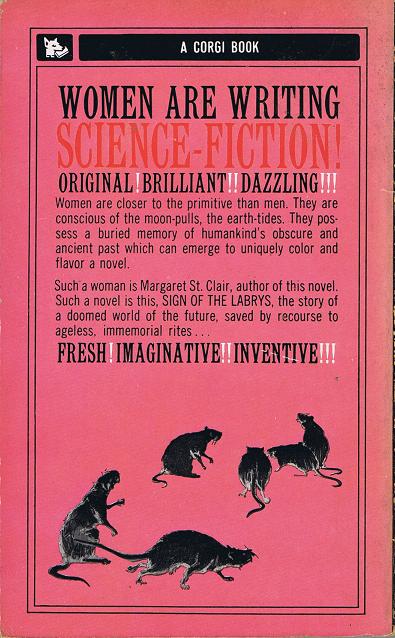
The book was a fun read, if dated. There is the typical mid-century sexism, of the 'women being conscious of the moon-pulls and earth-tides' variety, and African-American conjure-men working their mojo, but it's not as toxic as a lot of other mid-century pulp fiction. The book also had me looking up the folk-practices that it describes, and I found a great Lightnin' Hopkins song about a mojo hand as a result:
One mark of my enjoyment of a book, movie, or television series is the series of internet searches that the work inspires... I love works which set off a cascade of queries.
One of the lacunae in my Leiber reading was the 1943 novel Conjure Wife, a tale of witchcraft set in a small university. The protagonist of the novel is John Saylor, a sociologist who has recently completed a survey of folk-magic practices with the assistance of his wife Tansy, culminating in an upcoming monograph, The Social Background of the Modern Voodoo Cult. Saylor and his wife are nonconformists stuck in a conservative institution, yet are thriving despite not being quite as staid as the administration would wish them to be.
One day, on a whim which he acknowledges as being childish and perhaps illicit, Saylor decides to go through his wife's dressing room and discovers that she has drawers full of the trappings of witchcraft- graveyard dirt, hair-and-nail clippings, horseshoe nails, and flannel mojo hands. A social scientist, he is appalled by this evidence of superstition on the part of his wife. On her return home, he confronts her with his discovery and makes her promise not to engage in these practices, and combs through the house finding flannel mojo bags and other talismans everywhere.
After he destroys the items, bad things start to happen- he is accused of sexual harassment by a student-employee, he starts lecturing about controversial topics, he puts his path to a department chairmanship in jeopardy. Being a rational person, which is never a plus in a dark fantasy, he chalks these things up to coincidence. The reader, of course, susses out what's going on pretty quickly.
The threats that accumulate against Saylor culminate in a supernatural attack on his house by an architectural grotesque that adorns one of the campus buildings, and hints of a fatal curse placed on him by an unknown antagonist. Tansy, unknown to her husband, takes the curse upon herself in order to save him, and receives a compulsion to flee the university. In one particularly creepy scene, John tracks down Tansy and, finally realizing that his rational worldview is not up to the task of saving his wife, decides to use supernatural means to save her... too late. Having largely failed to save his wife from a soul-stealing enchantment, he has to find a means to return her trapped soul to her and discover the source of the supernatural attacks on them.
The weird thing about this novel is that it portrays every woman on the planet as being a witch. Tansy, the other university wives, a young hotel maid... all of them use magic to one extent or other. The rudiments of the practice are handed down mother-to-daughter (uh, no explanation for how orphans learn it), but each individual woman continues to the extent of her abilities, using trial-and-error to achieve more mastery of the craft.
The novel then shifts into a spiritual battle between Saylor, who uses his analytical skills to approach the supernatural arts, and the witches who have tormented him and his wife. His struggle is reminiscent of a video game, in which he has to face a succession of increasingly powerful 'level bosses', until he finally finds the authoress of the couple's misfortunes.
The book was a fun read, if dated. There is the typical mid-century sexism, of the 'women being conscious of the moon-pulls and earth-tides' variety, and African-American conjure-men working their mojo, but it's not as toxic as a lot of other mid-century pulp fiction. The book also had me looking up the folk-practices that it describes, and I found a great Lightnin' Hopkins song about a mojo hand as a result:
One mark of my enjoyment of a book, movie, or television series is the series of internet searches that the work inspires... I love works which set off a cascade of queries.
Monday, March 20, 2017
Infernal Equinox
Today is the vernal equinox, though looking at the amount of snow still on the ground here in the City of Y______, one would be hard-pressed to think of Spring. Rather than discussing the vernal equinox, this post concerns an infernal Equinox, a low-budget horror movie, produced by a crew of amateurs, released in 1970. While not very scary, the film does boast some not-terrible stop-motion special effects- from a practical effects standpoint it 'punches above its weight', given the low budget and inexperience of its creators. The plot, concerning a college student's search for his geology professor, who has gone missing from his cabin in the mountains while trying to decipher a mysterious grimoire, is very reminiscent of the first two films in the 'Evil Dead' horror franchise.
I'm not a big horror movie buff, though I do rate for the 'Evil Dead' films, being a fan of Bruce Campbell and Sam Raimi. It was interesting to watch Equinox with an eye to comparing the films. My primary interest in watching the movie was its casting of Bastard fave and fantasy juggernaut Fritz Leiber as the doomed professor. While not a speaking role, it was fascinating to see one of my literary heroes on the screen, even in a bit part. Here is the movie in all of its cheesy, low-budget glory:
Oh, and if you ever meet a guy named Asmodeus, run like... uhhhhhh... Hell.
I'm not a big horror movie buff, though I do rate for the 'Evil Dead' films, being a fan of Bruce Campbell and Sam Raimi. It was interesting to watch Equinox with an eye to comparing the films. My primary interest in watching the movie was its casting of Bastard fave and fantasy juggernaut Fritz Leiber as the doomed professor. While not a speaking role, it was fascinating to see one of my literary heroes on the screen, even in a bit part. Here is the movie in all of its cheesy, low-budget glory:
Oh, and if you ever meet a guy named Asmodeus, run like... uhhhhhh... Hell.
Tuesday, October 15, 2019
This Is Going to Upset the Fandom
Here's just a quick post before I head off to bar trivia on a rare night off... this post about the 21 best science fiction and fantasy series is bound to get the fans upset. A perusal of the comments reveals that many of the readers are upset about how 'PC' the selections are, and there are plenty of commenters who don't seem to have read the prerequisites for selection, and name standalone books or unfinished series.
My one personal beef is that there are no Jack Vance titles in the list. I'm also amazed that genre pioneer Edgar Rice Burroughs didn't get a nod, and I would have included works by Fritz Leiber and C.J. Cherryh. I'm surprised that Frank Herbert's 'Dune' series and Asimov's 'Foundation' series didn't make the cut. The one genuine shocker is that Gene Wolfe's The Book of the New Sun and it's related 'Long Sun' and 'Short Sun' books didn't make the list- Wolfe was perhaps the most 'literary' of Science Fiction and Fantasy writers, writing books which are intricate puzzles for readers. Oh, and J.K. Rowling's 'wizard kids' series didn't make the cut.
The list skews toward newer books, and does mention more women and people of color than the 'Sad/Rabid Puppies' could tolerate. For that reason, it's a useful list, one to use as a guide when hitting the library or bookstore.
My one personal beef is that there are no Jack Vance titles in the list. I'm also amazed that genre pioneer Edgar Rice Burroughs didn't get a nod, and I would have included works by Fritz Leiber and C.J. Cherryh. I'm surprised that Frank Herbert's 'Dune' series and Asimov's 'Foundation' series didn't make the cut. The one genuine shocker is that Gene Wolfe's The Book of the New Sun and it's related 'Long Sun' and 'Short Sun' books didn't make the list- Wolfe was perhaps the most 'literary' of Science Fiction and Fantasy writers, writing books which are intricate puzzles for readers. Oh, and J.K. Rowling's 'wizard kids' series didn't make the cut.
The list skews toward newer books, and does mention more women and people of color than the 'Sad/Rabid Puppies' could tolerate. For that reason, it's a useful list, one to use as a guide when hitting the library or bookstore.
Monday, August 19, 2013
Goodbye, Gray Mouser
Last week started off on a happy note, we had a surprise visitor on site and were able to find him a home. The week took a turn for the worse, though, and I have to confess that I have been bummed out since Friday, when I received some bad news on the job. In the interest of topicality, I decided to wait until today to reveal my melancholy mood.
Back in 1998, my former co-worker Peter, who relocated to Virginia a few years ago, found a tiny gray fuzzball in his neighborhood and named it after basketball great Moses Malone. He brought Moses the kitten to work, where he found employment as a mouser. Moses pretty much had the run of the property for a good fifteen years, and came to be loved by staff and visitors alike. When I started working here in 2006, I was immediately taken by the cat, with his luminous amber eyes and his silky gray fur. I'm a cat person to begin with, the family always had cats when I was growing up. Moses was something special- I've met many wonderful cats in my day, and Moses ranks pretty high up in the pantheon of felines.
Last Thursday, when the three site cats were brought in to the local animal hospital for their annual checkups, the veterinarian noted that Moses had lost two pounds since his last vet visit late last winter. Moses had been looking a little gaunt lately- he had been on thyroid medication for a couple of years, and had had a couple of teeth pulled recently. Well, on Thursday, the veterinarian discovered that Moses had an inoperable cancerous tumor in his mouth. The site manager who brought the cats in to the veterinarian returned to the site and revealed the bad news to everyone. He contacted Peter, who had found Moses and brought him to share in our work and our lives. Peter gave his consent to the agonizing decision to euthanize Moses to end his suffering. Today, the site manager is bringing Moses to the veterinarian who had taken care of him during his tenure here for the last time. As you can imagine, everyone in the organization is devastated. The plan is to cremate Moses' remains and scatter his ashes throughout the site he "ruled" for fifteen years after a memorial service.
When Moses was a kitten, Peter would place him in the hood of his sweatshirt in the colder months, and Moses would snuggle in it, contented. As an adult cat, Moses loved to jump on his human friends' shoulders and would often stay on one's shoulders for up to half an hour while one went about one's tasks. Here's a picture of Moses sitting on my shoulders on Christmas 2011, the most attractive "scarf" that I have ever worn:

This moment was captured by the talented Zombie Rotten McDonald. I will bring the sketch into work when we conduct our memorial service for our beloved coworker.
Our company e-mail server has been filling up with eulogies of Moses. One former co-worker sang his praises, and put him in the great company of mousers that have guarded mills and granaries since time immemorial. A great and admirable bunch! Another coworker related a touching story about a pair of cat lovers who met Moses on a visit to our site:
Our good friend Moses was sitting - posing, more like - on a bench... A middle age couple came by - instantly recognized as cat people - and began admiring Moses as so many visitors have.
Of course, I happily regaled them with his who and what abouts. Then, as he scratched Mo on the head and chucked his chin, the gentleman declared simply:
"Yep, he's the right cat for this place!"
Just that; not a word more or less.
Yep, Moses in summation, ..."The right cat for this place"
The right cat for this place indeed... the place won't be quite the same without him. Goodbye, Gray Mouser, you will remain forever enshrined in the hearts of your coworkers.
NOTE: Post title *yoinked* from Fritz Leiber.
Back in 1998, my former co-worker Peter, who relocated to Virginia a few years ago, found a tiny gray fuzzball in his neighborhood and named it after basketball great Moses Malone. He brought Moses the kitten to work, where he found employment as a mouser. Moses pretty much had the run of the property for a good fifteen years, and came to be loved by staff and visitors alike. When I started working here in 2006, I was immediately taken by the cat, with his luminous amber eyes and his silky gray fur. I'm a cat person to begin with, the family always had cats when I was growing up. Moses was something special- I've met many wonderful cats in my day, and Moses ranks pretty high up in the pantheon of felines.
Last Thursday, when the three site cats were brought in to the local animal hospital for their annual checkups, the veterinarian noted that Moses had lost two pounds since his last vet visit late last winter. Moses had been looking a little gaunt lately- he had been on thyroid medication for a couple of years, and had had a couple of teeth pulled recently. Well, on Thursday, the veterinarian discovered that Moses had an inoperable cancerous tumor in his mouth. The site manager who brought the cats in to the veterinarian returned to the site and revealed the bad news to everyone. He contacted Peter, who had found Moses and brought him to share in our work and our lives. Peter gave his consent to the agonizing decision to euthanize Moses to end his suffering. Today, the site manager is bringing Moses to the veterinarian who had taken care of him during his tenure here for the last time. As you can imagine, everyone in the organization is devastated. The plan is to cremate Moses' remains and scatter his ashes throughout the site he "ruled" for fifteen years after a memorial service.
When Moses was a kitten, Peter would place him in the hood of his sweatshirt in the colder months, and Moses would snuggle in it, contented. As an adult cat, Moses loved to jump on his human friends' shoulders and would often stay on one's shoulders for up to half an hour while one went about one's tasks. Here's a picture of Moses sitting on my shoulders on Christmas 2011, the most attractive "scarf" that I have ever worn:

This moment was captured by the talented Zombie Rotten McDonald. I will bring the sketch into work when we conduct our memorial service for our beloved coworker.
Our company e-mail server has been filling up with eulogies of Moses. One former co-worker sang his praises, and put him in the great company of mousers that have guarded mills and granaries since time immemorial. A great and admirable bunch! Another coworker related a touching story about a pair of cat lovers who met Moses on a visit to our site:
Our good friend Moses was sitting - posing, more like - on a bench... A middle age couple came by - instantly recognized as cat people - and began admiring Moses as so many visitors have.
Of course, I happily regaled them with his who and what abouts. Then, as he scratched Mo on the head and chucked his chin, the gentleman declared simply:
"Yep, he's the right cat for this place!"
Just that; not a word more or less.
Yep, Moses in summation, ..."The right cat for this place"
The right cat for this place indeed... the place won't be quite the same without him. Goodbye, Gray Mouser, you will remain forever enshrined in the hearts of your coworkers.
NOTE: Post title *yoinked* from Fritz Leiber.
Subscribe to:
Posts (Atom)