Last night, I headed down to the beautiful Bell House, in the Gowanus section of Brooklyn, for this month's Secret Science Club lecture. This month's lecture featured the triumphant return of physiology/medicine Nobel Prize winner and former director of the National Institutes of Health and the National Cancer Institute Dr Harold Varmus, currently with the Meyer Cancer Center at Weill Cornell Medical College, who delivered a lecture on the first anniversary of the Secret Science Club. For the record, this month marks the tenth anniversary of the Secret Science Club. This lecture was one in the continuing collaboration between the Secret Science Club and the Albert and Mary Lasker Foundation
Dr Varmus began his lecture by contrasting the current venue with the original venue of the Secret Science Club, the basement performance space of Park Slope's Union Hall, joking that the Secret Science Club really felt like a secret, something almost revolutionary given the contemporaneous occupant of the White House. He stressed the importance of keeping science in the public domain.
Dr Varmus then presented the basic facts about cancer. Cancer is not one disease, many cell types can give rise to unrestricted cell growth which invades other cells. There are many types of cancer- one wouldn't lump all infectious diseases together, so one shouldn't lump all cancers together. Cancers are illnesses of the genome. Some of the genetic risk factors are relatively minor, but other risk factors are closely related to the illness. Genetic changes occur in an individual's lifetime- DNA can be damaged by such factors as smoking or exposure to ultraviolet light. Small or large, changes to DNA can have dramatic results. Cancers are best described as 'too many cells doing bad things in the wrong places'. Different cancers can effect cells differently- some reduce cell function, while some increase function... all to the detriment of the organism.
Cancers become more frequent with age. The approach to fighting cancers must be multi-pronged. Researchers must observe and count cancers in populations. Screening must be performed- cancers must be diagnosed with specificity early on, and classified. Patients must me treated and comforted. Prevention must be attempted to reduce the incidence of cancer. Cancer must be studied in its various forms.
Dr Varmus displayed several graphs comparing the age-adjusted death rates for cancer and heart disease for individuals under the age of 85. He noted that the death rate for cancers peaked in the 1990s. He noted that the cancer death rates are decreasing, but not as dramatically as the death rate for heart disease. Different cancers have different mortality rates. Lung cancer mortality rates tend to be high, but are precipitously declining. Stomach and colorectal cancers are declining. Among women, there is a rapid decline of uterine cancers due to Pap smears, and the HPV vaccine could improve things further.
The traditional treatment for cancer involves surgery, chemotherapy, and radiotherapy. These therapies are extremely difficult for patients. An improvement in treatment would involve targeted therapies directed toward the genetic anomalies which produce the proteins which cause cancers. Two promising new therapeutic innovations are hormone therapy and immunotherapy. Of course, cancer prevention is preferable to treatment- tobacco use, viruses, obesity, and ultraviolet light exposure are all contributors to increased cancer risk. Vaccines against viruses such as HPV and hepatitis-B would reduce cancer risk. Screenings to recognize genetic predispositions to cancer are also promising.
Dr Varmus then proceeded to frame the discussion of the fight against cancer in historic terms, starting with Richard Nixon's signing of the National Cancer Act of 1971. This act was aspirational without a plan- we did not know how a normal cell becomes a cancer cell. There was a confidence, though, that money plus talent equals results. In the subsequent decades, new concepts, new methods, and new strategies emerged- genome research, DNA crystallography, computational methods. This fight culminated in President Obama's 2016 Precision Medicine Initiative. A base of information about diseases' genetic or molecular factors needs to be compiled. Taxonomy leads to better diagnoses, which lead to better treatments, which lead to better outcomes. Vice President Biden was tapped to lead the "moonshot" against cancer- a successful response to this challenge would be more effective, more efficient, and involve more collaboration.
Dr Varmus veered off to a short autobiography- his childhood was spent on Long Island. He studied literature in college though he did plan to attend medical school. After what he described as a 'prolonged adolescence', he became a scientist at the age of twenty-eight. He described the historical facts which influenced his life- hearing Eisenhower's push for scientific excellence, attending medical school while the Vietnam War raged, Nixon's signing of the National Cancer Act in 1971. He described his early days at the NIH as being a member of the 'yellow berets'. He displayed a picture of his 1968 cohort at the NIH and noted the gender imbalance of the organization. While at NIH, he started to study genetic expression in E. coli. He joked, "Few pleasures in life exceed a potent assay." In his case, he was measuring accurately how much RNA was made by a particular gene in E. coli. He noted that to answer complex problems, it was best to use simple models. Clear answers lead to more questions, both mundane and profound. He also noted that the 'gossip factor' was important to scientists- tell results to peers, even competitors, for the advancement of knowledge.
In cancer research, one must apply molecular models to complex organisms in order to determine when a normal cell becomes a violent miscreant which can kill the individual to which it belongs. The few genes in a virus which causes tumors in animals can change the behavior of an animal's cells permanently. How do these genes replicate? How do they cause cancers? How does one tiny retrovirus become thousands of particles? To answer these questions, Dr Varmus recounted the history of Peyton Rous and his researches into chicken tumors. Peyton Rouse, of the Rockefeller Institute (now Rockefeller University) described a transmissible chicken sarcoma in 1910. The sarcoma was caused by a virus which could change the behavior of cells in a petri dish- these 'rounded' cells looked different from the background cells in the dish.
Dr Warmus followed up on this area of inquiry with his collaborator and co-Nobel prize winner J. Michael Bishop. Displaying a sequence of photos of the pair, Dr Warmus joked, "The pictures show the changes in our own morphology over time." Dr Warmus and Dr Bishop's best known discovery was proto-oncogenes. In one instance, the tumor causing retroviral gene v-SRC is similar to, and derived from a cellular gene c-SRC. Genes code for enzymes, and genes with mutations cause cellular changes. Using a molecular probe, a nuclear-coded set of amino acids, it was determined that normal chickens have a set of genes which resemble viral genomes, a code for proteins similar to genes present in all metazoans, which suggests an important function. The discovery of c-SRC was important for being 'ahead of its time', there was no genetic sequencing at the time. The discovery also reversed existing thought- the normal gene was similar to the cancer gene. There were also evolutionary implications- evolution occurs through the same sort of changes which can result in cancers. Extensibility also comes into play, there are parallel cases of viral genes which are derived from cellular genes. Another factor is the functionality of the proto-oncogene, which encodes a novel enzyme, a tyrosine-protein kinase (the role of kinases in cancers was the subject of the June 2014 lecture by Dr Charles Sawywers). Understanding the role of proto-oncogenes in tumor foundation provides targets for therapies. In a particularly elegant symmetry, the discovery of the viral genes was the guide to the proto-oncogenes, and the viral genes are derived from cellular genes. The pattern of research into tumors typically goes as follows: human tumor cells are isolated, DNA from the tumor cells is purified and inserted into mouse cells, and the transformed cells become the focus of further experimentation.
Dr Warmus then brought up the topic of Chronic Myeloid Leukemia. CML typically has an early phase of five years, then a patient will undergo a blast crisis in the sixth year. CML patients typically have a 22/9 chimera, a transposition of genetic material between chromosome 9 and chromosome 22. This proto-oncogene was originally found in mouse tumors- a drug marketed as Gleevec blocks the oncogenic enzyme and kills the cancer cells, resulting in complete remission.
The situation is not always so simple- new studies reveal the complexity of cancer- for every type of cancer, there are ranges of mutational activity. In the case of lung cancers, which kill more than one million individuals annually, there are complex patterns of mutated genes, and heterogenous situations underlying the cancers. In a sizable percentage of lung cancers, it is hard to pin down genetic component, another sizable percentage can be attributed to mutations of the KRAS gene, and the remainder of cases can be attributed to various other driver genes. Even with these various underlying mutations, many drugs can be developed to cope with these cancers. The problem is that the lifespans of drugs are short, while cancers are not static- cancers evolve. In the case of renal cancer, heterogenous tumors can stymie targeted therapies and cancer 'phylogenies' are reminiscent of the evolutionary lineages of species. The evolution of various tumor subclones provides drug resistance to tumors, and increases the probability of metastasis.
Successful treatments must confront cancer's complexity- malignant cell behaviors should be targeted, not just a list of damaged genes and altered proteins. One promising avenue for treatment is harnessing the immune system to rein in or destroy cancer cells. For immunotherapy to 'come of age', targeted antibodies are necessary. Monoclonal antibodies can be developed to target specific antigens on tumor cells. The body's own T-cells can be engineered to target antigens on tumor cells with proteins known as chimeric antigen receptors.
Cancer prevention is of the utmost importance, involving risk assessment and early diagnosis, with liquid biopsies being a promising non-invasive early screening technique.
Dr Warmus ended his lecture with the observation that, in confronting cancer, one must grasp its complexity and seek simple solutions.
The lecture was followed by a Q&A session. The first question involved the origin of sarcomas- sarcomas arise from the mesenchyme, tissues such as fat and bone. Dr Warmus advised us not to mistake the causes of cancer with the mechanisms of cancer- cellular 'damage' may result from inherited genes or from the very process of mitosis. A lot of mutations arise through the process of cell division- the error prone nature of cell division is responsible for evolution as well as cancer. Some bastard in the audience, who had attended Dr Warmus' 2007 lecture, asked him about the changes that had occurred in the interim between the two lectures- which of them were the most significant? Dr Warmus noted that DNA sequencing had become much faster and cheaper in the intervening years. While the number of successes in cancer research have not profoundly changed the 'cancer landscape', a proliferation of small-scale successes has led to optimism about the long-haul. Immunotherapy, a new field, is very promising. Another questioner asked about liquid biopsies- mutations in newly formed tumors can be analyzed using blood samples. Regarding policies to improve cancer treatment, gene therapy reimbursement rates should be improved- genetic tests are not that expensive, and the costs pale in comparison to hospital stays and imaging. The cost of drugs is more difficult to control- different drugs have different success rates, should patients only pay for effective drugs? There is also a detrimental cost of not treating viral infections- novel solutions are required. Another individual asked if stress was a risk factor for cancer. Dr Warmus indicated that it was possible, but not on the level of tobacco use... he then quipped that cell division itself promotes cancer. Dr Warmus then brought up the Cancer Genome Atlas, a collaborative effort by scientists sharing data on the genetics of various cancers. The final question of the night involved antibody checkpoint inhibitors, specifically inhibitors of the PD-L1 protein. Dr Warmus cautioned that these therapies pose dangers- unchecked T-cells could attack normal cells, so this sort of therapy is not to be taken lightly. It's not a long-term therapy but the risk might be worth it on a short-term basis. The danger of using antibody checkpoint inhibitors is that the therapy perturbs a fundamental feature of the immune system.
Once again, the Secret Science Club, in conjunction with the Lasker Foundation and the Bell House staff, served up a fantastic lecture. Kudos to Dr Warmus, Margaret and Dorian, the staff of the beautiful Bell House, and the good people of the Lasker Foundation. Dr Warmus was around for the first anniversary of the SSC, so he was the perfect lecturer for the tenth anniversary.
Here's a video of Dr Warmus delivering a lecture to an audience at Paris' Institut Curie:
Pour yourself a libation, sit back, and soak in that ambience of the Secret Science Club. It's been ten years, ten great years of Learning While Intoxicated. Thanks again to Dorian and Margaret... happy tenth anniversary!
Showing posts sorted by relevance for query "secret science club". Sort by date Show all posts
Showing posts sorted by relevance for query "secret science club". Sort by date Show all posts
Wednesday, August 10, 2016



Thursday, October 29, 2015
Secret Science Club North Post Lecture Recap: One Hundred Years of Solitude Relativity
On Tuesday night, I headed to the Scintillating Symphony Space, on the Upper West Side of Manhattan, for the latest Secret Science Club North lecture, featuring astrophysicist Dr Jason Kalirai of the Space Telescope Science Institute and NASA's James Webb Space Telescope project. Dr Kalirai's lecture was a commemoration of both the 100th anniversary of the publication of Einstein's Theory of General Relativity and the 20th anniversary of the launching of the Hubble Space Telescope.
Dr Kalirai began his talk by asking, what is our place in the universe? His quick answer was that it depends on when an individual asked that question. He followed up with a quick overview of the history of astronomy, beginning with the ancient Egyptians, who aligned their pyramids with the circumpolar stars and used astronomical observation to determine the times of planting and harvest. He then moved on to a quick discussion of Greek philosophers and mathematicians, such as Pythagoras and Aristotle, who believed that earthly standards could be applied to celestial bodies. He singled out Hipparchus as an avid mapper of the changing positions of celestial bodies, and Ptolemy, whose geocentric model of the universe held sway for fifteen-hundred years, until Copernicus publicized his heliocentric model. Copernicus' model was corroborated by Galileo's discovery of moons orbiting Jupiter. By shifting the center of the universe away from the Earth, our position in the universe was considerably diminished.
In 1920, the Great Debate between Harlow Shapley and Heber Curtis regarding the nature of spiral nebulae took place- Shapely believed that spiral nebulae were formations within the Milky Way, which comprised the totality of the universe, while Curtis believed that spiral nebulae were additional galaxies outside the Milky Way, which would necessitate a vastly larger universe and a Milky Way which was merely one galaxy among many. Edwin Hubble was able to determine that spiral nebulae lay outside the Milky Way by observing a certain type of star in several nebulae, indicating that they lay outside our galaxy.
The next great leap forward in astronomy would require a telescope in space, outside of Earth's atmosphere- in 1946, Lyman Spitzer wrote a paper titled, "Astronomical Advantages of an Extra-Terrestrial Observatory". Within fifty years, the Hubble space telescope was sent into orbit, science fiction became science fact. Dr Kalirai then proceeded to show us some wonderful images from Hubble depicting the life of stars such as the explosion of a star and the end of a supernova. Stars are largely composed of hydrogen and helium- the heavier elements were formed in the core of stars and are disseminated throughout the universe by the explosion of older stars. The Earth formed in a region 'polluted' by supernovae, and we are all made of stars. He also showed lovely images of the Hubble Deep Field, which gave us a glimpse of the thousands and thousands of galaxies in the universe.
The talk then shifted to the topic of Einstein's Theory of General Relativity. In 1905, Albert Einstein published his Special Theory of Relativity. The two main postulates of Special Relativity are that the laws of physics are independent of a frame of reference and that light has a constant speed independent of the direction and motion of its source. According to Special Relativity, time and space are one (physicists speak of spacetime), and that time slows down for objects in motion (time dilation). Special Relativity was thought to apply only to systems in which there is no acceleration, in which speed is constant.
In 1915, Einstein published his General Theory of Relativity, which was a response to Newton's Law of Universal Gravitation- Einstein was not satisfied with Newton's equations, which approximated reality. He desired a more elegant explanation for gravity because Newton's laws break down at high speeds in high gravitational fields. Einstein noted that mass bends space and time, with larger masses distorting spacetime more than smaller masses. Gravity is the interaction of objects in the warped spacetime.
Dr Kalirai then noted that there are five basic pieces of evidence that backed General Relativity. First, the gravity of the sun bends light from objects behind it, an effect observed by astronomer Arthur Eddington during a solar eclipse in 1919, during which it was observed that stars behind the sun could be seen. The second piece of evidence is the observed precession (rotation) of Mercury, which deviates from the precession predicted by Newtonian models. The third piece of evidence supporting General Relativity is gravitational lensing- the bending of light from distant sources by intervening mass (the subject of the first Secret Science Club North lecture was the use of gravitational lensing to infer the presence of masses of dark matter). The fourth piece of evidence in support of General Relativity is stellar life cycles and black holes. Small stars, approximately the size of our sun, will form white dwarfs at the end of their 'lifespans'- these stars expand to form red giants, then lose their outer layers, with the core remaining, a small star remnant about the size of the Earth with a mass approximating that of our sun. Stars with higher mass will end up as pulsars, superdense neutron stars which emit beams of radiation that appear to pulse due to rotation. The largest stars will collapse to form black holes, which are so dense that their escape velocity exceeds the speed of light, so that not even light can escape their gravitational forces. The fifth piece of evidence supporting General Relativity is dark matter and dark energy- Einstein believed in a static universe and postulated a cosmological constant in order to 'hold back gravity' in order to allow his equations to account for it. When Edwin Hubble discovered that the universe is expanding, Einstein is reported to have labeled the cosmological constant his 'greatest blunder'. Dark energy is believed to compose 70% of the universe and is postulated to cause the acceleration of the expansion of the universe.
Dr Kalirai then tied the two major threads of the lecture together, talking about the need for improved telescopes to improve our observation of the universe in order to increase our knowledge. He talked about the James Webb Space Telescope project, which involves sending a telescope with a mirror array the size of a tennis court to a position a million miles away from Earth. The resolution provided by the telescope will exceed that of the Hubble. He also brought up the Wide Field Infrared Survey Telescope, which is supposed to explore the nature of both dark energy and exoplanets. Besides the 100th anniversary of General Relativity and the 25th anniversary of the Hubble, it's the 20th anniversary of the discovery of the first exoplanet. He noted that the Hubble Telescope was limited by its size- he likened its use to peering through a drinking straw. The Wide Field Infrared Survey Telescope will be able to observe a field one hundred times that provided by the Hubble. It is hoped that the WFIRST will allow us to transition from finding exoplanets to learning about exoplanets- using spectra to determine the composition of planetary atmospheres. Another desired result of the use of these telescopes is to search for the first light of the first stars.
All told, Dr Kalirai's lecture was a slam-dunk... he really tied together an introduction to General Relativity and research projects which will expand on our knowledge of astrophysics, the experimental data which corroborated Einstein's theoretical framework. The audience skewed both older and younger than the typical Secret Science Club crowd, with many senior citizens and a sprinkling of children. Only a handful of the Brooklyn regulars were on hand. The main Symphony Space auditorium was about 80% full, and the Q&A session was lively. After the lecture, I had a nice, brief discussion with Dr Kalirai about the use of these telescopes to give us a better idea of the larger structure of the universe- the clusters of galaxies and the tendrils of dark matter which trail from galaxy to galaxy. Dr Kalirai indicated that much of our theories about this structure were extrapolated from the Hubble Deep Field images- we're basically peering through the soda straw and making predictions about that. Any widening of the field will widen our knowledge.
Once again, the Secret Science Club delivered a great program- Dr Kalirai was an engaging, charismatic speaker, a true populizer of science, able to convey complex astrophysical information to a lay audience. Here is a video of him delivering a lecture on our place in the universe:
The lecture begins about ten minutes into the embedded video... pour yourself a nice cold beverage and approximate that Secret Science Club vibe.
Dr Kalirai began his talk by asking, what is our place in the universe? His quick answer was that it depends on when an individual asked that question. He followed up with a quick overview of the history of astronomy, beginning with the ancient Egyptians, who aligned their pyramids with the circumpolar stars and used astronomical observation to determine the times of planting and harvest. He then moved on to a quick discussion of Greek philosophers and mathematicians, such as Pythagoras and Aristotle, who believed that earthly standards could be applied to celestial bodies. He singled out Hipparchus as an avid mapper of the changing positions of celestial bodies, and Ptolemy, whose geocentric model of the universe held sway for fifteen-hundred years, until Copernicus publicized his heliocentric model. Copernicus' model was corroborated by Galileo's discovery of moons orbiting Jupiter. By shifting the center of the universe away from the Earth, our position in the universe was considerably diminished.
In 1920, the Great Debate between Harlow Shapley and Heber Curtis regarding the nature of spiral nebulae took place- Shapely believed that spiral nebulae were formations within the Milky Way, which comprised the totality of the universe, while Curtis believed that spiral nebulae were additional galaxies outside the Milky Way, which would necessitate a vastly larger universe and a Milky Way which was merely one galaxy among many. Edwin Hubble was able to determine that spiral nebulae lay outside the Milky Way by observing a certain type of star in several nebulae, indicating that they lay outside our galaxy.
The next great leap forward in astronomy would require a telescope in space, outside of Earth's atmosphere- in 1946, Lyman Spitzer wrote a paper titled, "Astronomical Advantages of an Extra-Terrestrial Observatory". Within fifty years, the Hubble space telescope was sent into orbit, science fiction became science fact. Dr Kalirai then proceeded to show us some wonderful images from Hubble depicting the life of stars such as the explosion of a star and the end of a supernova. Stars are largely composed of hydrogen and helium- the heavier elements were formed in the core of stars and are disseminated throughout the universe by the explosion of older stars. The Earth formed in a region 'polluted' by supernovae, and we are all made of stars. He also showed lovely images of the Hubble Deep Field, which gave us a glimpse of the thousands and thousands of galaxies in the universe.
The talk then shifted to the topic of Einstein's Theory of General Relativity. In 1905, Albert Einstein published his Special Theory of Relativity. The two main postulates of Special Relativity are that the laws of physics are independent of a frame of reference and that light has a constant speed independent of the direction and motion of its source. According to Special Relativity, time and space are one (physicists speak of spacetime), and that time slows down for objects in motion (time dilation). Special Relativity was thought to apply only to systems in which there is no acceleration, in which speed is constant.
In 1915, Einstein published his General Theory of Relativity, which was a response to Newton's Law of Universal Gravitation- Einstein was not satisfied with Newton's equations, which approximated reality. He desired a more elegant explanation for gravity because Newton's laws break down at high speeds in high gravitational fields. Einstein noted that mass bends space and time, with larger masses distorting spacetime more than smaller masses. Gravity is the interaction of objects in the warped spacetime.
Dr Kalirai then noted that there are five basic pieces of evidence that backed General Relativity. First, the gravity of the sun bends light from objects behind it, an effect observed by astronomer Arthur Eddington during a solar eclipse in 1919, during which it was observed that stars behind the sun could be seen. The second piece of evidence is the observed precession (rotation) of Mercury, which deviates from the precession predicted by Newtonian models. The third piece of evidence supporting General Relativity is gravitational lensing- the bending of light from distant sources by intervening mass (the subject of the first Secret Science Club North lecture was the use of gravitational lensing to infer the presence of masses of dark matter). The fourth piece of evidence in support of General Relativity is stellar life cycles and black holes. Small stars, approximately the size of our sun, will form white dwarfs at the end of their 'lifespans'- these stars expand to form red giants, then lose their outer layers, with the core remaining, a small star remnant about the size of the Earth with a mass approximating that of our sun. Stars with higher mass will end up as pulsars, superdense neutron stars which emit beams of radiation that appear to pulse due to rotation. The largest stars will collapse to form black holes, which are so dense that their escape velocity exceeds the speed of light, so that not even light can escape their gravitational forces. The fifth piece of evidence supporting General Relativity is dark matter and dark energy- Einstein believed in a static universe and postulated a cosmological constant in order to 'hold back gravity' in order to allow his equations to account for it. When Edwin Hubble discovered that the universe is expanding, Einstein is reported to have labeled the cosmological constant his 'greatest blunder'. Dark energy is believed to compose 70% of the universe and is postulated to cause the acceleration of the expansion of the universe.
Dr Kalirai then tied the two major threads of the lecture together, talking about the need for improved telescopes to improve our observation of the universe in order to increase our knowledge. He talked about the James Webb Space Telescope project, which involves sending a telescope with a mirror array the size of a tennis court to a position a million miles away from Earth. The resolution provided by the telescope will exceed that of the Hubble. He also brought up the Wide Field Infrared Survey Telescope, which is supposed to explore the nature of both dark energy and exoplanets. Besides the 100th anniversary of General Relativity and the 25th anniversary of the Hubble, it's the 20th anniversary of the discovery of the first exoplanet. He noted that the Hubble Telescope was limited by its size- he likened its use to peering through a drinking straw. The Wide Field Infrared Survey Telescope will be able to observe a field one hundred times that provided by the Hubble. It is hoped that the WFIRST will allow us to transition from finding exoplanets to learning about exoplanets- using spectra to determine the composition of planetary atmospheres. Another desired result of the use of these telescopes is to search for the first light of the first stars.
All told, Dr Kalirai's lecture was a slam-dunk... he really tied together an introduction to General Relativity and research projects which will expand on our knowledge of astrophysics, the experimental data which corroborated Einstein's theoretical framework. The audience skewed both older and younger than the typical Secret Science Club crowd, with many senior citizens and a sprinkling of children. Only a handful of the Brooklyn regulars were on hand. The main Symphony Space auditorium was about 80% full, and the Q&A session was lively. After the lecture, I had a nice, brief discussion with Dr Kalirai about the use of these telescopes to give us a better idea of the larger structure of the universe- the clusters of galaxies and the tendrils of dark matter which trail from galaxy to galaxy. Dr Kalirai indicated that much of our theories about this structure were extrapolated from the Hubble Deep Field images- we're basically peering through the soda straw and making predictions about that. Any widening of the field will widen our knowledge.
Once again, the Secret Science Club delivered a great program- Dr Kalirai was an engaging, charismatic speaker, a true populizer of science, able to convey complex astrophysical information to a lay audience. Here is a video of him delivering a lecture on our place in the universe:
The lecture begins about ten minutes into the embedded video... pour yourself a nice cold beverage and approximate that Secret Science Club vibe.
Thursday, July 14, 2016
Secret Science Club Post-Lecture Recap: Shedding Light on Dark Matter
Last night, I headed down to the beautiful Bell House, in the Gowanus section of Brooklyn, for this month's Secret Science Club lecture. This lecture featured the triumphant return of Dr Priyamvada Natarajan, of Yale University's departments of astronomy and physics, the Niels Bohr Institute in Copenhagen, and the University of Delhi, India, to the Secret Science Club event horizon. In 2014, Dr Natarajan kicked off the Secret Science Club North with a lecture about dark matter. Last night, Dr Natarajan's lecture was in support of her new book, Mapping the Heavens: The Radical Scientific Ideas That Reveal the Cosmos.
After a brief autobiographical introduction, detailing her childhood in India and her education at MIT and Cambridge University's Trinity College, Dr Natarajan gave a brief overview of science. Science is in the business of rethinking ideas- discarding or refining them as needed. She characterized the current time as a "golden age of cosmology", an amazing confluence of theory and technology, with astronomical discoveries occurring every day. Dr Natarajan described science as the arc of acceptance of radical ideas and stressed the need to demystify the techniques of science, which is the best way to understand nature and to make sense of the universe. Initially, there tends to be pushback towards new ideas, until a preponderance of data convinces skeptics. Fundamental to science is the interplay of ideas and instruments.
Dr Natarajan gave a brief overview of the history of astronomy, displaying images of the Nebra sky disc and the Venus tablet of Ammisaduqa as early astronomical artifacts. She then displayed an image from Riccioli's Almagestrum Novum depicting the muse Urania discarding the Ptolemaic cosmology and weighing the semi-geocentric model of Tycho Brahe (with the planets orbiting the sun and the whole orbiting the earth, which Riccioli favored) against the wholly heliocentric Copernican model:

Dr Natarajan then quickly pivoted to modern astronomy, specifically the mapping of the universe- citing the Hubble space telescope as being instrumental (HA). The main goals of astronomy are describing the contents, expansion, and eventual fate of the universe. To illustrate this combination of goals, she cited the example of the Cosmic Microwave Background which is a relic of the time shortly after the Big Bang.
Dr Natarajan's lecture then focused on two particular topics- dark matter and black holes. She contrasted the discovery of these two enigmatic phenomena- the existence of dark matter was determined through empirical observation (gravitational effects on other astronomical objects) and the existence of black holes was determined through theoretical modeling.
The topic shifted to dark matter, which was the subject of her fantastic Secret Science Club North lecture. The universe is composed of approximately 70% dark matter, approximately 25% dark matter, and approximately 5% baryonic matter. The existence of dark matter was first proposed by Fritz Zwicky in order to explain the observed behavior of galaxies in the Coma Cluster. In the 1970s, Vera Rubin and Kent Ford observed unexpectedly steady rates in the rotation of galaxies, evidence that there was a 'halo' of matter around these galaxies that balanced out the greater concentration of baryonic matter at their core. While dark matter has never been observed, it has an impact on dynamics- the motion of stars and galaxies and an impact on light rays. In a solar system, the dominant gravity is that of its star. In a galaxy, there is a lot of 'gravitating' dark matter at the edge. Dark matter is lumped and clumped and smeared all over galaxies, but has no interaction with other matter, except through its mass.
Light is both a wave and a particle, it can be bent through a process known as gravitational lensing. This gravitational lensing can be used to observe far distant astronomical features in galaxy clusters. The current model of the universe posits filaments of dark matter with galaxies at the intersections of filaments. The nature of dark matter is encapsulated in its smoothness- using its lensing effects on observable astronomical features, dark matter can be mapped with a high degree of resolution. It is thought that dark matter is cold, with few collisions between particles... Dr Natarajan noted that she was somewhat disappointed that this was so.
While dark matter has not been observed to interact with baryonic matter, except through gravitational forces, there are attempts to detect it- the Large Underground Xenon experiment is an attempt to detect WIMPS (weakly interacting massive particles), which are considered candidates for dark matter. So far, these haven't been found- we are stuck with cold dark matter, but we don't know what it is.
The topic then shifted to the second major focus of the lecture- how black holes became real. Black holes were predicted mathematically, the mathematical models were borne out observationally, to the extent that gravitational waves were recently detected. In science, mathematical models have to be squared with actual objects. Dr Natarajan wryly noted that the term 'black hole' entered the English lexicon in 1756, to describe the Black Hole of Calcutta, the proverbial place of no return. In 1783, John Michell proposed a dark star, and object so massive that light (which in the original Newtonian model was thought to have mass) could not escape its gravitational field. According to Einstein's Theory of General Relativity, mass bends spacetime, theoretically, an object could be so massive that it effectively 'punctured' spacetime. The term black hole was applied to this astronomical phenomenon by John Wheeler.
The first observational evidence of black holes came in the form of mysterious objects dubbed 'quasars' which have been determined to be X-ray emissions from black holes. Black holes are collapsed stars so massive that light cannot escape their gravity once past the event horizon, so dense that, were the Earth to collapse into a black hole, it would measure one cubic centimeter in volume. According to General Relativity, mass bends the curvature of spacetime into 'holes'- the more mass, the deeper the hole. Black holes are infinitely deep, the laws of physics that we know break down in the vicinity of a black hole. The curvature of spacetime due to gravity was described in Einstein's field equations- Karl Schwartzschild proposed a solution describing slowly rotating spherical objects and New Zealander Roy Kerr proposed a solution modeling gravitational fields around supermassive rotating objects.
Subrahmanyan Chandrasekhar, pondering the fate of stars, formulated the Chandrasekhar limit, the maximum mass of a star which will form a white dwarf- according to the Chandrasekhar's theoretical model, more massive stars will collapse into neutron stars, even more massive ones will collapse into black holes. Jocelyn Bell Burnell, while a graduate student, discovered the first pulsar, which turned out to be a radiation-emitting rotating neutron star, empirical evidence for one of Chandrasekhar's theoretical end-term stars. The first empirical evidence of a stellar mass hole was the discovery of Cygnus X-1, a stellar mass hole which is pulling matter from a blue giant companion star.
More massive by far than stellar mass black holes are supermassive black holes. In 1963, Maarten Schmidt of Caltech discovered the first quasar, an extremely distant, extremely black object which was determined to be a scaled up supermassive feeding black hole... the brightness of the 'quasar' results from a 'flare' of matter ejected from the accretion disk of the black hole at high temperature and high velocity.
Major questions remain about black holes... boiling down to three 'F's'- formation, fueling, and feedback. How do they form? How do they grow? What do they do? Where do black holes reside? Does every galaxy harbor a supermassive black hole at its center? What are the 'seeds' of black holes? Do they result from direct collapse? How do they grow? The formation of a black hole would have to involve a lot of gas- everything would have to be right for one to form. Gravitational waves were discovered emanating from colliding black holes by LIGO, the Laser Interferometer Gravitational-Wave Observatory. LISA, the Laser Interferometer Space Antenna, is a project to develop a more sensitive gravitational wave detector.
As Dr Natarajan wrapped up her lecture, she displayed a NASA animation simulating a stellar mass black hole, a groovy visual accompaniment to a thoroughly groovy lecture:
The lecture was followed by a Q&A in which the Bastard was unable to get a question in. One of the most involved questions involved dark energy, which Dr Natarajan likened to the 'gas pedal of the universe', resulting in the increasing speed of the universe's expansion. She postulated that dark energy is a property of spacetime, but that more research was necessary. In the course of the Q&A, she uttered a line which cannot be stressed enough, so I'm putting in all-caps: NOTHING CAN SUPPLANT THE POWER OF DATA.
Dr Natarajan's return to the Secret Science Club, and her debut at the beautiful Bell House, was triumphant one. Kudos to Dr Natarajan, Dorian and Margaret, and the staff of the beautiful Bell House. For a taste of Dr Natarajan's scientific virtuosity, here's a video of the good doctor giving a brief lecture on the subject at hand:
Also, I'd like to give a hearty high-five to Dr Natarajan for the publication of Mapping the Heavens... congratulations! It's nice to see someone who can so perfectly articulate these cosmological concepts on a level that the layperson can understand. At the end of the lecture, Dr Natarajan addressed the packed house and quipped, "I thought I'd be speaking to ten people." I chided her afterwards by noting that her Symphony Space lecture was delivered to a full house. The good doctor has star power, which is entirely appropriate for an astrophysicist. Again, congratulations are in order.
After a brief autobiographical introduction, detailing her childhood in India and her education at MIT and Cambridge University's Trinity College, Dr Natarajan gave a brief overview of science. Science is in the business of rethinking ideas- discarding or refining them as needed. She characterized the current time as a "golden age of cosmology", an amazing confluence of theory and technology, with astronomical discoveries occurring every day. Dr Natarajan described science as the arc of acceptance of radical ideas and stressed the need to demystify the techniques of science, which is the best way to understand nature and to make sense of the universe. Initially, there tends to be pushback towards new ideas, until a preponderance of data convinces skeptics. Fundamental to science is the interplay of ideas and instruments.
Dr Natarajan gave a brief overview of the history of astronomy, displaying images of the Nebra sky disc and the Venus tablet of Ammisaduqa as early astronomical artifacts. She then displayed an image from Riccioli's Almagestrum Novum depicting the muse Urania discarding the Ptolemaic cosmology and weighing the semi-geocentric model of Tycho Brahe (with the planets orbiting the sun and the whole orbiting the earth, which Riccioli favored) against the wholly heliocentric Copernican model:
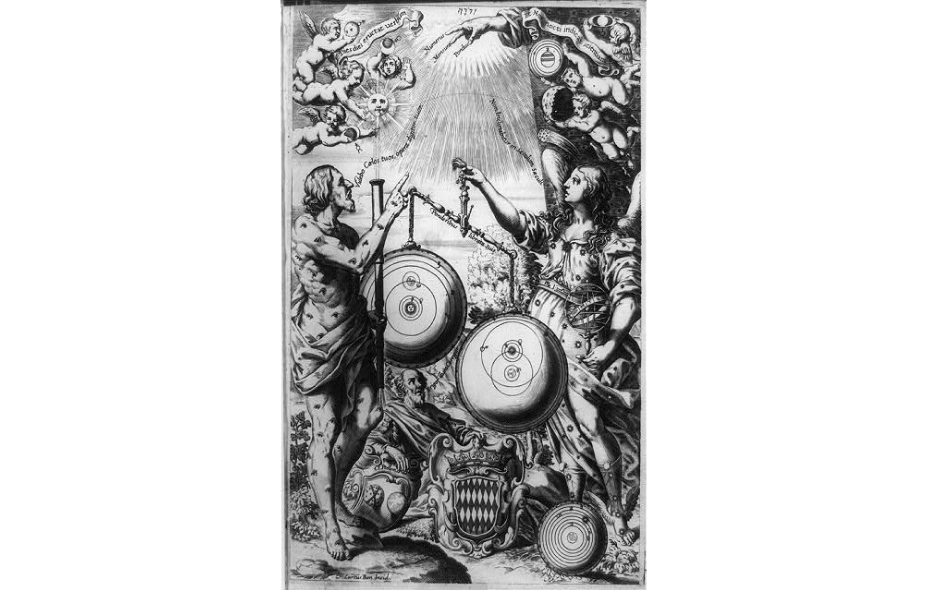
Dr Natarajan then quickly pivoted to modern astronomy, specifically the mapping of the universe- citing the Hubble space telescope as being instrumental (HA). The main goals of astronomy are describing the contents, expansion, and eventual fate of the universe. To illustrate this combination of goals, she cited the example of the Cosmic Microwave Background which is a relic of the time shortly after the Big Bang.
Dr Natarajan's lecture then focused on two particular topics- dark matter and black holes. She contrasted the discovery of these two enigmatic phenomena- the existence of dark matter was determined through empirical observation (gravitational effects on other astronomical objects) and the existence of black holes was determined through theoretical modeling.
The topic shifted to dark matter, which was the subject of her fantastic Secret Science Club North lecture. The universe is composed of approximately 70% dark matter, approximately 25% dark matter, and approximately 5% baryonic matter. The existence of dark matter was first proposed by Fritz Zwicky in order to explain the observed behavior of galaxies in the Coma Cluster. In the 1970s, Vera Rubin and Kent Ford observed unexpectedly steady rates in the rotation of galaxies, evidence that there was a 'halo' of matter around these galaxies that balanced out the greater concentration of baryonic matter at their core. While dark matter has never been observed, it has an impact on dynamics- the motion of stars and galaxies and an impact on light rays. In a solar system, the dominant gravity is that of its star. In a galaxy, there is a lot of 'gravitating' dark matter at the edge. Dark matter is lumped and clumped and smeared all over galaxies, but has no interaction with other matter, except through its mass.
Light is both a wave and a particle, it can be bent through a process known as gravitational lensing. This gravitational lensing can be used to observe far distant astronomical features in galaxy clusters. The current model of the universe posits filaments of dark matter with galaxies at the intersections of filaments. The nature of dark matter is encapsulated in its smoothness- using its lensing effects on observable astronomical features, dark matter can be mapped with a high degree of resolution. It is thought that dark matter is cold, with few collisions between particles... Dr Natarajan noted that she was somewhat disappointed that this was so.
While dark matter has not been observed to interact with baryonic matter, except through gravitational forces, there are attempts to detect it- the Large Underground Xenon experiment is an attempt to detect WIMPS (weakly interacting massive particles), which are considered candidates for dark matter. So far, these haven't been found- we are stuck with cold dark matter, but we don't know what it is.
The topic then shifted to the second major focus of the lecture- how black holes became real. Black holes were predicted mathematically, the mathematical models were borne out observationally, to the extent that gravitational waves were recently detected. In science, mathematical models have to be squared with actual objects. Dr Natarajan wryly noted that the term 'black hole' entered the English lexicon in 1756, to describe the Black Hole of Calcutta, the proverbial place of no return. In 1783, John Michell proposed a dark star, and object so massive that light (which in the original Newtonian model was thought to have mass) could not escape its gravitational field. According to Einstein's Theory of General Relativity, mass bends spacetime, theoretically, an object could be so massive that it effectively 'punctured' spacetime. The term black hole was applied to this astronomical phenomenon by John Wheeler.
The first observational evidence of black holes came in the form of mysterious objects dubbed 'quasars' which have been determined to be X-ray emissions from black holes. Black holes are collapsed stars so massive that light cannot escape their gravity once past the event horizon, so dense that, were the Earth to collapse into a black hole, it would measure one cubic centimeter in volume. According to General Relativity, mass bends the curvature of spacetime into 'holes'- the more mass, the deeper the hole. Black holes are infinitely deep, the laws of physics that we know break down in the vicinity of a black hole. The curvature of spacetime due to gravity was described in Einstein's field equations- Karl Schwartzschild proposed a solution describing slowly rotating spherical objects and New Zealander Roy Kerr proposed a solution modeling gravitational fields around supermassive rotating objects.
Subrahmanyan Chandrasekhar, pondering the fate of stars, formulated the Chandrasekhar limit, the maximum mass of a star which will form a white dwarf- according to the Chandrasekhar's theoretical model, more massive stars will collapse into neutron stars, even more massive ones will collapse into black holes. Jocelyn Bell Burnell, while a graduate student, discovered the first pulsar, which turned out to be a radiation-emitting rotating neutron star, empirical evidence for one of Chandrasekhar's theoretical end-term stars. The first empirical evidence of a stellar mass hole was the discovery of Cygnus X-1, a stellar mass hole which is pulling matter from a blue giant companion star.
More massive by far than stellar mass black holes are supermassive black holes. In 1963, Maarten Schmidt of Caltech discovered the first quasar, an extremely distant, extremely black object which was determined to be a scaled up supermassive feeding black hole... the brightness of the 'quasar' results from a 'flare' of matter ejected from the accretion disk of the black hole at high temperature and high velocity.
Major questions remain about black holes... boiling down to three 'F's'- formation, fueling, and feedback. How do they form? How do they grow? What do they do? Where do black holes reside? Does every galaxy harbor a supermassive black hole at its center? What are the 'seeds' of black holes? Do they result from direct collapse? How do they grow? The formation of a black hole would have to involve a lot of gas- everything would have to be right for one to form. Gravitational waves were discovered emanating from colliding black holes by LIGO, the Laser Interferometer Gravitational-Wave Observatory. LISA, the Laser Interferometer Space Antenna, is a project to develop a more sensitive gravitational wave detector.
As Dr Natarajan wrapped up her lecture, she displayed a NASA animation simulating a stellar mass black hole, a groovy visual accompaniment to a thoroughly groovy lecture:
The lecture was followed by a Q&A in which the Bastard was unable to get a question in. One of the most involved questions involved dark energy, which Dr Natarajan likened to the 'gas pedal of the universe', resulting in the increasing speed of the universe's expansion. She postulated that dark energy is a property of spacetime, but that more research was necessary. In the course of the Q&A, she uttered a line which cannot be stressed enough, so I'm putting in all-caps: NOTHING CAN SUPPLANT THE POWER OF DATA.
Dr Natarajan's return to the Secret Science Club, and her debut at the beautiful Bell House, was triumphant one. Kudos to Dr Natarajan, Dorian and Margaret, and the staff of the beautiful Bell House. For a taste of Dr Natarajan's scientific virtuosity, here's a video of the good doctor giving a brief lecture on the subject at hand:
Also, I'd like to give a hearty high-five to Dr Natarajan for the publication of Mapping the Heavens... congratulations! It's nice to see someone who can so perfectly articulate these cosmological concepts on a level that the layperson can understand. At the end of the lecture, Dr Natarajan addressed the packed house and quipped, "I thought I'd be speaking to ten people." I chided her afterwards by noting that her Symphony Space lecture was delivered to a full house. The good doctor has star power, which is entirely appropriate for an astrophysicist. Again, congratulations are in order.
Thursday, June 23, 2022
Secret Science Club Secrets Lecture Recap
Last night, I headed down to the beautiful Bell House, in the Gowanus section of Brooklyn, for this month's Secret Science Club lecture, featuring experimental psychologist Dr Michael Slepian of Columbia University, he is also the Sanford C. Bernstein & Co. Associate Professor of Leadership and Ethics. Dr Slepian has recently released a book, The Secret Life of Secrets: Hoe Our Inner Worlds Shape Well-Being, Relationships, and Who We Are, and the current lecture concerned having and keeping secrets.
People think about secrets every day. In a typical day, a typical person speaks or writes seventeen thousand words, the equivalent of forty-eight pages, double-spaced. About 30% of these words are used to disclose personal experience. About 18% of the words are small talk. About 3% of the words are saying nice things about people, and about 5% are saying not-so-nice things about people.
Secrecy is common, it is all around us. Dr Slepian cited secrets such as Coca-Cola's formula, the NSA, and Scientology. Secrecy is an intention to keep some piece of information unknown by one or more people. Dr Slepian asked, "What is it like to keep a secret?" Secrets are a burden, they can be draining, they can form a gulf between ourselves and others.
Secrets feel heavy- perception and behavior are scaled to the costs of acting on our environment- more resources are used, the world is more challenging to interact with. In one survey, participants were asked to estimate the slope of a hill- individuals keeping a big secret judged the hill to be steeper than individuals without big secrets did.
About ten percent of the subjects in one survey were preoccupied with infidelity. This can actually make tasks such as carrying groceries or walking the dog more difficult. Thinking about secrets makes one feel more burdened. Dr Slepian said that he would have stopped studying secrecy, but another researcher failed to replicate his work, so he had to continue.
Whether one sees a secret as big or small is not as important as how preoccupying a secret is. Big secrets are not always preoccupying, people learn to live with them. The burden of secrecy is less about what the secret is, and more about how often the secret is on one's mind.
As an example of a secret, Dr Slepian brought up infidelity. Among Americans, 30% of respondents have been unfaithful to a partner (not necessarily a current partner) at one time, the figure worldwide is about 20%. If individual A is in a long term monogamous relationship with B, and has a one-night stand while on a business trip, A has a secret at the moment A decides not to inform B. Even when B is not present, this secret will be a burden.
There are different ways to keep secrets, such as concealment, dodging the question. This is a small slice of the secrecy experience. Secrecy can result in mind-wandering, unresolved goals, and a failure to seize opportunities to take actions to solve problems. It's not necessary to actively hold back secrets, they can spontaneously come to mind.
In one study, respondents were asked to categorize experiences, and asked to list the ones they kept secret:

A typical respondent kept 13 secrets at a time. We keep the same kind of secrets. People think of their secrets far more than they conceal them. Secrets cause people's minds to wander more often than non-secrets. This matters for well-being. Frequently. concealing secrets doesn't harm individuals as much as preoccupation with secrets does. The stereotype of concealing a secret being harmful does not occur often... most secrets never come up in communication. People are ready for the moments in which they will conceal a secret, but not for the mind-wandering and preoccupation.
Dr Slepian noted that more data sets were required to gauge the harm of keeping secrets, and he displayed several diagrams concerning various dimensions of secrets and the harm they cause:
How do secrets hurt? In a recent JPSP, we find there are three dimensions to our secrets: 1. morality, 2. relationship-oriented, 3. goal-oriented. Each dimension has a unique harm (shame, isolation, uncertainty) and each offers an avenue for intervention https://t.co/BCqDlZLmoh pic.twitter.com/Z6rOoolxdg
— Michael Slepian (@michaelslepian) September 22, 2021
Each dimension of secrets has a degree of harm, such as causing bad moods or shame. Secrets can make us feel ashamed, feel isolated, and feel uncertainty. The paradox of secrets is that concealment is not usually harmful, but thinking about a secret is.
Can people think about secrets in better ways? While people can prepare to conceal secrets, can they prepare to think about them? Confiding secrets to a third party can help- it doesn't reduce concealment, but it does reduce mind-wandering. A small glimmer of hope can have a big effect- confiding leads to people feeling more capable. People tend to choose the right people to confide in, compassionate, assertive people. Would a confidant be burdened by a secret? It's best to choose someone slightly removed from the situation, someone whose morals are aligned and won't be scandalized (and prone to reveal a secret as a punishment). For confiding to backfire, it has to fail spectacularly. It takes a really negative response to make people second guess revealing secrets.
The lecture was followed by a Q&A session. The opening question, from some Bastard in the audience, involved cultural/religious factors in keeping or revealing secrets. Dr Slepian immediately picked up on the subtext about the sacrament of confession in the Roman Catholic church. He noted that, in comparing cross-cultural differences, it is useful to keep in mind how collectivist or individualistic a society is. In collectivist cultures, there is an inauthenticity to keeping secrets- it breaks norms, there is a greater expectation of revealing in order to keep order. That being said, in certain societies in which marriages are arranged, divorce is not an option, and social networks are small, there are more secrets. In societies in which you find a partner on your own, it's easier to leave on your own.
Another question involved the positivity or negativity of a secret, what's the difference between keeping a birthday party secret and keeping an affair secret? Positive secrets feel good because the point of concealment is to make the big reveal more exciting. Such secrets make us feel in control, and add to well-being.
Are there secrets we should never reveal? What harm would result from revelation? If you want to reveal something to make yourself feel better, you should nevertheless consider the harm revelation would do to others. Dr Slepian cited Dan Savage's "one time secret" model, but noted that repeat offenses aren't covered... ask yourself what your partner would want. Even with a one-time lapse, 77% of respondents stated that they would want to know. Dr Slepian also noted that there's no reason to figure this out on your own- seek a second opinion. There's no reason to be alone with your secret.
In one study of HIV positive men in the 1990s, men who concealed their sexual orientation had worse health outcomes and died sooner than men who were open about it.
Asked about methodology, and the candor of respondents, Dr Slepian noted that, in internet surveys, the level of detail is shocking, people want to talk about their secrets.
What differences are there between children and adults when it comes to keeping secrets? Children will deny even when there is evidence to the contrary (cooking crumbs on their shirts), they don't have other strategies. Adolescents are better at holding back secrets, which can cause problems
Regarding neurodivergent individuals, there is not enough data.
Journaling might be useful, as long as it isn't rehashing the past or merely chronicling a harmful record. Dr Slepian mentioned PostSecret as an anonymous way to write a secret down and anonymously reveal it.
Some secrets just 'time out', they simply lapse.
What's the utility of secrecy? A world without secrets would be less functional. Secrets protect the feelings of others. The optimal level of secrecy is not zero.
Regarding the difference between guilt and shame, guilt is "I did a bad thing", shame is "I am a bad person".
Once again, the Secret Science Club has dished out a fantastic lecture. Kudos to Dr Slepian, Dorian and Margaret, and the staff of the beautiful Bell House. High fives all around. For a taste of the Secret Science Club experience, check out this video with the good doctor:
Pour yourself a nice beverage and soak in that SCIENCE!!!
POSTSCRIPT: After the lecture, I joked with Dr Slepian that he should go into a Catholic church and participate in confession, just to experience the process of revealing a secret anonymously to a complete stranger. I told him that he could find movie scenes depicting the sacrament so he could do it in the traditional fashion. He joked that he would need a 'wingman'.
Sunday, February 28, 2021
Secret Science Club Zoom Lecture: What is Life?
Today, my great and good friends of the Secret Science Club for a Zoom lecture by Dr Paul Nurse, 2001 Nobel Prize winner in Physiology and Medicine, and director of London's Francis Crick Institute. The topic of the lecture was the subject of his book What Is Life? Five Great Ideas in Biology. This Zoom lecture represents Dr Nurse's triumphant return to the Secret Science Club, the good doctor lectured back in 2008, while heading Rockefeller University... my one big blogging regret is that I didn't start the blog earlier, so I could have summarized those lectures.
Having a crazy schedule these days, I entered the Zoom about fifteen minutes late, entering while Dr Nurse was discussing Gregor Mendel's study of heredity in pea plants, showing slides of the monk's gardens to illustrate his painstaking study.
Chromosomes, the molecules which regulate heredity were originally found in onion root cells. Chromosomes are made of deoxyribonucleic acid (DNA). DNA splits and the strands are templates for reproduction. The sequence of bases (adenine, cytosine, guanine, thymine) in a gene is coded in RNA which acts as a messenger to the cytoplasm to regulate proteins- one gene per protein. Heredity is written in the four letter nucleobase code (ACGT) in linear form.
Life is chemistry. Louis Pasteur, while studying the fermentation of sugar beets to ensure the production of alcohol rather than acid- he determined that yeast, a single cell organism, was responsible for producing alcohol, while bacteria would produce acid. He stated that fermentation is a physiological process. Proteins, polymers of amino acids, in the yeast acted as enzymes to alter carbohydrates, polymers of carbon, oxygen, and hydrogen. There are twenty amino acids which can combine to form complex molecular structures (DNA is rather simple). The various combinations of these twenty amino acids allow a wide range of proteins to be harnessed to power life functions.
Enzymes act as molecular machines which can reconfigure carbohydrates and lipids, they can transport other chemicals, they can turn sunlight to carbohydrates and break down other chemicals. Because they interact, enzymes need to be encapsulated to prevent harmful reactions. This separation allows the mechanism of life to occur.
Life is information, it is a complex system involving the management of information. The structure of DNA, iconic and beautiful, only makes sense when seen as a digital information system combined of four amino acids. Regulation is also necessary for life. There are governors to the processes of life- negative feedback loops to reduce synthesis of chemicals, and positive feedback loops to initiate growth. Homeostasis must be maintained, routines must be managed.
Life evolves, and life evolves by means of natural selection. Charles Darwin's father, Erasmus Darwin, believed in the evolution of life from simple forms to more complex forms, but did not name a process by which such evolution occurred. If life only evolved once, using four amino acids, all life is related. Charles Darwin proposed the mechanism of natural selection as the means for evolution- it is a consequence of a population having variations dependent on heritable traits. Traits which provide for better adaptation, and increased reproduction, will be passed on until there are sufficient changes to cause variable populations to cease to be able to interbreed.
Dr Nurse gave a brief rundown of Charles Darwin's gradual discovery of evolution by means of natural selection while serving on HMS Beagle. He also displayed an illustration of the famous Galápagos finches, comparing their beaks to various types of pliers:

The different beak shapes were selected for by the necessity to obtain different types of food. Natural selection requires reproduction, heritability, and mutability in heritability. Chromosomes determine cell properties, chromosomes replicate, and mutations arrive, which can be selected.
Dr Nurse ended his discussion of evolution by means of natural selection with this beautiful quote by Charles Darwin, who asserted that biology has laws, just like physics:
"Whilst this planet has gone cycling on according to the fixed law of gravity, from so simple a beginning endless forms most beautiful and most wonderful have been, and are being, evolved."
Dr then shifted the topic to intermediate-life forms, viruses. Viruses can reproduce and evolve, but can only do so in the cells of other organisms- they hijack the mechanism of cells to reproduce. One could say that viruses only live while inside other organisms, but are lifeless chemicals while outside cells. All life forms depend on other organisms- humans cannot synthesize certain amino acids, plants need bacterial symbiotes to produce nitrogen. There is a spectrum of interdependence among the organisms of earth. All life is interdependent.
Towards the end of the lecture, Dr Nurse summed up the various topics he had discussed in a series of bullet points.
Living things are independent bounded physical entities. The basic unit of life on Earth is the cell
Life forms are entities that can undergo evolution, they reproduce, they have a hereditary system, their progeny is subject to natural selection.
Life forms are chemical, physical, and informational machines which build their own metabolism to grow and reproduce.
Life is based on carbon polymer chemistry, polymers produce nucleic acid information storage Life is based on information storage in linear form encoded in polymers.
All known life on Earth descends from a common ancestor. We are all related to our fellow denizens of the planet.
If there is life beyond earth, it will be based on polymers, but might be based on different chemistry, utilizing different forms of energy.
All living organisms are related, and interact. We depend on our relationships to other inhabitants of Earth. Together, we are the great survivors, the currently living descendants of a single organism back in Deep Time. Because we are perhaps the only organisms to understand this, we have an obligation to protect and preserve life.
The lecture was followed by a Q&A session. The first question involved horizontal gene transfer, which can move genes from one branch of the Tree of Life to another- this doesn't alter natural selection, but does alter heritability. A question regarding consciousness evoked a call for increased study of the brain, and its chemical and electrical processes- Dr Nurse stated that the study of the brain will be the great scientific study of the next one-hundred years. Another question involved mitochondrial migration in neurons- neurons often being of great length, mitochondria might have to migrate to ensure proper energy supplies throughout the cells. How likely or unlikely was the eukaryotic revolution? Having studied the mechanism of cell division, the way in which human cells control cell division is identical to the way in which yeast cells control cell division- this is an extraordinary level of conservation, unchanged over a billion years. One could even take a human gene and implant it in a yeast cell, and cell division would not change. Questioned about the Drake equation, Dr Nurse noted that the universe is so vast, with enormous numbers of potential homes for life, the universe is most likely home to other lifeforms than earthly ones.
The Q&A session was short, as Dr Nurse had a prior claim on his time, which is just as well, because I had to get ready for work.
For a taste of the Secret Science Club experience, here is a video by Dr Nurse covering the topic he lectured on today:
Kudos to Dr Nurse, Dorian, and Margaret for another great Secret Science Club lecture. Now, folks, soak in that SCIENCE!
Wednesday, June 16, 2021
Secret Science Club Zoom Lecture: Shape
Tonight, my great and good friends at the Secret Science Club hosted a Zoom lecture featuring mathemetician Dr Jordan Elleberg of the University of Wisconsin, Madison. Dr Ellenberg's newly published book is Shape: The Hidden Geometry of Information, Biology, Strategy, Democracy, and Everything Else.
Dr Ellebberg began his lecture by noting that everything is connected, showing a 'map' of connections of topics in his book. Ronald Ross was a physician who determined that malaria was transmitted by mosquitos. Ross was an indifferent doctor, but had a love for mathematics, and he applied mathematical models to epidemiology. Ross wanted to formulate a theory of phenomena, starting with epidemics. His work in this field was the beginning of mathematical modeling. He applied it to the problem of malaria... eliminating malaria would involve eliminating mosquitos, which is impossible. Mosquitos can be temporarily eliminated from an area- how long would it take for them to repopulate an area. Mosquitos do not move in predetermined fashion, they move largely at random. Ross enlisted mathemetician Karl Pearson to couch a model of mosquito repopulation of an area in neutral terms, removing references to insects- The Problem of the Random Walk.
Botanist Robert Brown noticed the movement of particles in a medium, which became known as Brownian motion- he wondered if is it a vital life principle, noticing it in pollen first. Brown tested it on organic and non-organic materials (including a 'fragment of the Sphinx'). Albert Einstein noted that the molecules are colliding, causing this movement. This motion can be figured only on a basis of probability.
Russian mathematician Andrey Markov had a reputation for being furious- he was angry that Tolstoy was excommunicated while he was not, so he ended up being excommunicated as well. He approached the problem of the Law of Large Numbers, which basically states that if one were to flip a coin numerous times, the more times it is flipped, the probability of heads and tails approach fifty percent increases. Flip a coin ten times, there is a good chance there will be six heads and four tails... flipping one thousand coins, having six hundred heads and four hundred tails would be less probable. Markov formulated the concept of the Markov Chain. He applied the Markov chain to determine the sequence of vowels and consonants in Pushkin's poem Eugene Onegin
Dr Ellengram then played around with bigrams- what letters are likely to follow other letters? He mentioned playing with a computer game called AI Dungeon which can be used to generate texts. He presented an artificial intelligence generated text about geometry- not quite convincing, but with an occasional flash of brilliance such as: "But squares aren't just shapes, they're also numbers!" Can machines replace humans? There is a line of difficulty from, say Tic Tac To to a perfect Go game- computers aren't smarter if they can beat humans at chess or Go, it's a one dimensional difficulty issue... a robot may beat a human at chess, but it can't fold a shirt. Machines will be great collaborators for us- we must determine which tasks they can outperform us in. Dr Ellenberg hopes they can be capable partners.
The lecture was followed by a Q&A session, which began with a question about gerrymandering- new districts are going to be drawn, this gives the people who draw these lines great power over who gets elected. In Wisconsin, the current legislators draw the maps, which is a problem. Legislators are given the keys to thwarting the electorate. Districting is a geometric problem- there are districts which look like 'polyamorous octopuses'. Mathematical tests can determine how bad gerrymandering is.
How many holes in a straw? It depends.
Dr Ellenberg criticized a mathematical approach which separates the subject into discrete courses of study- mathematical fields are connected.
The Random Walk is a probability problem, but also a geometry problem. Dr Ellenberg sees most math as having a geometric component.
Was Lewis Carroll aware of Bigrams? Jabberwocky seems to hint that he was... his fake words sound plausible, but Dr Ellenberg wasn't sure if he were aware of bigrams... it would be a great fake theory to promulgate, Dr Ellenberg joked.
Squaring the circle- problem for the ancient Greeks, could a square be created with the same area as a circle? It became a symbol of a difficult problem. Lincoln, a geometry enthusiast, used this metaphor to express difficulty.
Mathematics is built one the one hand on rigid reasoning and on the other hand on intuition. Geometry is based on our bodies, our two-dimensional field of perception and our three-dimensional space.
Regarding internet searches, the search engines use a random walk process to determine the priority of search results.
Regarding the use of math to map pandemics, Dr Ellenberg referred back to Ross attempt to formulate a theory of phenomena. People move, pathogens are transmitted, this is a geometric problem.
Once again, the Secret Science Club has dished out another fantastic lecture, a humorous deep dive into esoteric topics. Kudos to Dr Ellenberg, Margaret and Dorian. For a small taste of the Secret Science Club experience, here is the Good Doctor speaking on the subject of his new book:
Pour yourself a nice beverage, sit back, and soak in that SCIENCE!!!
Wednesday, December 3, 2014
Secret Science Club North Lecture Recap: Sense of Style
Last night, I headed down to the scintillating Symphony Space for the third Secret Science Club North lecture, which featured the triumphant return of Harvard psychologist and linguist Dr Steven Pinker. Regular readers will remember that Dr Pinker presented a lecture last April at the Bell House concerning the decline of violence over the course of history. Last night's lecture touched on topics covered in Dr Pinker's new book, The Sense of Style: The Thinking Person's Guide to Writing in the 21st Century. In this book, Dr Pinker, the chair of the American Heritage Dictionary's usage panel, analyzes writing style manuals through the prism of cognitive science and linguistics.
The Sense of Style is a modern answer to the hoary old Strunk and White. He began the lecture by asking why writing is so hard, and why bad writing is so common, joking: "Bad writing is a choice!" He singled out "legalese" and "academese" as particularly egregious examples of bad writing. Bureaucrats use gibberish to evade responsibility, nerds use jargon as "revenge" on mundanes, and pseudo-intellectuals use gobbledegook to bamboozle their readers in order to seem smart. Being a kind man, Dr Pinker quickly followed these assertions with an acknowledgement that even good scientists and earnest people engage in bad writing.
Dr Pinker then took on the assertion that digital media are undermining the language. He had a very funny slide which addressed the limitations of Twitter's hundred-and-forty characters:
We hold these truths to be self-evident, that all men are created equal, that they are endowed by their Creator with certain unalienable Ri
He quickly torpedoed the "Dumbest Generation Theory" by displaying various quotes concerning assertions like this dating back to 1785, following these with a relevant cartoon. He then quoted Darwin on the difference between speech and writing: “Man has an instinctive tendency to speak as we see in the babble of our young children while no child has an instinctive tendency to bake, brew or write.” Speech is instinctive, writing is hard, and there is no feedback from the readers (readers are imaginary and can't interrupt during the writing process for clarification). Writing is both an act of pretense and an act of craftsmanship.
The talk then shifted focus to improving the craft of writing, whereupon Dr Pinker brought up Strunk and White's The Elements of Style While generally praising the book, Dr Pinker opined that language style manuals are largely collections of a particular stylist's preferences and peeves, not an understanding of how language works. He characterized some of the book's advice as "baffling" and asserted that we can produce a better approach to writing style by using science and modern scholarship. Much of the old stylistic advice was based on Latin grammar (not splitting infinitives is a perfect example of this- it can't be done with the one-word Latin infinitives). He also stressed the use of cognitive science to help determine whether a sentence is easy to read or difficult.
Dr Pinker made an argument for using "classic prose style", which involves showing an object, not describing the act of studying it- prose should be a window on reality, and should credit the reader's intelligence without apology or hedging. He also brought up the topic of the overuse of cliches, which can lead to mixed metaphors (with some particularly hilarious examples) and joked about membership of "AWFUL: Americans Who Figuratively Use Literally"
One particularly amusing example of bad stylistic advice was Strunk and White's admonishment to not use the passive voice, which uses the passive voice:
The habitual use of the active voice, however, makes for forcible writing. This is true not only in narrative principally concerned with action, but in writing of any kind. Many a tame sentence of description or exposition can be made lively and emphatic by substituting a transitive in the active voice for some such perfunctory expression as there is, or could be heard.
Dr Pinker defended the use of passive voice in the sciences, where an emphasis must be made on replicability (anyone should be able to replicate an experiment, this is encouraged by use of passive voice). He also noted that passive voice is useful to place emphasis on particular words- the word order in English is important due to the lack of case endings such as Latin or German have.
Dr Pinker also discussed the various approaches to acting as custodians of the language. Should there be a central authority determining proper usage (this has been attempted in countries such as France) or should changes in style occur naturally in a "bottom-up" fashion.
Since Dr Pinker is currently on a book tour supporting his new authorial endeavor, he has been delivering lectures on this topic all over the U.S. Here's a recording of one of his lectures, if you want to listen to the whole thing rather than my rehash of the topic:
Dr Pinker's talk blended humor, theory, and policy prescription. His criticisms were gentle and good-natured, his proposed solutions sensible. All-in-all, it was a lovely lecture which contained good advice for writers. Myself, I like to engage in wordplay... I like ambiguity and an occasional touch of grotesquerie in my writing. In the Q&A, I asked how one should differentiate between "plain bad" and "so bad it's good" writing, and Dr Pinker noted that exaggeration or an intentional misuse of language can be employed to comic effect, but that much of this is subjective.
Once again, my friends Dorian and Margaret of The Secret Science Club curated a fine lecture. The main hall of Symphony Space was packed for the lecture, and many attendees were new to the S.S.C. There was a hint about further Secret Science Club North lectures- hopefully, now that the word is out, the events will all take place in the main performance space (Dr Pinker is a celebrity- he has appeared numerous times on Stephen Colbert's show- let's hope there will be a "coattails" effect on future lectures). Kudos all around!
The Sense of Style is a modern answer to the hoary old Strunk and White. He began the lecture by asking why writing is so hard, and why bad writing is so common, joking: "Bad writing is a choice!" He singled out "legalese" and "academese" as particularly egregious examples of bad writing. Bureaucrats use gibberish to evade responsibility, nerds use jargon as "revenge" on mundanes, and pseudo-intellectuals use gobbledegook to bamboozle their readers in order to seem smart. Being a kind man, Dr Pinker quickly followed these assertions with an acknowledgement that even good scientists and earnest people engage in bad writing.
Dr Pinker then took on the assertion that digital media are undermining the language. He had a very funny slide which addressed the limitations of Twitter's hundred-and-forty characters:
We hold these truths to be self-evident, that all men are created equal, that they are endowed by their Creator with certain unalienable Ri
He quickly torpedoed the "Dumbest Generation Theory" by displaying various quotes concerning assertions like this dating back to 1785, following these with a relevant cartoon. He then quoted Darwin on the difference between speech and writing: “Man has an instinctive tendency to speak as we see in the babble of our young children while no child has an instinctive tendency to bake, brew or write.” Speech is instinctive, writing is hard, and there is no feedback from the readers (readers are imaginary and can't interrupt during the writing process for clarification). Writing is both an act of pretense and an act of craftsmanship.
The talk then shifted focus to improving the craft of writing, whereupon Dr Pinker brought up Strunk and White's The Elements of Style While generally praising the book, Dr Pinker opined that language style manuals are largely collections of a particular stylist's preferences and peeves, not an understanding of how language works. He characterized some of the book's advice as "baffling" and asserted that we can produce a better approach to writing style by using science and modern scholarship. Much of the old stylistic advice was based on Latin grammar (not splitting infinitives is a perfect example of this- it can't be done with the one-word Latin infinitives). He also stressed the use of cognitive science to help determine whether a sentence is easy to read or difficult.
Dr Pinker made an argument for using "classic prose style", which involves showing an object, not describing the act of studying it- prose should be a window on reality, and should credit the reader's intelligence without apology or hedging. He also brought up the topic of the overuse of cliches, which can lead to mixed metaphors (with some particularly hilarious examples) and joked about membership of "AWFUL: Americans Who Figuratively Use Literally"
One particularly amusing example of bad stylistic advice was Strunk and White's admonishment to not use the passive voice, which uses the passive voice:
The habitual use of the active voice, however, makes for forcible writing. This is true not only in narrative principally concerned with action, but in writing of any kind. Many a tame sentence of description or exposition can be made lively and emphatic by substituting a transitive in the active voice for some such perfunctory expression as there is, or could be heard.
Dr Pinker defended the use of passive voice in the sciences, where an emphasis must be made on replicability (anyone should be able to replicate an experiment, this is encouraged by use of passive voice). He also noted that passive voice is useful to place emphasis on particular words- the word order in English is important due to the lack of case endings such as Latin or German have.
Dr Pinker also discussed the various approaches to acting as custodians of the language. Should there be a central authority determining proper usage (this has been attempted in countries such as France) or should changes in style occur naturally in a "bottom-up" fashion.
Since Dr Pinker is currently on a book tour supporting his new authorial endeavor, he has been delivering lectures on this topic all over the U.S. Here's a recording of one of his lectures, if you want to listen to the whole thing rather than my rehash of the topic:
Dr Pinker's talk blended humor, theory, and policy prescription. His criticisms were gentle and good-natured, his proposed solutions sensible. All-in-all, it was a lovely lecture which contained good advice for writers. Myself, I like to engage in wordplay... I like ambiguity and an occasional touch of grotesquerie in my writing. In the Q&A, I asked how one should differentiate between "plain bad" and "so bad it's good" writing, and Dr Pinker noted that exaggeration or an intentional misuse of language can be employed to comic effect, but that much of this is subjective.
Once again, my friends Dorian and Margaret of The Secret Science Club curated a fine lecture. The main hall of Symphony Space was packed for the lecture, and many attendees were new to the S.S.C. There was a hint about further Secret Science Club North lectures- hopefully, now that the word is out, the events will all take place in the main performance space (Dr Pinker is a celebrity- he has appeared numerous times on Stephen Colbert's show- let's hope there will be a "coattails" effect on future lectures). Kudos all around!
Friday, December 6, 2019
C-SPAN Science Club
In my blog post from December 4th, I noted that I learned that the last two Secret Science Club North lectures were recorded for broadcast on C-SPAN. Well, I found the video of Sean Carroll's September lecture, and it's a good introduction to the Secret Science Club experience, especially since Dr Carroll is such a charismatic champion of an esoteric subject.
Pour yourself a beverage, make yourself comfortable, and soak in that Secret Science Club (North) experience.
When Dr Sullivan's SSCN lecture makes it to C-SPAN, I will post that as well.
Pour yourself a beverage, make yourself comfortable, and soak in that Secret Science Club (North) experience.
When Dr Sullivan's SSCN lecture makes it to C-SPAN, I will post that as well.
Wednesday, December 4, 2019
Secret Science Club North Post-Lecture Recap: Walk Tall, My Captain!
Last night, I headed down to the scintillating Symphony Space, on Manhattan's Upper West Side, for a Secret Science Club North lecture featuring Dr (and naval Captain) Kathryn Sullivan. Dr Sullivan is the first American woman to walk in space, and was instrumental in the mission which placed the Hubble Space Telescope in orbit. She has just released a book, Handprints on Hubble: An Astronaut's Story of Invention.
Dr Sullivan started her lecture with a passage from her book that came across as a passage from a techno-thriller, describing sitting in the shuttle, on the launchpad when an indicator light came on, showing a possible fuel leak. As she sat in the shuttle, a propulsion operator, known to her only by the callsign MPS, had to determine whether it was an actual leak or a faulty indicator, and whether to manually override the stoppage of the countdown clock- spoiler, the launch proceeded. It was a nice, sorta tense beginning to the lecture, an appetizer for the narrative that followed.
Captain Sullivan began her career as an astronaut in 1978, when NASA selected its first space shuttle crews. She had just received her PhD in geology, and was seeking her first post-doctorate job. The initial shuttle crews were, as she described them, TFNGs- thirty-five new guys (with the 'F' having another meaning not fit for the Symphony Space stage). Six of the Class of '78 were women, three were African-American men, and one was an Asian-American man. She joked that they were 'ten interesting people and twenty-five standard white guys'. As a 'baby astronaut', she had to go back to school for intensive classwork in physics, physiology, and other necessary subjects, receiving the equivalent of a first year graduate coursework in these fields. Before being considered as a crew member, she had to help prepare other flights- she compared this to starting work in the mailroom of a company and rotating around to other positions in order to learn what she needed for spaceflight.
Dr Sullivan's first spaceflight was in October 1984. Prior to that, her classmate Sally Ride flew in June 1983. Sally Ride flew with Dr Sullivan on her first flight, when she became the first American woman to walk in space. Dr Sullivan, a magnanimous person, noted that Russian cosmonaut Svetlana Savitskaya was the first woman to make two spaceflights and the first woman to walk in space. Dr Sullivan joked that her first mission allowed her to do 'cool earth-science things', and to test tools that would be needed for refueling satellites in orbit, thereby increasing their lifespan.
She also displayed an iconic photograph of her with Sally Ride, and related a funny anecdote... the two wee in the 'White Room' outside the shuttle launchpad, and they both knew that they were the recipients of media attention. In order to look like they were doing something, they decided to play out a stereotype from all sorts of military movies and tech thrillers, and pretended to synchronize their watches (which had already been done long before):

She quipped that astronauts are on top of the world before a flight, receiving a lot of attention, but when they land, they go back to being nobodies, having to seek themselves out in photographs.
After her spacewalk, Dr Sullivan was placed on the 'space telescope' project which would result in Hubble. The space telescope was supposed to be maintained for fifteen years, but no tools were developed with which to work on the device. One of her earliest tasks was to figure out what tools were needed for maintenance. She displayed a painting by Chesley Bonestell from a 1952 issue of Colliers magazine (published shortly after her birth) depicting a space shuttle, a space telescope, and a space station:

Her work would be making this image a reality... to make the engineering catch up with the vision. She noted that we have accomplished this, though the details were slightly different, with different shuttle wing configurations and an Erector Set space station instead of that 'Arthur C. Clarke hub-and-spokes space station'.
The space telescope being conceived shortly before her birth, she jokingly referred to Hubble as her 'big brother'. The telescope was designed to be worked on by space-suited astronauts. Dr Sullivan humorously likened this to putting on two snowmobile suits, placing a bucket on one's head, donning clumsy gloves, and trying to change the spark plugs in one's car... oh, and if you drop a tool, it floats away. Special tools needed to be devised, and the work choreography had to be figured out in a water tank. Dozens of tests were needed to develop good bench strength to work on the Hubble telescope. The original plan was to have large instruments worked on in orbit, but to perhaps bring the telescope back to Earth every five years to repair smaller electronics... this idea was scrapped in 1984, and everything had to be modified to allow repairs to take place in orbit.
Dr Sullivan then walked us through the necessary tasks to work on equipment in orbit. In order to hold one's feet still, a portable foot restraint is needed, a pivoting platform attached to the object to be worked on by a semi-rigid tether... all while the object to be worked on is restrained by the shuttle's robotic arm. Even the pliers and ratchet sets to be used in orbit have to be modified so they can be used while wearing heavy, clumsy gloves.
Before the Hubble mission, the crew ordered a bunch of mission patches, and enamel badges for the launch team, which were misprinted 'Lunch Team' and instantly became highly sought-after collectors' items.
In April 1990, the Hubble was released into orbit with a hitch- one of the solar arrays was stuck, so Dr Sullivan had to suit up and spend time cooped up in an airlock in case she had to manually crank the array into place. A technician on the ground was able to properly deploy the solar array, so Captain Sullivan never had to leave the airlock.
When Hubble was deployed, it was found to be 'nearsighted'- there was an imperfection in the main mirror, one-fiftieth of the thickness of a human hair. Arthur Fisher writing for Popular Science put it: “It was as if an eagle had become a bat.” The mess-up was a severe blow for NASA, but the Hubble team figured out that the error was precisely calibrated, and could be corrected by a similarly calibrated adjustment of the optical works. The correction, dubbed COSTAR, was envisioned by engineer Jim Crocker... Crocker, a tall individual, hit upon a solution while loosening an adjustable showerhead in an Utrecht hotel room, and realized that a corrective optical device could be added to Hubble. The repair took place in 1993, and the gorgeous images obtained by Hubble afterwards have become iconic.
The Hubble telescope has entered the public imagination like no other scientific instrument. It has been improved throughout its lifetime, which has been much longer than its projected fifteen year term. Dr Captain Sullivan finished her lecture by displaying a photograph of the actual handprints on the surface of the Hubble which inspired the title of her book, sections of the telescope's surface which, due to contact, have been weathered by interactions with particles in space. Being a magnanimous person, she noted that the ground crews which have participated in the Hubble mission have left metaphorical handprints as well.
The lecture was followed up with a Q&A session. I am happy to note that there were several families with children present for the lecture... it's beautiful to see the values embodied by Dr Sullivan and the Secret Science Club team instilled in kids. One of the first questions was, were you ever scared while on a mission? Dr Sullivan joked that astronauts ride bombs for a living, but that the risk is totally worth it, and that as an astronaut, she had to be 'all in' on every mission. Regarding a question about the scientific benefits of space programs, Dr Sullivan noted that the Apollo program marked the first time that computer scientists stopped bragging about how big their computers were and started bragging about how small their computers were (I was reminded of this). Another question regarded the effects of space flight on her body- after ten days in orbit, her body felt like wet sand, and she had to remind herself that she couldn't just 'launch' objects to other people because of the gravity. Another question regarded looking down on the Earth, and Dr Sullivan noted that most boundaries cannot be seen from space, but certain divisions are visible due to human effects on the terrain. When asked if she experienced sexism in NASA, she noted that she walked on as a full astronaut, and that NASA had been attempting to make a 'one size fits all' spacesuit, a sort of modular 'Mr Potato Head' design that could be adjusted to fit a broad range of physiques. Asked what inspired her to transition from Marine Geology to Spaceflight, she said that she wanted to see the Earth with her own eyes. Asked if the view of the stars from space was different than from Earth, Dr Sullivan joked that the differene in distance from the ground is negligible, but that the view of the Earth from orbit is dramatic- Earth isn't Carl Sagan's 'pale blue dot', but a 'big blue beachball'. Some Bastard in the audience asked her to contrast her career in NASA with her career with NOAA, particularly with regard to politics- she noted that NASA is seen as a bipartisan gem, with a unified space law formulated in 1958 with the administration's creation, and defining its mission. NOAA, formed in 1970, aggregated bits and pieces of many agencies, some such as the Weather Bureau and the Department of the Fisheries dating back to the 1800s. It was created to synthesize a 'big picture' from various oceanographic and atmospheric sources. If NASA is a gem, NOAA is a quilt, and its efforts have to be more convincing to more people in order to ensure proper funding.
Dr Sullivan delivered a fantastic lecture, a blend of hard science and engineering, with a fascinating career retrospective, and a bold adventure narrative... all of it leavened with humor, and heartfelt expressions of gratitude to her colleagues. I often talk about the 'Secret Science Sweet Spot', and Dr Sullivan achieved it. Grand Slam? She knocked it into orbit. Kudos to Dr Sullivan, Dorian and Margaret, and the staff of the scintillating Symphony Space.
For a taste of that Secret Science Club experience, here is a video of Dr Sullivan speaking on her career with NASA:
Last night, I learned that the two latest Secret Science Club North lectures were recorded for C-SPAN Book TV. Last night's lecture should be broadcast in three weeks or so. I will post the last SSCN lecture's C-SPAN recording in another blog entry, so you can get the full experience.
Dr Sullivan started her lecture with a passage from her book that came across as a passage from a techno-thriller, describing sitting in the shuttle, on the launchpad when an indicator light came on, showing a possible fuel leak. As she sat in the shuttle, a propulsion operator, known to her only by the callsign MPS, had to determine whether it was an actual leak or a faulty indicator, and whether to manually override the stoppage of the countdown clock- spoiler, the launch proceeded. It was a nice, sorta tense beginning to the lecture, an appetizer for the narrative that followed.
Captain Sullivan began her career as an astronaut in 1978, when NASA selected its first space shuttle crews. She had just received her PhD in geology, and was seeking her first post-doctorate job. The initial shuttle crews were, as she described them, TFNGs- thirty-five new guys (with the 'F' having another meaning not fit for the Symphony Space stage). Six of the Class of '78 were women, three were African-American men, and one was an Asian-American man. She joked that they were 'ten interesting people and twenty-five standard white guys'. As a 'baby astronaut', she had to go back to school for intensive classwork in physics, physiology, and other necessary subjects, receiving the equivalent of a first year graduate coursework in these fields. Before being considered as a crew member, she had to help prepare other flights- she compared this to starting work in the mailroom of a company and rotating around to other positions in order to learn what she needed for spaceflight.
Dr Sullivan's first spaceflight was in October 1984. Prior to that, her classmate Sally Ride flew in June 1983. Sally Ride flew with Dr Sullivan on her first flight, when she became the first American woman to walk in space. Dr Sullivan, a magnanimous person, noted that Russian cosmonaut Svetlana Savitskaya was the first woman to make two spaceflights and the first woman to walk in space. Dr Sullivan joked that her first mission allowed her to do 'cool earth-science things', and to test tools that would be needed for refueling satellites in orbit, thereby increasing their lifespan.
She also displayed an iconic photograph of her with Sally Ride, and related a funny anecdote... the two wee in the 'White Room' outside the shuttle launchpad, and they both knew that they were the recipients of media attention. In order to look like they were doing something, they decided to play out a stereotype from all sorts of military movies and tech thrillers, and pretended to synchronize their watches (which had already been done long before):

She quipped that astronauts are on top of the world before a flight, receiving a lot of attention, but when they land, they go back to being nobodies, having to seek themselves out in photographs.
After her spacewalk, Dr Sullivan was placed on the 'space telescope' project which would result in Hubble. The space telescope was supposed to be maintained for fifteen years, but no tools were developed with which to work on the device. One of her earliest tasks was to figure out what tools were needed for maintenance. She displayed a painting by Chesley Bonestell from a 1952 issue of Colliers magazine (published shortly after her birth) depicting a space shuttle, a space telescope, and a space station:

Her work would be making this image a reality... to make the engineering catch up with the vision. She noted that we have accomplished this, though the details were slightly different, with different shuttle wing configurations and an Erector Set space station instead of that 'Arthur C. Clarke hub-and-spokes space station'.
The space telescope being conceived shortly before her birth, she jokingly referred to Hubble as her 'big brother'. The telescope was designed to be worked on by space-suited astronauts. Dr Sullivan humorously likened this to putting on two snowmobile suits, placing a bucket on one's head, donning clumsy gloves, and trying to change the spark plugs in one's car... oh, and if you drop a tool, it floats away. Special tools needed to be devised, and the work choreography had to be figured out in a water tank. Dozens of tests were needed to develop good bench strength to work on the Hubble telescope. The original plan was to have large instruments worked on in orbit, but to perhaps bring the telescope back to Earth every five years to repair smaller electronics... this idea was scrapped in 1984, and everything had to be modified to allow repairs to take place in orbit.
Dr Sullivan then walked us through the necessary tasks to work on equipment in orbit. In order to hold one's feet still, a portable foot restraint is needed, a pivoting platform attached to the object to be worked on by a semi-rigid tether... all while the object to be worked on is restrained by the shuttle's robotic arm. Even the pliers and ratchet sets to be used in orbit have to be modified so they can be used while wearing heavy, clumsy gloves.
Before the Hubble mission, the crew ordered a bunch of mission patches, and enamel badges for the launch team, which were misprinted 'Lunch Team' and instantly became highly sought-after collectors' items.
In April 1990, the Hubble was released into orbit with a hitch- one of the solar arrays was stuck, so Dr Sullivan had to suit up and spend time cooped up in an airlock in case she had to manually crank the array into place. A technician on the ground was able to properly deploy the solar array, so Captain Sullivan never had to leave the airlock.
When Hubble was deployed, it was found to be 'nearsighted'- there was an imperfection in the main mirror, one-fiftieth of the thickness of a human hair. Arthur Fisher writing for Popular Science put it: “It was as if an eagle had become a bat.” The mess-up was a severe blow for NASA, but the Hubble team figured out that the error was precisely calibrated, and could be corrected by a similarly calibrated adjustment of the optical works. The correction, dubbed COSTAR, was envisioned by engineer Jim Crocker... Crocker, a tall individual, hit upon a solution while loosening an adjustable showerhead in an Utrecht hotel room, and realized that a corrective optical device could be added to Hubble. The repair took place in 1993, and the gorgeous images obtained by Hubble afterwards have become iconic.
The Hubble telescope has entered the public imagination like no other scientific instrument. It has been improved throughout its lifetime, which has been much longer than its projected fifteen year term. Dr Captain Sullivan finished her lecture by displaying a photograph of the actual handprints on the surface of the Hubble which inspired the title of her book, sections of the telescope's surface which, due to contact, have been weathered by interactions with particles in space. Being a magnanimous person, she noted that the ground crews which have participated in the Hubble mission have left metaphorical handprints as well.
The lecture was followed up with a Q&A session. I am happy to note that there were several families with children present for the lecture... it's beautiful to see the values embodied by Dr Sullivan and the Secret Science Club team instilled in kids. One of the first questions was, were you ever scared while on a mission? Dr Sullivan joked that astronauts ride bombs for a living, but that the risk is totally worth it, and that as an astronaut, she had to be 'all in' on every mission. Regarding a question about the scientific benefits of space programs, Dr Sullivan noted that the Apollo program marked the first time that computer scientists stopped bragging about how big their computers were and started bragging about how small their computers were (I was reminded of this). Another question regarded the effects of space flight on her body- after ten days in orbit, her body felt like wet sand, and she had to remind herself that she couldn't just 'launch' objects to other people because of the gravity. Another question regarded looking down on the Earth, and Dr Sullivan noted that most boundaries cannot be seen from space, but certain divisions are visible due to human effects on the terrain. When asked if she experienced sexism in NASA, she noted that she walked on as a full astronaut, and that NASA had been attempting to make a 'one size fits all' spacesuit, a sort of modular 'Mr Potato Head' design that could be adjusted to fit a broad range of physiques. Asked what inspired her to transition from Marine Geology to Spaceflight, she said that she wanted to see the Earth with her own eyes. Asked if the view of the stars from space was different than from Earth, Dr Sullivan joked that the differene in distance from the ground is negligible, but that the view of the Earth from orbit is dramatic- Earth isn't Carl Sagan's 'pale blue dot', but a 'big blue beachball'. Some Bastard in the audience asked her to contrast her career in NASA with her career with NOAA, particularly with regard to politics- she noted that NASA is seen as a bipartisan gem, with a unified space law formulated in 1958 with the administration's creation, and defining its mission. NOAA, formed in 1970, aggregated bits and pieces of many agencies, some such as the Weather Bureau and the Department of the Fisheries dating back to the 1800s. It was created to synthesize a 'big picture' from various oceanographic and atmospheric sources. If NASA is a gem, NOAA is a quilt, and its efforts have to be more convincing to more people in order to ensure proper funding.
Dr Sullivan delivered a fantastic lecture, a blend of hard science and engineering, with a fascinating career retrospective, and a bold adventure narrative... all of it leavened with humor, and heartfelt expressions of gratitude to her colleagues. I often talk about the 'Secret Science Sweet Spot', and Dr Sullivan achieved it. Grand Slam? She knocked it into orbit. Kudos to Dr Sullivan, Dorian and Margaret, and the staff of the scintillating Symphony Space.
For a taste of that Secret Science Club experience, here is a video of Dr Sullivan speaking on her career with NASA:
Last night, I learned that the two latest Secret Science Club North lectures were recorded for C-SPAN Book TV. Last night's lecture should be broadcast in three weeks or so. I will post the last SSCN lecture's C-SPAN recording in another blog entry, so you can get the full experience.
Friday, September 12, 2014
Secret Science Club Post Lecture Recap: Seeing AI's
Last night, I headed down the the beautiful Bell House in the Gowanus section of Brooklyn for this month's Secret Science Club lecture, featuring Dr Rob Fergus of NYU and Facebook's Artificial Intelligence lab. Dr Fergus' lecture concerned the development of visual systems for artificial intelligences.
The lecture began with a question- can computers see and make sense of their surroundings? Dr Fergus' project is to build machines that can see with deep learning. The goal is to build intelligent machines... such machines need to be able to perceive- they need visual recognition and understanding of that which is perceived. Until recently, this problem was unsolved, interpreting images is not straightforward to a computer. The human visual system is complex, involving not only the eyes and optic nerve, but multiple parts of the brain- the pathway from eyes to decision making area of the brain is complex.
AI developers aren't copying natural visual systems because the understanding of the brain is still vague, and the "architecture" of the brain isn't the best model. Compared to computer processors, the human brain is made up of slow but parallel systems, while computers have fast but linear systems. The ideal artificial visual processor would be able to outperform nature's designs and constraints. Convolutional neural networks are the networks with special connectivity designed for computer visual systems.
The first problem of developing a visual system is image classification. Can a particular description of an image match a single label? The key to image description is making the best prediction for an image. Pixels have to receive a class label, one per image, the image and label forms a data set.
Training has to take place- a model needs to be chosen to map images to the labels- the training involves incrementally upgrading the parameters of the data sets to reduce a loss of visual function. After the training is accomplished, test data needs to be added- overly complex models can impede training.
In order to achieve Deep Learning, models with hierarchical structures need to be built. These hierarchies become increasingly complicated, building to a desired stage. The initial "layer" of the image is a simple filtered image, and each subsequent layer extracts features from the previous layer. The pixels are filtered through a non-linear dimension, and the process occurs in a "learned" direction. Multiple filters, hundreds or thousands in practice, are used to create "feature maps".
Pooling of the feature maps the occurs, serving to create invariant output despite multiple inputs... ideally, changes in the input won't result in changes to the output. As pooling increases, smaller local models accumulate, with higher convolution layers adding up to a whole picture.
Dr Fergus then gave us a brief history of this field, from 1989 to 2012. One major breakthrough occured in 2012 with the creation of the ImageNet database, which includes about 14 million images from about twenty-thousand classes. Another breakthrough was the implementation of Graphics Processing Units in visual systems. Current visual models have filters which can be retrained late in the filtering process to improve performance. The CLARIFAI image recognition system is able to autotag processed images.
The talk then proceeded to a demonstration of the different layers of filters in a hierarchy. Due to the visual component of this part of the talk, it's hard to encapsulate it in a blog post. Luckily, here's a video by Dr Fergus- the camera-work insufficiently covers the slides, but a viewer should get some idea of the different filter values:
After the lecture, some bastard asked Dr Fergus what sort of progress has been made in AIs' ability to process novel images. He indicated that this is a subject which is just now being broached- getting AI visual processing up to its present standard has been difficult enough even with labelling.
Once again, the Secret Science Club presented a fine, fine lecture. Kudos to Dr Fergus, Secret Science goddesses Dorian and Margaret, and the staff of the beautiful Bell House.
The lecture began with a question- can computers see and make sense of their surroundings? Dr Fergus' project is to build machines that can see with deep learning. The goal is to build intelligent machines... such machines need to be able to perceive- they need visual recognition and understanding of that which is perceived. Until recently, this problem was unsolved, interpreting images is not straightforward to a computer. The human visual system is complex, involving not only the eyes and optic nerve, but multiple parts of the brain- the pathway from eyes to decision making area of the brain is complex.
AI developers aren't copying natural visual systems because the understanding of the brain is still vague, and the "architecture" of the brain isn't the best model. Compared to computer processors, the human brain is made up of slow but parallel systems, while computers have fast but linear systems. The ideal artificial visual processor would be able to outperform nature's designs and constraints. Convolutional neural networks are the networks with special connectivity designed for computer visual systems.
The first problem of developing a visual system is image classification. Can a particular description of an image match a single label? The key to image description is making the best prediction for an image. Pixels have to receive a class label, one per image, the image and label forms a data set.
Training has to take place- a model needs to be chosen to map images to the labels- the training involves incrementally upgrading the parameters of the data sets to reduce a loss of visual function. After the training is accomplished, test data needs to be added- overly complex models can impede training.
In order to achieve Deep Learning, models with hierarchical structures need to be built. These hierarchies become increasingly complicated, building to a desired stage. The initial "layer" of the image is a simple filtered image, and each subsequent layer extracts features from the previous layer. The pixels are filtered through a non-linear dimension, and the process occurs in a "learned" direction. Multiple filters, hundreds or thousands in practice, are used to create "feature maps".
Pooling of the feature maps the occurs, serving to create invariant output despite multiple inputs... ideally, changes in the input won't result in changes to the output. As pooling increases, smaller local models accumulate, with higher convolution layers adding up to a whole picture.
Dr Fergus then gave us a brief history of this field, from 1989 to 2012. One major breakthrough occured in 2012 with the creation of the ImageNet database, which includes about 14 million images from about twenty-thousand classes. Another breakthrough was the implementation of Graphics Processing Units in visual systems. Current visual models have filters which can be retrained late in the filtering process to improve performance. The CLARIFAI image recognition system is able to autotag processed images.
The talk then proceeded to a demonstration of the different layers of filters in a hierarchy. Due to the visual component of this part of the talk, it's hard to encapsulate it in a blog post. Luckily, here's a video by Dr Fergus- the camera-work insufficiently covers the slides, but a viewer should get some idea of the different filter values:
After the lecture, some bastard asked Dr Fergus what sort of progress has been made in AIs' ability to process novel images. He indicated that this is a subject which is just now being broached- getting AI visual processing up to its present standard has been difficult enough even with labelling.
Once again, the Secret Science Club presented a fine, fine lecture. Kudos to Dr Fergus, Secret Science goddesses Dorian and Margaret, and the staff of the beautiful Bell House.
Subscribe to:
Posts (Atom)


