It's that time of year, when I pull a Captain Nemo, going under and not surfacing for a good long time. October is the major fundraising month for the non-profit for which I work, which means long hours on my feet, running hither, tither and yon. I'm busy before an event starts, during an event, and after the event ends, so I don't have as much time to write as I do on one of my quieter days. I hope to post regularly, but the posts may be shorter than usual. Last year, in response to my sentence: Captain Nemo going down in the submarine, Smut Clyde wrote:
Needs moar Filthbot.
Operating, to some extent, on the principle "You wish it, I dish it", here's some hilariously cheesy submarine related filth, a piss-take from one-time Iron Maiden lead singer Bruce Dickinson:
For the record, my favorite "submarine" themed song is Submission by the Sex Pistols. I dig it so much, I'll post it again:
Showing posts sorted by relevance for query submission. Sort by date Show all posts
Showing posts sorted by relevance for query submission. Sort by date Show all posts
Saturday, October 1, 2011



Wednesday, January 27, 2021
Secret Science Club Zoom Lecture: Perchance to Dream
Tonight, I am participating in a Zoom lecture with my great and good friends of the Secret Science Club. Tonight's lecture features sleep researchers Dr Antonio Zadra, professor of psychology at the Université de Montréal and a researcher at the Center for Advanced Research in Sleep Medicine, and Dr Robert Stickgold, professor of psychiatry at Harvard Medical School and director of the Center for Sleep and Cognition. Drs Zadra and Stickgold are the authors of When Brains Dream: Exploring the Science & Mystery of Sleep.
Dr Zadra began the lecture by joking that he and Dr Stickgold would be running the lecture like a tag-team wrestling match- he would set the stage and Dr Stickgold would wrestle the topic into submission. He then posed the question: why study dreams? We all dream, and these vivid experiences are usually quickly forgotten. What are the origins and meanings of dreams? Dreams are as old as humankind and feature in literature, philosophy, and medicine. Both as a concept and an experience, dreams are trickier than most people imagine. Dreams are often dismissed... "it's just a dream" is a common rejoinder to a dreamer. It takes a while to understand what dreams are.
Dr Zadra noted that his five year old nephew had a pretty good handle on what dreaming is all about, believing that dreams occurred before his eyes. Questioning the lad, he'd tell him that his eyes were closed while he was dreaming, resulting in consternation. He joked that, now that he has children of his own, he doesn't have to torment his nephews.
Most preschoolers believe that dreams are real, that they originate outisde the body, and can be seen by others. Usually by ages six to eight, children realize that dreams are private, originate in the mind, and cannot be perceived by others.
An understanding of dreams requires the ability to distinguish between real and imagined event.s Narcolepsy effects the sleep-wake cycle and can interfere with this distinction. False awakenings, a dream that an individual has awakened, also occur. Confusion between dreams and reality can manifest themselves in different ways. Among our ancestors, supernatural causes were often posited to explain dreams
Thre are challenges to studying dreams. Being private, dreams cannot be studied, only dream reports. An analogy is that pain is difficult to study, patients must describe pain for physicians to study it.
There is no real consensus about what counts as a dream. A broad view of dreaming encompasses everything from fragmented, thought-like dreams to sweeping, epic dreams with dramatic imagery and emotional content.
In sleep labs, heart rates and brain patterns can be measured. Patients can be awakened soon after REM sleep to increase retention of dreams. Home dream journals and questionnaires can also be used to study dream reports. Dream reports can study settings, characters (real or imagined), social interactions, emotions, bizarreness, length.
Four questions drive dream research. What are dreams? Where do they come from? What do they mean? What are they for? Dr Zadra then turned over the lecture to Dr Stickgold.
Dr Stickgold started his lecture by stating that he would address the cognitive nature of dreams. He described dreams as 'memory evolution'. During the day, we form memories, but have little time to process them. We 'file them away', but these memories evolve overnight, over a lifetime. In one experiment, subjects typed a number sequence over and over, in a thirty second cycles interspersed with thirty seconds of rest for twelve minutes. They would be sent away for twelve hours and return, if they conduct the test at night and re-test in the morning, their performance improves in terms of speed and accuracy. Given a more complex task, a number reduction problem, ten percent of the subjects figure out a shortcut to figuring out the pattern (Dr Stickgold joked that they are taken out back and shot). Given a period of sleep and re-tested in the morning, subjects are two and a half times better at discerning the pattern.
Dr Stickgold's student Erin Wamsley tested subjects with a maze problem. Individuals allowed to sleep performed better the following morning. She also had her subjects report dreams. Subjects reporting no dreams didn't get faster at performing the task. Subjects who dreamed about the maze solved it an average of three minutes faster, using one hundred fewer grid movements. Subjects reported dreaming about swimming above the maze, seeing everything, or looking for a friend in the maze, or being in a real labyrinth, such as a hedge maze.
Drs Stickland and Zadra formed the NEXT UP model of dreaming: Network exploration to explore possibilities. Dreams are related to memories of recent events. Dreams don't just replay memories. Our dreams search for, discover, and activate related memories. Most sleep dependent memory processing serves to extract information from recent memories, seeking answers. Dreaming seeks possibilities, potential uses of memories.
Dr Stickland then moved to the subject of dream cycles, a brief onset of sleep, then cycles of slow wave sleep and rapid eye movement sleep throughout the night. Different stages of sleep play different roles in memory evolution. Different stages of sleep have impacts on different memory tasks, such as word pairs, motor skill tasks, or emotional memory tasks. Sleep onset identifies and 'tags' memories for processing. Non REM sleep explores strong associations. REM sleep involves the exploration of weaker, more distant associations.
The hard problem of dreaming is the question of are we talking about dreaming or about the underlying processes. Why can't this processing take place in the background of consciousness. Consciousness can be described as a 'gimmick' evolution gave us as a new means to solving problems. It creates the world of the imagination, the world of planning and prediction. A crucial value of sleep is to discover and evaluate previously unexpected associations in our minds.
Dr Zadra then took the mic in the tag-team match and returned to the NEXT UP model, which helps to explain recurrent dreams, nightmares, lucid dreams, and even dreams which seem to predict the future. He likened dreaming to an artist who creates a work, then asks people to interpret the art, which is what people often do with dreams. There is no 'one true meaning' to any dream. To understand a dream, the artist, the dreamer, must be involved in the analysis. Working with dreams can be useful in a therapeutic context- it can contribute to the alliance between therapist and patient, increase client involvement in therapy, enhance the understanding of the clinical progress, and improve patient well-being.
Dr Zadra advised us in remembering dreams- he advised us to close our eyes and review everything before recording the dream. Once recorded, the dream can be re-read and re-examined. Then you can explore the meaning- the images and emotions, the settings and people or animals encountered. What associations come to mind? Do your dreams remind you of things that you are experiencing?
The lecture was followed by a Q&A session. The first question involved talking in one's sleep... could sleep apnea be a factor? Sleep talking can occur in all stages of sleep, and can be in the form of gibberish, or be articulate. One's statements can be related or unrelated to a dream, and can hear others and respond to them. Sleep talking has no disruptive effects on sleep, and has no connection to sleep apnea. Another question regarded lucid dreaming- there are practices during wakefulness to foster it, and gadgets of dubious value marketed to improve it. Lucid dreaming draws a lot of attention and is learnable, but learning it is difficult. What are factors in remembering dreams and are dreams really in grayscale, rather than in color. Dr Stickgold noted that remembering dreams is best done by lying down. People usually don't have the opportunity to remember dreams- they fall asleep quickly without hypnogogic dreams, they sleep deeply, and wake suddently to an alarm clock. He suggested drinking a lot of water to cause one to wake up during the night. Some people dream in gray but others dream in color. Dr Zadra interjected that people who remember dreams often experience micro-awakenings, then mentioned that, until recently, people didn't report dreaming in grayscale. Perhaps the advent of black and white photography had an effect on this perception. Perhaps colors are not registered as important parts of dreams. Some bastard in the audience asked how dreams affect our sensory cortices- these areas of the brain are activated during dreaming, but it is unclear if these activations are important. The memories that are recalled activate the visual and auditory circuits and this might strengthen the sensory encoding of these memories. Answering another question, Dr Stickgold indicated that his biggest regret was not studying the connection between memory and dreams until Erin Wamsley devised the maze test. Another question regarded sleep among animals- sleep occurs throughout the animal kingdom. Even fruit flies sleep, and mice and rats (and even fish) display sleep-dependent learning. We have to shut down every so often and process information- what we learn during the day is the easy part, it makes us smart, but learning how to process the information requires sleep- that's what makes us wise. Another questioner noted that she kicks when she sleeps- while in REM sleep, the body experiences muscle paralysis, but some individuals experience REM sleep behavior disorder, in which they can leap out of bed (this is distinct from sleep walking) or otherwise act out dream behaviors.
Once again, the Secret Science Club has served up a dream of a lecture. Kudos to Drs Zadra and Stickgold, and Dorian and Margaret. Both Dr Stickgold and Dr Zadra have videos posted on YouTube. Pour yourself a beverage, sit back, and soak in that SCIENCE!!!
Tuesday, October 5, 2010
Should've Posted This Yesterday
In keeping with my "in the submarine, won't surface much" theme- perhaps my favorite 'Pistols song is Submission. The Sex Pistols' Svengali manager, the late Malcolm McLaren suggested that the band write a song about BDSM, but the band subverted the idea.
My favorite thing about this song is that, while superficially silly, it works on a deeper level as an ode to the inscrutability that all women can possess. The hapless narrator is literally out of his depth, and is unable to fathom the mystery posed by the woman in whom he's "drowning". Yes, it's about taking the piss in response to Malcolm McLaren's management, and it's about a "submarine mission", but it's about so much more and it rucking focks... TURN IT UP TO ELEVEN!!!
I also want to put in a quick plug for Jon Savage's England's Dreaming, which is my all-time favorite book on music/pop-culture. I am not big on rock-star biography/hagiography, but this book transcends the genre, and offers a fascinating glimpse of mid-to-late seventies culture, in the U.K., and further afield. It also has an indispensible discography.
My favorite thing about this song is that, while superficially silly, it works on a deeper level as an ode to the inscrutability that all women can possess. The hapless narrator is literally out of his depth, and is unable to fathom the mystery posed by the woman in whom he's "drowning". Yes, it's about taking the piss in response to Malcolm McLaren's management, and it's about a "submarine mission", but it's about so much more and it rucking focks... TURN IT UP TO ELEVEN!!!
I also want to put in a quick plug for Jon Savage's England's Dreaming, which is my all-time favorite book on music/pop-culture. I am not big on rock-star biography/hagiography, but this book transcends the genre, and offers a fascinating glimpse of mid-to-late seventies culture, in the U.K., and further afield. It also has an indispensible discography.
Tuesday, July 23, 2013
Moshing at the Met?
Today was my day off, so I decided to head to the Metropolitan Museum of Art to see the exhibit Punk: Chaos to Couture. While I enjoyed the exhibit, I have to say that it was a lot more "couture" than "chaos". Here's the press release for the exhibit.
The exhibit, situated on the second floor of the 'Met, started with a brief overview of punk's "Do It Yourself" aesthetic- an aesthetic born largely out of poverty, as slumming Lower East Siders in New York and working-class kids in England cobbled together distinctive looks out of worn clothing and found objects, forming a look which was calculated to shock middle-class sensibilities. One of the first displays featured a Vivienne Westwood designed red "parachute" tunic, paired with red bondage pants with a terrycloth drop seat. Ms Westwood, it must be noted, was one of the designers who shaped the English punk aesthetic in the 1970s, while running the boutique "SEX" with Malcolm McLaren, who went on to become the "Svengali" behind the Sex Pistols.
The next gallery focused more on the New York punk scene, including (hilariously) a mock-up of the men's bathroom of C.B.G.B.- thankfully, the exhibit did not replicate the hideous miasma which accompanied the original (let's face it, the club was a fetid hellhole, storied as it was). As there wasn't a single "fount" of fashion for the 1970's Lower East Side scenesters, this wasn't the most compelling portion of the show. The soundtrack of this part of the exhibit included snippets of such NYC classics as I Don't Wanna Go Down to the Basement.
Following on this was an exhibit of clothes sold at the various McLaren and Westwood run shops at 430 Kings Road, London. Among the infamous designs on display were the "Two Cowboys" shirt (modeled by Sid Vicious here), which was inspired by the gay fetish art of Tom of Finland, the "God Save the Queen" T-Shirt, and the "Tits" T-shirt (modeled by Steve Jones here). Additionally, there was a video filmed at the 430 King's Road shop featuring an individual completely encased in a latex bondage suit, complete with "gimp" mask. As an aside, Malcolm McLaren was fascinated by the topic of submission, and he asked the Sex Pistols to write a song about it, with hilarious results. The centerpiece of this area of the exhibit was a "compare and contrast" of the classic Westwood designs and contemporary designs inspired by the originals.
The next galleries explored four different aspects of the punk aesthetic, starting with "Hardware". This section started off with the safety pins, chains, and studs that adorned punk clothes. Johnny Rotten, in his typical blunt fashion, explained the provenance of the safety pin in punk fashion: “The arse of your pants falls out, you just use safety pins.” The exhibit featured designer clothes with gold faux safety pins, padlocks(Sid famously wore a padlock necklace), and studs.
The second aspect of the aesthetic that was explored was bricolage. This gallery featured plastic garbage- and shopping-bag dresses, and dresses made up to look like they were made out of newsprint. In this gallery, the sountrack featured snippets of Boredom by the Buzzcocks, New Rose by The Damned, and Identity by the X-Ray Spex.
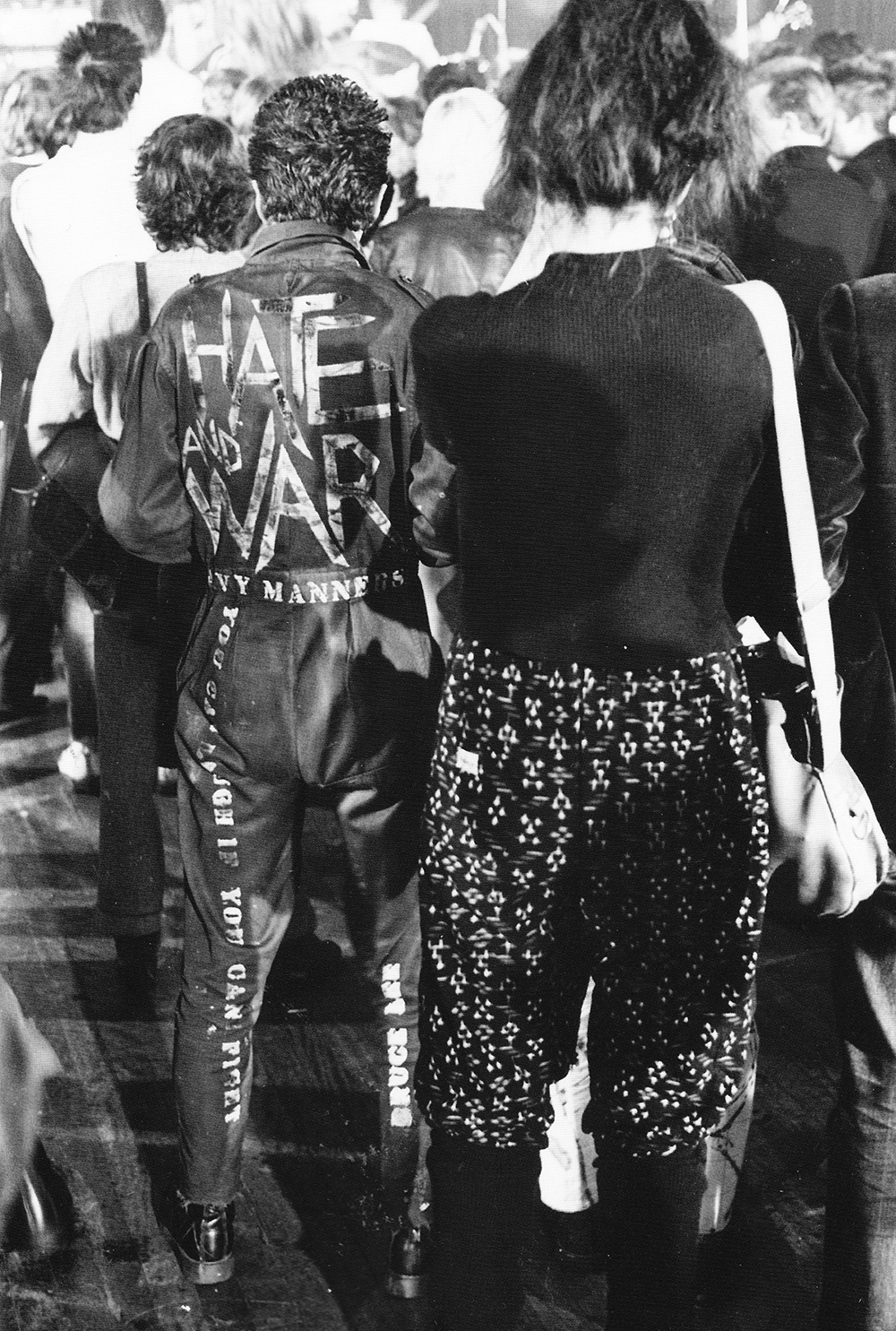
The third aspect dwelt on was Graffiti and Agitprop, typified by the spray painted and stenciled jumpsuits worn by The Clash. Tragically, the soundtrack in this section of the exhibit was ambient music, no Mick, Joe, Paul, and Tory-or-Topper to be heard. Among the current examples in this section was Vivienne Westwood's "Climate Revolution" design.
The last facet of the punk aesthetic touched upon in this exhibit was titled "Destroy", and hinged on the ripped-and-reconstituted look necessitated by poverty (refer to Monsieur Rotten's quote about safety pins and the arse of his pants).
All told, I wanted to see more chaos and less couture, to hear more of the raucous music I love so well. The exhibit was good, but I probably wasn't the target audience. Anyway, here's a video featuring Vivienne Westwood in her salad days on the King's Cross Road:
It was nice to see the Met playing homage to punk, they have a heavy metal exhibit every day.
The exhibit, situated on the second floor of the 'Met, started with a brief overview of punk's "Do It Yourself" aesthetic- an aesthetic born largely out of poverty, as slumming Lower East Siders in New York and working-class kids in England cobbled together distinctive looks out of worn clothing and found objects, forming a look which was calculated to shock middle-class sensibilities. One of the first displays featured a Vivienne Westwood designed red "parachute" tunic, paired with red bondage pants with a terrycloth drop seat. Ms Westwood, it must be noted, was one of the designers who shaped the English punk aesthetic in the 1970s, while running the boutique "SEX" with Malcolm McLaren, who went on to become the "Svengali" behind the Sex Pistols.
The next gallery focused more on the New York punk scene, including (hilariously) a mock-up of the men's bathroom of C.B.G.B.- thankfully, the exhibit did not replicate the hideous miasma which accompanied the original (let's face it, the club was a fetid hellhole, storied as it was). As there wasn't a single "fount" of fashion for the 1970's Lower East Side scenesters, this wasn't the most compelling portion of the show. The soundtrack of this part of the exhibit included snippets of such NYC classics as I Don't Wanna Go Down to the Basement.
Following on this was an exhibit of clothes sold at the various McLaren and Westwood run shops at 430 Kings Road, London. Among the infamous designs on display were the "Two Cowboys" shirt (modeled by Sid Vicious here), which was inspired by the gay fetish art of Tom of Finland, the "God Save the Queen" T-Shirt, and the "Tits" T-shirt (modeled by Steve Jones here). Additionally, there was a video filmed at the 430 King's Road shop featuring an individual completely encased in a latex bondage suit, complete with "gimp" mask. As an aside, Malcolm McLaren was fascinated by the topic of submission, and he asked the Sex Pistols to write a song about it, with hilarious results. The centerpiece of this area of the exhibit was a "compare and contrast" of the classic Westwood designs and contemporary designs inspired by the originals.
The next galleries explored four different aspects of the punk aesthetic, starting with "Hardware". This section started off with the safety pins, chains, and studs that adorned punk clothes. Johnny Rotten, in his typical blunt fashion, explained the provenance of the safety pin in punk fashion: “The arse of your pants falls out, you just use safety pins.” The exhibit featured designer clothes with gold faux safety pins, padlocks(Sid famously wore a padlock necklace), and studs.
The second aspect of the aesthetic that was explored was bricolage. This gallery featured plastic garbage- and shopping-bag dresses, and dresses made up to look like they were made out of newsprint. In this gallery, the sountrack featured snippets of Boredom by the Buzzcocks, New Rose by The Damned, and Identity by the X-Ray Spex.
The third aspect dwelt on was Graffiti and Agitprop, typified by the spray painted and stenciled jumpsuits worn by The Clash. Tragically, the soundtrack in this section of the exhibit was ambient music, no Mick, Joe, Paul, and Tory-or-Topper to be heard. Among the current examples in this section was Vivienne Westwood's "Climate Revolution" design.
The last facet of the punk aesthetic touched upon in this exhibit was titled "Destroy", and hinged on the ripped-and-reconstituted look necessitated by poverty (refer to Monsieur Rotten's quote about safety pins and the arse of his pants).
All told, I wanted to see more chaos and less couture, to hear more of the raucous music I love so well. The exhibit was good, but I probably wasn't the target audience. Anyway, here's a video featuring Vivienne Westwood in her salad days on the King's Cross Road:
It was nice to see the Met playing homage to punk, they have a heavy metal exhibit every day.
Thursday, July 2, 2020
Horror of Horrors
To my dismay, when I arrived at work tonight, I discovered that our internet service is not available. I suspect that we had a brief power outage which knocked our server offline. Tomorrow morning, I will have to text my boss to let him know that our email and scheduling programs are inaccessible. Luckily, our self-reporting payroll submission took place last week.
I will try to set up some posts at home tomorrow, in case the IT guys can’t get the server online tomorrow. They will probably text instructions to our work cell phone to walk us through the process of resetting everything. If we don’t have Internet, it’s no big deal, I need to calculate my taxes for last year, which should kill a few hours that I’d usually spend snarking online.
I will try to set up some posts at home tomorrow, in case the IT guys can’t get the server online tomorrow. They will probably text instructions to our work cell phone to walk us through the process of resetting everything. If we don’t have Internet, it’s no big deal, I need to calculate my taxes for last year, which should kill a few hours that I’d usually spend snarking online.
Sunday, January 31, 2016
Six Decades of Serious Mischief
Today, I'd like to wish a happy 60th birthday to John Lydon, who has been quite the gadfly since the mid-70s, when he fronted the Sex Pistols, using the nom de guerre Johnny Rotten. It's been a while since I've posted about the 'Pistols or Mr Lydon, but I certainly consider Never Mind the Bollocks, Here's the Sex Pistols an essential part of my record collection, as well as being an essential document of late 20th century Western malaise. Johnny Rotten was the quintessential intelligent teenager faced with poor economic prospects and the resultant righteous rage... he used his keen wit to slash through the pretensions of a staid, stagnant culture with such sonic onslaughts as God Save the Queen and Anarchy in the UK. While the song Submission is perhaps my favorite 'Pistols song, my favorite political song of theirs is the album opener, Holidays in the Sun, which seems to be the pessimistic counterpart of David Bowie's "Heroes":
I still get a bit of gooseflesh when I hear John Lydon growl that opening line... "A cheap holiday in other people's misery!"
Mr Lydon's pinnacle of bird-flipping, his Johnny Rottenest moment, was his final question to the audience at the 'Pistols' last concert, at San Francisco's Winterland:
That's a question that could be asked by just about every denizen of the planet.
After his stint with the Sex Pistols, Mr Lydon formed the band Public Image Limited, with their first single, Public Image, being a kiss-off to the 'Pistols:
My favorite post-Pistols song by Mr Lydon was his collaboration with Afrika Bambaataa, 1984's World Destruction:
Mr Lydon continues on as a gadfly, even though he flogged butter for money a few years back:
To anyone who would accuse Mr Lydon of selling out, I'd have to point out that the Sex Pistols were originally founded to sell clothing, even though John Lydon was too smart and too independent to be anybody's mere pitchman.
The essential account of the Sex Pistols and the milieu in which they were formed is Jon Savage's England's Dreaming, a fascinating read with an indispensable discography in the appendices. I'm not a big 'rawk and/or roll' history reader, but this book was something quite greater than mere hagiography.
Happy birthday, Mr John Lydon. May you have another six decades of troublemaking ahead of you.
I still get a bit of gooseflesh when I hear John Lydon growl that opening line... "A cheap holiday in other people's misery!"
Mr Lydon's pinnacle of bird-flipping, his Johnny Rottenest moment, was his final question to the audience at the 'Pistols' last concert, at San Francisco's Winterland:
That's a question that could be asked by just about every denizen of the planet.
After his stint with the Sex Pistols, Mr Lydon formed the band Public Image Limited, with their first single, Public Image, being a kiss-off to the 'Pistols:
My favorite post-Pistols song by Mr Lydon was his collaboration with Afrika Bambaataa, 1984's World Destruction:
Mr Lydon continues on as a gadfly, even though he flogged butter for money a few years back:
To anyone who would accuse Mr Lydon of selling out, I'd have to point out that the Sex Pistols were originally founded to sell clothing, even though John Lydon was too smart and too independent to be anybody's mere pitchman.
The essential account of the Sex Pistols and the milieu in which they were formed is Jon Savage's England's Dreaming, a fascinating read with an indispensable discography in the appendices. I'm not a big 'rawk and/or roll' history reader, but this book was something quite greater than mere hagiography.
Happy birthday, Mr John Lydon. May you have another six decades of troublemaking ahead of you.
Tuesday, March 19, 2019
Secret Science Club Post Lecture Recap: The Triumphant Return of Dr de Waal
Last night, I headed down to the beautiful Bell House, in the Gowanus section of Brooklyn, for this month's Secret Science Club lecture, which featured the triumphant return of Dr Frans de Waal, Emory University primatologist and psychologist, director of the Living Links Center at Yerkes National Primate Research Center, living legend, and one of my heroes. Dr de Waal delivered a Secret Science Club lecture Dr de Waal delivered a Secret Science Club lecture in April 2016 on animal cognition. Last night's lecture, riffing on his latest book, Mama's Last Hug: Animal Emotions and What They Tell Us About Ourselves, concerned, you guessed it, animal emotions.
Dr de Waal began his lecture by mentioning Charles Darwin's book The Expression of the Emotions in Man and Animals and noting that this book had fallen out of favor by the time he was a student. Scholars used to be able to talk about animal motions, but he was told as a student not to talk about thinking, feeling, or any inner states. The main objection to discussing inner states was the sin of anthropomorphism, (mis)attributing human feelings to non-human animals. Another objection is our inability to know what animals feel.
In Darwin's model of emotions, stimulus leads to emotion which leads to action, and emotions must lead to adaptive responses. For example, fear can lead to hiding. An alternate model of emotion, proposed by William James and Carl Lange, held that stimulus led to action which was the basis of emotion. The current model is that stimulus leads to emotion which leads to action and feelings. Actions are adaptive and feelings are awareness of emotion. Dr de Waal stated that he cannot know an animal's feelings, he cannot know your feelings, feelings are hard to access... not knowing how an animal feels does not mean that he cannot study its emotions.
Dr de Waal then tackled the subject of anthropomorphism, the 'sin' of attributing human characteristics to animals. In some cases, similar seeming behavior is due to convergent evolution, a process by which organisms which are not closely related appear to be similar due to adaptation- by independently adapting to similar environments, they end up looking similar. homology, on the other hand, involves similar traits shared by closely related organisms being due to shared ancestry. Dr de Waal contrasted two kisses... when kissing gouramis 'kiss', they lock their mouths in a form of fighting. Bonobos, which are closely related to humans, kiss for reasons similar to human reasons for kissing. In the case of bonobos, there is homology with human kisses, while the mouth-to-mouth contact of gouramis does not represent homology. Similarly, a chimpanzee forelimb, with its homologous structures, is referred to as a hand rather than a paw (as an aside, I have to note that this courtesy is not extended to monkeys). Dr de Waal showed us a picture of a baby gorilla laughing and quipped that, in the interest of avoiding anthropomorphism, this would be characterized as 'short vocalized panting', which elicited short vocalized panting from the audience. When a baby gorilla, a close relative of humans, laughs for reasons which would make humans laugh, call it a laugh, not vocalized panting.
Dr de Waal coined the term 'anthropodenial' to denote an a priori denial that other animals can have mental experiences or that humans are like animals. He opined that anthropodenial is more dangerous than anthropomorphism- the belief that humans are separate from nature is a major factor in our current ecological catastrophe.
When studying emotions, Dr de Waal advised us to start with the face, the window to the soul. Chimpanzees have as many facial muscles as humans. Inspired by Darwin, Dr Paul Ekman was a pioneer of the study of emotion. When Dr Ekman began his study of emotion, the prevailing belief was that emotions were expressed differently in different cultures- when he looked into this belief, there were no records, no photos... this belief was all in the theorists' heads. Dr Ekman studied emotions and categorized six major emotions: disgust, sadness, happiness,fear,anger, surprise. This model is still somewhat constraining, as there are subtler emotional expressions.
Dr de Waal's professor, Dr Jan Van Hooff, studied emotions and recognized differences between laughing and smiling. While smiling was thought to be a 'lower' version of laughing, Dr Van Hooff discovered that smiles are based on teeth baring behavior (often used to show aggression or submission) while laughter is rooting in play expressions. There are variations in behavior, nervous smiles and aggressive laughter. Aristotle famously wrote 'man is the only animal which laughs', but chimpanzees laugh under similar conditions that humans do. Chimps have the same tickle response that humans do:
Even though rats are ubiquitous lab animals, it was long thought that they didn't exhibit emotion through facial expressions, but when this was finally tested, it turns out that these animals were underestimated. Dr Jaak Panksepp even discovered that rats respond to tickling with ultrasonic laughter:
Showing us the video of the laughing rat, Dr de Waal joked, "As a student, I had a bunch of rats, they tend to multiply."
Studies of humor among apes are relatively new. In one instance, a zoo employee in a mask startled chimpanzees in a zoo, eliciting anger responses. On his last masked escapade, he took off his mask, and the chimpanzees laughed, suggesting that, like humans, they are amused by incongruity. Unexpected endings lead to laughter. When an alpha male allows a baby to chase him, it's funny. When a chimpanzee tricks her son and steals his nut-cracking rocks, she laughs afterwards:
An orangutan can be made to laugh with a simple magic trick:
Laughing represents a loss of control, it can be seen as animalistic- you can pee yourself, you need to catch your breath... why can't people just say 'this is funny'? Dr de Waal showed a video of Bill Clinton laughing uncontrollably, and causing Boris Yeltsin to laugh until he tears up:
A lot of emotional expressions affect our bodies deeply. The problem with the basic theory of emotion is that it is hard to study emotions that have no 'face'. Love, attachment, jealousy, hope, empathy... there are no facial expressions for them. Also, there are animals that don't expression emotions facially, such as cats and dolphins. Dr de Waal cited the example of the grieving orca which carried the body of its deceased young around for seventeen days. Chimpanzees are emotional beings, they express their emotion on reuniting with each other vocally.
Dr de Waal posed several questions: Are there uniquely human emotions? Are animals 'captives of the present'? Are humans the only animals with impulse control? Do only humans know disgust? He noted that he found this question the strangest of them all.
We don't know what animals feel, so the question of uniquely human emotions is unverifiable.
Regarding the notion that animals live only in the present, forgiveness involves a knowledge of the past. After fights, chimps engage in reconciliation- they have conflict resolution to shift from aggression to friendliness. The model for conflict resolution involves PC/MC (post-conflict/matched-control) observation, the reconciliation model is found in the wild and in captivity. Dr de Waal joked that he is from a family with six boys, so he is familiar with reconciliation. Besides primates, reconciliation behavior has been observed in most mammals- goats, hyenas, dolphins all reconcile. In an aside which I found particularly funny, he noted that reconciliation has not been observed in domestic cats. Among human preschoolers, reconciliation behavior was observed, and it was handled better by Japanese children than American children, probably because American teachers intervene in conflicts more frequently.
Dr de Waal displayed some pictures of Barack Obama and John McCain after a particularly contentious meeting, and Barack Obama has his cheeks puffed with air. A similar puffed cheek, bulging lip expression is used by male chimpanzees, and politicians such as Anthony Weiner, Bill Clinton, and others, probably to express regret. This expression is a male behavior, women don't do it.
Besides reconciling for past behaviors, animals also plan for the future. Psychologist Dr Wolfgang Köhler tasked chimpanzees with obtaining fruit that was hanging from the ceiling. The chimps were provided with boxes and poles and were able to employ them to get their reward. Köhler noted that the chimps solved the problem in their heads, not by a laborious trial-and-error process. Dr de Waal joked that this made him very unpopular with behaviorists. When he replicated the Köhler experiment, one particular female chimpanzee solved the problem by throwing a box and bringing down the fruit... she was the chimpanzee which brought down the drone:
Chimps can plan ahead, the collect tools and move them to areas where resources are available- they are not trapped in the present.
Animals can also exhibit impulse control. The standard laboratory test for impulse control is the marshmallow test:
Chimpanzees, like the children in the video, look around at other objects to distract themselves from temptation, they can hold out longer if given toys. Even some birds are able to pass the marshmallow test, with one African grey parrot holding out for fifteen minutes. Animals can control their impulses, such as a cat stalking a chipmunk rather than pouncing prematurely.
Subordinate animals in a hierarchy also exhibit impulse control. In the Menzel test, a chimpanzee is separated from the group and shown a hidden cache of food, which it must keep concealed from dominant chimps. Near the food source, the chimp will act nonchalant, an act of deception. If a low-value cucumber and a high-value banana are hidden, the aware chimp will sometimes lead the dominant chimp to the cucumber and grab the banana while the dominant one is occupied.
Animals feel disgust, it is an important adaptation to avoid contaminants and poisons. Psychologist Dr Paul Rozin opined that disgust seems to be uniquely human and is entirely or primarily cultural. Dogs were held up as exemplars of animals' lack of disgust- they eat feces and lick their testicles. Dogs do exhibit disgust, but only when presented with stimuli which disgust them, such as lemons:
Chimpanzees don't like the rain, and they try to keep their hands dry, hunching over and covering them. They tend to exhibit the wrinkled-nose disgust display when outside in the rain.
In one experiment, food was placed on plastic replica feces and real feces and macaques were observed eating food placed on plastic feces while rejecting the food placed on real feces.
Dr de Waal then discussed Dr Sarah Brosnan's primate fairness study, in which capuchin monkeys were given unequal rewards (a meh cucumber or a prized grape) for performing a task. The monkey receiving the poor reward doesn't take things well:
Inequity aversion is an irrational response- rationally, you should always take what you get. Reject the reward and you get nothing. Chimpanzees subjected to this test will sometimes refuse a grape until the other chimp gets a grape. Dr de Waal joked that this inequity aversion is lost in humans- one percent of us are grape monkeys, while ninety-nine percent of us are cucumber monkeys. In a not-so-funny coda, he noted that this is undermining our societies.
On a lighter note, parents are now doing this experiment on their children, giving one kid a whole cookie and another kid half of one. Dr de Waal also recounted a colleague who has a Great Dane and a Chihuahua which want the same amount of food.
Dr de Waal summed up his take on anthropomorphism: if two related species have the same response to the same stimulus, use the same term. Don't separate animals from humans.
Dr de Waal ended his lecture on a poignant note, addressing consolation behavior. All mammals show empathic concern. Among elephants, consolation takes the form of vulnerable contact- an elephant will stick its trunks in another elephant's mouth, a display of trust. Dr de Waal then turned to the subject of his book Mama's Last Hug. Mama was the alpha female of the Royal Burgers Zoo (Arnhem, Netherlands) chimpanzee colony. She was the most powerful chimpanzee in the colony, a mediator and decision maker, and important contact with human researchers- when she died, conflict arose in the group. At the age of eighty, Dr de Waal's professor, Dr Jan van Hooff, visited Mama, aged fifty-nine, as she was dying. Dr de Waal described the visit as 'two aging hominids meeting'. Typically, because chimpanzees are stronger than humans and are potentially dangerous, all interaction is done through a cage. On this occasion, Dr van Hooff decided to forego protocol and enter the enclosure to pay his final respects to Mama:
The hug, the arm around the neck and the patting, is reassuring behavior. Some viewers didn't expect such an emotional reaction and he felt the need to explain. Animal emotions can be studied objectively, cortisol levels and heart rates can be measured. Humans have no organs that aren't in a rat's body, while our emotions may be more sophisticated, they are not that different.
The lecture was followed by a Q&A session. One question regarded bad emotions- Dr de Waal noted that animals do kill conspecific animals in conflicts over mates, hierarchical positions, territory. Another questioner asked, do animals have emotions that humans don't have? Dr de Waal noted that cetaceans may have stronger affiliative feelings (which may be a factor in mass strandings), but the basics are similar. To find something foreign to human experience, one might have to look at more distantly related animals, such as octopodes. Regarding the lack of reconciliation among cats, Dr de Waal noted that domestic cats are solitary hunters, so they have less of a need of affiliation than other mammals. Lions, being social, might exhibit reconciliation behavior, but this needs further study. Another question involved altruism- the origin of empathy is thought to be parental care, in which the hormone oxytocin plays a role. Chimpanzees share food, but this may be a case of reciprocity, rather than altruism. Sharing just makes sense. The house was packed, so the Bastard was unable to get a question in until the post lecture book signing, when he asked Dr de Waal about the role of olfaction in the expression of emotion, and how this could be measured. As a primatologist who studies apes, he noted that smell doesn't play as big a role as visual and vocal cues, but that other mammals might communicate that way. The bastard also thanked Dr de Waal for his kindness to linking to the blog.
Once again, the Secret Science Club served up a fantastic program. Dr de Waal's lecture informed, enthralled, saddened, and amused- how appropriate for a lecture on emotions. To use a baseball term, he knocked it out of the park. Kudos to the good doctor, Margaret and Dorian, and the staff of the beautiful Bell House.
Here's a recent interview with Dr de Waal concerning the topic of the lecture:
Pour yourself a nice beverage and soak in that SCIENCE!
Dr de Waal began his lecture by mentioning Charles Darwin's book The Expression of the Emotions in Man and Animals and noting that this book had fallen out of favor by the time he was a student. Scholars used to be able to talk about animal motions, but he was told as a student not to talk about thinking, feeling, or any inner states. The main objection to discussing inner states was the sin of anthropomorphism, (mis)attributing human feelings to non-human animals. Another objection is our inability to know what animals feel.
In Darwin's model of emotions, stimulus leads to emotion which leads to action, and emotions must lead to adaptive responses. For example, fear can lead to hiding. An alternate model of emotion, proposed by William James and Carl Lange, held that stimulus led to action which was the basis of emotion. The current model is that stimulus leads to emotion which leads to action and feelings. Actions are adaptive and feelings are awareness of emotion. Dr de Waal stated that he cannot know an animal's feelings, he cannot know your feelings, feelings are hard to access... not knowing how an animal feels does not mean that he cannot study its emotions.
Dr de Waal then tackled the subject of anthropomorphism, the 'sin' of attributing human characteristics to animals. In some cases, similar seeming behavior is due to convergent evolution, a process by which organisms which are not closely related appear to be similar due to adaptation- by independently adapting to similar environments, they end up looking similar. homology, on the other hand, involves similar traits shared by closely related organisms being due to shared ancestry. Dr de Waal contrasted two kisses... when kissing gouramis 'kiss', they lock their mouths in a form of fighting. Bonobos, which are closely related to humans, kiss for reasons similar to human reasons for kissing. In the case of bonobos, there is homology with human kisses, while the mouth-to-mouth contact of gouramis does not represent homology. Similarly, a chimpanzee forelimb, with its homologous structures, is referred to as a hand rather than a paw (as an aside, I have to note that this courtesy is not extended to monkeys). Dr de Waal showed us a picture of a baby gorilla laughing and quipped that, in the interest of avoiding anthropomorphism, this would be characterized as 'short vocalized panting', which elicited short vocalized panting from the audience. When a baby gorilla, a close relative of humans, laughs for reasons which would make humans laugh, call it a laugh, not vocalized panting.
Dr de Waal coined the term 'anthropodenial' to denote an a priori denial that other animals can have mental experiences or that humans are like animals. He opined that anthropodenial is more dangerous than anthropomorphism- the belief that humans are separate from nature is a major factor in our current ecological catastrophe.
When studying emotions, Dr de Waal advised us to start with the face, the window to the soul. Chimpanzees have as many facial muscles as humans. Inspired by Darwin, Dr Paul Ekman was a pioneer of the study of emotion. When Dr Ekman began his study of emotion, the prevailing belief was that emotions were expressed differently in different cultures- when he looked into this belief, there were no records, no photos... this belief was all in the theorists' heads. Dr Ekman studied emotions and categorized six major emotions: disgust, sadness, happiness,fear,anger, surprise. This model is still somewhat constraining, as there are subtler emotional expressions.
Dr de Waal's professor, Dr Jan Van Hooff, studied emotions and recognized differences between laughing and smiling. While smiling was thought to be a 'lower' version of laughing, Dr Van Hooff discovered that smiles are based on teeth baring behavior (often used to show aggression or submission) while laughter is rooting in play expressions. There are variations in behavior, nervous smiles and aggressive laughter. Aristotle famously wrote 'man is the only animal which laughs', but chimpanzees laugh under similar conditions that humans do. Chimps have the same tickle response that humans do:
Even though rats are ubiquitous lab animals, it was long thought that they didn't exhibit emotion through facial expressions, but when this was finally tested, it turns out that these animals were underestimated. Dr Jaak Panksepp even discovered that rats respond to tickling with ultrasonic laughter:
Showing us the video of the laughing rat, Dr de Waal joked, "As a student, I had a bunch of rats, they tend to multiply."
Studies of humor among apes are relatively new. In one instance, a zoo employee in a mask startled chimpanzees in a zoo, eliciting anger responses. On his last masked escapade, he took off his mask, and the chimpanzees laughed, suggesting that, like humans, they are amused by incongruity. Unexpected endings lead to laughter. When an alpha male allows a baby to chase him, it's funny. When a chimpanzee tricks her son and steals his nut-cracking rocks, she laughs afterwards:
An orangutan can be made to laugh with a simple magic trick:
Laughing represents a loss of control, it can be seen as animalistic- you can pee yourself, you need to catch your breath... why can't people just say 'this is funny'? Dr de Waal showed a video of Bill Clinton laughing uncontrollably, and causing Boris Yeltsin to laugh until he tears up:
A lot of emotional expressions affect our bodies deeply. The problem with the basic theory of emotion is that it is hard to study emotions that have no 'face'. Love, attachment, jealousy, hope, empathy... there are no facial expressions for them. Also, there are animals that don't expression emotions facially, such as cats and dolphins. Dr de Waal cited the example of the grieving orca which carried the body of its deceased young around for seventeen days. Chimpanzees are emotional beings, they express their emotion on reuniting with each other vocally.
Dr de Waal posed several questions: Are there uniquely human emotions? Are animals 'captives of the present'? Are humans the only animals with impulse control? Do only humans know disgust? He noted that he found this question the strangest of them all.
We don't know what animals feel, so the question of uniquely human emotions is unverifiable.
Regarding the notion that animals live only in the present, forgiveness involves a knowledge of the past. After fights, chimps engage in reconciliation- they have conflict resolution to shift from aggression to friendliness. The model for conflict resolution involves PC/MC (post-conflict/matched-control) observation, the reconciliation model is found in the wild and in captivity. Dr de Waal joked that he is from a family with six boys, so he is familiar with reconciliation. Besides primates, reconciliation behavior has been observed in most mammals- goats, hyenas, dolphins all reconcile. In an aside which I found particularly funny, he noted that reconciliation has not been observed in domestic cats. Among human preschoolers, reconciliation behavior was observed, and it was handled better by Japanese children than American children, probably because American teachers intervene in conflicts more frequently.
Dr de Waal displayed some pictures of Barack Obama and John McCain after a particularly contentious meeting, and Barack Obama has his cheeks puffed with air. A similar puffed cheek, bulging lip expression is used by male chimpanzees, and politicians such as Anthony Weiner, Bill Clinton, and others, probably to express regret. This expression is a male behavior, women don't do it.
Besides reconciling for past behaviors, animals also plan for the future. Psychologist Dr Wolfgang Köhler tasked chimpanzees with obtaining fruit that was hanging from the ceiling. The chimps were provided with boxes and poles and were able to employ them to get their reward. Köhler noted that the chimps solved the problem in their heads, not by a laborious trial-and-error process. Dr de Waal joked that this made him very unpopular with behaviorists. When he replicated the Köhler experiment, one particular female chimpanzee solved the problem by throwing a box and bringing down the fruit... she was the chimpanzee which brought down the drone:
Chimps can plan ahead, the collect tools and move them to areas where resources are available- they are not trapped in the present.
Animals can also exhibit impulse control. The standard laboratory test for impulse control is the marshmallow test:
Chimpanzees, like the children in the video, look around at other objects to distract themselves from temptation, they can hold out longer if given toys. Even some birds are able to pass the marshmallow test, with one African grey parrot holding out for fifteen minutes. Animals can control their impulses, such as a cat stalking a chipmunk rather than pouncing prematurely.
Subordinate animals in a hierarchy also exhibit impulse control. In the Menzel test, a chimpanzee is separated from the group and shown a hidden cache of food, which it must keep concealed from dominant chimps. Near the food source, the chimp will act nonchalant, an act of deception. If a low-value cucumber and a high-value banana are hidden, the aware chimp will sometimes lead the dominant chimp to the cucumber and grab the banana while the dominant one is occupied.
Animals feel disgust, it is an important adaptation to avoid contaminants and poisons. Psychologist Dr Paul Rozin opined that disgust seems to be uniquely human and is entirely or primarily cultural. Dogs were held up as exemplars of animals' lack of disgust- they eat feces and lick their testicles. Dogs do exhibit disgust, but only when presented with stimuli which disgust them, such as lemons:
Chimpanzees don't like the rain, and they try to keep their hands dry, hunching over and covering them. They tend to exhibit the wrinkled-nose disgust display when outside in the rain.
In one experiment, food was placed on plastic replica feces and real feces and macaques were observed eating food placed on plastic feces while rejecting the food placed on real feces.
Dr de Waal then discussed Dr Sarah Brosnan's primate fairness study, in which capuchin monkeys were given unequal rewards (a meh cucumber or a prized grape) for performing a task. The monkey receiving the poor reward doesn't take things well:
Inequity aversion is an irrational response- rationally, you should always take what you get. Reject the reward and you get nothing. Chimpanzees subjected to this test will sometimes refuse a grape until the other chimp gets a grape. Dr de Waal joked that this inequity aversion is lost in humans- one percent of us are grape monkeys, while ninety-nine percent of us are cucumber monkeys. In a not-so-funny coda, he noted that this is undermining our societies.
On a lighter note, parents are now doing this experiment on their children, giving one kid a whole cookie and another kid half of one. Dr de Waal also recounted a colleague who has a Great Dane and a Chihuahua which want the same amount of food.
Dr de Waal summed up his take on anthropomorphism: if two related species have the same response to the same stimulus, use the same term. Don't separate animals from humans.
Dr de Waal ended his lecture on a poignant note, addressing consolation behavior. All mammals show empathic concern. Among elephants, consolation takes the form of vulnerable contact- an elephant will stick its trunks in another elephant's mouth, a display of trust. Dr de Waal then turned to the subject of his book Mama's Last Hug. Mama was the alpha female of the Royal Burgers Zoo (Arnhem, Netherlands) chimpanzee colony. She was the most powerful chimpanzee in the colony, a mediator and decision maker, and important contact with human researchers- when she died, conflict arose in the group. At the age of eighty, Dr de Waal's professor, Dr Jan van Hooff, visited Mama, aged fifty-nine, as she was dying. Dr de Waal described the visit as 'two aging hominids meeting'. Typically, because chimpanzees are stronger than humans and are potentially dangerous, all interaction is done through a cage. On this occasion, Dr van Hooff decided to forego protocol and enter the enclosure to pay his final respects to Mama:
The hug, the arm around the neck and the patting, is reassuring behavior. Some viewers didn't expect such an emotional reaction and he felt the need to explain. Animal emotions can be studied objectively, cortisol levels and heart rates can be measured. Humans have no organs that aren't in a rat's body, while our emotions may be more sophisticated, they are not that different.
The lecture was followed by a Q&A session. One question regarded bad emotions- Dr de Waal noted that animals do kill conspecific animals in conflicts over mates, hierarchical positions, territory. Another questioner asked, do animals have emotions that humans don't have? Dr de Waal noted that cetaceans may have stronger affiliative feelings (which may be a factor in mass strandings), but the basics are similar. To find something foreign to human experience, one might have to look at more distantly related animals, such as octopodes. Regarding the lack of reconciliation among cats, Dr de Waal noted that domestic cats are solitary hunters, so they have less of a need of affiliation than other mammals. Lions, being social, might exhibit reconciliation behavior, but this needs further study. Another question involved altruism- the origin of empathy is thought to be parental care, in which the hormone oxytocin plays a role. Chimpanzees share food, but this may be a case of reciprocity, rather than altruism. Sharing just makes sense. The house was packed, so the Bastard was unable to get a question in until the post lecture book signing, when he asked Dr de Waal about the role of olfaction in the expression of emotion, and how this could be measured. As a primatologist who studies apes, he noted that smell doesn't play as big a role as visual and vocal cues, but that other mammals might communicate that way. The bastard also thanked Dr de Waal for his kindness to linking to the blog.
Once again, the Secret Science Club served up a fantastic program. Dr de Waal's lecture informed, enthralled, saddened, and amused- how appropriate for a lecture on emotions. To use a baseball term, he knocked it out of the park. Kudos to the good doctor, Margaret and Dorian, and the staff of the beautiful Bell House.
Here's a recent interview with Dr de Waal concerning the topic of the lecture:
Pour yourself a nice beverage and soak in that SCIENCE!
Subscribe to:
Posts (Atom)