Showing posts sorted by relevance for query fossil fuels. Sort by date Show all posts
Showing posts sorted by relevance for query fossil fuels. Sort by date Show all posts
Friday, April 20, 2012
Second Anniversary, Attempted Gaiacide
Today marks the second anniversary of the Deepwater Horizon oil spill, brought to you by British Petroleum, in collaboration with Halliburton and Transocean, LTD. The Deepwater Horizon oil spill was the largest environmental disaster to occur in the precincts of a developed nation (although the "developed" nature of the Gulf Coast region of the U.S. can be debated- apologies to my friends in Lafayette, LA).
The disaster occurred in a context of corporate malfeasance, involving
depraved indifference to human life, cutting corners in construction, using insufficiently tested (possibly untested) material, and
executive sociopathy. In the wake of the seafloor oil gusher's creation, BP attempted to hide the extent of the spill by using dispersants, the extreme toxicity of which had been hidden under the pretense of "trade secrets". The full extent of the disaster is unknown, and is likely to remain so, as information critical of the fossil fuels industry is typically suppressed.
Two years after the toxic mix of petroleum and Corexit was added to the Gulf, the marine life is exhibiting horrific deformities. It's a common right-wing trope that environmentalism is about putting "nature" over the needs of humans, but the mouth-breathers ignore the inconvenient fact that humans are part of nature... we don't exist in some separate, rarefied sphere. A knucklehead may ask, "So what? Who cares about a bunch of lousy shrimp?" The retort is, unfortunately, too complicated to fit into a soundbite- humans are long-lived apex predators (in fact, we eat a lot of oceanic apex predators), toxins have great opportunities to accumulate in our bodies. Environmentalism concerns human health and quality of life. Nature, red in tooth and claw, cannot be destroyed- there are organisms which are a lot hardier than we overly smart yet overly stupid apes, organisms which will survive us. We won't destroy the planet, we'll just destroy our ability to inhabit it, and there are no alternatives.
Problems with the supply of, and ill affects of the use of, fossil fuels have been known for decades. Fossil fuels should be thought of as "startup capital"- they allowed us to industrialize quickly, and to achieve unprecedented productivity, but the use of fossil fuels should have been a stepping stone to the development of renewable energy sources. Unfortunately, we are, to paraphrase Gene Wolfe "waiting for the money to run out."
The problem with renewable energy is that it's hard to monopolize wind and sun, and the plutocrats would rather kill the planet than to give up an iota of profit.



Wednesday, July 8, 2015
Decades of Lies and Obfuscation
Finally, evidence of something that all of us knew- Exxon executives knew that carbon dioxide was a greenhouse gas since the early 80s. Think of all of the progress in alternative and renewable energy sources that could have been made in three decades, using the money that Exxon and the other fossil fuel businesses used to fund climate change denialism, not to mention all of the money and (more importantly) lives thrown away in order to secure or steal fossil fuel sources.
Three decades of lost ground, lost momentum, and lost lives... let that sink in for a brief moment. Three decades of knowingly committing Gaiacide. I have often likened fossil fuels to "startup capital" to be used to kick off a mature energy economy based on a variety of safer renewable energy sources, but the short-term profits of the fossil fuel companies have long trumped the prospects of long-term human survival.
It's obvious that the oil and coal companies knew that continued burning of fossil fuels would be a problem, just like it's obvious that the tobacco companies knew that smoking caused lung cancer, it's pretty appalling to finally see one of the "smoking guns" exposed.
Three decades of lost ground, lost momentum, and lost lives... let that sink in for a brief moment. Three decades of knowingly committing Gaiacide. I have often likened fossil fuels to "startup capital" to be used to kick off a mature energy economy based on a variety of safer renewable energy sources, but the short-term profits of the fossil fuel companies have long trumped the prospects of long-term human survival.
It's obvious that the oil and coal companies knew that continued burning of fossil fuels would be a problem, just like it's obvious that the tobacco companies knew that smoking caused lung cancer, it's pretty appalling to finally see one of the "smoking guns" exposed.
Wednesday, August 15, 2012
Building a Bridge to the 19th Century
So... I'm feeling a little unambitious so I'm going to fall back on the old "expand on a comment you made on another blog" gambit. This time, it's a comment I made at Vixen Strangely's blog. VS, who is not to be confused with VS (can't have enough VS's in your blogroll), posted on Romney's flip-flop on the coal industry. Recently, Mitt, in rather asinine fashion, accused President Obama of (wait for it... wait for it) waging a "War on Coal". Shya, how can Obama wage a War on Christmas if he doesn't wage a war on the very coal which will be placed in the stockings of naughty children?
First off, coal production is up in Ohio, so Obama is not hampering the coal industry in any way. More importantly, Obama should be waging a war on coal. Coal extraction is destructive to the environment and dangerous to workers. The burning of coal releases toxins into the environment and contributes to climate change. As Gene Wolfe put it in a passage I've quoted here before:
"That's coal smoke, the technology of the Nineteenth Century brought into the Twenty-First and hard at work. They could have conquered the solar system and harnessed the sun, but they did this instead, because there was no fun involved. Their great-grandfathers had done it, and they knew it would work."
Fossil fuels should be regarded as energy start-up capital, the basic pool of relatively easily obtained energy sources which can allow us to make the transition to renewable energy resources, such as wind, solar, tidal, biomass, biofuels, hydroelectric, and geothermal. Once again, Gene Wolfe is the go-to guy here, referring to our inaction on the environment as the do nothing future, the one in which humanity clings to its old home, the continents of Earth, and waits for the money to run out.
We've known that reliance on fossil fuels was a problem since the 1970's but Carter was ridiculed for asking people to turn down the thermostat and put on a sweater and Reagan ripped the solar panels from the White House roof. We've had an ass-backwards energy policy for the past thirty-odd years and still fucking idiots are wasting time and resources making sure that nothing is done.
Mitt Romney's energy policy is basically the Bain Capital model of energy policy- use up all the resources you have until you've extracted all the value out of your "investment" at the expense of its long-term prospects... the one hitch is that, when you've burned through (literally) all of your fossil fuel "startup capital", there's no possibility of a bailout.
First off, coal production is up in Ohio, so Obama is not hampering the coal industry in any way. More importantly, Obama should be waging a war on coal. Coal extraction is destructive to the environment and dangerous to workers. The burning of coal releases toxins into the environment and contributes to climate change. As Gene Wolfe put it in a passage I've quoted here before:
"That's coal smoke, the technology of the Nineteenth Century brought into the Twenty-First and hard at work. They could have conquered the solar system and harnessed the sun, but they did this instead, because there was no fun involved. Their great-grandfathers had done it, and they knew it would work."
Fossil fuels should be regarded as energy start-up capital, the basic pool of relatively easily obtained energy sources which can allow us to make the transition to renewable energy resources, such as wind, solar, tidal, biomass, biofuels, hydroelectric, and geothermal. Once again, Gene Wolfe is the go-to guy here, referring to our inaction on the environment as the do nothing future, the one in which humanity clings to its old home, the continents of Earth, and waits for the money to run out.
We've known that reliance on fossil fuels was a problem since the 1970's but Carter was ridiculed for asking people to turn down the thermostat and put on a sweater and Reagan ripped the solar panels from the White House roof. We've had an ass-backwards energy policy for the past thirty-odd years and still fucking idiots are wasting time and resources making sure that nothing is done.
Mitt Romney's energy policy is basically the Bain Capital model of energy policy- use up all the resources you have until you've extracted all the value out of your "investment" at the expense of its long-term prospects... the one hitch is that, when you've burned through (literally) all of your fossil fuel "startup capital", there's no possibility of a bailout.
Tuesday, June 19, 2018
Secret Science Club Post-Lecture Recap: Astrobiology and the Anthropocene
Last night, I headed down to the beautiful Bell House, in the Gowanus section of Brooklyn, for this month's Secret Science Club lecture featuring astrophysicist Dr Adam Frank of the University of Rochester. Dr Frank is the host of NPR's 13.7: Cosmos And Culture and has recently released a book, Light of the Stars: Alien Worlds and the Fate of the Earth.
Dr Frank's talk riffed on the topic of the book- the research behind it came out of being a science writer who specializes in outreach. In the book, he wanted to address climate change denialism. An astronomer looks at what happens to planets undergoing climate change differently than a typical climate scientist. Regarding climate change, the problem can't be solved unless it is understood, and it can't be understood unless its story can be told. Anthropogenic climate change being a recent phenomenon, there is no broad story about it. The story that must be pieced together is: what is the human future on a climate-changing planet? Currently, there is an anthropogenically driven change in the planetary climate state from 'warm and moist' to an unknown state. Climate change will be accompanied by resource depletion, most dangerously, a depletion of potable water.
The effects of increasing carbon dioxide levels has been a source of concern since at least the 1960s, with President Johnson making this declaration in a special message to Congress in 1965:
"Air pollution is no longer confined to isolated places. This generation has altered the composition of the atmosphere on a global scale through radioactive materials and a steady increase in carbon dioxide from the burning of fossil fuels. Entire regional airsheds, crop plant environments, and river basins are heavy with noxious materials. Motor vehicles and home heating plants, municipal dumps and factories continually hurl pollutants into the air we breathe. Each day almost 50,000 tons of unpleasant, and sometimes poisonous, sulfur dioxide are added to the atmosphere, and our automobiles produce almost 300,000 tons of other pollutants. "
Currently, climate change denialism is another aspect of our political polarization.
In 2000 publication, Paul Crutzen and Eugene Stoermer coined the term Anthropocene (PDF) to describe the current geological epoch in which human activity is a fundamental driver of coupled Earth systems. Humans are altering the planet to the extent that researchers a million or two years in the future could be able to detect isotopic evidence of human activity. Humanity is pushing the levers on climate, biodiversity, the nitrogen cycle, and the phosphorous cycle. In 2009, Johan Rockström of the Stockholm Resilience Centre led an effort to describe the planetary boundaries within which humanity could thrive and to foster stability. Dr Frank described the Anthropocene with a wonderful turn of phrase: We have reached a mythic power regarding planetary change.
Dr Frank characterized his fusion of astrobiology and the Anthropocene as the 10,000 light-year view. Astrobiology is the study of life in an astronomical perspective. The difficulty in astrobiological studies is that it involves an N=1 problem because we only know of one life-bearing world. That being said, there were three revolutions in the field: the first being the discovery of exoplanets, the second being the exploration of the solar system, and the third being an exploration of Earth's distant past.
The existence of life on other planets has occupied the human imagination for millennia, with optimists and pessimists vying for public acceptance. Epicurus believed that extraterrestrial life was common while Aristotle believed that Earth is unique. Newton believed in extraterrestrial life, but by 1900, pessimism regarding life beyond Earth was ascendant. In 1995, NASA's Kepler Space Telescope detected the first concrete evidence of an exoplanet. Since then, planets have been found wholesale- almost every star has planets orbiting it, with one in five stars having planets in the Habitable Zone- that region around a star in which liquid water can exist.
The exploration of the solar system has proceeded apace, with all sorts of objects (planets, asteroids, comets) being visited. Climate is the generic status of all planets with an atmosphere, and climate models exist for the other planets of the solar system (PDF). Climate is a universal planetary phenomenon. Mars used to be a blue world, with a vast amount of liquid water. Dr Frank described its current state as hellish, a cold and nasty place, and joked 'bring your blanket!' He then noted that you can change your planet, it might not be the one you grew up on.
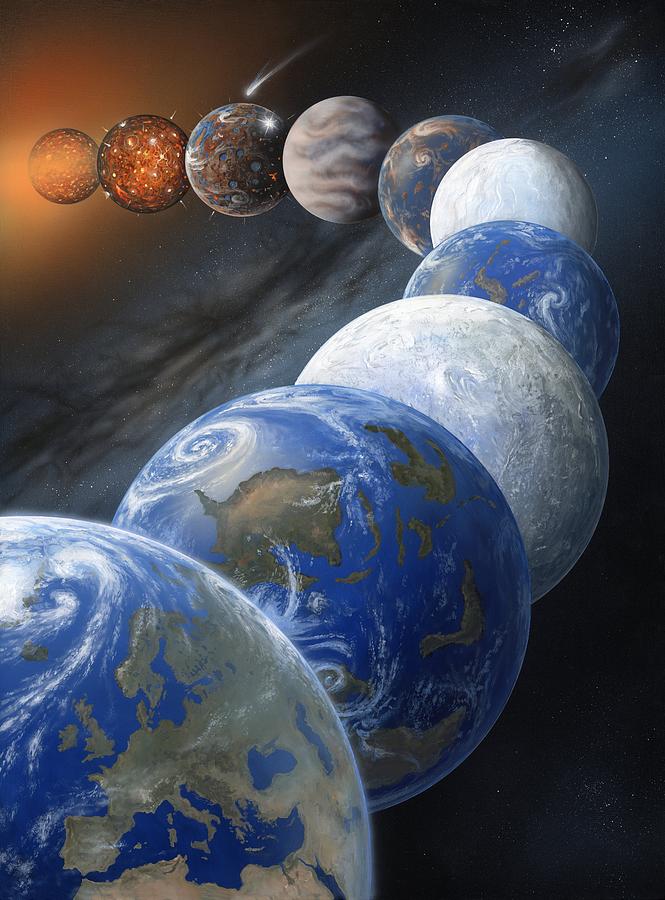
Dr Frank then showed us an image of various planets and asked us to identify them- they all turned out to be artists' conceptions of the stages of Earth's development, much like depicted in this gorgeous painting. At one stage, the Earth was molten. At another stage, before the formation of continents, the only landmasses were cratons. At another stage, it is believed that there was a Snowball Earth. During the Paleocene-Eocene Thermal Maximum, it is believed that Earth had no sea or land ice. Dr Frank quipped that the Earth has worn many masks.
The study of the Earth's past involves the study of many Earth systems: the co-evolution of the atmosphere, cryosphere, hydrosphere, geosphere, and biosphere. The Holocene, the geological epoch which encompasses our current Anthropocene, is one of many interglacial periods. AlL of human history has taken place in this epoch, approximately the last 10,000 years. Dr Frank posed the question, what would you experience if you landed on Earth three billion years ago? The answer is that you would asphyxiate because of a lack of oxygen in the atmosphere. The presence of free oxygen in the atmosphere is due to life- the Great Oxidation Event occurred when cyanobacteria 'farted out' oxygen as a waste product of photosynthesis. Life has changed the atmosphere over and over again. Successful species are numerous, but such success can lead to catastrophes- the cyanobacteria changed the atmosphere enough that it killed most of them off.
In 1979, James Lovelock and Lynn Margulis formulated the Gaia Hypothesis, the idea that the planet changes to maintain life. The hypothesis was controversial due to the notion of a teleological planet, a planet that 'wants' life, even though evolution is a blind processs. The idea of a 'living' planet led to some loopy interpretations in the public imagination, which led to some pushback, but it is undeniable that life plays an enormous role in Earth's systems dynamics. Earth and its life have been evolving together as a coupled system for a long time.
Dr Frank's research involves the study of astrobiological systems to determine if sustainable versions of our type of civilization are possible. Do industrialized civilizations like ours burn out in two hundred years? Astrobiological studies can inform us of new perspectives on our trajectory into and through the Anthropocene. How common are 'anthropocenes'? How fatal are 'anthropocenes'? What is the average lifespan of an industrial civilization? What are the characteristics of planets that survive an 'anthropocene'? Dr Frank urged us to take the prospect of exocivilizations seriously.
At this time, I will leave off the recap for now because bar trivia beckons- what good is learning while intoxicated if one cannot follow it up with showing off intellectually while intoxicated? I will finish this recap tomorrow...
By which I mean today!
Different stars have different characteristics. A star with a different spectrum from our sun would mean that photosynthesis on a planet orbiting it would differ from terrestrial photosynthesis. There are no tools in the toolbox to constrain our models focusing on the co-evolution of civilization and planetary systems. One definition of civilization involves the use of energy by intelligent lifeforms. A problem with studying astrobiology is the bad prosthetic forehead variety of science fiction- aliens provide a snicker factor. The search for extraterrestrial intelligence can be refined, as Dr Frank put it, "This is not your grandfather's SETI." Mentioning the excitement over the discovery of a possible extrasolarian megastructure, he exhorted us: "Consider the possibilities!" Within the next thirty years, we may have data relevant to the possibility of extraterrestrial life. For example, atmospheric signatures of industrial civilization include methane and CFCs.
The theoretical studies of exocivilizations involve a battle between optimists and pessimists. Astronomer Frank Drake formulated the Drake Equation, a theoretical exercise to estimate the possible number of detectable extrasolar civilizations, expressed as:

N is the number of detectable civilizations. R* is the average rate of star formation. Fp is the number of stars with planets. Ne is the number of those stars which have planets which can sustain life. Fl is the number of those planets on which life develops. Fi is the number of those planets which develop intelligent life which can produce civilizations. Fc is the number of those civilizations which have developed detectable communications technologies. L is the duration of time in which those civilizations release detectable signals.
Dr Frank posed the question: What sub-questions in the Drake Equation can be answered? Are we the only instance in cosmic evolution that intelligent life evolved? This ultra-pessimistic view would be a one in ten billion trillion chance. Even a pessimist like Ernst Mayr was ten million times more optimistic than that. Most pessimists would get a universe full of civilizations of two hundred years' duration.
Building world civilizations involves planetary feedback- 'anthropocenes' have probably happened before. We now know enough about planets and how they respond to to anthropocenes to begin how species will drive planetary feedback. Science is about constraining imagination, and the astrobiological/archaeological models are based on the predator/prey population models formulated by Lotka and Volterra:

Predator numbers tend to go up after the amount of prey increases, and crash after the prey numbers crash. Dr Frank used similar equations for population and planetary temperatures- he quipped that planets are machines, push hard enough and they go off. The models used for the equations were based on the population of Easter Island, as detailed in his May 2018 article in The Atlantic. Running multiple scenarios, he determined that there are three main results. The first is a mass die off as population exceeds the planet's carrying capacity. The second is the achievement of sustainability- a soft landing to a steady state is reached. The last is a true collapse, perhaps a runaway Venus scenario.
Dr Frank posed the question, what does the astrobiological perspective change? He joked that he is from New Jersey, so he is naturally combative, then noted that this is not a battle to save the planet- as Lynn Margulis joked: "Gaia is a tough bitch." The planet has been the scene of five known mass extinctions, and the only reason why we are here is because the non-avian dinosaurs went extinct, leaving ecological niches for our ancestors. What are we trying to sustain? What moral imperatives do we invoke to do so? Dr Frank showed the picture of the polar bear stranded on a melting ice flow and noted that it is an apex predator that would easily kill you. He then stated that humans can no longer practice ecological hooliganism. Even if humans are successful in reaching sustainability, there will be no more ice ages. Climate change poses a probably existential threat to the project of civilization, but Earth will survive even if we do not. Ecologically, the Earth's phytoplankton is more important than the charismatic megafauna usually invoked in ecological pleas.
Dr Frank urged activists to stop with the human hate- the goal should be to sustain the climatic conditions that are amenable to the project of civilization. Sustainability goals should balance a technologically advanced, energy intensive, high population with quality of life. 'Hockey Stick' diagrams won't change the narrative, stories are needed and the wrong story is 'we suck'. Cities are ecosystems just like forests, they have just been invented recently. The wrong question to ask is 'did we change climate?' The right question is 'what did we expect?' When oil was discovered, humans did not set out to change the climate, it was a mistake resulting from one particular sort of energy production. Our mistake now is to keep using fossil fuels. Climate scientist Raymond Pierrehumbert characterized climate change as 'Humanity's Final Exam'. Through right action and skillful means, we might just pass it. If we acknowledge that planets have rules, and achieve sustainability, we might create an 'awakened' planet on which the biosphere and civilization can flourish together, and the Gaia hypothesis can be realized.
The lecture was followed by a Q&A session. The first question involved mass extinctions, and Dr Frank noted that the biosphere would be happy to move on without us, and the burden falls on us to 'think like the biosphere' to benefit ourselves. Some bastard in the audience asked the good doctor for his opinion on the theoretical notion that a planet had 'one shot' to produce a high-tech civilization, because a failing civilization would 'spend all the startup capital' and impoverish any successors. Happily, Dr Frank's colleague Gavin Schmidt posed a speculative scenario in which a high tech civilization evolved millions of years before humanity. What sort of evidence would survive, say, thirty-five million years? Could climate change end one civilization and set up the cycle of fossil fuel production for the next civilization? Would a wind powered civilization be possible? What does a planet provide? What would our footprint be millions of years from now? It would be weird isotopic anomalies.
Regarding Mars, it is not Planet B. There is no way to move a mass of population and enough resources to sustain them to the red planet. Dr Frank then joked that we should 'fuck up' Mars- as we are triggering climate change, we are becoming spacefarers, and the price for climate change is the rest of the solar system.
Regarding the lifespan of technological civilizations, Dr Frank joked that, two hundred years ago, anyone traveling more than thirty miles per hour would be falling to their death.
Regarding the Fermi Paradox, Dr Frank noted that SETI funding has been slim, and that, if space were an ocean, we have only looked at at thimble. If there were aliens which could travel at approximately the speed of light, they could have disseminated throughout the galaxy in six thousand years, but if they had visited Earth, any traces would have been lost, so researchers should (shades of Arthur C. Clarke) look on the moon. I have my own theory about the Fermi Paradox.
Asked for the most effective story about climate change, Dr Frank opined that climate change shows us how powerful we are. He advised us not to bother talking to hardcore climate denialists, and noted that carbon dioxide doesn't care who you vote for.
Regarding Easter Island models, he noted that in most cases the population of the island exceeds its carrying capacity... sustainability is almost impossible. Carrying capacity studies for the planet use real climate models, with the parameters being based on energy sources. Even using wind power as a parameter, a two-degree change is expected. He noted that doctors don't only study sick people, and that many models are needed.
Asked about what technologies are needed, Dr Frank noted that we must get off fossil fuels and develop renewables. He noted that, near his Rochester campus, there are four bits of transportation infrastructure: the Erie Canal, a railroad, a highway, and an airport. Infrastructure changes, technologies change.
Dr Frank delivered a really great lecture- while much of it was speculative, it was a valuable intellectual exercise, and a call to action. I particularly dug the almost Lovecraftian evocation of vast periods of time, unburdened by Lovecraftian cosmic indifference and other less pleasant baggage. This was a superfun think piece. Kudos to Dr Frank, Dorian and Margaret, and the staff of the beautiful Bell House. Here is a video of Dr Frank discussing his new book:
Pour yourself a libation and soak in that SCIENCE!
ADDENDUM: Here is a short, sweet video featuring Dr Frank:
Now, that's a quick shot of SCIENCE!
Dr Frank's talk riffed on the topic of the book- the research behind it came out of being a science writer who specializes in outreach. In the book, he wanted to address climate change denialism. An astronomer looks at what happens to planets undergoing climate change differently than a typical climate scientist. Regarding climate change, the problem can't be solved unless it is understood, and it can't be understood unless its story can be told. Anthropogenic climate change being a recent phenomenon, there is no broad story about it. The story that must be pieced together is: what is the human future on a climate-changing planet? Currently, there is an anthropogenically driven change in the planetary climate state from 'warm and moist' to an unknown state. Climate change will be accompanied by resource depletion, most dangerously, a depletion of potable water.
The effects of increasing carbon dioxide levels has been a source of concern since at least the 1960s, with President Johnson making this declaration in a special message to Congress in 1965:
"Air pollution is no longer confined to isolated places. This generation has altered the composition of the atmosphere on a global scale through radioactive materials and a steady increase in carbon dioxide from the burning of fossil fuels. Entire regional airsheds, crop plant environments, and river basins are heavy with noxious materials. Motor vehicles and home heating plants, municipal dumps and factories continually hurl pollutants into the air we breathe. Each day almost 50,000 tons of unpleasant, and sometimes poisonous, sulfur dioxide are added to the atmosphere, and our automobiles produce almost 300,000 tons of other pollutants. "
Currently, climate change denialism is another aspect of our political polarization.
In 2000 publication, Paul Crutzen and Eugene Stoermer coined the term Anthropocene (PDF) to describe the current geological epoch in which human activity is a fundamental driver of coupled Earth systems. Humans are altering the planet to the extent that researchers a million or two years in the future could be able to detect isotopic evidence of human activity. Humanity is pushing the levers on climate, biodiversity, the nitrogen cycle, and the phosphorous cycle. In 2009, Johan Rockström of the Stockholm Resilience Centre led an effort to describe the planetary boundaries within which humanity could thrive and to foster stability. Dr Frank described the Anthropocene with a wonderful turn of phrase: We have reached a mythic power regarding planetary change.
Dr Frank characterized his fusion of astrobiology and the Anthropocene as the 10,000 light-year view. Astrobiology is the study of life in an astronomical perspective. The difficulty in astrobiological studies is that it involves an N=1 problem because we only know of one life-bearing world. That being said, there were three revolutions in the field: the first being the discovery of exoplanets, the second being the exploration of the solar system, and the third being an exploration of Earth's distant past.
The existence of life on other planets has occupied the human imagination for millennia, with optimists and pessimists vying for public acceptance. Epicurus believed that extraterrestrial life was common while Aristotle believed that Earth is unique. Newton believed in extraterrestrial life, but by 1900, pessimism regarding life beyond Earth was ascendant. In 1995, NASA's Kepler Space Telescope detected the first concrete evidence of an exoplanet. Since then, planets have been found wholesale- almost every star has planets orbiting it, with one in five stars having planets in the Habitable Zone- that region around a star in which liquid water can exist.
The exploration of the solar system has proceeded apace, with all sorts of objects (planets, asteroids, comets) being visited. Climate is the generic status of all planets with an atmosphere, and climate models exist for the other planets of the solar system (PDF). Climate is a universal planetary phenomenon. Mars used to be a blue world, with a vast amount of liquid water. Dr Frank described its current state as hellish, a cold and nasty place, and joked 'bring your blanket!' He then noted that you can change your planet, it might not be the one you grew up on.
Dr Frank then showed us an image of various planets and asked us to identify them- they all turned out to be artists' conceptions of the stages of Earth's development, much like depicted in this gorgeous painting. At one stage, the Earth was molten. At another stage, before the formation of continents, the only landmasses were cratons. At another stage, it is believed that there was a Snowball Earth. During the Paleocene-Eocene Thermal Maximum, it is believed that Earth had no sea or land ice. Dr Frank quipped that the Earth has worn many masks.
The study of the Earth's past involves the study of many Earth systems: the co-evolution of the atmosphere, cryosphere, hydrosphere, geosphere, and biosphere. The Holocene, the geological epoch which encompasses our current Anthropocene, is one of many interglacial periods. AlL of human history has taken place in this epoch, approximately the last 10,000 years. Dr Frank posed the question, what would you experience if you landed on Earth three billion years ago? The answer is that you would asphyxiate because of a lack of oxygen in the atmosphere. The presence of free oxygen in the atmosphere is due to life- the Great Oxidation Event occurred when cyanobacteria 'farted out' oxygen as a waste product of photosynthesis. Life has changed the atmosphere over and over again. Successful species are numerous, but such success can lead to catastrophes- the cyanobacteria changed the atmosphere enough that it killed most of them off.
In 1979, James Lovelock and Lynn Margulis formulated the Gaia Hypothesis, the idea that the planet changes to maintain life. The hypothesis was controversial due to the notion of a teleological planet, a planet that 'wants' life, even though evolution is a blind processs. The idea of a 'living' planet led to some loopy interpretations in the public imagination, which led to some pushback, but it is undeniable that life plays an enormous role in Earth's systems dynamics. Earth and its life have been evolving together as a coupled system for a long time.
Dr Frank's research involves the study of astrobiological systems to determine if sustainable versions of our type of civilization are possible. Do industrialized civilizations like ours burn out in two hundred years? Astrobiological studies can inform us of new perspectives on our trajectory into and through the Anthropocene. How common are 'anthropocenes'? How fatal are 'anthropocenes'? What is the average lifespan of an industrial civilization? What are the characteristics of planets that survive an 'anthropocene'? Dr Frank urged us to take the prospect of exocivilizations seriously.
At this time, I will leave off the recap for now because bar trivia beckons- what good is learning while intoxicated if one cannot follow it up with showing off intellectually while intoxicated? I will finish this recap tomorrow...
By which I mean today!
Different stars have different characteristics. A star with a different spectrum from our sun would mean that photosynthesis on a planet orbiting it would differ from terrestrial photosynthesis. There are no tools in the toolbox to constrain our models focusing on the co-evolution of civilization and planetary systems. One definition of civilization involves the use of energy by intelligent lifeforms. A problem with studying astrobiology is the bad prosthetic forehead variety of science fiction- aliens provide a snicker factor. The search for extraterrestrial intelligence can be refined, as Dr Frank put it, "This is not your grandfather's SETI." Mentioning the excitement over the discovery of a possible extrasolarian megastructure, he exhorted us: "Consider the possibilities!" Within the next thirty years, we may have data relevant to the possibility of extraterrestrial life. For example, atmospheric signatures of industrial civilization include methane and CFCs.
The theoretical studies of exocivilizations involve a battle between optimists and pessimists. Astronomer Frank Drake formulated the Drake Equation, a theoretical exercise to estimate the possible number of detectable extrasolar civilizations, expressed as:

N is the number of detectable civilizations. R* is the average rate of star formation. Fp is the number of stars with planets. Ne is the number of those stars which have planets which can sustain life. Fl is the number of those planets on which life develops. Fi is the number of those planets which develop intelligent life which can produce civilizations. Fc is the number of those civilizations which have developed detectable communications technologies. L is the duration of time in which those civilizations release detectable signals.
Dr Frank posed the question: What sub-questions in the Drake Equation can be answered? Are we the only instance in cosmic evolution that intelligent life evolved? This ultra-pessimistic view would be a one in ten billion trillion chance. Even a pessimist like Ernst Mayr was ten million times more optimistic than that. Most pessimists would get a universe full of civilizations of two hundred years' duration.
Building world civilizations involves planetary feedback- 'anthropocenes' have probably happened before. We now know enough about planets and how they respond to to anthropocenes to begin how species will drive planetary feedback. Science is about constraining imagination, and the astrobiological/archaeological models are based on the predator/prey population models formulated by Lotka and Volterra:

Predator numbers tend to go up after the amount of prey increases, and crash after the prey numbers crash. Dr Frank used similar equations for population and planetary temperatures- he quipped that planets are machines, push hard enough and they go off. The models used for the equations were based on the population of Easter Island, as detailed in his May 2018 article in The Atlantic. Running multiple scenarios, he determined that there are three main results. The first is a mass die off as population exceeds the planet's carrying capacity. The second is the achievement of sustainability- a soft landing to a steady state is reached. The last is a true collapse, perhaps a runaway Venus scenario.
Dr Frank posed the question, what does the astrobiological perspective change? He joked that he is from New Jersey, so he is naturally combative, then noted that this is not a battle to save the planet- as Lynn Margulis joked: "Gaia is a tough bitch." The planet has been the scene of five known mass extinctions, and the only reason why we are here is because the non-avian dinosaurs went extinct, leaving ecological niches for our ancestors. What are we trying to sustain? What moral imperatives do we invoke to do so? Dr Frank showed the picture of the polar bear stranded on a melting ice flow and noted that it is an apex predator that would easily kill you. He then stated that humans can no longer practice ecological hooliganism. Even if humans are successful in reaching sustainability, there will be no more ice ages. Climate change poses a probably existential threat to the project of civilization, but Earth will survive even if we do not. Ecologically, the Earth's phytoplankton is more important than the charismatic megafauna usually invoked in ecological pleas.
Dr Frank urged activists to stop with the human hate- the goal should be to sustain the climatic conditions that are amenable to the project of civilization. Sustainability goals should balance a technologically advanced, energy intensive, high population with quality of life. 'Hockey Stick' diagrams won't change the narrative, stories are needed and the wrong story is 'we suck'. Cities are ecosystems just like forests, they have just been invented recently. The wrong question to ask is 'did we change climate?' The right question is 'what did we expect?' When oil was discovered, humans did not set out to change the climate, it was a mistake resulting from one particular sort of energy production. Our mistake now is to keep using fossil fuels. Climate scientist Raymond Pierrehumbert characterized climate change as 'Humanity's Final Exam'. Through right action and skillful means, we might just pass it. If we acknowledge that planets have rules, and achieve sustainability, we might create an 'awakened' planet on which the biosphere and civilization can flourish together, and the Gaia hypothesis can be realized.
The lecture was followed by a Q&A session. The first question involved mass extinctions, and Dr Frank noted that the biosphere would be happy to move on without us, and the burden falls on us to 'think like the biosphere' to benefit ourselves. Some bastard in the audience asked the good doctor for his opinion on the theoretical notion that a planet had 'one shot' to produce a high-tech civilization, because a failing civilization would 'spend all the startup capital' and impoverish any successors. Happily, Dr Frank's colleague Gavin Schmidt posed a speculative scenario in which a high tech civilization evolved millions of years before humanity. What sort of evidence would survive, say, thirty-five million years? Could climate change end one civilization and set up the cycle of fossil fuel production for the next civilization? Would a wind powered civilization be possible? What does a planet provide? What would our footprint be millions of years from now? It would be weird isotopic anomalies.
Regarding Mars, it is not Planet B. There is no way to move a mass of population and enough resources to sustain them to the red planet. Dr Frank then joked that we should 'fuck up' Mars- as we are triggering climate change, we are becoming spacefarers, and the price for climate change is the rest of the solar system.
Regarding the lifespan of technological civilizations, Dr Frank joked that, two hundred years ago, anyone traveling more than thirty miles per hour would be falling to their death.
Regarding the Fermi Paradox, Dr Frank noted that SETI funding has been slim, and that, if space were an ocean, we have only looked at at thimble. If there were aliens which could travel at approximately the speed of light, they could have disseminated throughout the galaxy in six thousand years, but if they had visited Earth, any traces would have been lost, so researchers should (shades of Arthur C. Clarke) look on the moon. I have my own theory about the Fermi Paradox.
Asked for the most effective story about climate change, Dr Frank opined that climate change shows us how powerful we are. He advised us not to bother talking to hardcore climate denialists, and noted that carbon dioxide doesn't care who you vote for.
Regarding Easter Island models, he noted that in most cases the population of the island exceeds its carrying capacity... sustainability is almost impossible. Carrying capacity studies for the planet use real climate models, with the parameters being based on energy sources. Even using wind power as a parameter, a two-degree change is expected. He noted that doctors don't only study sick people, and that many models are needed.
Asked about what technologies are needed, Dr Frank noted that we must get off fossil fuels and develop renewables. He noted that, near his Rochester campus, there are four bits of transportation infrastructure: the Erie Canal, a railroad, a highway, and an airport. Infrastructure changes, technologies change.
Dr Frank delivered a really great lecture- while much of it was speculative, it was a valuable intellectual exercise, and a call to action. I particularly dug the almost Lovecraftian evocation of vast periods of time, unburdened by Lovecraftian cosmic indifference and other less pleasant baggage. This was a superfun think piece. Kudos to Dr Frank, Dorian and Margaret, and the staff of the beautiful Bell House. Here is a video of Dr Frank discussing his new book:
Pour yourself a libation and soak in that SCIENCE!
ADDENDUM: Here is a short, sweet video featuring Dr Frank:
Now, that's a quick shot of SCIENCE!
Saturday, September 8, 2012
Why Did He Have to Use an AEI Approved Term?
I hate to sound a sour note after a generally rousing Democratic Convention, but there's something that really stuck out and stuck in my craw in President Obama's otherwise inspiring speech:
You can choose the path where we control more of our own energy. After thirty years of inaction, we raised fuel standards so that by the middle of the next decade, cars and trucks will go twice as far on a gallon of gas.
We’ve doubled our use of renewable energy, and thousands of Americans have jobs today building wind turbines and long-lasting batteries. In the last year alone, we cut oil imports by one million barrels a day – more than any administration in recent history. And today, the United States of America is less dependent on foreign oil than at any time in nearly two decades.
Now you have a choice – between a strategy that reverses this progress, or one that builds on it. We’ve opened millions of new acres for oil and gas exploration in the last three years, and we’ll open more. But unlike my opponent, I will not let oil companies write this country’s energy plan, or endanger our coastlines, or collect another $4 billion in corporate welfare from our taxpayers.
We’re offering a better path – a future where we keep investing in wind and solar and clean coal; where farmers and scientists harness new biofuels to power our cars and trucks; where construction workers build homes and factories that waste less energy; where we develop a hundred year supply of natural gas that’s right beneath our feet. If you choose this path, we can cut our oil imports in half by 2020 and support more than 600,000 new jobs in natural gas alone.
Why, why, why did the president have to use American Enterprise Institute weasel words in his nomination speech? There is no such thing as clean coal, "clean coal" is a corporatist right-wing term that is as false as "job creators" and as cynical as "entitlement reform". Coal extraction is dangerous to workers and the environment, the burning of coal adds carbon and mercury to the atmosphere, and coal ash contains a variety of toxins (as if that's not bad enough ash disposal protocols are shoddy at best). To put it in vulgar terms, clean coal is as imaginary as petroleum-pissing unicorns and nuclear-powered rainbows.
This isn't the first time that President Obama pissed me off with the use of this term. The fossil fuel industry will always support his opponents, so why does he use their P.R.B.S. (insert Reince Priebus joke) terms?
Now, for the typical B.B.B.B. fossil fuel rant... Fossil fuels should be considered "startup capital" or "seed corn"- they are the energy source that allowed the wide-scale industrialization necessary for the development of alternative energy sources. Over thirty years ago, President Jimmy Carter warned the citizens of the U.S. of our profligate energy use, and the need to develop alternatives:
Tragically, nothing substantial was done in the intervening decades... we're blowing through the startup capital, eating the seed corn. As Gene Wolfe (whose Seven American Nights is a beautiful, baffling, unsettling depiction of American decline) might put it, we're "doing nothing, sitting around waiting for the money to run out". In his short story The Adopted Father (written in 1980 and included in his collection Castle of Days,) Wolfe wrote a depressingly prescient paragraph:
"That's coal smoke, the technology of the Nineteenth Century brought into the Twenty-First and hard at work. They could have conquered the solar system and harnessed the sun, but they did this instead, because there was no fun involved. Their great-grandfathers had done it, and they knew it would work."
Hearing the president mentioning this "bridge to the 19th century" as a beneficial policy marred an otherwise decent speech. Sure, I'll be voting for the guy because the alternative is unthinkable, but I really wish he wouldn't participate in moving the Overton Window further to the right.
In the interests of thoroughness, I'd also like to mention my second "beef" with the speech- would it have hurt the president to stress the importance of the down-ticket races? He devoted some time to pretending that bipartisanship would be possible, when he should have been lambasting the no-good, obstructionist GOP congresscritters. While Bill Clinton did a good job of making this point in his barn-burner of a speech, President Obama should have continued the tirade.
Cross-posted at Rumproast.
You can choose the path where we control more of our own energy. After thirty years of inaction, we raised fuel standards so that by the middle of the next decade, cars and trucks will go twice as far on a gallon of gas.
We’ve doubled our use of renewable energy, and thousands of Americans have jobs today building wind turbines and long-lasting batteries. In the last year alone, we cut oil imports by one million barrels a day – more than any administration in recent history. And today, the United States of America is less dependent on foreign oil than at any time in nearly two decades.
Now you have a choice – between a strategy that reverses this progress, or one that builds on it. We’ve opened millions of new acres for oil and gas exploration in the last three years, and we’ll open more. But unlike my opponent, I will not let oil companies write this country’s energy plan, or endanger our coastlines, or collect another $4 billion in corporate welfare from our taxpayers.
We’re offering a better path – a future where we keep investing in wind and solar and clean coal; where farmers and scientists harness new biofuels to power our cars and trucks; where construction workers build homes and factories that waste less energy; where we develop a hundred year supply of natural gas that’s right beneath our feet. If you choose this path, we can cut our oil imports in half by 2020 and support more than 600,000 new jobs in natural gas alone.
Why, why, why did the president have to use American Enterprise Institute weasel words in his nomination speech? There is no such thing as clean coal, "clean coal" is a corporatist right-wing term that is as false as "job creators" and as cynical as "entitlement reform". Coal extraction is dangerous to workers and the environment, the burning of coal adds carbon and mercury to the atmosphere, and coal ash contains a variety of toxins (as if that's not bad enough ash disposal protocols are shoddy at best). To put it in vulgar terms, clean coal is as imaginary as petroleum-pissing unicorns and nuclear-powered rainbows.
This isn't the first time that President Obama pissed me off with the use of this term. The fossil fuel industry will always support his opponents, so why does he use their P.R.B.S. (insert Reince Priebus joke) terms?
Now, for the typical B.B.B.B. fossil fuel rant... Fossil fuels should be considered "startup capital" or "seed corn"- they are the energy source that allowed the wide-scale industrialization necessary for the development of alternative energy sources. Over thirty years ago, President Jimmy Carter warned the citizens of the U.S. of our profligate energy use, and the need to develop alternatives:
Tragically, nothing substantial was done in the intervening decades... we're blowing through the startup capital, eating the seed corn. As Gene Wolfe (whose Seven American Nights is a beautiful, baffling, unsettling depiction of American decline) might put it, we're "doing nothing, sitting around waiting for the money to run out". In his short story The Adopted Father (written in 1980 and included in his collection Castle of Days,) Wolfe wrote a depressingly prescient paragraph:
"That's coal smoke, the technology of the Nineteenth Century brought into the Twenty-First and hard at work. They could have conquered the solar system and harnessed the sun, but they did this instead, because there was no fun involved. Their great-grandfathers had done it, and they knew it would work."
Hearing the president mentioning this "bridge to the 19th century" as a beneficial policy marred an otherwise decent speech. Sure, I'll be voting for the guy because the alternative is unthinkable, but I really wish he wouldn't participate in moving the Overton Window further to the right.
In the interests of thoroughness, I'd also like to mention my second "beef" with the speech- would it have hurt the president to stress the importance of the down-ticket races? He devoted some time to pretending that bipartisanship would be possible, when he should have been lambasting the no-good, obstructionist GOP congresscritters. While Bill Clinton did a good job of making this point in his barn-burner of a speech, President Obama should have continued the tirade.
Cross-posted at Rumproast.
Saturday, January 7, 2012
GOP EPA Mendacity
Hey, presidential candidate and almost lifelike human simulacrum Mitt Romney has some lies to tell about the Environmental Protection Agency:
Of course, the reality of the job-killing EPA trope is bullshit. The critics of environmental regulation aren't interested in creating well-paying jobs, they're simply trying to squash any alternatives to the fossil fuel industry.
Tighter regulations would force innovations in the renewable fuel sector and in the efficiency of our appliances and conveyances. The fossil fuel extractors really aren't engaged in grand, sweeping innovations- they just refine techniques that date back to the 19th Century. In addition, environmental remediation would result in the creation of many jobs which can't be outsourced. Meanwhile, other nations will leave the U.S. in the dust in the alternative energy field. It's way past time that we do something to end our dependence on fossil fuels- it's been a problem for decades. Deregulation and a "more of the same" approach to our energy production will hasten the seemingly inevitable decline of 'Murka. As much as I am disappointed in President Obama's approach to governing, if a GOPer wins the 2012 election, things will be much worse.
VOTE GOP 2012: building a bridge to the 19th Century (uh, without the plentiful resources to exploit, that is).
Of course, the reality of the job-killing EPA trope is bullshit. The critics of environmental regulation aren't interested in creating well-paying jobs, they're simply trying to squash any alternatives to the fossil fuel industry.
Tighter regulations would force innovations in the renewable fuel sector and in the efficiency of our appliances and conveyances. The fossil fuel extractors really aren't engaged in grand, sweeping innovations- they just refine techniques that date back to the 19th Century. In addition, environmental remediation would result in the creation of many jobs which can't be outsourced. Meanwhile, other nations will leave the U.S. in the dust in the alternative energy field. It's way past time that we do something to end our dependence on fossil fuels- it's been a problem for decades. Deregulation and a "more of the same" approach to our energy production will hasten the seemingly inevitable decline of 'Murka. As much as I am disappointed in President Obama's approach to governing, if a GOPer wins the 2012 election, things will be much worse.
VOTE GOP 2012: building a bridge to the 19th Century (uh, without the plentiful resources to exploit, that is).
Thursday, August 2, 2018
A Ridiculous Rationale for a Stupid 'Solution' to a Manufactured Problem
Stupid and evil often go hand-in-hand, especially with the current crop of incompetent grifters in the Trump Maladministration. The latest atrocity is the proposed rollback of fuel efficiency and emissions standards for automobiles. Trump and his crony capitalist kakistocrats also seek to remove California's ability to regulate in-state emissions. It's a bundle of badness, guaranteed to boost fossil fuel corporations' profits, lower the cost of automobile manufacturing, and 'own the libs' by poisoning the air and ramping up anthropogenic global warming. Never mind that a chronic heat wave is gripping much of North America, doing something to mitigate climate change cuts into profits.
Adding insult to injury is the maladministration's claim that decreasing fuel efficiency standards will save lives:
The Trump administration says people would drive more and be exposed to increased risk if their cars get better gas mileage, an argument intended to justify freezing Obama-era toughening of fuel standards.
The maladministration also claimed that heavier cars are safer:
New vehicles would be cheaper – and heavier – if they don’t have to meet more stringent fuel requirements and more people would buy them, the draft says, and that would put more drivers in safer, newer vehicles that pollute less.
The equation mass x velocity puts the lie to this assertion.
This lowering of standards benefits only large corporations- fossil fuel companies, auto manufacturers, and the various support industries that prop them up, including mercenaries to fight in petrowars. The average person suffers from the effects of pollution, from extraction, from the conflicts that surround petroleum reserves, both abroad and at home. The very idea that any nation would work to stymie, even reverse, progress on fuel efficiency and environmental standards is monstrous.
It's here where I note that Russia's economy depends heavily on fossil fuels.
Adding insult to injury is the maladministration's claim that decreasing fuel efficiency standards will save lives:
The Trump administration says people would drive more and be exposed to increased risk if their cars get better gas mileage, an argument intended to justify freezing Obama-era toughening of fuel standards.
The maladministration also claimed that heavier cars are safer:
New vehicles would be cheaper – and heavier – if they don’t have to meet more stringent fuel requirements and more people would buy them, the draft says, and that would put more drivers in safer, newer vehicles that pollute less.
The equation mass x velocity puts the lie to this assertion.
This lowering of standards benefits only large corporations- fossil fuel companies, auto manufacturers, and the various support industries that prop them up, including mercenaries to fight in petrowars. The average person suffers from the effects of pollution, from extraction, from the conflicts that surround petroleum reserves, both abroad and at home. The very idea that any nation would work to stymie, even reverse, progress on fuel efficiency and environmental standards is monstrous.
It's here where I note that Russia's economy depends heavily on fossil fuels.
Tuesday, July 26, 2011
The Dead Zoo
I actually composed this post yesterday. Today, I'm heading down with my brother, Sweetums, and my nephews to one of my all-time favorite places on the planet, a zoo in which the majority of the animals are dead. Of course, I'm a big old dinosaur freak, always have been. The boys share my enthusiasm. In a previous post, I mentioned that I used to be pissed off that the Hall of Vertebrate Paleontology was named after one of the Koch brothers. I now think that it's an appropriate moniker- its a hall filled with the fossils of extinct animals, bearing the name of a fossil who made his money on fossil fuels, and who is doing his damnedest to back policies which are sure to hasten the currently on-going extinction event. What could be a more fitting tribute for the evil old coot?
Tuesday, July 31, 2012
I Need For You to be Serious for a Second Here, OK?
Today's been surprisingly cool for July in the NY metro area, but global warming has been all over the news lately. A recent Rolling Stone article is absolutely terrifying in it's implications. Less dire, but not too reassuring is a recent NPR piece on the "weirdness" that climate change is creating. Meanwhile, a horrific drought is threatening U.S. farm yields. A serious talk about the effects of our fossil fuel dependence is long, long overdue. What's this? A front group for the fossil fuels industry compares a climate scientist to a child molester? A major national conservative publication has reiterated the odious comparison? Wow, that's as bad as comparing hardworking scientists to a terrorist.
Shit, it's time to get serious about climate change, but the denialists are too mendacious and well-funded. They even lie about a plan begun as a "market-based solution" now being a communist plot (much like the current "Obamacare" with its mandate started off as a "market based" alternative to single-payer healthcare). I would say that there's a glimmer of hope, seeing that a prominent "skeptic" has had a change of mind, but scientists don't buy politicians, and the goddamn rubes in the states affected by the drought will blame the queers and shower hucksters who tell them to pray for rain with their dwindling disposable income, and NOTHING WILL GET ACCOMPLISHED.
I harp on this subject from time to time, but the confluence of pieces about global warming, and the idiotic attacks from denialists forced my writer's hand today.
Shit, it's time to get serious about climate change, but the denialists are too mendacious and well-funded. They even lie about a plan begun as a "market-based solution" now being a communist plot (much like the current "Obamacare" with its mandate started off as a "market based" alternative to single-payer healthcare). I would say that there's a glimmer of hope, seeing that a prominent "skeptic" has had a change of mind, but scientists don't buy politicians, and the goddamn rubes in the states affected by the drought will blame the queers and shower hucksters who tell them to pray for rain with their dwindling disposable income, and NOTHING WILL GET ACCOMPLISHED.
I harp on this subject from time to time, but the confluence of pieces about global warming, and the idiotic attacks from denialists forced my writer's hand today.
Sunday, April 11, 2021
Biden and Science
Last week was a busy one for me, which is reflected by my blog posts from the week. Because of this, some news items almost slipped by me, such as the GOP outrage over the EPA chief firing almost 45 Trump-appointed 'science advisors' from the Science Advisory Board and the Clean Air Scientific Advisory Committee.
Predictably, the Trump Maladministration ousted EPA scientists from academia and replaced them with fossil fuel and chemical industry flacks back in 2017, so this is a corrective measure. Of course, when Republicans do this, it's not political- only Democrats are so churlish to politicize science (or morals, or 'family values' or...). GOP representatives James Comer and Ralph Norman had the gall to write this to EPA chief Michael Regan:
“Traditionally science advisory boards are bipartisan panels used to provide advice to the administrator. Unfortunately, it appears the Biden administration is continuing to purge officials in the government who do not share its political beliefs. The midterm firing of science advisory board members within the first months of a new administration .... raises serious concerns about the politicization of the EPA.”
Here is where I note that the same 'researchers' who are trying to cast doubt on the connection between climate change and the burning of fossil fuels were the monsters who tried to obfuscate the link between cigarette smoking and cancer. There's no need to give these prevaricators a seat at the table when discussing such a crisis as global climate change. They just aren't good faith actors, and they would do their level best to derail any discussion of climate crisis mitigation.
Joe Biden has the Herculean task of cleaning out the Augean Stable that Former Guy turned the government into, and thankfully he's willing to do the necessary work. Starting with four dozen hired guns posing as scientists gives me hope that he is up to the challenge.
Even more importantly, President Biden signaled his commitment to science by elevating the role of Science Advisor to a cabinet position. The only thing that would make me more excited would be Biden's formation of a Science Ninja Team:
Thursday, January 26, 2017
Trump Acts in Jacksonian Fashion
Roy summarizes for us an attempt on the Right to connect Trump to a thread of conservatism that has run through the country since its inception... for example, Bloody Bill Kristol's son-in-law blurts: "He draws strength from his gut connection with Jacksonian America". There's a connection, alright, Andrew Jackson immiserated Native Americans and Donald Trump will immiserate Native Americans.
I didn't post about the Dakota Access Pipeline protests this past fall- it's a topic which was covered by the news media here in the East, but between an arduous work schedule and my apartment hunt/move, I really didn't feel like I had enough time to pay the topic the attention it deserved. Generally speaking, I am against any moves to double down on fossil fuel use (I believe that fossil fuels should be viewed as 'startup capital' to help humanity develop the technological base necessary for building an economy based on renewable energy), and I believe that the treatment that Native Americans have received at the hands of the various European-derived governments that have sprouted up on this continent has been disgraceful. The very re-routing of the Dakota Access Pipeline away from the City of Bismark was an egregious form of environmental racism (really, Republicans, if this pipeline is so necessary, and so safe, why not put it in white people's backyards?). The whole issue hits on a number of points of interest of mine- environmentalism, energy technology, and race relations- I wish I had had more time to write about it.
For a brief time, it appeared as if President Obama had solved the issue by having the Army Corps of Engineers put a stop to the pipeline project, but this victory was short-lived as the Orange Ogre won the Presidential election.
I have no doubt that Donald Trump will have no qualms about oppressing the Native Americans who have been at the heart of the fight against this pipeline. Donald Trump has a history of maligning Native Americans. When the St Regis Mohawks attempted to open a casino in New York's Catskill Mountains, Donald Trump, and his creepy flack Roger Stone, approved attack ads that amounted to character assassination, characterizing the St Regis as violent criminals and drug dealers:

If Donald Trump was venal and greedy enough to engage in character assassination of a Native American ethnic group in a petty dispute over upstate casino gambling, he's sure to be even more of an evil, racist asshole given the financial stakes involved in this pipeline dispute. He's not quite as bad as Jackson, but then again, this isn't the 19th century... on both a social justice and an environmental basis, this executive order is a terrible, horrible thing.
I didn't post about the Dakota Access Pipeline protests this past fall- it's a topic which was covered by the news media here in the East, but between an arduous work schedule and my apartment hunt/move, I really didn't feel like I had enough time to pay the topic the attention it deserved. Generally speaking, I am against any moves to double down on fossil fuel use (I believe that fossil fuels should be viewed as 'startup capital' to help humanity develop the technological base necessary for building an economy based on renewable energy), and I believe that the treatment that Native Americans have received at the hands of the various European-derived governments that have sprouted up on this continent has been disgraceful. The very re-routing of the Dakota Access Pipeline away from the City of Bismark was an egregious form of environmental racism (really, Republicans, if this pipeline is so necessary, and so safe, why not put it in white people's backyards?). The whole issue hits on a number of points of interest of mine- environmentalism, energy technology, and race relations- I wish I had had more time to write about it.
For a brief time, it appeared as if President Obama had solved the issue by having the Army Corps of Engineers put a stop to the pipeline project, but this victory was short-lived as the Orange Ogre won the Presidential election.
I have no doubt that Donald Trump will have no qualms about oppressing the Native Americans who have been at the heart of the fight against this pipeline. Donald Trump has a history of maligning Native Americans. When the St Regis Mohawks attempted to open a casino in New York's Catskill Mountains, Donald Trump, and his creepy flack Roger Stone, approved attack ads that amounted to character assassination, characterizing the St Regis as violent criminals and drug dealers:

If Donald Trump was venal and greedy enough to engage in character assassination of a Native American ethnic group in a petty dispute over upstate casino gambling, he's sure to be even more of an evil, racist asshole given the financial stakes involved in this pipeline dispute. He's not quite as bad as Jackson, but then again, this isn't the 19th century... on both a social justice and an environmental basis, this executive order is a terrible, horrible thing.
Monday, February 1, 2010
My One Major Beef with the SotU Speech
I had mentioned posting about my one major beef with the State of the Union speech, but I held off for the weekend because I was still savoring the President's smackdown of the Republican Caucus during their retreat (how appropos...). Well, my one big beef (VPR?) is his use of Competitive Enterprise Institute/Club for Growth/Republican Party propaganda term clean coal. His support for offshore drilling and nuclear power were bad enough, but clean coal? Honestly, coal is not clean. Back in 1980, in his short story The Adopted Father, collected in the compilation Castle of Days, Gene Wolfe wrote:
John Parker crossed to the window and stared at the dark sky beyond the glass. "That's coal smoke, the technology of the Nineteenth Century brought into the Twenty-First and hard at work. They could have conquered the solar system and harnessed the sun, but they did this instead, because there was no fun involved. Their great-grandfathers had done it, and they knew it would work."
This was written in 1980, after a decade marked with energy crises. Thirty years later, what has been accomplished in updating our energy policies? Precious little, as we loony lefties all know. It's been decades of tax policies encouraging the purchase of gas guzzlers, "Nuke their ass, take their gas", and missed opportunities for promoting conservation.
Also in 1980, Gene Wolfe wrote the essay Helioscope as a companion to the first volume of his haunting, masterful Book of the New Sun. Uh... **SPOILERS** follow here, so anybody unfamiliar with BotNS, go out, purchase, read it, become totally addicted to the work, and come back in a couple of months, armed to the teeth with in-jokes about "alzabos" and "cacogens". The essay was included in the book Castle of the Otter, which was then reprinted as part of the aforementioned Castle of Days volume. In Helioscope, Wolfe describes the genesis of The Book of the New Sun, which is set in a "medieval" society on a far-future Earth:
The challenge to science fiction today is not to describe a slightly hyped-up present, but a real future- a time radically unlike the present, that is. Clearly , there are more than one of these futures, there is the future in which mankind returns to the sea for new sources of food and raw materials. There is the future of extermination. I decided that the future most in keeping with the dark figure I had planned and his journey toward war was what I call the do nothing future, the one in which humanity clings to its old home, the continents of Earth, and waits for the money to run out(emphasis mine).
As Thom Hartmann so poetically put it in The Last Hours of Ancient Sunlight, fossil fuels capture millions of years of carbon produced through photosynthesis- a "bank account" that we continue to squander, when we should be using it as "start-up capital" for the production of renewable energy sources. The President had a real opportunity to eschew the talking points of the do nothing crowd, and issue a genuine call to action, but he blew it. I think I'll leave it at that, before I spin out a rambling rant about how algae is going to save the world.
John Parker crossed to the window and stared at the dark sky beyond the glass. "That's coal smoke, the technology of the Nineteenth Century brought into the Twenty-First and hard at work. They could have conquered the solar system and harnessed the sun, but they did this instead, because there was no fun involved. Their great-grandfathers had done it, and they knew it would work."
This was written in 1980, after a decade marked with energy crises. Thirty years later, what has been accomplished in updating our energy policies? Precious little, as we loony lefties all know. It's been decades of tax policies encouraging the purchase of gas guzzlers, "Nuke their ass, take their gas", and missed opportunities for promoting conservation.
Also in 1980, Gene Wolfe wrote the essay Helioscope as a companion to the first volume of his haunting, masterful Book of the New Sun. Uh... **SPOILERS** follow here, so anybody unfamiliar with BotNS, go out, purchase, read it, become totally addicted to the work, and come back in a couple of months, armed to the teeth with in-jokes about "alzabos" and "cacogens". The essay was included in the book Castle of the Otter, which was then reprinted as part of the aforementioned Castle of Days volume. In Helioscope, Wolfe describes the genesis of The Book of the New Sun, which is set in a "medieval" society on a far-future Earth:
The challenge to science fiction today is not to describe a slightly hyped-up present, but a real future- a time radically unlike the present, that is. Clearly , there are more than one of these futures, there is the future in which mankind returns to the sea for new sources of food and raw materials. There is the future of extermination. I decided that the future most in keeping with the dark figure I had planned and his journey toward war was what I call the do nothing future, the one in which humanity clings to its old home, the continents of Earth, and waits for the money to run out(emphasis mine).
As Thom Hartmann so poetically put it in The Last Hours of Ancient Sunlight, fossil fuels capture millions of years of carbon produced through photosynthesis- a "bank account" that we continue to squander, when we should be using it as "start-up capital" for the production of renewable energy sources. The President had a real opportunity to eschew the talking points of the do nothing crowd, and issue a genuine call to action, but he blew it. I think I'll leave it at that, before I spin out a rambling rant about how algae is going to save the world.
Thursday, April 28, 2011
Once Again, It Happens
For the second time in two weeks, violent storms have left a trail of carnage in the Southern U.S. Even here, in the Northeast, there were tornado warnings for parts of New York and New Jersey. Damnit, global warming is happening and it is causing severe storms. I never lived in a goddamn tornado zone until recently, and I haven't moved! The time to address the problem has long passed.
Tonight, I am planning on attending an opera in Lincoln Center, in the David Koch auditorium (phooey!). David Koch also affixed his name to the dinosaur wing of the American Museum of Natural History, this really pissed me off at first (the dinosaur wing of the AMNH is one of my favorite places on the planet), but I have come to realize that having David Koch's name on it is a good thing. What better tribute to David Koch could there be than a room filled with fossils (fossil fuels being the foundation of his inherited wealth) of extinct animals (the policies fostered by Koch's businesses and his pet politicians are contributing to an ongoing mass extinction event).
Let David Fucking Koch believe that the Koch Hall in the AMNH is an honor- it's really an indictment.
UPDATE: Holy crap, there are reports that the tornado which hit Tuscaloosa was a mile in diameter!
Tonight, I am planning on attending an opera in Lincoln Center, in the David Koch auditorium (phooey!). David Koch also affixed his name to the dinosaur wing of the American Museum of Natural History, this really pissed me off at first (the dinosaur wing of the AMNH is one of my favorite places on the planet), but I have come to realize that having David Koch's name on it is a good thing. What better tribute to David Koch could there be than a room filled with fossils (fossil fuels being the foundation of his inherited wealth) of extinct animals (the policies fostered by Koch's businesses and his pet politicians are contributing to an ongoing mass extinction event).
Let David Fucking Koch believe that the Koch Hall in the AMNH is an honor- it's really an indictment.
UPDATE: Holy crap, there are reports that the tornado which hit Tuscaloosa was a mile in diameter!
Monday, March 28, 2011
You Shall Know Them by a Foulness*
The Sweetheart of the Heartland has informed her adoring public that there is a "library scented" perfume named, in a creative ferment, "In the Library". Hmmm... how about a perfume like "In the Labyrinth", smelling of slime poison and prootwaddle sweat?
Barring that, how about an "In the Miskatonic Library" variation, with the scent of old parchment and lemon oil underlaid with the faintest hint of *****SPOILER WARNING***** deliquescing Wilbur Whateley?
My friend Margaret got me hip to the Mountain Goats' Lovecraft in Brooklyn, which deals with alienation (Lovecraft lived in Brooklyn while he was married to Sonia Greene, and was apparently very unhappy while he lived there). His Brooklyn idyll resulted in his short story Horror at Red Hook, which was probably inspired by a spleen sandwich.
In looking up a link for Lovecraft in Brooklyn, I saw a website for Lovecraft Biofuels, which gives me hope that we'll be able to kick the fossil fuels and transition to shoggoth based energy systems.
*Oddly enough, not a political post...
Barring that, how about an "In the Miskatonic Library" variation, with the scent of old parchment and lemon oil underlaid with the faintest hint of *****SPOILER WARNING***** deliquescing Wilbur Whateley?
My friend Margaret got me hip to the Mountain Goats' Lovecraft in Brooklyn, which deals with alienation (Lovecraft lived in Brooklyn while he was married to Sonia Greene, and was apparently very unhappy while he lived there). His Brooklyn idyll resulted in his short story Horror at Red Hook, which was probably inspired by a spleen sandwich.
In looking up a link for Lovecraft in Brooklyn, I saw a website for Lovecraft Biofuels, which gives me hope that we'll be able to kick the fossil fuels and transition to shoggoth based energy systems.
*Oddly enough, not a political post...
Tuesday, January 11, 2022
Secret Science Club Zoom Lecture: Changing Climate, Winds, and the Deep Blue Sea.
Tonight, my great and good friends of the Secret Science Club are presenting a Zoom lecture featuring oceanographer, climate scientist, and Antarctica explorer Dr Joellen Russell of the University of Arizona. Dr Russell also serves co-chair of the NOAA Science Advisory Board’s Climate Working Group, heading up the Southern Ocean Carbon and Climate Observations and Modeling team. She is also a founding member of Science Moms.
Dr Russell, appropriately, greeted the audience with an 'ahoy', and told us that she had a story for us. She began her lecture with Voyager's picture of the pale blue dot that Carl Sagan urged NASA to photograph. She noted that Planet Earth is better called Planet Water, the surface of the planet being 72% water. She then displayed the Earth Systems Model, a computer simulation of the planet.
The Keeling Curve is a diagram of carbon dioxide measurements taken from Mauna Loa and the South Pole. Even during the pandemic, carbon emissions rose, driven by forest fires and ocean warming which expelled CO2. In her home in Tuscon, there were heat waves, long-term drought, and a flood driven by a monsoon.
Global warming is ocean warming. Sunlight radiates onto the earth, and most of it radiates back into space. Certain gases, such as carbon dioxide, trap the heat in the planetary system. 93% of this heat differential effects the ocean. She then talked about the carbon dioxide issue- the government declared greenhouse gases pollutants. In 2007, the government required cutting greenhouse gas emissions.
85% of the increasing CO2 is the result of burning fossil fuels, 15% is the result of deforestation and land use changes.
Using the oceans to sequester CO2 poses problems, such as the release of the gas due to natural cycles, such as loss of solubility due to warming. The planet has gotten windier, which stirs the ocean, prompting CO2 release. Wave height can be measured with radar. This ocean-mixing is getting deeper. Simulations have mapped the air-sea carbon flux, but they have to be verified by observation, typically done at sea.
From 1999 to 2015, 585,652 ship-borne temperature measurements were made, but robot (Argo) floats made 1,485,744 measurements in the same time period. There are only about 6,000 oceanographers currently working.
The Argo floats are biogeochemical floats descend to a depth of 1000 meters, then continue a descent to 2000 meters, measuring temperature, pressure and salinity. The floats drift, which allows them to be deployed without the permits that propelled probes would necessitate. Analysis of the data can be conducted aboard ship in realtime.
The Southern Ocean around Antarctica is the blender in which the global ocean is mixed- it takes up to 50% of the carbon dioxide, and up to 75% of the heat. Why does Dr Russell study the sea around Antarctica? This is where the fate of Arizona will be decided. The world is deeply, profoundly connected. The Southern Ocean is a critical, yet precarious, carbon cycling engine.
Cool water upwells from the depths, driven by the extreme winds which displace water higher in the water column. This water carries carbon-rich detritus from the ocean floor, even though most decaying material never reaches the bottom. This seafloor carbon is one of the most significant carbon sources which is going to pose a problem.
SOCCOM measures air-sea carbon flux- high carbon deep waters reach the surface. Pathways of high carbn spiral upward, and are taken into the atmosphere. Better models can lead to better predictions of climate patterns globally. Weather models are now more properly called climate models, which take into account ocean conditions.
Progress toward real-time carbon accounting is occurring. Dr Russell's goal is a real-time carbon accounting and climate model, so better predictions can be made. The ultimate goal is to make this a better
The lecture was followed by a Q&A session. Some Bastard in the audience asked about the possibility of the upwelling of methane hydrates. Dr Russell noted that she's a chemist, the methane issue is 95% dependent on pressure, so a wholesale release of methane is unlikely, though local conditions, such as a landslide, can reduce pressure. Another question regarded carbon sequestration, and Dr Russell waxed rhapsodic about trees, which are literally made of air, using carbon dioxide for photosynthesis.
What is the most important thing to bring on an expedition? Chapstick, though she always brings antibiotic ointment, blocks and blocks of chocolate to bribe the crew, and coffee, including coffee beans to chew. She joked that anyone yearning to go to sea should leave a leaf blower running on their kitchen table for a month. There is constant engine noise, intense winds, hundred-foot waves. Chapstick is necessary. Also, don't skimp on buying gloves. If you are hurt, you lose measurement time, if you miss a measurement, that data is forever lost. I'm going to note that Dr Russell is a gifted comedian.
Regarding carbon emissions during the pandemic, our vehicle emissions dropped, but home heating and air condition usage increased. The air quality in New Delhi dramatically improved. The wildfires in the Northern Hemisphere added tons of carbon into the atmosphere. We also experienced a hot La Niña, which increased ocean upwelling.
Another question involved the role of ocean upwelling on the melting of the Antarctic ice shelves. Some of the models didn't take into account melting in Antarctica and Greenland, which she considers crazy. The ice sheets are thinning and the freshwater sitting on top of the ocean water can trap heat in the water at a depth of about 600 meters. This cap raises the water temperature by about four degrees, driving additional melting. She described this finding as a watershed.
Regarding ice ages, Dr Russell indicated that we put so much CO2 into the atmosphere that there will be no other glacial advance- the warming atmosphere, the increased winds, the 'burping' of CO2 into the atmosphere... this synergy has overloaded the system.
Another question involved the next phase of the research- Dr Russell indicated that she wants to go from two measurements of wind speeds to four measurements to measure peak winds, the winds that most drive carbon flux. There is no way to make up for missing peak winds when making models. She needs realtime carbon budget, and the satellites to accomplish this. She also wants to better measure coastal carbon budgets, which would necessitate the use of gliders, and a denser floater array. There is plenty to do, and she wishes that our global partners would further help in funding. She joked that the Germans had the flimsiest floats with the least impressive engineering.
Regarding the recyclability of the Argo floats- their housing is edible... as the floats approach the end of their lifespan, they will sink and biodegrade until organisms can consume the material. Regarding the float bot costs, a particular cable (RF resistant, salt resistant) increased in price from about $2 apiece to about $1000 apiece. Tank tests are difficult, they need to operate in the inky depths. The floats can be reprogrammed remotely though, a couple of lines of code to change operational ranges and avoid hazards. Each float measures temperature, pressure, and salinity, diving two thousand meters over the course of ten days. The floats also have two optical sensors, a chlorophyll fluorescence and backscatter to measure growing and pooping. There are also oxygen and Ph (increased carbon increases acidity) sensors. There are also other possible projects for realtime carbon accounting- Boeing offered to install carbon sensors in the noses of their planes, but NOAA didn't have the budget to provide the sensors. This is a low-cost, minimally damaging program, but there wasn't the will to push it. Dr Russell also noted that we don't have a civilian ocean forecast system. In 2004, NOAA declared there was no budget for it, but the EU has such a system.
Another question regarded the effect of fresh meltwater on ocean currents- the only current which is not speeding up is the Labrador Current, which is effected by an influx of fresh water. This upsets the hydrological cycle of the planet and is a Big Deal. The older model of slowing currents has been refuted by observation.
The last question involved the role of seismic activity in oceanic warming- Dr Russell indicated that it typically doesn't. They do monitor seismic activity in active subduction zones. The majority of carbon emitted doesn't come from hydrothermal vents, but from volcanoes. She stressed that her goal is to measure every carbon molecule.
Once again, the Secret Science Club delivered a fantastic lecture. This particular lecture hit what I call the Secret Science Sweet Spot, that blend of hard science, adventure narrative, and advocacy, all accompanied by vivid graphics, that is so appealing to me. Kudos to Dr Russell, Margaret, and Dorian for an informative, entertaining, and enlightening program.
Here's a brief video of Dr Russell discussing the Southern Ocean:
Here's a longer video regarding the subject of the measuring array:
Pour yourself a nice beverage and soak in that SCIENCE!Monday, April 22, 2019
What Have We Done to Our Fair Mother?
It's Earth Day, the Google doodle told me so... I'm not exactly optimistic about the fate of OUR planet, though THE planet will do fine (though we will pretty much take down all of our pretty, fragile fellow Earthlings, life will go on without us if we continue on our current path). The stories of marine life being killed by ingested plastic are disgusting, especially in light of revelations of systemic inaction nullifying personal virtue. There are virtual continents of garbage and the petrochemical industry is spending crazy amounts of money to delay, if not prevent, development away from fossil fuels, and the fact that the same organizations that fight climate action fought to obfuscate the link between smoking and health problems is a sick joke. Put succinctly, we are engaged in a global suicide pact so that a tiny minority of individuals on the planet can make shittons of money.
I am not ordinarily a 'downer', but this is a topic I have been harping on for the past decade of blogging. Take a walk outside, and gauge how long it takes to find a plastic bag stuck in a tree or blowing down the street. Check out the health statistics for asthma or for any of a number of cancers. Read up on plummeting insect populations (no worries, Monsanto will partner with Raytheon to build pollinator microdrones). It's pretty damn infuriating... the next quarter's profits are more important than the long-term survival of our species. The real shame is that we are taking the charismatic megafauna with us, though life is resilient and new ecological niches will develop on the flotsam and jetsam we'll leave behind, occupied by slimy little critters that don't tug at our heartstrings.
The title is a riff on a line from a song by the Doors, a band which I, like David Crosby, think is overrated... I think David Crosby is overrated too, though he has some good environmentalist content on his Twitter feed.
I am not ordinarily a 'downer', but this is a topic I have been harping on for the past decade of blogging. Take a walk outside, and gauge how long it takes to find a plastic bag stuck in a tree or blowing down the street. Check out the health statistics for asthma or for any of a number of cancers. Read up on plummeting insect populations (no worries, Monsanto will partner with Raytheon to build pollinator microdrones). It's pretty damn infuriating... the next quarter's profits are more important than the long-term survival of our species. The real shame is that we are taking the charismatic megafauna with us, though life is resilient and new ecological niches will develop on the flotsam and jetsam we'll leave behind, occupied by slimy little critters that don't tug at our heartstrings.
The title is a riff on a line from a song by the Doors, a band which I, like David Crosby, think is overrated... I think David Crosby is overrated too, though he has some good environmentalist content on his Twitter feed.
Monday, December 23, 2019
Windbag
In the annals (by which I mean anals) of Trump speeches, his recent speech in front of a crowd from young Republican group Turning Point USA has to be one of the most unhinged (and that's saying something). In particular, his Quixotic campaign against windmills was quite the farrago of bullshit:
Trump is lying about the role of wind turbines in bald eagle deaths while eliding the fact that high-rise buildings like the ones he favors are much more dangerous to avians. As far as his claims that the production of wind turbines creates fumes, it's inevitable that any manufacturing process will create emissions (until we have a grid powered by renewables, that is), but the installation of wind turbines will offset any 'fumes' footprint. Also, he's not exactly against fumes, as his support for coal-fired power plants makes clear (by which I mean smoggy). This sort of concern trollery isn't exactly convincing, and I imagine even the Turning Point troglodytes know this, but are the sort of knuckle-draggers who want pollution because it 'owns the libs'.
Trump's major personality trait is his cupidity, but secondary to that is his inability to let go of a grudge. He still picks fights with Rosie O'Donnell decades after the two had a falling-out. He can't let go of a quarter-century old crack by Greydon Carter, and he's never realized that the heart of the insult was 'vulgarian', not 'short-fingered'. Much of his animus against wind power stems from his failed lawsuit over a wind farm offshore of a Scottish golf resort. He's willing to watch the world burn because of this particular grudge.
Perhaps the real root of Trump's animus against wind power is the fact that his boss hates wind power- much of Russia's economy is based on fossil fuels, so anything which reduces Europe's reliance on Russian petroleum products is anathema to Putin. Nancy Pelosi quipped that, with Trump, all roads lead to Putin. While the rant is still nonsensical, it's not inexplicable.
TRUMP: "They were killing the bald eagle. If you shoot a bald eagle, they want to put you in jail for 10 years. A windmill will kill many. It’s true. And you know what? After a certain number, they make you turn the windmill off. That’s true, by the way.” pic.twitter.com/DvkJqa4MNO
— Aaron Rupar (@atrupar) December 23, 2019
Trump is lying about the role of wind turbines in bald eagle deaths while eliding the fact that high-rise buildings like the ones he favors are much more dangerous to avians. As far as his claims that the production of wind turbines creates fumes, it's inevitable that any manufacturing process will create emissions (until we have a grid powered by renewables, that is), but the installation of wind turbines will offset any 'fumes' footprint. Also, he's not exactly against fumes, as his support for coal-fired power plants makes clear (by which I mean smoggy). This sort of concern trollery isn't exactly convincing, and I imagine even the Turning Point troglodytes know this, but are the sort of knuckle-draggers who want pollution because it 'owns the libs'.
Trump's major personality trait is his cupidity, but secondary to that is his inability to let go of a grudge. He still picks fights with Rosie O'Donnell decades after the two had a falling-out. He can't let go of a quarter-century old crack by Greydon Carter, and he's never realized that the heart of the insult was 'vulgarian', not 'short-fingered'. Much of his animus against wind power stems from his failed lawsuit over a wind farm offshore of a Scottish golf resort. He's willing to watch the world burn because of this particular grudge.
Perhaps the real root of Trump's animus against wind power is the fact that his boss hates wind power- much of Russia's economy is based on fossil fuels, so anything which reduces Europe's reliance on Russian petroleum products is anathema to Putin. Nancy Pelosi quipped that, with Trump, all roads lead to Putin. While the rant is still nonsensical, it's not inexplicable.
Sunday, September 21, 2014
Sustainable Ecology, Sustainable Economy
I missed out on the big climate change awareness march in Manhattan today. I work weekends, and heading down to Manhattan for a spell before rushing back to Westchester in time for work was just not an option. I don't think that this was a cop-out on my part. I cover "green" issues fairly regularly, and the presence of one more person at the rally isn't as important as the presence of a voice consistently harping on green issues.
To me, the biggest problem facing our society is our utter failure to look beyond the immediate future: the next quarter, the next election cycle, the next ratings period... these occupy the thoughts of our policy makers to a far greater extent than a long-term, sustainable future. The symptoms of this underlying failure to develop a long-range plan, better yet, a multi-generational blueprint for the future, can be see in all walks of life- bubble economies, boom-and-bust cycles, environmental degradation, and infrastructure delapidation. Tragically, I don't see any changes being implemented until it's too late. Hell, at this point, I'm convinced that the best we can do is to lessen the impact of the coming crash, but big business and bad government actors are doing their damnedest to put the pedal to the metal.
I've long maintained that fossil fuels should be considered "startup capital" to be used to usher in a sustainable energy economy. The problem is that Homo sapiens has been burning (quite literally) the "seed money" with little effort to develop the next generation of energy sources. My personal feeling is that biofuels developed from algae or small, quick growing plants suck as duckweed. Carbon capture would best be achieved through reforestation efforts.
At any rate, the most important change that has to occur is that we, as a species, have to think of a future beyond the next quarter.
To me, the biggest problem facing our society is our utter failure to look beyond the immediate future: the next quarter, the next election cycle, the next ratings period... these occupy the thoughts of our policy makers to a far greater extent than a long-term, sustainable future. The symptoms of this underlying failure to develop a long-range plan, better yet, a multi-generational blueprint for the future, can be see in all walks of life- bubble economies, boom-and-bust cycles, environmental degradation, and infrastructure delapidation. Tragically, I don't see any changes being implemented until it's too late. Hell, at this point, I'm convinced that the best we can do is to lessen the impact of the coming crash, but big business and bad government actors are doing their damnedest to put the pedal to the metal.
I've long maintained that fossil fuels should be considered "startup capital" to be used to usher in a sustainable energy economy. The problem is that Homo sapiens has been burning (quite literally) the "seed money" with little effort to develop the next generation of energy sources. My personal feeling is that biofuels developed from algae or small, quick growing plants suck as duckweed. Carbon capture would best be achieved through reforestation efforts.
At any rate, the most important change that has to occur is that we, as a species, have to think of a future beyond the next quarter.
Friday, November 11, 2016
Fermi Paradox Explained?
One of the great conundrums of astrophysics is the Fermi Paradox, which basically poses the question: "With the vast number of stars in the galaxy, why can't we find evidence of extraterrestrial life?"
I think this week's election pretty much answers the question... rather than seeing a progression in wisdom, technological advancement, and species unity, we've seen a regression into tribalism, hatred, fear, and anti-intellectualism. Even if Vulgarmort doesn't touch off a nuclear war, the energy policy he's probably going to enact will be overly reliant on fossil fuels, a topic I touch upon every so often. Instead of pursuing renewable energy sources, we will probably see another lost decade of climate inaction at a time when urgent action is crucial to the survival of our species.
I have a trepidation that SETI is finally going to intercept one lone, final radio signal from a distant planet: "Make Rigel-5 great again!"
I think this week's election pretty much answers the question... rather than seeing a progression in wisdom, technological advancement, and species unity, we've seen a regression into tribalism, hatred, fear, and anti-intellectualism. Even if Vulgarmort doesn't touch off a nuclear war, the energy policy he's probably going to enact will be overly reliant on fossil fuels, a topic I touch upon every so often. Instead of pursuing renewable energy sources, we will probably see another lost decade of climate inaction at a time when urgent action is crucial to the survival of our species.
I have a trepidation that SETI is finally going to intercept one lone, final radio signal from a distant planet: "Make Rigel-5 great again!"
Subscribe to:
Posts (Atom)