Last night, I headed down to the beautiful Bell House, in the Gowanus section of Brooklyn, for this month's Secret Science Club lecture featuring astrophysicist Dr Adam Frank of the University of Rochester. Dr Frank is the host of NPR's 13.7: Cosmos And Culture and has recently released a book, Light of the Stars: Alien Worlds and the Fate of the Earth.
Dr Frank's talk riffed on the topic of the book- the research behind it came out of being a science writer who specializes in outreach. In the book, he wanted to address climate change denialism. An astronomer looks at what happens to planets undergoing climate change differently than a typical climate scientist. Regarding climate change, the problem can't be solved unless it is understood, and it can't be understood unless its story can be told. Anthropogenic climate change being a recent phenomenon, there is no broad story about it. The story that must be pieced together is: what is the human future on a climate-changing planet? Currently, there is an anthropogenically driven change in the planetary climate state from 'warm and moist' to an unknown state. Climate change will be accompanied by resource depletion, most dangerously, a depletion of potable water.
The effects of increasing carbon dioxide levels has been a source of concern since at least the 1960s, with President Johnson making this declaration in a special message to Congress in 1965:
"Air pollution is no longer confined to isolated places. This generation has altered the composition of the atmosphere on a global scale through radioactive materials and a steady increase in carbon dioxide from the burning of fossil fuels. Entire regional airsheds, crop plant environments, and river basins are heavy with noxious materials. Motor vehicles and home heating plants, municipal dumps and factories continually hurl pollutants into the air we breathe. Each day almost 50,000 tons of unpleasant, and sometimes poisonous, sulfur dioxide are added to the atmosphere, and our automobiles produce almost 300,000 tons of other pollutants. "
Currently, climate change denialism is another aspect of our political polarization.
In 2000 publication, Paul Crutzen and Eugene Stoermer coined the term Anthropocene (PDF) to describe the current geological epoch in which human activity is a fundamental driver of coupled Earth systems. Humans are altering the planet to the extent that researchers a million or two years in the future could be able to detect isotopic evidence of human activity. Humanity is pushing the levers on climate, biodiversity, the nitrogen cycle, and the phosphorous cycle. In 2009, Johan Rockström of the Stockholm Resilience Centre led an effort to describe the planetary boundaries within which humanity could thrive and to foster stability. Dr Frank described the Anthropocene with a wonderful turn of phrase: We have reached a mythic power regarding planetary change.
Dr Frank characterized his fusion of astrobiology and the Anthropocene as the 10,000 light-year view. Astrobiology is the study of life in an astronomical perspective. The difficulty in astrobiological studies is that it involves an N=1 problem because we only know of one life-bearing world. That being said, there were three revolutions in the field: the first being the discovery of exoplanets, the second being the exploration of the solar system, and the third being an exploration of Earth's distant past.
The existence of life on other planets has occupied the human imagination for millennia, with optimists and pessimists vying for public acceptance. Epicurus believed that extraterrestrial life was common while Aristotle believed that Earth is unique. Newton believed in extraterrestrial life, but by 1900, pessimism regarding life beyond Earth was ascendant. In 1995, NASA's Kepler Space Telescope detected the first concrete evidence of an exoplanet. Since then, planets have been found wholesale- almost every star has planets orbiting it, with one in five stars having planets in the Habitable Zone- that region around a star in which liquid water can exist.
The exploration of the solar system has proceeded apace, with all sorts of objects (planets, asteroids, comets) being visited. Climate is the generic status of all planets with an atmosphere, and climate models exist for the other planets of the solar system (PDF). Climate is a universal planetary phenomenon. Mars used to be a blue world, with a vast amount of liquid water. Dr Frank described its current state as hellish, a cold and nasty place, and joked 'bring your blanket!' He then noted that you can change your planet, it might not be the one you grew up on.
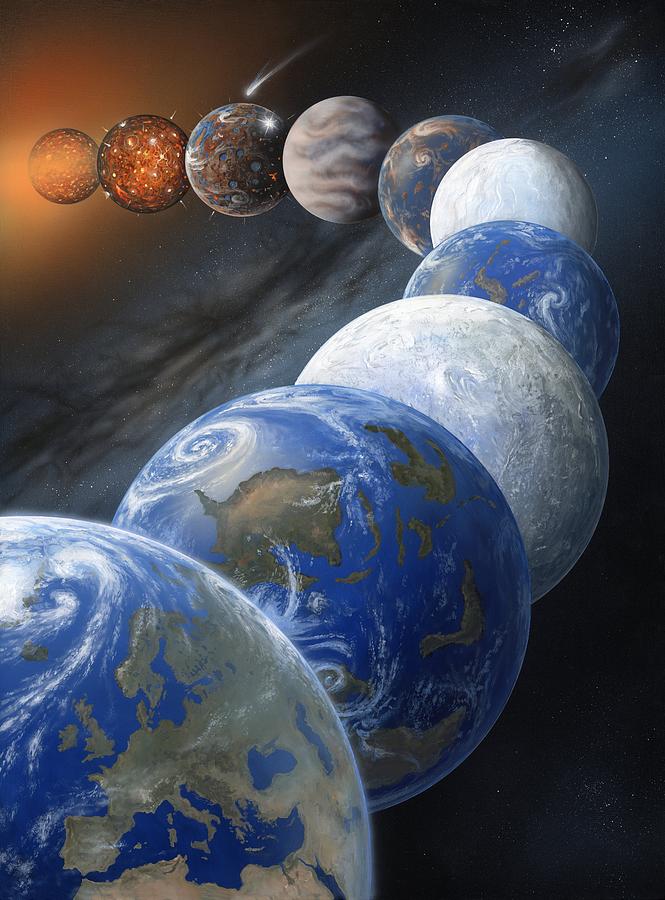
Dr Frank then showed us an image of various planets and asked us to identify them- they all turned out to be artists' conceptions of the stages of Earth's development, much like depicted in this gorgeous painting. At one stage, the Earth was molten. At another stage, before the formation of continents, the only landmasses were cratons. At another stage, it is believed that there was a Snowball Earth. During the Paleocene-Eocene Thermal Maximum, it is believed that Earth had no sea or land ice. Dr Frank quipped that the Earth has worn many masks.
The study of the Earth's past involves the study of many Earth systems: the co-evolution of the atmosphere, cryosphere, hydrosphere, geosphere, and biosphere. The Holocene, the geological epoch which encompasses our current Anthropocene, is one of many interglacial periods. AlL of human history has taken place in this epoch, approximately the last 10,000 years. Dr Frank posed the question, what would you experience if you landed on Earth three billion years ago? The answer is that you would asphyxiate because of a lack of oxygen in the atmosphere. The presence of free oxygen in the atmosphere is due to life- the Great Oxidation Event occurred when cyanobacteria 'farted out' oxygen as a waste product of photosynthesis. Life has changed the atmosphere over and over again. Successful species are numerous, but such success can lead to catastrophes- the cyanobacteria changed the atmosphere enough that it killed most of them off.
In 1979, James Lovelock and Lynn Margulis formulated the Gaia Hypothesis, the idea that the planet changes to maintain life. The hypothesis was controversial due to the notion of a teleological planet, a planet that 'wants' life, even though evolution is a blind processs. The idea of a 'living' planet led to some loopy interpretations in the public imagination, which led to some pushback, but it is undeniable that life plays an enormous role in Earth's systems dynamics. Earth and its life have been evolving together as a coupled system for a long time.
Dr Frank's research involves the study of astrobiological systems to determine if sustainable versions of our type of civilization are possible. Do industrialized civilizations like ours burn out in two hundred years? Astrobiological studies can inform us of new perspectives on our trajectory into and through the Anthropocene. How common are 'anthropocenes'? How fatal are 'anthropocenes'? What is the average lifespan of an industrial civilization? What are the characteristics of planets that survive an 'anthropocene'? Dr Frank urged us to take the prospect of exocivilizations seriously.
At this time, I will leave off the recap for now because bar trivia beckons- what good is learning while intoxicated if one cannot follow it up with showing off intellectually while intoxicated? I will finish this recap tomorrow...
By which I mean today!
Different stars have different characteristics. A star with a different spectrum from our sun would mean that photosynthesis on a planet orbiting it would differ from terrestrial photosynthesis. There are no tools in the toolbox to constrain our models focusing on the co-evolution of civilization and planetary systems. One definition of civilization involves the use of energy by intelligent lifeforms. A problem with studying astrobiology is the bad prosthetic forehead variety of science fiction- aliens provide a snicker factor. The search for extraterrestrial intelligence can be refined, as Dr Frank put it, "This is not your grandfather's SETI." Mentioning the excitement over the discovery of a possible extrasolarian megastructure, he exhorted us: "Consider the possibilities!" Within the next thirty years, we may have data relevant to the possibility of extraterrestrial life. For example, atmospheric signatures of industrial civilization include methane and CFCs.
The theoretical studies of exocivilizations involve a battle between optimists and pessimists. Astronomer Frank Drake formulated the Drake Equation, a theoretical exercise to estimate the possible number of detectable extrasolar civilizations, expressed as:
N is the number of detectable civilizations. R* is the average rate of star formation. Fp is the number of stars with planets. Ne is the number of those stars which have planets which can sustain life. Fl is the number of those planets on which life develops. Fi is the number of those planets which develop intelligent life which can produce civilizations. Fc is the number of those civilizations which have developed detectable communications technologies. L is the duration of time in which those civilizations release detectable signals.
Dr Frank posed the question: What sub-questions in the Drake Equation can be answered? Are we the only instance in cosmic evolution that intelligent life evolved? This ultra-pessimistic view would be a one in ten billion trillion chance. Even a pessimist like Ernst Mayr was ten million times more optimistic than that. Most pessimists would get a universe full of civilizations of two hundred years' duration.
Building world civilizations involves planetary feedback- 'anthropocenes' have probably happened before. We now know enough about planets and how they respond to to anthropocenes to begin how species will drive planetary feedback. Science is about constraining imagination, and the astrobiological/archaeological models are based on the predator/prey population models formulated by Lotka and Volterra:
Predator numbers tend to go up after the amount of prey increases, and crash after the prey numbers crash. Dr Frank used similar equations for population and planetary temperatures- he quipped that planets are machines, push hard enough and they go off. The models used for the equations were based on the population of Easter Island, as detailed in his May 2018 article in The Atlantic. Running multiple scenarios, he determined that there are three main results. The first is a mass die off as population exceeds the planet's carrying capacity. The second is the achievement of sustainability- a soft landing to a steady state is reached. The last is a true collapse, perhaps a runaway Venus scenario.
Dr Frank posed the question, what does the astrobiological perspective change? He joked that he is from New Jersey, so he is naturally combative, then noted that this is not a battle to save the planet- as Lynn Margulis joked: "Gaia is a tough bitch." The planet has been the scene of five known mass extinctions, and the only reason why we are here is because the non-avian dinosaurs went extinct, leaving ecological niches for our ancestors. What are we trying to sustain? What moral imperatives do we invoke to do so? Dr Frank showed the picture of the polar bear stranded on a melting ice flow and noted that it is an apex predator that would easily kill you. He then stated that humans can no longer practice ecological hooliganism. Even if humans are successful in reaching sustainability, there will be no more ice ages. Climate change poses a probably existential threat to the project of civilization, but Earth will survive even if we do not. Ecologically, the Earth's phytoplankton is more important than the charismatic megafauna usually invoked in ecological pleas.
Dr Frank urged activists to stop with the human hate- the goal should be to sustain the climatic conditions that are amenable to the project of civilization. Sustainability goals should balance a technologically advanced, energy intensive, high population with quality of life. 'Hockey Stick' diagrams won't change the narrative, stories are needed and the wrong story is 'we suck'. Cities are ecosystems just like forests, they have just been invented recently. The wrong question to ask is 'did we change climate?' The right question is 'what did we expect?' When oil was discovered, humans did not set out to change the climate, it was a mistake resulting from one particular sort of energy production. Our mistake now is to keep using fossil fuels. Climate scientist Raymond Pierrehumbert characterized climate change as 'Humanity's Final Exam'. Through right action and skillful means, we might just pass it. If we acknowledge that planets have rules, and achieve sustainability, we might create an 'awakened' planet on which the biosphere and civilization can flourish together, and the Gaia hypothesis can be realized.
The lecture was followed by a Q&A session. The first question involved mass extinctions, and Dr Frank noted that the biosphere would be happy to move on without us, and the burden falls on us to 'think like the biosphere' to benefit ourselves. Some bastard in the audience asked the good doctor for his opinion on the theoretical notion that a planet had 'one shot' to produce a high-tech civilization, because a failing civilization would 'spend all the startup capital' and impoverish any successors. Happily, Dr Frank's colleague Gavin Schmidt posed a speculative scenario in which a high tech civilization evolved millions of years before humanity. What sort of evidence would survive, say, thirty-five million years? Could climate change end one civilization and set up the cycle of fossil fuel production for the next civilization? Would a wind powered civilization be possible? What does a planet provide? What would our footprint be millions of years from now? It would be weird isotopic anomalies.
Regarding Mars, it is not Planet B. There is no way to move a mass of population and enough resources to sustain them to the red planet. Dr Frank then joked that we should 'fuck up' Mars- as we are triggering climate change, we are becoming spacefarers, and the price for climate change is the rest of the solar system.
Regarding the lifespan of technological civilizations, Dr Frank joked that, two hundred years ago, anyone traveling more than thirty miles per hour would be falling to their death.
Regarding the Fermi Paradox, Dr Frank noted that SETI funding has been slim, and that, if space were an ocean, we have only looked at at thimble. If there were aliens which could travel at approximately the speed of light, they could have disseminated throughout the galaxy in six thousand years, but if they had visited Earth, any traces would have been lost, so researchers should (shades of Arthur C. Clarke) look on the moon. I have my own theory about the Fermi Paradox.
Asked for the most effective story about climate change, Dr Frank opined that climate change shows us how powerful we are. He advised us not to bother talking to hardcore climate denialists, and noted that carbon dioxide doesn't care who you vote for.
Regarding Easter Island models, he noted that in most cases the population of the island exceeds its carrying capacity... sustainability is almost impossible. Carrying capacity studies for the planet use real climate models, with the parameters being based on energy sources. Even using wind power as a parameter, a two-degree change is expected. He noted that doctors don't only study sick people, and that many models are needed.
Asked about what technologies are needed, Dr Frank noted that we must get off fossil fuels and develop renewables. He noted that, near his Rochester campus, there are four bits of transportation infrastructure: the Erie Canal, a railroad, a highway, and an airport. Infrastructure changes, technologies change.
Dr Frank delivered a really great lecture- while much of it was speculative, it was a valuable intellectual exercise, and a call to action. I particularly dug the almost Lovecraftian evocation of vast periods of time, unburdened by Lovecraftian cosmic indifference and other less pleasant baggage. This was a superfun think piece. Kudos to Dr Frank, Dorian and Margaret, and the staff of the beautiful Bell House. Here is a video of Dr Frank discussing his new book:
Pour yourself a libation and soak in that SCIENCE!
ADDENDUM: Here is a short, sweet video featuring Dr Frank:
Now, that's a quick shot of SCIENCE!

Showing posts sorted by date for query fossil fuels startup capital. Sort by relevance Show all posts
Tuesday, June 19, 2018
Thursday, January 26, 2017
Trump Acts in Jacksonian Fashion
Roy summarizes for us an attempt on the Right to connect Trump to a thread of conservatism that has run through the country since its inception... for example, Bloody Bill Kristol's son-in-law blurts: "He draws strength from his gut connection with Jacksonian America". There's a connection, alright, Andrew Jackson immiserated Native Americans and Donald Trump will immiserate Native Americans.
I didn't post about the Dakota Access Pipeline protests this past fall- it's a topic which was covered by the news media here in the East, but between an arduous work schedule and my apartment hunt/move, I really didn't feel like I had enough time to pay the topic the attention it deserved. Generally speaking, I am against any moves to double down on fossil fuel use (I believe that fossil fuels should be viewed as 'startup capital' to help humanity develop the technological base necessary for building an economy based on renewable energy), and I believe that the treatment that Native Americans have received at the hands of the various European-derived governments that have sprouted up on this continent has been disgraceful. The very re-routing of the Dakota Access Pipeline away from the City of Bismark was an egregious form of environmental racism (really, Republicans, if this pipeline is so necessary, and so safe, why not put it in white people's backyards?). The whole issue hits on a number of points of interest of mine- environmentalism, energy technology, and race relations- I wish I had had more time to write about it.
For a brief time, it appeared as if President Obama had solved the issue by having the Army Corps of Engineers put a stop to the pipeline project, but this victory was short-lived as the Orange Ogre won the Presidential election.
I have no doubt that Donald Trump will have no qualms about oppressing the Native Americans who have been at the heart of the fight against this pipeline. Donald Trump has a history of maligning Native Americans. When the St Regis Mohawks attempted to open a casino in New York's Catskill Mountains, Donald Trump, and his creepy flack Roger Stone, approved attack ads that amounted to character assassination, characterizing the St Regis as violent criminals and drug dealers:
If Donald Trump was venal and greedy enough to engage in character assassination of a Native American ethnic group in a petty dispute over upstate casino gambling, he's sure to be even more of an evil, racist asshole given the financial stakes involved in this pipeline dispute. He's not quite as bad as Jackson, but then again, this isn't the 19th century... on both a social justice and an environmental basis, this executive order is a terrible, horrible thing.
I didn't post about the Dakota Access Pipeline protests this past fall- it's a topic which was covered by the news media here in the East, but between an arduous work schedule and my apartment hunt/move, I really didn't feel like I had enough time to pay the topic the attention it deserved. Generally speaking, I am against any moves to double down on fossil fuel use (I believe that fossil fuels should be viewed as 'startup capital' to help humanity develop the technological base necessary for building an economy based on renewable energy), and I believe that the treatment that Native Americans have received at the hands of the various European-derived governments that have sprouted up on this continent has been disgraceful. The very re-routing of the Dakota Access Pipeline away from the City of Bismark was an egregious form of environmental racism (really, Republicans, if this pipeline is so necessary, and so safe, why not put it in white people's backyards?). The whole issue hits on a number of points of interest of mine- environmentalism, energy technology, and race relations- I wish I had had more time to write about it.
For a brief time, it appeared as if President Obama had solved the issue by having the Army Corps of Engineers put a stop to the pipeline project, but this victory was short-lived as the Orange Ogre won the Presidential election.
I have no doubt that Donald Trump will have no qualms about oppressing the Native Americans who have been at the heart of the fight against this pipeline. Donald Trump has a history of maligning Native Americans. When the St Regis Mohawks attempted to open a casino in New York's Catskill Mountains, Donald Trump, and his creepy flack Roger Stone, approved attack ads that amounted to character assassination, characterizing the St Regis as violent criminals and drug dealers:
If Donald Trump was venal and greedy enough to engage in character assassination of a Native American ethnic group in a petty dispute over upstate casino gambling, he's sure to be even more of an evil, racist asshole given the financial stakes involved in this pipeline dispute. He's not quite as bad as Jackson, but then again, this isn't the 19th century... on both a social justice and an environmental basis, this executive order is a terrible, horrible thing.
Wednesday, July 8, 2015
Decades of Lies and Obfuscation
Finally, evidence of something that all of us knew- Exxon executives knew that carbon dioxide was a greenhouse gas since the early 80s. Think of all of the progress in alternative and renewable energy sources that could have been made in three decades, using the money that Exxon and the other fossil fuel businesses used to fund climate change denialism, not to mention all of the money and (more importantly) lives thrown away in order to secure or steal fossil fuel sources.
Three decades of lost ground, lost momentum, and lost lives... let that sink in for a brief moment. Three decades of knowingly committing Gaiacide. I have often likened fossil fuels to "startup capital" to be used to kick off a mature energy economy based on a variety of safer renewable energy sources, but the short-term profits of the fossil fuel companies have long trumped the prospects of long-term human survival.
It's obvious that the oil and coal companies knew that continued burning of fossil fuels would be a problem, just like it's obvious that the tobacco companies knew that smoking caused lung cancer, it's pretty appalling to finally see one of the "smoking guns" exposed.
Three decades of lost ground, lost momentum, and lost lives... let that sink in for a brief moment. Three decades of knowingly committing Gaiacide. I have often likened fossil fuels to "startup capital" to be used to kick off a mature energy economy based on a variety of safer renewable energy sources, but the short-term profits of the fossil fuel companies have long trumped the prospects of long-term human survival.
It's obvious that the oil and coal companies knew that continued burning of fossil fuels would be a problem, just like it's obvious that the tobacco companies knew that smoking caused lung cancer, it's pretty appalling to finally see one of the "smoking guns" exposed.
Sunday, September 21, 2014
Sustainable Ecology, Sustainable Economy
I missed out on the big climate change awareness march in Manhattan today. I work weekends, and heading down to Manhattan for a spell before rushing back to Westchester in time for work was just not an option. I don't think that this was a cop-out on my part. I cover "green" issues fairly regularly, and the presence of one more person at the rally isn't as important as the presence of a voice consistently harping on green issues.
To me, the biggest problem facing our society is our utter failure to look beyond the immediate future: the next quarter, the next election cycle, the next ratings period... these occupy the thoughts of our policy makers to a far greater extent than a long-term, sustainable future. The symptoms of this underlying failure to develop a long-range plan, better yet, a multi-generational blueprint for the future, can be see in all walks of life- bubble economies, boom-and-bust cycles, environmental degradation, and infrastructure delapidation. Tragically, I don't see any changes being implemented until it's too late. Hell, at this point, I'm convinced that the best we can do is to lessen the impact of the coming crash, but big business and bad government actors are doing their damnedest to put the pedal to the metal.
I've long maintained that fossil fuels should be considered "startup capital" to be used to usher in a sustainable energy economy. The problem is that Homo sapiens has been burning (quite literally) the "seed money" with little effort to develop the next generation of energy sources. My personal feeling is that biofuels developed from algae or small, quick growing plants suck as duckweed. Carbon capture would best be achieved through reforestation efforts.
At any rate, the most important change that has to occur is that we, as a species, have to think of a future beyond the next quarter.
To me, the biggest problem facing our society is our utter failure to look beyond the immediate future: the next quarter, the next election cycle, the next ratings period... these occupy the thoughts of our policy makers to a far greater extent than a long-term, sustainable future. The symptoms of this underlying failure to develop a long-range plan, better yet, a multi-generational blueprint for the future, can be see in all walks of life- bubble economies, boom-and-bust cycles, environmental degradation, and infrastructure delapidation. Tragically, I don't see any changes being implemented until it's too late. Hell, at this point, I'm convinced that the best we can do is to lessen the impact of the coming crash, but big business and bad government actors are doing their damnedest to put the pedal to the metal.
I've long maintained that fossil fuels should be considered "startup capital" to be used to usher in a sustainable energy economy. The problem is that Homo sapiens has been burning (quite literally) the "seed money" with little effort to develop the next generation of energy sources. My personal feeling is that biofuels developed from algae or small, quick growing plants suck as duckweed. Carbon capture would best be achieved through reforestation efforts.
At any rate, the most important change that has to occur is that we, as a species, have to think of a future beyond the next quarter.
Saturday, September 8, 2012
Why Did He Have to Use an AEI Approved Term?
I hate to sound a sour note after a generally rousing Democratic Convention, but there's something that really stuck out and stuck in my craw in President Obama's otherwise inspiring speech:
You can choose the path where we control more of our own energy. After thirty years of inaction, we raised fuel standards so that by the middle of the next decade, cars and trucks will go twice as far on a gallon of gas.
We’ve doubled our use of renewable energy, and thousands of Americans have jobs today building wind turbines and long-lasting batteries. In the last year alone, we cut oil imports by one million barrels a day – more than any administration in recent history. And today, the United States of America is less dependent on foreign oil than at any time in nearly two decades.
Now you have a choice – between a strategy that reverses this progress, or one that builds on it. We’ve opened millions of new acres for oil and gas exploration in the last three years, and we’ll open more. But unlike my opponent, I will not let oil companies write this country’s energy plan, or endanger our coastlines, or collect another $4 billion in corporate welfare from our taxpayers.
We’re offering a better path – a future where we keep investing in wind and solar and clean coal; where farmers and scientists harness new biofuels to power our cars and trucks; where construction workers build homes and factories that waste less energy; where we develop a hundred year supply of natural gas that’s right beneath our feet. If you choose this path, we can cut our oil imports in half by 2020 and support more than 600,000 new jobs in natural gas alone.
Why, why, why did the president have to use American Enterprise Institute weasel words in his nomination speech? There is no such thing as clean coal, "clean coal" is a corporatist right-wing term that is as false as "job creators" and as cynical as "entitlement reform". Coal extraction is dangerous to workers and the environment, the burning of coal adds carbon and mercury to the atmosphere, and coal ash contains a variety of toxins (as if that's not bad enough ash disposal protocols are shoddy at best). To put it in vulgar terms, clean coal is as imaginary as petroleum-pissing unicorns and nuclear-powered rainbows.
This isn't the first time that President Obama pissed me off with the use of this term. The fossil fuel industry will always support his opponents, so why does he use their P.R.B.S. (insert Reince Priebus joke) terms?
Now, for the typical B.B.B.B. fossil fuel rant... Fossil fuels should be considered "startup capital" or "seed corn"- they are the energy source that allowed the wide-scale industrialization necessary for the development of alternative energy sources. Over thirty years ago, President Jimmy Carter warned the citizens of the U.S. of our profligate energy use, and the need to develop alternatives:
Tragically, nothing substantial was done in the intervening decades... we're blowing through the startup capital, eating the seed corn. As Gene Wolfe (whose Seven American Nights is a beautiful, baffling, unsettling depiction of American decline) might put it, we're "doing nothing, sitting around waiting for the money to run out". In his short story The Adopted Father (written in 1980 and included in his collection Castle of Days,) Wolfe wrote a depressingly prescient paragraph:
"That's coal smoke, the technology of the Nineteenth Century brought into the Twenty-First and hard at work. They could have conquered the solar system and harnessed the sun, but they did this instead, because there was no fun involved. Their great-grandfathers had done it, and they knew it would work."
Hearing the president mentioning this "bridge to the 19th century" as a beneficial policy marred an otherwise decent speech. Sure, I'll be voting for the guy because the alternative is unthinkable, but I really wish he wouldn't participate in moving the Overton Window further to the right.
In the interests of thoroughness, I'd also like to mention my second "beef" with the speech- would it have hurt the president to stress the importance of the down-ticket races? He devoted some time to pretending that bipartisanship would be possible, when he should have been lambasting the no-good, obstructionist GOP congresscritters. While Bill Clinton did a good job of making this point in his barn-burner of a speech, President Obama should have continued the tirade.
Cross-posted at Rumproast.
You can choose the path where we control more of our own energy. After thirty years of inaction, we raised fuel standards so that by the middle of the next decade, cars and trucks will go twice as far on a gallon of gas.
We’ve doubled our use of renewable energy, and thousands of Americans have jobs today building wind turbines and long-lasting batteries. In the last year alone, we cut oil imports by one million barrels a day – more than any administration in recent history. And today, the United States of America is less dependent on foreign oil than at any time in nearly two decades.
Now you have a choice – between a strategy that reverses this progress, or one that builds on it. We’ve opened millions of new acres for oil and gas exploration in the last three years, and we’ll open more. But unlike my opponent, I will not let oil companies write this country’s energy plan, or endanger our coastlines, or collect another $4 billion in corporate welfare from our taxpayers.
We’re offering a better path – a future where we keep investing in wind and solar and clean coal; where farmers and scientists harness new biofuels to power our cars and trucks; where construction workers build homes and factories that waste less energy; where we develop a hundred year supply of natural gas that’s right beneath our feet. If you choose this path, we can cut our oil imports in half by 2020 and support more than 600,000 new jobs in natural gas alone.
Why, why, why did the president have to use American Enterprise Institute weasel words in his nomination speech? There is no such thing as clean coal, "clean coal" is a corporatist right-wing term that is as false as "job creators" and as cynical as "entitlement reform". Coal extraction is dangerous to workers and the environment, the burning of coal adds carbon and mercury to the atmosphere, and coal ash contains a variety of toxins (as if that's not bad enough ash disposal protocols are shoddy at best). To put it in vulgar terms, clean coal is as imaginary as petroleum-pissing unicorns and nuclear-powered rainbows.
This isn't the first time that President Obama pissed me off with the use of this term. The fossil fuel industry will always support his opponents, so why does he use their P.R.B.S. (insert Reince Priebus joke) terms?
Now, for the typical B.B.B.B. fossil fuel rant... Fossil fuels should be considered "startup capital" or "seed corn"- they are the energy source that allowed the wide-scale industrialization necessary for the development of alternative energy sources. Over thirty years ago, President Jimmy Carter warned the citizens of the U.S. of our profligate energy use, and the need to develop alternatives:
Tragically, nothing substantial was done in the intervening decades... we're blowing through the startup capital, eating the seed corn. As Gene Wolfe (whose Seven American Nights is a beautiful, baffling, unsettling depiction of American decline) might put it, we're "doing nothing, sitting around waiting for the money to run out". In his short story The Adopted Father (written in 1980 and included in his collection Castle of Days,) Wolfe wrote a depressingly prescient paragraph:
"That's coal smoke, the technology of the Nineteenth Century brought into the Twenty-First and hard at work. They could have conquered the solar system and harnessed the sun, but they did this instead, because there was no fun involved. Their great-grandfathers had done it, and they knew it would work."
Hearing the president mentioning this "bridge to the 19th century" as a beneficial policy marred an otherwise decent speech. Sure, I'll be voting for the guy because the alternative is unthinkable, but I really wish he wouldn't participate in moving the Overton Window further to the right.
In the interests of thoroughness, I'd also like to mention my second "beef" with the speech- would it have hurt the president to stress the importance of the down-ticket races? He devoted some time to pretending that bipartisanship would be possible, when he should have been lambasting the no-good, obstructionist GOP congresscritters. While Bill Clinton did a good job of making this point in his barn-burner of a speech, President Obama should have continued the tirade.
Cross-posted at Rumproast.
Wednesday, August 15, 2012
Building a Bridge to the 19th Century
So... I'm feeling a little unambitious so I'm going to fall back on the old "expand on a comment you made on another blog" gambit. This time, it's a comment I made at Vixen Strangely's blog. VS, who is not to be confused with VS (can't have enough VS's in your blogroll), posted on Romney's flip-flop on the coal industry. Recently, Mitt, in rather asinine fashion, accused President Obama of (wait for it... wait for it) waging a "War on Coal". Shya, how can Obama wage a War on Christmas if he doesn't wage a war on the very coal which will be placed in the stockings of naughty children?
First off, coal production is up in Ohio, so Obama is not hampering the coal industry in any way. More importantly, Obama should be waging a war on coal. Coal extraction is destructive to the environment and dangerous to workers. The burning of coal releases toxins into the environment and contributes to climate change. As Gene Wolfe put it in a passage I've quoted here before:
"That's coal smoke, the technology of the Nineteenth Century brought into the Twenty-First and hard at work. They could have conquered the solar system and harnessed the sun, but they did this instead, because there was no fun involved. Their great-grandfathers had done it, and they knew it would work."
Fossil fuels should be regarded as energy start-up capital, the basic pool of relatively easily obtained energy sources which can allow us to make the transition to renewable energy resources, such as wind, solar, tidal, biomass, biofuels, hydroelectric, and geothermal. Once again, Gene Wolfe is the go-to guy here, referring to our inaction on the environment as the do nothing future, the one in which humanity clings to its old home, the continents of Earth, and waits for the money to run out.
We've known that reliance on fossil fuels was a problem since the 1970's but Carter was ridiculed for asking people to turn down the thermostat and put on a sweater and Reagan ripped the solar panels from the White House roof. We've had an ass-backwards energy policy for the past thirty-odd years and still fucking idiots are wasting time and resources making sure that nothing is done.
Mitt Romney's energy policy is basically the Bain Capital model of energy policy- use up all the resources you have until you've extracted all the value out of your "investment" at the expense of its long-term prospects... the one hitch is that, when you've burned through (literally) all of your fossil fuel "startup capital", there's no possibility of a bailout.
First off, coal production is up in Ohio, so Obama is not hampering the coal industry in any way. More importantly, Obama should be waging a war on coal. Coal extraction is destructive to the environment and dangerous to workers. The burning of coal releases toxins into the environment and contributes to climate change. As Gene Wolfe put it in a passage I've quoted here before:
"That's coal smoke, the technology of the Nineteenth Century brought into the Twenty-First and hard at work. They could have conquered the solar system and harnessed the sun, but they did this instead, because there was no fun involved. Their great-grandfathers had done it, and they knew it would work."
Fossil fuels should be regarded as energy start-up capital, the basic pool of relatively easily obtained energy sources which can allow us to make the transition to renewable energy resources, such as wind, solar, tidal, biomass, biofuels, hydroelectric, and geothermal. Once again, Gene Wolfe is the go-to guy here, referring to our inaction on the environment as the do nothing future, the one in which humanity clings to its old home, the continents of Earth, and waits for the money to run out.
We've known that reliance on fossil fuels was a problem since the 1970's but Carter was ridiculed for asking people to turn down the thermostat and put on a sweater and Reagan ripped the solar panels from the White House roof. We've had an ass-backwards energy policy for the past thirty-odd years and still fucking idiots are wasting time and resources making sure that nothing is done.
Mitt Romney's energy policy is basically the Bain Capital model of energy policy- use up all the resources you have until you've extracted all the value out of your "investment" at the expense of its long-term prospects... the one hitch is that, when you've burned through (literally) all of your fossil fuel "startup capital", there's no possibility of a bailout.
Friday, April 20, 2012
Second Anniversary, Attempted Gaiacide
Today marks the second anniversary of the Deepwater Horizon oil spill, brought to you by British Petroleum, in collaboration with Halliburton and Transocean, LTD. The Deepwater Horizon oil spill was the largest environmental disaster to occur in the precincts of a developed nation (although the "developed" nature of the Gulf Coast region of the U.S. can be debated- apologies to my friends in Lafayette, LA).
The disaster occurred in a context of corporate malfeasance, involving
depraved indifference to human life, cutting corners in construction, using insufficiently tested (possibly untested) material, and
executive sociopathy. In the wake of the seafloor oil gusher's creation, BP attempted to hide the extent of the spill by using dispersants, the extreme toxicity of which had been hidden under the pretense of "trade secrets". The full extent of the disaster is unknown, and is likely to remain so, as information critical of the fossil fuels industry is typically suppressed.
Two years after the toxic mix of petroleum and Corexit was added to the Gulf, the marine life is exhibiting horrific deformities. It's a common right-wing trope that environmentalism is about putting "nature" over the needs of humans, but the mouth-breathers ignore the inconvenient fact that humans are part of nature... we don't exist in some separate, rarefied sphere. A knucklehead may ask, "So what? Who cares about a bunch of lousy shrimp?" The retort is, unfortunately, too complicated to fit into a soundbite- humans are long-lived apex predators (in fact, we eat a lot of oceanic apex predators), toxins have great opportunities to accumulate in our bodies. Environmentalism concerns human health and quality of life. Nature, red in tooth and claw, cannot be destroyed- there are organisms which are a lot hardier than we overly smart yet overly stupid apes, organisms which will survive us. We won't destroy the planet, we'll just destroy our ability to inhabit it, and there are no alternatives.
Problems with the supply of, and ill affects of the use of, fossil fuels have been known for decades. Fossil fuels should be thought of as "startup capital"- they allowed us to industrialize quickly, and to achieve unprecedented productivity, but the use of fossil fuels should have been a stepping stone to the development of renewable energy sources. Unfortunately, we are, to paraphrase Gene Wolfe "waiting for the money to run out."
The problem with renewable energy is that it's hard to monopolize wind and sun, and the plutocrats would rather kill the planet than to give up an iota of profit.
Subscribe to:
Posts (Atom)